The More Loving One

You can’t decide to be more loving. That’s like imagining you’ll prevail over time itself.  But you can decide to love the voyage and make this choice even though your mother was violent; though you were harmed as you played in the grass; though depression still gets the best of you.

I went on an excursion to the corner store. I walked the whole way with my eyes closed, my tired eyes. My guide dog conducted the route. I traveled. Loving as I went. How dear are the minutes. How dear are we. When we get home, I thought, I’ll tell my family all about it.

When I get home I don’t say anything. The kids are arguing about television. It’s starting to rain. How can my little spindrift joy excursion gone so trippingly along crooked streets only to end up at an uninspiring corner store be interesting? My privacies like rubies in the dirt; the dearness of tiny mythic journeys down customary sidewalks. Well, I tell myself, I’ll keep silent for now, though I’ve just surpassed Magellan and have sailed completely around the world with a yellow dog.

**

I walk straight out of my febrile noggin. Other times I walk in there—depends on the route, the morning, what’s happening in my wrist bone; thoughts, fast as water striding insects, twenty thoughts per footfall, god, blood, a bell—small as a fingertip—ringing in mind; walking without destination…

More loving, decide it’s a place, a universal neighborhood, have good shoes…


Do You Like Your College Students? Really?

I entered a college classroom as an instructor for the first time in August, 1983. I was 28 years old, legally blind, with extremely long hair and an unkempt beard. I was in love with poetry and fresh off a Fulbright in Scandinavia where I translated Finnish poems into half-baked English and in the process, tried desperately to avoid slipping down the throat of my own increasingly consumerist and reactionary country. I was arriving in an undergraduate class in the first full blush of Reaganism. The students were unaccountably different from my college peers, and really almost a different species. I was Java Man and they were Mall Children and that’s just the way it was and I saw very quickly I’d have to get used to it. Somehow I understood they weren’t going to be like me and moreover it wasn’t my job to make them over in my image. I was lucky to have recognized this. Not every graduate student instructor of “Intro to Lit” got it and yet I did.

Maybe it had something to do with the fact that I liked them. They were mostly Iowa kids and some were from the Chicago suburbs. We were at the University of Iowa which in those days had very few foreign students and almost none from historically marginalized backgrounds—the campus was packed with third generation Czechs and Swedes. They were in college because their families wanted them there and they were lost both intellectually and spiritually as they wandered the big state U. They weren’t about to protest US involvement in Central America or organize against apartheid. What I liked about them—and this will sound rotten—was their earnestness mixed with a non-phlegmatic naïveté I’d never seen before.

Back east where I’d attended college there was invariably a ground swell of contrarianism among students—even if it was Sears Roebuck-ish, wearing sandals because everyone else did, or playing the stereo loudly, as if annoyance might be politics enough. If my classmates were each a kind of enfant naïf at least they imagined themselves to be worse and posing is, at the very least a step on life’s road and false steps are action. There were always students who’d climb on the roof of a dormitory and play flutes and guitars. Everyone hated Nixon and in my freshman year a popular graffito was: “If you voted for Nixon in ’72 you can’t shit here because your asshole’s in Washington.” If many of us were false, we were edgy, and I liked it.

Until I didn’t. Which is to say I was all for protesting the US incursion into Laos and Cambodia, wildly angry about Kent State—angry for the right reasons surely, and not ashamed to say so and not discomfited by my associations. I liked the Trotskyites and wave one feminists and took up fierce reading, everything from Frances Moore Lappe to Emerson, Hannah Arendt to James Baldwin. I felt good in my Army-Navy work pants and L.L. Bean moccasins. And yet…how to say it? What’s the opposite of earnestness? Insincerity and a lack of conviction pervaded the mannerisms of undergraduate life and if one had an ounce of irony one knew it. I remember a classmate who, hearing I liked to visit a local retirement community and lead sing-alongs with the residents said: “Schmaltz for the old bastards eh?” Anyone over thirty was to be distrusted. There were rules, many unspoken, but in the air nonetheless which is to say the late sixties and early seventies could be aggressively shallow. All generations are of course. The shallows weren’t new. But it gave me the fantods as Huck Finn would say. I didn’t like my introduction to privileged solipsism.

In that Iowa classroom I found myself among students so entirely a-political they seemed like people born without antibodies. I was reminded of a poem by Robert Bly in which he says: “The cry of those being eaten by America/and others, pale and soft, being stored for later eating…” (I need to look up the actual lines, but these are close…) The kids before me looked to be pre-digested. They were too sweet to live. And I caught myself then, for what in me was solipsistic? Had I grown up on a farm? Had I lived in small town Iowa? Did I know anything about living outside the Northeast? Of course the answer was no.

The question for me became one of intentionality. Perhaps some would become college professors—one hated to discount possibilities—but wasn’t this an opportunity to show them how lively, improbable, and compelling books can be? Wasn’t my job to be really, nothing more than a bookish impresario? And yes, of course, to help them be discerning when they wrote short essays about what they’d read. My job was to be interesting. And if that’s the case, well, you better like your audience. You’d best avoid thinking you’re better than they are.

This was not such an easy thing to do since my social circle was mostly made up of graduate students. Many of my acquaintances talked about the undergraduates they were teaching with a smooth contempt, which reminded me of “schmaltz for the old bastards”—a privileging of disdain built from nothing more than unfamiliarity and a generalized suspicion of goodness.

Books are good but only if you believe in readers. Fledgling academics parsed and limited who their student readers ought to be, how they should absorb literary consciousness, and worst of all, how they were permitted to write about it. My graduate school years coincided with the first big push to professionalize the study of English, the first big wave of literary theory (mostly French) and the first turn toward what scholars hoped would be a scientific approach toward language and culture. Our students were to be modified. Every pedagogue was a theorist. There was a lot of post-structural typhoid going around. Nowadays it’s typhoid squared and while many debate whether trigger warnings are proper in classrooms, I’ll argue the biggest threat to students is the unvarying adoption of a proleptic critical apparatus which makes the reading and discussion of literature largely unappealing to a broad range of students—students who are generalists, business majors, psych majors, math majors—who in the old days would read some Dreiser or Dickinson or Dos Passos, admire the books, and appreciate the opportunity to think about what they were reading—all without the pressure to be improved. And here I should say I’m an affectionado of Frederic Jameson; Julia Kristeva; Judith Butler—I believe reading our culture and knowing how language reflects, resists, or fails to resist dominant and unexamined sign systems is crucial to becoming a sharp and resilient thinker. I do. But I don’t think it should be your first pony.

If, as seems the case, the humanities are in trouble, it’s in no small part because of the febrile insistence from “the departments” that students be molded, inculcated directly, and forced to adopt a critical position “over” the reading of books for something akin to pleasure—such a term is nefarious within academe, tantamount to saying “apolitical” meaning the instructor is a quisling if she or he or they refuse to frame every class discussion around oppression. (Here is where I have to laugh: I’m all for oppression! I’m disabled for god’s sake! I’m reified and atomized into abjections galore and trust me I’m not shy when talking about it or teaching it.)

Nor do I think one has to abandon examinations of ableism, racism, homo-phobia, or a solid discussion of misogyny while teaching—one shouldn’t. But damn! Give students a few first ponies. English departments should be teaching Shakespeare for business students; poetry for scientists; Toni Morrison for pre-med students. Let the rich ethical and imaginative properties of great literature inspire students rather than, as we currently do, imagine the role of arts and sciences courses is to immediately create new baby professors.

Back to my Iowans. They liked Kurt Vonnegut; didn’t like Cervantes; enjoyed Jonathan Swift; mostly abjured Tristram Shandy. They understood injustice, but liked a little entertainment. And me? I threw away the required book on critical approaches to lit. I had them write book reports as though they were sharing their thoughts with their grandmothers.


Have Me, You Birds

When I hear Donizetti’s Requiem I’m the only man in Syracuse. Ridiculous!

In Memoria Aeterna. Honey and wormwood in my veins. How foolish!

Old syphilitic Gaetano! Sugared cruelty of flesh!

He makes me want to pray on my knees in the weeds behind my shabby house!

What else? Judex Ergo. The tenor breaks your heart.

**

If you’re a facts based sort, the tenor is Pavarotti.

Donizetti did have syphilis and he caused his young wife’s death from same.

Judex ergo—when he comes to arraign you…

I think, sometimes—how else—that as we’re dying—the tenor breaks our hearts…

You’re in the weeds behind your shabby house…

**

Candy and coconuts are facts. I love facts. Once I sat in Sibelius’ arm chair, a big tall wooden contraption which wasn’t very comfortable, and I realized that pine boughs were tapping at the windows. His metronome.

**

In 1961 my mother built a bomb shelter in the cellar of our house and filled it with canned goods and jars of water. One afternoon I went in there after being abused by a neighbor kid who flat out hated me because the world gave him permission—who after all wanted a disabled child next door? And so it was the bomb shelter for me. I lay on cool cement and whispered stories to no one. That’s how storying unfolded, talking in the dark, breathing the odor of Army blankets. Who loves you, who doesn’t, where’s a lucky window, how high the sun, my lips moving. To this day I talk to myself. My wife sees me, says, “what are you saying?” I shrug. How can I say? I’m reciting fragments the way some boys skip pebbles. It might be someone else’s words. Maybe Ezra Pound: “And the days are not full enough/And the nights are not full enough/And life slips by like a field mouse/Not shaking the grass”… Or sometimes it’s just me: “Trace the veins of a barberry leaf, that’s Braille enough…” Talking in sidelong darknesses of broken manners, when the day is insufficient, the minutes not feeding me… Up river go the words, the lonely words. Oh anything will do.

**

Have me you birds. Sit for a time in the Agora thinking of Aristotle’s wrists. I believe he looked at them before he spoke. My favorite bird is the Phoebe. I like Miss Dickinson. I’m fond of the late Finnish poet Pentti Saarikoski. He imagined snakes cleaning his ears. Some poets love the snake properly. I like to spread my ten fingers across my face. “Not only is the Universe stranger than we think, it is stranger than we can think.” (Werner Heisenberg) Don’t give up. Keep moving. Even in a small dark room.

Old Friends, Early Occasions, and Blue Mountain Center

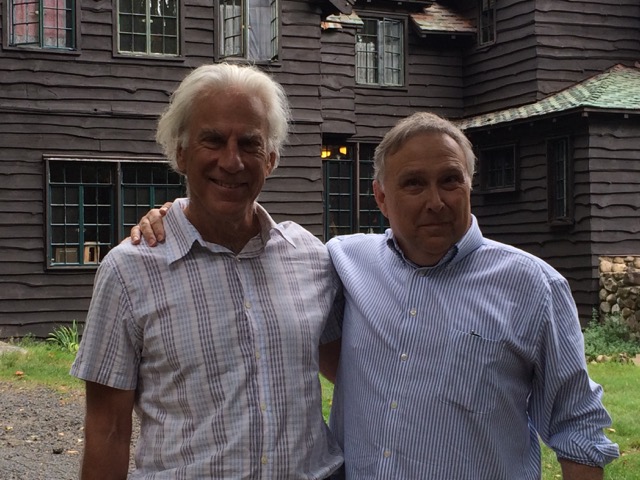
img_0302

Photo: Left, David Morris, co-founder of The Institute for Local Self Reliance; Stephen Kuusisto, poet. Blue Mountain Center in background.

I’m reminded many days (though never enough days, never enough) how lucky I am as along the road I’ve been graced with friendships that have turned me. I mean the agricultural metaphor and know precisely why I’m using it, for when I was 33 years old (28 years ago) I was essentially “Top Soil Man” (as opposed to “Java Man”) and that was when I first met David Morris and his wife Harriet Barlow at the Blue Mountain Center in the Adirondacks of New York. Harriet founded BMC, a progressive retreat for activist artists and scholars, and as a comparatively young laddie I found in her company (and a broad company it was and remains) a community of social planters. Me? I was just an MFA grad trying to keep writing—a noble enough pursuit in these United States, maybe, but in my case conducted largely without commitment to sewing (again with the agronomy) and worse, perhaps, (employing one of Kropotkin’s favorite metaphors, of “broadcast”—flinging your seeds as far as you can) I wasn’t much of a thrower.

(Kropotkin in his Anarchist Morality: “Be strong. Overflow with emotional and intellectual energy, and you will spread your intelligence, your love, your energy of action broadcast among others! This is what all moral teaching comes to.”)

I hadn’t had much moral teaching—not at the University of Iowa’s “Writer’s Workshop” nor at my undergraduate college. I knew the bad men in Dreiser and saw plenty of Babbits in America and fully recognized the nation’s soul was Ahab-ish and with Reagan’s encouragement there were  tons of Elmer Gantrys to go around. A foundation in literature can hardly proceed without ethical animadversions, all that praise or blame in classroom discussions, but what I didn’t know was how to inhabit a public square with curiosity and diligence since no professor I’d ever had had sufficiently claimed either the space or the stance. I’d say it was just my college but the workshop was equally insular. Faculty and students alike had library pallor. Certainly no one ever said be strong…spread your intelligence, broadcast among others…commitments of such magnanimity and magnitude are neighborly, impassioned, and unconcerned with payback.  

Well, I didn’t know what I didn’t know. “Je m’en vais chercher un grand peut-être.” (Rabelais) I was looking for a big “maybe” and maybe I’d be a writer. If I didn’t know what that meant (and I  didn’t) surely “doing” was Rabelaisian enough. I was lucky then, and it was two fold luck as one part of good fortune is it’s timing and the other is being ready. This also I didn’t fully understand. But I knew the Blue Mountain Center was beautiful. And I saw on day one on the wide stone porch of an Adirondack “great camp” (a vacation manor, built long ago for the wealthy, now a place of ideas) that poetry (by which affectedly I mean all the arts from philosophy to dousing) was being practiced as spread intelligence (again with the Kropotkin) and there was plenty of vigor to go around.

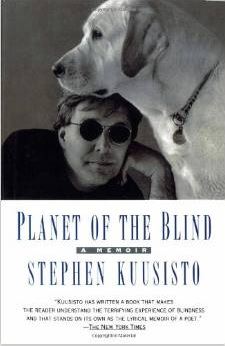
I won’t name names but there were writers at BMC working on eco-feminism; poets creating social spaces for the elderly to swap stories with the young; a journalist home stateside from a probative stint in Central America (the “Gipper’s” Central America with the assassination of Oscar Romero fresh in mind); a performance artist-filmmaker highlighting the work of Meret Oppenheim, the foundational Surrealist overlooked by the boys. The wealth of talent and action was rather astonishing—at least to me having lived a self-contained life to that point. Of self-containment one may say several things, not all of them bad. Later I’d write a book about it, a memoir, Planet of the Blind in which I noted the isolation of a disabled childhood, a story familiar to anyone who’s been an outsider, crippled or not, and in turn I argued for the attainment of a worldly life which means (you’ve guessed it) “action broadcast.”

I don’t think the term is much of an ars vivendi. Father Kropotkin was no Horace. But action is the fulfillment of imaginative possibilities and you know it when others are doing it.

It was early one morning over coffee I had my first conversation with David Morris. We talked of how it’s possible for local communities to take control of their electricity and then we were instantly talking of citizenship. I’d never had such a conversation and it was all the better for being unanticipated. There was a thing called the public good. It was energy democracy. Or better: democracy itself. Morris was funny. Progressive, with ardor, and sufficiently wry to gracefully sidestep the pedantic, David was at once generous, hopeful, and properly stubborn. Later I’d hear the term “scholarship in action” and like a Jeopardy contestant I wanted to push the buzzer and say: “Who is David Morris?”

Harriet is harder to describe, chiefly because she’s an activist impresario, though not a publicist or showman. She’s more a cultural maestro for which we have no term in English but in French might be a “salon d’accueil.” Gertrude Stein with more fancies is how I’ll put it. She’s more interested in the structural and humanitarian transformation of the public sphere than anyone I’ve ever met, though by now I’ve met many. Harriet also has zero vanity so she’ll be a wee teensy bit uncomfortable with all this. I can hear her laughing at me now.

It’s hard to say with any certainty how any of us might have turned out minus a spot of formative luck. In my experience Americans don’t like to talk about luck. Cowboys don’t need it. We’re all self-made snakeskin salesmen around these parts. One evening in the mid 1990’s when I was working for a non-profit organization that serves the blind, and owing to my having a bad headache, I lay in bed powerless to change the TV channel. Paul Newman was being interviewed by Larry King. That’s when I heard Newman say something wonderful. He said after WW II when he was a stage actor in New York, there were, as he saw it, dozens of actors and actresses who were more talented than he was. Then he described how one night, the lead actor in a play by Tennessee Williams came down ill and since he was the understudy, Paul Newman had to assume the role. I don’t remember the play. What I do recall is Newman’s declaration that his performance that evening got him some attention in the press and from that came a quick succession of opportunities and then Hollywood. And he said, essentially, I’ve never forgotten there were better people than me, who didn’t have my luck. He talked about his charitable foundation called “The Hole in the Wall Gang” and how he never forgot how capricious luck really is—how important it is to give back when you’ve been fortunate.

Like anyone else I can’t say how I might have turned out in an alternate past and I have no idea how my work would have gone without meeting David and Harriet and their salon of optimist-seed throwers and I’ll be damned if I’m going to try. The last thing I want to do (or maybe never) is be sentimental or mystical. One can go to the opera for that. But I know two things for sure: I turned to public life, and advocacy because of these friends. And in no small part, because of them I’ve kept at it.

As a final point—if you’re thinking of applying to the Blue Mountain center you should know that the food they serve is very good. It’s a great place for fresh vegetables. Which reminds me of this old joke:

A guy has celery sticking out of one ear, lettuce out of the other, and a zucchini up his nose.

He goes to the doctor and asks him what’s wrong.

The doctor tells him, “Well, for one thing, you’re not eating right.”


Are You Privileged? No I’m a Privet Hedge…

Not long ago during a question and answer session a woman asked if my ideas about traveling with a disability–that doing it is a kind of art–might essentially be a privileged position. She didn’t offer this with hostility. I’d been discussing something artsy. The gist of my talk was that disability travel is often a richly imaginative activity. Her point was that if I had the means to travel I must necessarily be well off when compared to the disabled majority. I had the good sense to agree with her. I then said: “The trouble with privilege is it’s opacity. When we say it we can’t see through it. Disability travel has little of privilege about it since the built environment doesn’t like us. Try flying with a guide dog or a wheelchair; visit Italy…the physical and social obstacles are terrible and unending.”

While it’s not always significant in Q and A the woman in question who questioned didn’t have a disability. If she did she’d know that disability travel is in fact so daunting, so often painful that the very notion of privilege is hilarious. I swear I didn’t laugh. I think I was kind. Sometimes I can be kindly.

But I’ve been mulling the P word over and over since then. Thinking of privilege when you don’t have much of it is like reciting the great chain of being. If I’m a lower order of man at least I’m better than the ox or snake. In the end it becomes tautological and wearisome. I am privileged. For one thing I’ve a job. I get paid to write, at least some of the time. Occasionally I get invitations to speak to good people and I’m often paid for that as well. I think I’m pretty damned lucky if not quite privileged, for when I board a train or airplane I often experience unhappiness that’s unknown to abled travelers. Disability life when one’s a passenger can really be humiliating. Am I privileged because I have greater opportunity to be abused? I think that’s right.

Back to the great chain of being: I’m the most privileged of the lower orders. What a thrill! Here! Capture my tears in this little box. You may need them some day.


Ubiquitous Ableism Run Amok Department

The Finnish poet Tua Forsstrom once wrote “nothing terrifies us more than the godforsaken places” but I don’t think it’s true. I think disability frightens people even more than death or a profane landscape with goblins. A wheelchair or a blind man scares the pants off of most folks. They’re not even circumspect about it. “I think if I had to ride around in a chair like you, I’d have to kill myself” is a phrase heard often by my paralyzed friends. I kid you not. It’s in circulation, this idea that disability is worse than dying. Once, riding in a cab in New York the driver told me I must be the victim of voodoo. My blindness was living evidence of demonism. His subtext was clear: I’d be better off dead.

Lately we’ve seen several instances of disability murder—from Japan to California to the Middle East. From ISIS murdering children with Down Syndrome to a ceremonial garden party where tastefully dressed men and women say goodbye to their hostess who’s decided to end her life because she has Lou Gehrig’s disease, the idea that disabled lives ain’t worth living is absolutely everywhere and largely unchallenged. Of course there are plenty of us in disability circles who cry foul. We ask on social media why the news reporting is so ubiquitously one sided; why disability life remains so undervalued in our media. How frustrating it is for those of us who raise this question, since we already know the answer. We’re locked out of television networks; under represented in even the progressive press. Where’s the disability writer for The Nation or Mother Jones?

In our absence networks treat disability almost exclusively as inspiration. Recently NBC’s “Today Show” raised a guide dog puppy “on air” as a year long feature. While this was engaging the program never explored what blindness in America means, how real blind people live, what they do, how they do it. The treatment of the guide dog puppy was reduced to what we in the disability rights community call “inspiration porn” which is to say it was designed explicitly to make able bodied people feel good. That sweet Labrador puppy would soon change a blind person’s life. Fair enough but they missed the chance to interview blind computer designers, attorneys, school teachers—you name it. Who’d know blind people aren’t passively sitting in dark rooms awaiting the gift of dogs who’ll save their lives? Who’d know blind lives aren’t summed up by dogs?

When able bodied people don’t understand the richness and beauty of disabled lives they remain convinced disability is a calamity. Sometimes I think we should just drop the word disability and use calamity instead. Calamity Parking. Calamity seating. Calamity services.

Imagine the conversations. “How did you become calamitized?” “Oh, I played with dark magic…” Or: “God grew tired of me.”

I’m closing with a link to this terrific interview with disability activist John Kelly over at the website of Not Dead Yet. Disabled lives are not merely under represented in the mainstream, they’re actually under attack in movies and TV shows that suggest our deaths are better than our lives.

http://notdeadyet.org/2016/08/in-case-you-missed-it-john-kelly-video-interview-on-me-before-you-assisted-suicide.html

On Being a Token

I have to face it, I’m a token. Let’s visit tokens and tokenism. “Mistletoe was cut from an oak tree as a token of good fortune…”—the noun—descended from “betoken” (verb) “to be a sign of”—those of us so “tokened” are like laborers one sees wearing sandwich boards on city streets. The betokened are mobile sign systems. “Eat at Joe’s!” “Look! We Hire the Handicapped!”

I’ve been resistant to my betokened place. I’m a 60 year old university professor who entered higher education in his early thirties during “wave one” of feminism and I was present as the academy extended to include people who broadly hail from historically marginalized positions. Along came Disability Studies. “Aha!” I thought, (for I’m one of those “Aha” guys) “Disability is being taken seriously at last!”

Lucky me, I even landed a job.

So I’m fortunate but alas, I’m not a lucky token. Make no mistake: I’m a hanging plant.

I’m perfect for photo ops. I look fabulous standing with my guide dog next to the former astronaut, later a senator who graces the university with his good name. And I’m the “go to” professor when visiting “disabled” suddenly appear on campus and they want to showcase multiculturalism. Because I’m not a token when I’m more than a symbol I have to make choices. (I reminded the astronaut that as senator he voted against the Americans with Disabilities Act.)

Yes, Professor, you are a token.

He’s a token when he has no agency. When software and websites are inaccessible. His abled colleagues don’t really understand that this “inaccessibility thing” is a genuine problem. One Dean told me, “well it takes a long time for me to get my computer upgraded,” when I told her I’d been waiting months for someone to install a talking word processing program on my laptop. She equated ordinary delays and inconveniences with my inability to work. She saw no difference. Moreover, the comment was a micro-aggression. It ended further conversation. Where software and hardware support and disability are concerned I’ve been told to stop asking. My job is to look good and keep quiet. Tokenism indeed.

I know other disabled faculty, know they experience the same things, or worse.

Why then have I been slow to admit my entire betokened status?

In Finnish, my father’s language, “toivo” means hope. I’m a toiveikas mies—a hopeful man. I come from a long line of optimistic Scandinavians. Like many Finns I’m accepting of slow change. Essentially I’m more of a Finn than an American. I push steadily, keep on message, say what I think needs to be said.

I’ve told administrators at each academic institution where I’ve labored about their ADA snafus.

I’m almost inured to the eye rolling, though not entirely. It’s painful being a civil rights nag.

But here’s the rub: every day the place I work for makes decisions that perpetuate or extend inaccessibility I’m still a token.

In a way, when I’m not taken seriously I’m a stick figure. All tokens are cartoons.

Why “Nothing About Us Without Us” Should Be Required Reading for Everyone in Higher Education

In his groundbreaking book Nothing About Us Without Us, published in 1998, James Charlton declared the disabled have a culture, an extensive one, and that time is up for able bodied people to be making decisions about the disabled without their input. In one of my favorite passages Charlton writes about the imperatives behind his book:

““Nothing About Us Without Us” requires people with disabilities to recognize their need to control and take responsibility for their own lives. It also forces political-economic and cultural systems to incorporate people with disabilities into the decision-making process and to recognize that the experiential knowledge of these people is pivotal in making decisions that affect their lives. Third, while the number of people affected by this epistemological breakthrough is relatively small, a movement has emerged. The disability rights movement has developed its own ideology and politics. It is a liberation movement that is confronting the realpolitik of the world at large. The demand “Nothing About Us Without Us” is a demand for self-determination and a necessary precedent to liberation. Fourth, the philosophy and organization that the international DRM {Disability Rights Movement} embraces includes independence and integration, empowerment and human rights, and self-help and self-determination. The demand “Nothing About Us Without Us” affirms the essence of these principles. Finally, the DRM is one of many emerging movements in which new attitudes and world views are being created. Through its struggle comes a vision that requires a fundamental reordering of priorities and resources.”

Excerpt From: James I. Charlton. “Nothing About Us Without Us.” iBooks. https://itun.es/us/gEPDU.l

Nowadays self-determination for the disabled has grown from a nascent concept to a global movement. From Africa to Asia, Finland to the Middle East, disability activists are not merely calling for their rights but are living their lives in accord with the best principles of independence and empowerment—educating others, assisting their sisters and brothers, demanding opportunities for children, health care, freedom to travel…just to name the basics.

The passage of the Americans with Disabilities Act in 1990 helped create international opportunities for dialogue between the disabled and served to incite a worldwide confrontation with what Charlton calls “realpolitik” but I’m calling “business as usual” because—why not?

What does “business as usual” mean where disability is concerned? Historically the disabled have been segregated, locked up, hidden, euthanized, sterilized, denied educational opportunities, kept out of public spaces, and perhaps worst of all—they’ve been talked over. Their lives are narrated (and mediated) by medicine and rehabilitation programs that always fortify pejorative meanings about disability—not disability as it’s actually lived, but instead reinforcing how it’s understood by the public. Biz as Usual pushes a medical model of disability which designates imperfect bodies, ill bodies, “incurable” bodies as outlier corporealities, things not devoutly to be wished—they become failed patients, abnormalities. Accordingly the abnormal must be farmed out to “special” places which stand at the edge of the fairground where normal people remain happily assembled. Consider the average college campus. Disability is “dealt with” “managed” “serviced” “accommodated” by underfunded offices that in many instances are hard to locate both physically and administratively. I’ve been to many universities where the disability services office is in the basement of a building—reachable only by elevator, or on the top floor of a building, reachable only by elevator—where in the event of fire there’s no way out. I’ve been to campuses where renovations to facilities have left out necessary improvements to make auditoriums accessible; classrooms usable; technology approachable; where there’s minimal or entirely unacceptable transportation for disabled people. These examples are legion and not exceptions. In Biz as Usual disability is conceived as a marginal issue, something that must be grudgingly acknowledged because of the Rehab Act of 1974 and the ADA of 1990, but not as a matter of culture, inclusion, communication, or respect. When college administrations make decisions about the physical or digital agora they seldom if ever consult with the disability communities on their campuses. “Nothing About Us Without Us” should be required reading for administrators, staff, and faculty in higher ed. Of course in 99% of the cases, there’s no required reading for the aforementioned. Faculty know next to nothing about disability, relying on the hidden “special” unit to solve whatever student accommodation request comes their way—and note, accommodation is always narrated as a problem. And so the disabled student is a problem. He or she is defective and trying to get into the happy tent. Faculty Member A resents having to think about this. “Doesn’t someone else handle this?” The disabled must be “handled” —the imagery is perfect given our histories, we’re straight jacketed and dragged away.

At Syracuse we offered the first disability studies courses in the country. We understand disability is part of our diversity and inclusion aspirations. But still we have problems. All too many students, staff, and faculty with disabilities feel left out of important conversations. And we have real problems. Unfortunately, raising them, we’re often made to feel like oppositional figures, malcontents, stylized figures with megaphones, waving our crutches. This should be easy to solve. Invite the disability community “in”—ask them what they think. Employ what I like to call the Ed Koch gambit—“How am I doing?” If the question is sincere it will come after listening. And then we will take positive, culturally engaged action.

Back to James Charlton whose book remains indispensable.

“Life itself is a series of struggles—some won, some lost. Resistance for most people with disabilities is a necessity for survival. The DRM should never lose sight of this. Throughout the course of this project, I have been impressed with how many of the stories and experiences of politically active people with disabilities reflect this proposition. We have begun to speak for ourselves, to make demands, to organize, and to educate others. ”

Excerpt From: James I. Charlton. “Nothing About Us Without Us.” iBooks. https://itun.es/us/gEPDU.l

In the coming years “best practices” in every human endeavor must acknowledge the experiences of the marginalized and embrace the opportunities for education diversity offers.

Ode to the Lesbian Farmers

Here come the Lesbian Farmers who we love,

Stomping home from the fields, damp and very hot,

For how else should they be, their farms like stoves,

And critters, machines, tall beans, even doves

Stealing the cool air? Farms are really Hell

Don’t kid yourself, agronomy’s pure Sisyphus,

That’s the way it is, repetitious, it smells,

There’s no time for love poems! There ain’t no Sappho-mus!