Blind at Widget College

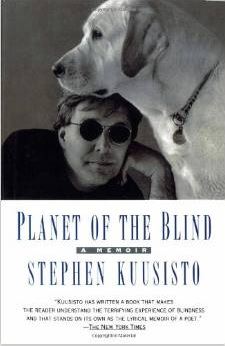
I am a blind person. Notice I’m using people last language since in public I’m blind “first” and a person only in the most conditional sense. It’s not fashionable to say this. What’s popular in “the idioms” is arguing blindness is nothing more than an inconvenience, why it’s nothing really. I wish this was true. But in my experience I’m always a problem whenever I leave my house. I’ve written about this on my blog for close to nine years. Many disability themed bloggers also discuss the subject—this problematized life we endure when we venture out.

As a poet I tend to think about disadvantaging spaces in gestural ways which is to say I think being on the playing field is important. If the Americans with Disabilities Act gave us the opportunity to be out in public then by God we should be everywhere. You can’t count on your rights unless you use them. Poets believe in community or most good ones do. We want people to gather and hear words, share emotions. Just so I think all the disabled turn environments into something new when they arrive where formerly they were strictly absent. I’m a blind man at the movies with my guide dog. Blind at the ball game. A few people will think. They’ll say: “well, yes, of course the blind can enjoy things…” Silly to have to say so? Silly yes, but necessary every day. 25 years after the ADA John Q. Public still thinks in a moist  way the cripples probably belong in asylums. Or worse: they think we should be eliminated.

So anyway I leave my house. Because I can’t drive it takes a long time to get to work. (You’re lucky if you have work or you’re going to school…) And when I get to work I discover they’ve changed the computer system overnight. No one took blindness into account when they jumped to “Leverage 2.0” and now I can’t use the damned PC. I call the IT people and learn they’ve no idea what to do next. Blindness (nothing more than an inconvenience) now becomes an “impossibility” in the workplace. Complain about it and lo and behold, one becomes a crank in the eyes of administrators at the Widget Company or Widget College. Your very presence is inconvenient.

At Widget College they regularly adopt inaccessible software and course management tools and try later to retrofit them. This is not uncommon. Widget College is the norm in higher education when it comes to digital access. What’s so demoralizing is that while you’ve complained about it for years they simply hold more committee meetings and voila, continue buying inaccessible software.

You’re tempted over time to throw up your hands and say, “well I don’t belong in the workforce after all.” And when the bus driver won’t call out the stops even though you’ve asked him politely to do so and you get off in the wrong neighborhood and it takes you an hour to solve this and it’s raining and you’re half lost, well, you think, “I don’t belong on the bus or the street.”

Let’s be clear these are nearly daily problems.

My faculty colleagues are not disabled for the most part. They nod when I tell them how inhospitable Widget College is. I’ve found liberal minded faculty are great nodders. They can’t imagine being blind. Why if they were blind, they know they’d never leave their houses.
 

Those First Months with a Service Dog…Stream of Consciousness….

I had to differentiate between my human desires and my dog’s life if was going to make a “go” of service dog existence. A blind friend told me that god gave man dominion over all the animals. The very thought made me shudder. Dominion conjures slavery, imprisonment, entitlement—my life and Corky’s were not in a power relation even though she’d been trained to watch for traffic and encouraged to trust her judgment, even though she guided me and I was supposed to set our course, practice daily obedience, sit, down, come—here’s a treat. Even with all this I knew she was her own being and this gave me a great sense of relief. I believed in the dignity of animals. One large part of this was knowing they are our equals. At the guide dog school I was surprised by the number of trainers who thought this rather silly. One has to be alpha dog. Dogs respect their leaders. But while this is so—working animals, whether horses, dogs, or aquarium dolphins will adhere to our requests and insistences, where does the notion that our domestic leadership makes us better come from? Savages vs. the civilized, the oldest narrative of them all…We label all living beings as beasts because they’re not like us. Well of course. Of course. The taxonomies of inequality are profound. I couldn’t imagine being like my blind friend who thought god had put her in charge of her dog.

Thoughts early in the morning. I walked along Central Park West. Stopped. Took in a light rain. Corky turned her face up to the mist. We were happy.

I thought of William Blake: Mutual forgiveness of each vice/such are the gates of Paradise…  

To this one could add mutual forgiveness of our respective embodiments and our strangely connected but intangible souls. Man and dog. Street corner.

Guide Dog Etiquette, Those First Few Weeks…

I told myself I was a new man but what did this mean? I was still blind; I still had no job; and irony of ironies, being overtly impaired in the sight of others brought it’s own host of problems. Just because I felt confident didn’t mean others knew it. Strangers sometimes grabbed me, believing they were doing me a favor. While crossing 7th avenue in New York an old man put a bear hug on me and shunted me across the street while Corky tried stoically to keep guiding me. She looked up repeatedly as if to say, “who’s this Bozo?” I let out a shriek, as being manhandled on a busy thoroughfare is frightening. At the far curb the man bowed and ran away.

Post-Corky I was genuinely in the world as a blind man and it meant lots of things. The guide dog schools said I should be an ambassador for the service dog movement. So Lordy! I was now a Homeric standard of excellence, an exemplary hero from a Greek epic. Even while being manhandled I ought to evince decorum. One was expected to be better than the unknowing public. I saw quickly this wasn’t going to work for me. I might want to be a kinder and more thoughtful man but I still had an irascible streak. Maybe it was the poet in me, who knows? But I didn’t want to be kind to everyone. Screw that man who dragged me across 7th avenue. As he ran off I shouted: “Don’t ever grab a blind person you asshole!” I gave him the finger.

Did being a new man require never being angry? Of course I knew I shouldn’t give a stranger the big fuck you but I couldn’t help it. And this was a new circumstance for me. Formerly I’d pretended I could see. Now I was in blind-land and I saw that many sighted people think the blind are as stupid as stumps. Worse they have a kind of boy scout code. And if that’s not bad enough, they imagine talking to the blind is unnecessary. After all we’re just lumber. Do you want to help me Mr. Stranger? Why not ask if I need it? How about introducing yourself?

It doesn’t look good standing on a corner with your dog and shouting invectives. I was a new man alright. Before Corky I’d never had this problem. What did it tell me? At the very least I had to think hard about my impulses, perhaps change what I could and forgive myself for what I couldn’t. Even a New York City curb with its wastebasket and traffic light offered an opportunity for self-reflection.

I thought: “Can a newly mobile guide dog user be kind to himself while learning the ropes?” The answer had to be yes. “Can I tell people to fuck off once in awhile?” The answer had to be yes.


H.G. Wells and the Kid…

As a boy I loved me some H.G. Wells, especially his time machine which, to an isolated blind kid was the best thing possible even with all its prospective dangers and late Victorian caprice for children sense adults are fickle, especially disabled children, and accordingly I saw Wells had created a gizmo much like one’s untrustworthy uncle, the one you liked despite all the evidence. I think I was around eleven when I read it. And I understood it was a book about social psychology, though I didn’t have the words for such a concept. But I understood this:

“I think that at that time none of us quite believed in the Time Machine. The fact is, the Time Traveller was one of those men who are too clever to be believed: you never felt that you saw all round him; you always suspected some subtle reserve, some ingenuity in ambush, behind his lucid frankness.”

I had to look up lucid. I got it. Some of the smilingest adults were the most dangerous. Kids too.

Could someone cobble together for me a freedom machine? That’s what I thought.

Now I’m remembering him, that kid. Again I want the freedom machine—want it to lift up refugees and my brothers and sisters, black, disabled, women, men, children, all of them living in perpetual violence. I want them at the victory celebration when humankind looks back with triumph for we saved our people; rescued the planet. Wells again: “when mind and strength had gone, gratitude and a mutual tenderness still lived on in the heart of man.” We’re an aging species. Mind and strength are increasingly in short supply. Can we have gratitude? Just a little mutual tenderness?

Silly of course. I should erase everything I’ve just written. Haven’t I read too much to believe what I’m saying? Capital wraps affection; stone blunts scissors…try to be funny. Carry on. Everyone in the academy talking these days like army colonels—interrogating the subject; leveraging the problem; poring over the grid. “Jeezus, old stuffed bear, don’t reveal you’ve a heart, they’ll cut it right out of you.”

Hopscotch and Disability

“You’re like a witness. You’re the one who goes to the museum and looks at the paintings. I mean the paintings are there and you’re in the museum too, near and far away at the same time. I’m a painting. Rocamadour is a painting. Etienne is a painting, this room is a painting. You think that you’re in the room but you’re not. You’re looking at the room, you’re not in the room.”

Julio Cortázar, Hopscotch

The above lines from Cortazar offer a beautiful description of disability for every cripple who seeks entrance to public space never makes it, never quite, though the tireless mind insists, believes, remonstrates that it’s in the room, salon, gallery, it isn’t and never has been. The cripple is always outside looking in. We are in effect at a party that doesn’t love us. And like Cortazar’s existential figure, we’re near and far at the same time.

Every sensible person must feel this to varying degrees. The “Groucho Effect” holds one shouldn’t join any club that will have you, a fair joke as modernity is all about joining and the membership may be too dear if you’re not paying attention. The disability conundrum is different—you think you’re in the club but you’re not which combine to offer a disappointment both of illusion and agency. It’s a two-fold setback.

Give up, yes? Cortazar:

“Why couldn’t I accept what was happening without trying to explain it, without bringing up ideas of order and disorder, of freedom, as one sets out geranium pots in a courtyard on the Calle Cochabamba? Maybe one had to fall into the depths of stupidity in order to make the key fit the lock to the latrine or to the Garden of Olives.”

Who hasn’t thought about falling into the depths of stupid? Cripple-dom is the unending insistence on belonging, pertaining to rights, hence exhausting.

When you’ve lived a long time under a regime of intolerance and guile, a governance of positioned despairs, all of them explained by businessmen and men like Clint Eastwood, well why not speak in a low gibberish?

Some days I really do believe I’m gibbering in the museum of normalcy.

You’re looking at the room, you’re not in the room.

The consolations of phenomenology….

As Cardinal Newman said: “We can believe what we choose. We are answerable for what we choose to believe.” I know my choices well. I’m of an age when (again quoting Newman): “You must make up your mind to the prospect of sustaining a certain measure of pain and trouble in your passage through life.” I ask myself if I knew what fights were proper? Did I accept the consequences? Admit I couldn’t be liked by many? I accepted the repercussions. There would indeed be a certain measure of pain. We are all answerable for what we choose to believe, whether we’re religious or atheists. We’re also answerable for the choices we make when it comes to speaking up or not speaking at all. In an age of calculated victimization, when universal human rights are besieged on all sides, not speaking is a choice but one I fear.

I’m in the room alright.

The cripple-room always offers invitations to demand the answerable. It’s the classroom of critical pedagogy in practice.

Newman, we’re also answerable for what we choose to disbelieve.

I will sustain my measure of pain and trouble. Accept what I can change and rail against what I can’t.

I’ll still say “peace” without irony.


I was blind in a strange town…


I was alone in a room with a radio, a dog, and a glass of water.

That’s how it was. There was a chair, a bed, the usual hotel furnishings.

My connecting flight had been canceled and it was toward midnight.

The hotel was in a run down part of the city. Then it was—

as we say in the vernacular—then it was I had to take the dog out.

My guide dog wearing her leather harness. Me? Wearing

track shoes and a rumpled business suit. Out we went,

first into a hallway that smelled of soap flakes;

then up to street level, a strange arrangement

hard to explain, then down a corridor

filled with plastic ferns

until we reached the parking lot

the only place to take the dog, or so I’d been told

and there we were

standing in the nowhere of blindness—

that beautiful nowhere with its hope and autonomy and its private song

shared between man and animal, the oldest song on earth.

National Federation of the Blind Comments on Foundation Fighting Blindness #HowEyeSeeIt Campaign

National Federation of the Blind Comments on Foundation Fighting Blindness #HowEyeSeeIt Campaign

Baltimore, Maryland (September 26, 2016): The National Federation of the Blind commented today on the #HowEyeSeeIt  challenge launched in the past month by the Foundation Fighting Blindness, which has garnered considerable recent publicity. The NFB has also delivered a letter to the Foundation Fighting Blindness, and NFB members are using the #HowEyeSeeIt hash tag to counter the campaign via social media.

Mark A. Riccobono, President of the National Federation of the Blind, said: “The National Federation of the Blind is deeply concerned that the #HowEyeSeeIt challenge, as currently structured, will do lasting harm to the ability of millions of blind Americans to live the lives we want. In encouraging people who are not blind to don blindfolds and make videos of themselves attempting everyday tasks, this campaign perpetuates the fears, misconceptions, and low expectations that society has about blindness by giving those who take the challenge or view the videos an inaccurate understanding of the lived experience of blind people. In particular, suggesting that it is difficult or impossible for blind parents to care for their children is false and irresponsible. As a blind father of three children who also happens to be married to a blind person, I can say unequivocally that, with nonvisual techniques, we can, and do, capably parent thriving children every day. Yet children have been removed from the custody of blind parents solely because of misconceptions about their ability to care for them, without any actual proof of abuse or neglect, and the #HowEyeSeeIt campaign threatens to worsen this already grave problem. This is only one example of how this campaign will harm the chances of blind people, including board members and supporters of the Foundation Fighting Blindness, to live productive and happy lives.

“To be clear, we have no quarrel with the Foundation Fighting Blindness or the medical research that it seeks to fund. However, we believe that this particular method of gathering support will harm the very people whom the Foundation Fighting Blindness and the National Federation of the Blind, in different but complementary ways, seek to help. I and other members of the National Federation of the Blind have told the Foundation Fighting Blindness that the perpetuation of misconceptions about, and by extension discrimination against, the blind is unacceptable, but so far we have been ignored. We therefore demand that the Foundation Fighting Blindness stop filling its coffers by spreading misconceptions and jeopardizing the dreams and aspirations of blind people.”

###

About the National Federation of the Blind

The National Federation of the Blind knows that blindness is not the characteristic that defines you or your future. Every day we raise the expectations of blind people, because low expectations create obstacles between blind people and our dreams. You can live the life you want; blindness is not what holds you back.

National Federation of the Blind

200 East Wells Street
at Jernigan Place
BaltimoreMD 21230
United States

(410) 659-9314 

Leaving Jacques Lacan

One has questions of course. It starts when you’re just old enough to despise Jacques Lacan. Blind kid, I was—“we don’t need no stinking mirrors…” And forget audio identification, no one born human in the last 30,000 years has imagined s(h)e’s a bird, even in infancy, for even a babe knows they’re too beautiful to be emulated though we try, lord knows, and there’s plenty of evidence to suggest our very language comes from our attempts to mimic birdsong and I’ve no problem with this, in fact I like the idea and favor it. But I was never nor have I ever been disposed to the Lacanian fix of proto-ego formation wherein one’s troubled by all that is and isn’t me. How do I know this? Because I didn’t look in a mirror in gloomy or ecstatic revery as a child. I had a toy monkey instead. And I talked to that monkey. And I said things like:

“Monkey, do you like ice cream cones?”

“Monkey, how do you do?”

You see? I was already beyond the mirror period. And Lacan goes on and on as if he’s speaking for all children in all eras, the mistake of Freud and his followers. Some of us are just wilderness children. It helps to have been impaired where the eyes were concerned, but you don’t have to be a blind child to abjure or skip or kick the can of the “mirror stage” and I’ve been thinking about this rather much for I have a rag bag piñata kind of sensibility—there’s all kinds of starstuff and goo gaws and goo gabs inside me (yes, Whitman, as well as you too…) and even as a wee bairn I never met a looking glass I gave a diddly damn about. I didn’t think I was the monkey. Didn’t think he felt the way I did. How old was I you ask? Three. I was three. We lived near the harbor in Helsinki. I wasn’t overly concerned about the self.

Lacan would say I just don’t remember. He would have to say that for his idea about human development and the elaboration of psychological determination rests on the infantile mirror. I see myself. I see that which is not me. I will be clobbered into language.

Silly. Last gasp of enlightenment. If there’s anything about trans humanism I like it’s this: your head is connected below the cellular level to the pine tree. And as Basho said: “The pine tree! Another thing that will never be my friend!”

One has questions of course. Why should I be friends with Lacan?

Longer Poems, Mrs. Equitone, Please…

Manon Lescaut. Nice. Great aria for the tenor straight off. Love those kinds of operas where the male lead has to sing his lungs out in the first twenty minutes. Aida is the same. Many a tenor has fallen in the opening acts. Which puts me in mind of poetry, how this isn’t a problem for poets. When you fail you do so privately. The man from Porlock comes to the door and Kubla Khan is never finished and maybe a handful of your moist and ironical friends think this is amusing—they tell you to publish it “as is” because why not? Can you imagine Jussi Bjorling singing a third of an aria then stopping, saying: “Well that’s damn good, you know?” No you can’t imagine this. There’s an expectation, a contract, whether it’s opera or a string quartet. You’re going to get the whole enchilada. There’s no man from Porlock in Puccini! Unless of course you want to argue for tuberculosis. You can always kill off your heroine with bacilli. But at least it’s part of the plot and all the cash paying customers know it.

When I was a student at the Iowa Writer’s Workshop Donald Justice, esteemed poet-teacher threw a literary magazine in the trash in front of a room full of aspiring poets saying: “This is the latest issue of Seneca Review devoted to the “long poem”—I hate long poems…” Imagine Jussi Bjorling singing a third of an aria. Think of Eliot stopping the “Wasteland” on page one. It would end here:

Here is the man with three staves, and here the Wheel,

And here is the one-eyed merchant, and this card

Which is blank, is something he carries on his back,

Which I am forbidden to see. I do not find

The Hanged Man. Fear death by water.

I see crowds of people, walking round in a ring.

Thank you. If you see dear Mrs. Equitone,

Tell her I bring the horoscope myself:

One must be so careful these days.

It doesn’t matter if you know Eliot’s canonical poem. Let’s say the poem ends here. One must be so careful these days. Perfect. It’s all about your subjective horoscope. Personal pan pizza. Lyric me-self. Ah but the poem, on page two:

Unreal City,

Under the brown fog of a winter dawn,

A crowd flowed over London Bridge, so many,

I had not thought death had undone so many.

Sighs, short and infrequent, were exhaled,

And each man fixed his eyes before his feet.

Flowed up the hill and down King William Street,

To where Saint Mary Woolnoth kept the hours

With a dead sound on the final stroke of nine.

There I saw one I knew, and stopped him, crying: “Stetson!

“You who were with me in the ships at Mylae!

“That corpse you planted last year in your garden,

“Has it begun to sprout? Will it bloom this year?

“Or has the sudden frost disturbed its bed?

“Oh keep the Dog far hence, that’s friend to men,

“Or with his nails he’ll dig it up again!

“You! hypocrite lecteur!—mon semblable—mon frère!”

Sing the opera to the end and it’s about something extensively dramatic. The first world war is over and the survivors are collectively afflicted by PTSD and trying rather desperately to rejoin the workaday world which won’t—can’t—sustain them. This is far better stuff than “one must be so careful these days…”

Even short poems must give you the opera entire.

Why am I bothering with this, just now, early, over coffee, the day not yet a day?

I had a dream last night. I was in a great hotel. With people I’d never met in my waking life. We were eating while floating in a fountain. Little cakes.

When I woke I understood it was a long long dream, a ribbon of psyche’s sparks, and I’ll never get to the end of it. Even when I return to the stars.

I want page two of that dream.

I want Jussi Bjorling at the victory celebration after I’ve figured it out.

And just now I realize “Dear Mrs. Equitone” sounds like a brand name for Victrolas.

Damn modernity with its neologisms and shrinking spirits.


UFO Abduction Department

Terry Eagleton, Marxist critic and spry raconteur once wrote the United Nations should pass a resolution calling on space aliens to abduct a more representative swath of humankind than just the Americans. Reading this caused me to remember a time in the mid 1980’s when my sister, four years younger than I, took up the subject of aliens and human experimentation with earnestness and true belief. We had one of those convos you really can’t believe is happening and I experienced the Kubler-Ross stages—denial, bargaining, et. al. for she believed it was only a matter of time before she would be lifted from the planet and medicated aboard a space ship.

I spent the weeks following trying to figure out what was going on—my sister was a smart woman. What was she afraid of? One knows the readers of Bram Stoker’s Dracula feared barbarians from the caucuses and the middle east. Maybe my sister and others like her were afraid of globalization? Chernobyl had just happened. Or her vision was less a nightmare and more a wish? The UFO as impending nursing home? Jung speculated in the late 1950’s that flying saucers represent the psyche’s wish for wholeness. For Jung they were flying mandalas, spiritual signs. We all need mythologies.

But Jung didn’t foresee the Dr. Mengele aspect of alien fantasy. This was harder to get at. “Occam’s Razor,” I thought. My sister and I grew up in a very dysfunctional house—our mother was a violent alcoholic. Abduction by sinister aliens was, of course, a sinister fantasy about returning home where ugly mama had knives. A far better analysis than Jung’s I thought. Moreover the prevalence of broken and vicious family histories in the US helps to explain the collective nature of the fantasy. It also explains our fixation with fundamentalist churches. “I once was lost, but now I’m found…”

Yes America is essentially a nation of hyper-vigilant orphans. HVO’s explain the UFO’s. I’m glad to have cleared this up for myself. I feel better. “Help,” as Kurt Vonnegut said, “is not on the way…”