I should tell you I’m a misadventurist. Getting lost in unfamiliar places is my metier. Moreover, it’s often my ambition. Part artistic principle, part happenstance dysfunction, this little life is surely mine. Or is it? It’s proper to say it’s my life and my dog’s—blind, I go everywhere in the company of a superior canine. And before I got my first guide, whose name was “Corky” (some 20 years ago) I was reluctant to travel the wider world.
Corky made it possible for me to go solo to New York City. I, who had always lived in small upstate New York towns, who felt afraid to travel outside safe and known circuits, was now walking across Manhattan, entirely enraptured by the city and my odd place in it.
Here is what I wrote in a journal twenty years ago:
I was in a good dream all day with Corky: we walked across the Brooklyn Bridge just for the sake of walking. The sky was blue-going-to-green, that oceanic sky, the beckoning one. And we were racing fast along the promenade deck, a remnant of the great ocean liners. Easy to imagine men in swallow tailed coats and women with wide hats approaching. Blindness, all mist for me, and the dear light, fresh and wonderfully unrevealing. For the blind, light is a mystery–a literal one, less a problem of physics and more a matter of interpretation. Its dream light. The light of the Greek underworld. Any moment my grandmother was likely to appear from the green-blue haze amid the glittering rails and she would tell me of her Lutheran heaven. We were having a jogger’s reverie, Corky and I. We passed two slow runners. I wondered what my guide dog’s dream was like.
Hers would be without sentimentality. Dogs don’t need squishy daydreams, though they have emotions aplenty; though she loves it when I say good dog with the right tones; but reassurance differs from sentiment–the former is true, the latter a brand of falseness. Dogs don’t care about falseness. They don’t give it a second thought. As we crossed the bridge I thought how a dog’s waking dream must be thrilling in its motion–a kind of widescreen cinema–what they used to call Panavision–the whole world is like watching Ben Hur for a dog. The entire day is a series of chariot races. Amazing to think of it. No wonder dogs are so excited to face the day. Every day, a Hollywood Roman movie.
The entire morning was devoted to plunging into the unknown. Bonding is all about the plunge. I recalled my uncle telling me when I was ten, how I could dive off a raft into deep water. “You just go,” he said, and added, “its amazing!”
We went. We walked along the shore in Brooklyn. We’d never been there before. We were day-tripping like the Beatles–honestly we were in love with freedom and having no agenda. Blind and walking. In New York. I, who had never left a circle of familiar trees. Good God!
**
Bonding 101. We walked around NYC for three full days. A trusting exercise. Best place in the world for trust explorations…
We went to the east village and visited McSorley’s pub. The place was filled with mid-19th century bric-a-brac. Corky wanted to lick sawdust off the floor.
We entered a jewelry shop where an old Russian woman wanted to give me a silver crucifix on a chain. I tried to refuse it, but it became clear she meant to have her way–there was something sincere and strict behind her eagerness, like the last chapter of Crime and Punishment. I accepted the cross and she gently placed it around my neck. Corky sat obediently by my side.
Bonding. I walked up seventh avenue with a tsarist cross around my neck. I remembered a Russian proverb: Бо́гу моли́сь, а добра́-ума́ держи́сь–pray to god but hold on to your good mind…
Bonding. Corky and I together created a good mind, a steadfast one.
Bonding. Sublime and ridiculous. A cab driver refused to take us in his taxi. I think, “but I’m wearing my silver cross, and my dog is beautiful!” Oh dear. He shouted horribly, the back door to his cab wide open, my left foot on the sill. Passersby stopped then moved ahead, the old New York shuffle, no one wanted to get involved with a blind man and a dog and a fucked up cabbie. I couldn’t really blame them. I got the cabbie’s number and resolved to report him to the Taxi and Limousine Commission. Later at the TLC I’d learn the cab license had been stolen–the real driver had reported it a year earlier–I was the victim of an illegal driver who likely would never be found.
Bonding.
For the sheer hell of it we went solo to the Empire State Building.
Bonding.
Sometimes I felt we were playing an untuned piano all day.
We rode the number 7 train to Shea Stadium. It was March. Baseball wouldn’t begin for two more weeks. We walked. Then rode the train back to Manhattan. Strange sights—a man on the train platform wearing a tattered raincoat waved an umbrella which had very little fabric and we followed him up the escalator. He wasn’t bothering anyone, wasn’t speaking. He just waved his found object—his lightning rod and we trailed like we might know him. I felt safe in Corky’s company. And we passed the umbrella man and plunged into the sea of humanity on 7th avenue.
The darkness of night was coming along fast. We were happy walking north among people. There was so much magnificence being part of a crowd. I felt like a blind version of Walt Whitman.
I realized that at any given moment there must be thousands who feel like Whitman as they move through Manhattan. When I went to Guiding Eyes I had no idea this would happen. I saw how a guide dog brings out what was always inside you, wakes you up.
**
I was breaking the rules. You’re supposed to go straight home after guide dog school and remain in your own neighborhood for at least a month. I went home for a few days and then hit New York.
If bonding was to have meaning it would necessarily involve taking on the world. Going to the city I was refusing to be timid. Timidity could easily overtake me—I had always been such a localized blind person. I wanted to be like Morris Frank and cross New York’s crowded streets.
Corky was telling me who I wanted to be. I was the man walking 7th avenue in waves of light. I was walking straight out of my spiritual flatness and depression. Even a stroll past a row of ruined storefronts—dead electronics wholesalers, failed restaurants, a tattoo parlor with a cage for a door—even these stretches of capital’s broken dentistry didn’t phase us. Walking was new and was filled with realizations step by step.
Bonding. Love realized. Love going everywhere with you. Love beside you on a bus. Love in the tiniest entrances. Being released into the world with a dog was positively erotic. My daily sense of failure was being replaced by ridiculous levels of joy.
The poet Kabir said: “When one flower opens, ordinarily dozens open.” I was getting it.
**
We got up early. We met a policeman on horseback in Union Square. “Jesus,” he said, “that’s a great dog!” “Jesus,” I said, “that’s a great horse!” We laughed. I thought, “what is most alive in us comes out by chance.” I also thought, “sighted people must know this.” I’d been missing out on chance!
**
Kabir again: “If you have not lived through something it is not true.” I felt the enormity of my entrance into a true life. On our second bonding day in New York we rode the subway to Fort Tryon Park in northern Manhattan to see “The Cloisters”—the Metropolitan Museum’s replica of a medieval monastery.
We took the A Train to 190th St.—a trip that would have been unimaginable just a month before. People on the train loved the sight of us. An old man said: “That dog looks strong as a tree!” And she did look strong. I could feel Corky’s strength in large and small ways—through her harness, and when she was simply lying at my feet on a rocking train. Power and contentment are the same. And that was the first time I’d ever thought about it. And lots of things were coming loose in my head. At 18, terribly closed within myself, I went alone to a Duke Ellington concert staged in a hockey arena at the University of New Hampshire. The year was 1973 and there were probably only one hundred students in attendance. At intermission suddenly, there, standing before me was the Duke himself. He shook my hand. Said: “How do we sound tonight?” I said, knowing just enough, “you sound like champagne, sir!” And now I was brave, riding the A Train, getting someplace, getting down into the sharp and joyful.
At 190th St we took the M4 bus about a block. Poof! We were in the middle ages.
Seeing very poorly is still something. We were going to visit the unicorn tapestries, man and dog. We were in a quest. Corky was pulling hard, happy with the day.
The tapestries depict a hunt for the unicorn, a creature all school children know. We were early at the Cloisters and a guard offered to describe things for me. With a dog and a kindly stranger I entered the sparkling world of a unicorn hunt.
In the last panel a unicorn, half goat, half narwhal, glowing like the moon, sat under a pomegranate tree, radiating magic against a backdrop of stars.
“He looks like he knows you’re watching,” said the guard. “And he doesn’t care. They may have caught him but he’s pure magic!”
I thought of the Zen poet Basho: “Scarecrow about the hillside rice fields, how unaware! How useful!”
I was free.
**
Riding back downtown on the train I thought about unicorns and I hugged my dog. It made sense that magic would have a bright horn and run fast among pomegranate trees. I wanted to dance around the railway car.
**
In Macy’s I made the mistake of talking to a mannequin. Every blind person has done this. A woman said, “that man won’t be talkin’” and laughed and walked with me to the Mens department. Bonding meant I couldn’t be embarrassed—I felt it, as if some essential part of my delicate self-regard had been fired in a kiln. “Thank you Corky,” I said. “Thank you, girl!”
I felt like Charlie Chaplin—easy, loose jointed, mistake prone and strong.
**
Little things: she walked me around a sidewalk elevator, its doors stood open revealing steep stairs. New York: the city of ominous basements.
She stopped at a curb, then backed up. A double decked tour bus was drifting, scraping the street signs, the people up top laughing—the whole thing was like a boat load of drunks. Good girl.
We walked past odd little shops, their doors were open, releasing the Victorian odors of commerce—New York is a city of smells—many are unidentifiable—the scent of earth from one door; fragrance of plums from another. On sixth avenue a woman ran out of a shop, grabbed my arm, “you must taste,” she said. “Taste?” I said. “Yeah, you taste!” She dragged us into a Chinese bakery and offered us a Chinese cocktail bun, filled with coconut. Corky and I rewarded her with a little dance. New York. Everyone feels vaguely as if he or she is in a circus. What can you do? You chew, dance, and walk. You thank strangers who suddenly appear. Do they appreciate your soul? Do they have pity for you? You don’t know.
Because I was having these surprises I felt there had to be a better word than “bonding”. I was living the patterned chaos of joy, something one can’t talk about with ease, largely because there’s no vocabulary for the thing—you’re in love with your surroundings, loving the barefoot mind, wild to go any place. Sometimes crossing fifth avenue felt like traveling to the top of Mt. Olympus. The hot dog vendor on the corner was Zeus. I could tell.
We bought a bag of wild cherries from a fruit stand. Stood beside a fountain. Touched the hair on skinny trees.
**
George Eliot:
“We long for an affection altogether ignorant of our faults. Heaven has accorded this to us in the uncritical canine attachment.”
On day two in New York I saw George Eliot was wrong. Corky wasn’t ignorant of my faults at all. Working through the tangled places she surmised my confusions. Stopping before a flight of subway steps she looked up at my face, wanting to be certain I’d found my location and that my footing was secure.
**
And the caresses of the subway dark! A softness like twilight under the city! The ante-room of Hell with its stink of burnt rubber and urine and the collected odor of ten million human fears—and we were forging ahead through the damasked air and I don’t know how to convey it—but the rhythms of the trains and our own courage were tightly bound. Who the hell is happy in the subway? I swear we were.
**
Our three day practice session in the city was proving both our safety and our portable happiness. Now and then we had to stop someplace just so I could hug her—we found a bench outside of FAO Schwartz, the famous toy store, and I took her harness off and scratched her chest. And then she flopped over demanding a belly rub. And wouldn’t you know it? Two children from Germany, a boy and girl, about ten years old, accompanied by their mother—they wanted to help give Corky a belly rub…we had a spontaneous belly rub klatsch. Then more people came. A dozen. People unbeknownst to each other, drawn by softness and animal faith in the heart of a great city.
“Animal faith” was philosopher George Santayana’s term for instinctive belief, belief without any rational foundation. I’d begun using the term for my own purposes—walking with Cork was opening things for me and I was starting to feel a foundational confidence and openness I’d never known before. Perhaps it wasn’t rational. But maybe it was? Animals keep us alive to perceptions we’ve given up on. I’d always imagined this was true. Now I was experiencing it. The belly rub klatsch was a little, impromptu church ceremony. Late afternoon sunlight was reflected by tall windows. Children and adults were laughing. Corky had all four feet in the air and a wizened dog smile.
**
Our last trial day in the city had to involve a long walk in Central Park. We entered somewhere around 72nd Street at Fifth Avenue and made our way to the boat pond. I was walking with my eyes closed. I’d always suffered from tremendous eye pain, and Corky’s great skill allowed me to rest them, and to largely give up on the desperation of residual sight. It was a late March day and the scent of new grass was in the wind. And from a distance we heard boaters laughing on water.
We sat on a patch of lawn. Sometimes I thought of our respective hearts, man and dog, as being wrapped in delicate cloth—by walking and exploring we were unwrapping them. A boy raced past on a skateboard. I wondered if he was unwrapping his own heart. I felt wonderfully goofy beside the pond, imagining the whole city unwrapping hearts and letting little cloths fly away.
**
We were having a long walk, unencumbered by the usual distresses, the business of hyper-ventilating, of not knowing step by step what might happen. For Corky there were balloons and attached children; old men feeding pigeons—really, they still did that!; teenaged boys playing hacky-sack; joggers; descending spools of blown waste paper; statues; topiary gardens; one man on a unicycle. And the squirrels of New York: toxic, fast, survivors…
Someone had a transistor radio playing Beethoven’s Fifth Symphony. Lovely, weird, tempered joy among trees.
I recalled Joseph Campbell once saying: “You must have a room or a certain hour of the day or so, where you do not know who your friends are, you don’t know what you owe anybody or what they owe you—but a place where you can simply experience and bring forth what you are and what you might be…”
For us, that place was now anywhere, anywhere at all…
**
My three day experiment in New York proved some things beyond joy. I was a “newbie” to guide dog land. I didn’t know one could go from exultation to misery in seconds. After walking in Central Park, Corky and I tried entering a mega-computer store on Sixth Avenue. I’d decided to buy a laptop pc. As we came through the door a security guard put his hand on my chest. “You no come in, no dog,” he said. I didn’t know it, but this moment would become a regular part of my life—routine as a six month checkup at the dentist’s office.
I pushed forward and the guard let go. We were in a dance of folly. He shouted in broken English, “no no no!” Customers stared. There was a fractional instant of silence. These instances happen ten thousand times a day in New York. Then the rush of ordinary noise returns. The nominal buzz. Ambient and reassuring. “No no no no!” He really was shouting.
Over time I’d learn to call these moments “culture shadows”—as strange and frequent as street shadows. I’d learn from social obstacles what I felt about life—a confirmatory, forgiving toughness. My civil rights and the security guard’s lack of education were equally delicate, equally products of culture. I didn’t know where the guard hailed from, but his accent sounded east African. How could he possibly know about guide dogs? He couldn’t. And the mega-store’s managers hadn’t given him information. All he knew was “no dogs allowed” and there I was, with a big assed dog. And so there we were: the unforeseeable amid the spontaneous and I saw it would be my job to foster dignity for both of us. They hadn’t taught me about this at Guiding Eyes; they’d given me a booklet with the access laws—a useful thing. I had the right to go anywhere the public went—but no one had mentioned emotional intelligence or how to engage in mediation.
I made Corky sit. Guide dogs sit at attention with poise. “Listen,” I said, softly, “get the manager. This will be okay.” “This is a special dog for the blind.” As the poet William Carlos Williams said, “no defeat is entirely made up of defeat”. I wanted to turn our misunderstanding into a teachable moment. “Let’s have a productive defeat,” I thought.
The manager was one of those men you see all the time in New York stores: sadder than his customers, red faced and put upon. He had a scoured toughness about him. He approached and began shouting at the guard. “Its a seeing-eye dog for god’s sake!” “Let him in!” “Sorry, sorry!”
My fight or flee rush was subsiding—I wanted all three of us to experience kindness.
I saw that transforming defeat meant having a vision of human dignity for everyone around me. I was in the proscenium arch of a dingy computer store and dignity was in peril. It would have been easy to say “fuck it” and look out for myself alone. I got into the store. But I didn’t feel that way. The guard’s name was Ekwueme. My name was Kuusisto. The manager’s name was Phil. “Listen,” I said, “dogs for the blind are not common, you don’t see them every day. This is Corky. She’s very smart.” I decided Corky could be the ambassador. I let my voice be kind. Ekwueme and Phil both pet Corky. A customer approached, said: “I’ve raised puppies for the guide dog school! Best dogs in the world!” Phil seemed suddenly pleased, as if he too was philanthropic, or could be. Ekwueme admitted he loved dogs. I’d been slow to feel good about my disability but I was going to make up for lost time. I was going to try to love myself and try like hell to love others. Maybe I could be an incidental educator along the way.
Outside I walked with a mantle—something new—my life with Corky was more complex than a simple story of accessibility. Cork and I walked slowly south on Sixth Avenue. Ekwueme and Phil would become legion in my travels but I didn’t know it yet. What I did know was reflected in a quote I’d always liked from Martin Luther King: “An individual has not started living until he can rise above the narrow confines of his individualistic concerns to the broader concerns of all humanity.”
Being in the world as a blind man meant something more than merely honoring my own issues of access. I could see that.
**
Dr King, again: “Take the first step in faith. You don’t have to see the whole staircase, just take the first step.”
I didn’t have to see the whole staircase. It was enough to know others were also climbing it.
**
Day three in New York on our journey of walking assurances.
We were staying in the Algonquin Hotel on West 44th St. We walked there in a light rain. I couldn’t remember when I’d felt so much simultaneous love—love for the sidewalks; for chance conversation; for the chords of light falling between skyscrapers; for the calls of recognition from people we passed. “Nice dog!” “Lookin’ good!” “What a champ!”
The traffic cops were friendly, often initiating conversation. “You know where you need to go?” said one, at the corner of Fifth Avenue at 51st. “Yeah, I said, I’m looking for Mt. Everest!” He laughed. “That’s in the Bronx!” he said.
In the lobby of the Algonquin we sat under a potted tree and drank a cup of tea and a graciously proffered bowl of water. I thought again about Kabir. “Do you have a body? Don’t sit on the porch! Go out and walk in the rain!” There was a lot of good news going on inside the man and dog. We were absorbing it.
When you’re in the world in a new way—say with a wheelchair or crutches, with a service animal, you’re a public figure, a kind of celebrity, for good or ill. Its a minor celebrity—you’re like the actor who plays a befuddled grocer in a TV commercial—“Please don’t squeeze the Charmin!” People see you in airports or strolling and they want to talk to you. Even in the lobby of the Algonquin. A well dressed businessman from the Netherlands approached us and in a courtly way said he’d raised two puppies for the Royal Dutch Guide Dog Foundation. Both were Labradors. He described riding up and down the canals in Amsterdam with Labs on his lap. Then, just as quickly, he bid us adieu. I felt honored. No phony baloney. Corky and I were proving that kind people can appear from the mist at any moment. We say in the shabby Edwardian hotel and basked in the shy, unasked for warmth of belonging.
In the 1970’s when I was in college I’d felt too blind to go alone to New York. I’d wanted so much to visit CBGB and Max’s Kansas City—to hear Lou Reed and Patti Smith; to attend poetry readings on the lower east side at St. Mark’s Place. But in those days I didn’t know how to go. And there we were—Corky and I just noodling along, talking with almost anyone who was coming down the road of life.
**
That night we went to Bradley’s, a great little jazz bar on University Place just opposite the old offices of the Village Voice. I listened to John Hicks at the piano. I shook hands with Art Blakey. I discussed the work of Larry Rivers with the bar tender. I was having spontaneous conversation. Stan Getz said: “as far as playing jazz, no other art form, other than conversation, can give the satisfaction of spontaneous interaction.” And that was the thing: we were taking jazz steps.
“What’s your guide dog’s name?” people would ask at street corners. “Jazz,” I said.
**
Corky and I rode home on the train, headed for Syracuse, then Ithaca. After three days in the city my dog seemed larger. She sat with her head on my knee and stared at me. Blind people know when their dogs are staring—it feels like visual cinnamon—a thing both soft and memorable. We sat a long time like that in a rocking railway car—the two of us taking in each other’s growth. We’d had a superb journey.
I’d seen Art Blakey. Corky had seen three super sized rats under the fountain at the Plaza Hotel. I’d seen—no, felt, how it really was to take the subway without a human partner—she saw the lightning of underground trains and didn’t flinch. And so we really were larger, together. It’s this largeness that makes a guide dog team—invisible, rich, made all the richer by experience—like love itself. And like survival. I saw that if you survive the unknown without bitterness you grow. You grow when your name has taken on new progressive meanings. This is why tribal people have always had spirit journeys for their young people. Corky and I had gone into the woods and come had home again with stronger identities. I’d followed my dog; had stopped when she told me to; and she’d trusted me to make the right directional choices. There are two streets for guide dogs and their partners—the visible one, the one with the traffic—then there’s the hidden one, the one seen only by dog and man—the road of moonbeams and faith. “Jesus,” I thought. “No wonder we feel accomplished. We’ve just walked all over New York on a net of moonbeams.”
 Posted with Blogsy
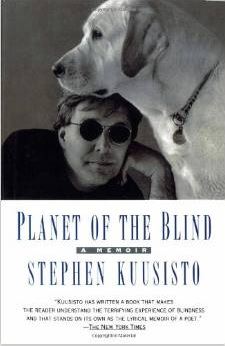
 Planet of the Blind