On Dreaming of Pagans and Thomas Jefferson

Who are these pagans Thomas Jefferson loved? Last night I dreamt of them (or so I think) as it must have been Lucretius who stood beside me in a great stadium filled with star struck people to whisper in my ear everyone is a sack of atoms and all atoms are senseless and so, we can make of our lives what we wish.

In the way of dreams the stadium was local. I think it was the mighty Carrier Dome at Syracuse University. Imagine! I was at a sporting event with Lucretius!

(BTW: when pagans attend sporting events, they do not imagine God has anything to do with the score.)

Pagans. Admit them. They saw Gods cared nothing about human affairs. Who instead relied on observation for evidence. Our ancestors who bequeathed us science, democracy, and the Enlightenment.

Jefferson desperately needed them. He especially needed Lucretius. If you’re plan is to overthrow the king, you must tackle “divine right” head on.

Christopher Hitchens writes in his grand tour de force God is Not Great:

“In some ways, the most attractive and the most charming of the founders of antireligion is the poet Lucretius, who lived in the first century before Christ and admired the work of Epicurus beyond measure. Reacting to a revival of ancient worship by the Emperor Augustus, he composed a witty and brilliant poem entitled De Rerum Natura, or “On the Nature of Things.” This work was nearly destroyed by Christian fanatics in the Middle Ages, and only one printed manuscript survived, so we are fortunate even to know that a person writing in the time of Cicero (who first published the poem) and Julius Caesar had managed to keep alive the atomic theory. Lucretius anticipated David Hume in saying that the prospect of future annihilation was no worse than the contemplation of the nothingness from which one came, and also anticipated Freud in ridiculing the idea of prearranged burial rites and memorials, all of them expressing the vain and useless wish to be present in some way at one’s own funeral. Following Aristophanes, he thought that the weather was its own explanation and that nature, “rid of all gods,” did the work that foolish and self-centered people imagined to be divinely inspired, or directed at their puny selves:

Who can wheel all the starry spheres, and blow

Over all land the fruitful warmth from above

Be ready in all places and all times,

Gather black clouds and shake the quiet sky

With terrible thunder, to hurl down bolts which often

Rattle his own shrines, to rage in the desert, retreating

For target drill, so that his shafts can pass

The guilty by, and and slay the innocent?

Atomism was viciously persecuted throughout Christian Europe for many centuries, on the not unreasonable ground that it offered a far better explanation of the natural world than did religion. But, like a tenuous thread of thought, the work of Lucretius managed to persist in a few learned minds. Sir Isaac Newton may have been a believer—in all sorts of pseudoscience as well as in Christianity—but when he came to set out his Principia he included ninety lines of De Rerum Natura in the early drafts. Galileo’s 1623 volume Saggiatore, while it does not acknowledge Epicurus, was so dependent on his atomic theories that both its friends and its critics referred to it as an Epicurean book.”

Excerpt From: Christopher Hitchens. “God Is Not Great.” iBooks. https://itun.es/us/xNwuv.l

**

So the Pagans might not have been great scientists—it took the Enlightenment to raise scientific reasoning to its modern place—but they were avowedly, even wickedly smart about superstition.

Here is Thomas Jefferson in Notes on the State of Virginia:

“Difference of opinion is advantageous in religion. The several sects perform the office of a Censor morum over each other. Is uniformity attainable? Millions of innocent men, women and children, since the introduction of Christianity, have been burnt, tortured, fined, imprisoned: yet we have not advanced one inch towards uniformity. What has been the effect of coercion? To make one half the world fools, and the other half hypocrites. To support roguery and error all over the earth.”2

**

Strong stuff. I like the word “uniformity”. Here Jefferson means it in the sense of “harmony” (one of the word’s earlier meanings.)

**

What else does Jefferson gain from knowing the Pagans?

He knew well this famous passage from Epicurus:

“Pleasure is our first and kindred good. It is the starting point of every choice and of every aversion, and to it we always come back, inasmuch as we make feeling the rule by which to judge of every good thing.”

And this:

“When we say, then, that pleasure is the end and the aim, we do not mean the pleasures of the prodigal or the pleasures of sensuality, as we are understood to do through ignorance, prejudice, or willful misrepresentation. By pleasure we mean the absence of pain in the body and trouble in the soul. It is not an unbroken succession of drinking bouts and of revelry, not sexual lust, not the enjoyment of fish and other delicacies of a luxurious table, that produces a pleasant life. It is rather sober reasoning, searching out the grounds of choice and avoidance, and banishing those beliefs that lead to the tumult of the soul.”

Here is Thomas Jefferson in a letter to James Madison:

“…life is of no value but as it brings gratifications. among the most valuable of these is rational society. it informs the mind, sweetens the temper, chears our spirits, and promotes health.”

**

Back to the stadium. The pursuit of happiness can’t be a spectator sport. It requires, among other things, a banishing of harmful beliefs.

If you need a gold test for how to banish harmful beliefs, remember that the “golden rule” is also Pagan: “do unto others as you would have them do unto you”.

And the golden rule is why Jefferson wanted to keep church and state wholly apart in the United States.

Here is the text from his Virginia Statue for Religious Freedom:

An Act for establishing religious Freedom.

Whereas, Almighty God hath created the mind free;

That all attempts to influence it by temporal punishments or burthens, or by civil incapacitations tend only to beget habits of hypocrisy and meanness, and therefore are a departure from the plan of the holy author of our religion, who being Lord, both of body and mind yet chose not to propagate it by coercions on either, as was in his Almighty power to do,

That the impious presumption of legislators and rulers, civil as well as ecclesiastical, who, being themselves but fallible and uninspired men have assumed dominion over the faith of others, setting up their own opinions and modes of thinking as the only true and infallible, and as such endeavouring to impose them on others, hath established and maintained false religions over the greatest part of the world and through all time;

That to compel a man to furnish contributions of money for the propagation of opinions, which he disbelieves is sinful and tyrannical;

That even the forcing him to support this or that teacher of his own religious persuasion is depriving him of the comfortable liberty of giving his contributions to the particular pastor, whose morals he would make his pattern, and whose powers he feels most persuasive to righteousness, and is withdrawing from the Ministry those temporary rewards, which, proceeding from an approbation of their personal conduct are an additional incitement to earnest and unremitting labours for the instruction of mankind;

That our civil rights have no dependence on our religious opinions any more than our opinions in physics or geometry,

That therefore the proscribing any citizen as unworthy the public confidence, by laying upon him an incapacity of being called to offices of trust and emolument, unless he profess or renounce this or that religious opinion, is depriving him injuriously of those privileges and advantages, to which, in common with his fellow citizens, he has a natural right,

That it tends only to corrupt the principles of that very Religion it is meant to encourage, by bribing with a monopoly of worldly honours and emoluments those who will externally profess and conform to it;

That though indeed, these are criminal who do not withstand such temptation, yet neither are those innocent who lay the bait in their way;

That to suffer the civil magistrate to intrude his powers into the field of opinion and to restrain the profession or propagation of principles on supposition of their ill tendency is a dangerous fallacy which at once destroys all religious liberty because he being of course judge of that tendency will make his opinions the rule of judgment and approve or condemn the sentiments of others only as they shall square with or differ from his own;

That it is time enough for the rightful purposes of civil government, for its officers to interfere when principles break out into overt acts against peace and good order;

And finally, that Truth is great, and will prevail if left to herself, that she is the proper and sufficient antagonist to error, and has nothing to fear from the conflict, unless by human interposition disarmed of her natural weapons free argument and debate, errors ceasing to be dangerous when it is permitted freely to contradict them:

Be it enacted by General Assembly that no man shall be compelled to frequent or support any religious worship, place, or ministry whatsoever, nor shall be enforced, restrained, molested, or burthened in his body or goods, nor shall otherwise suffer on account of his religious opinions or belief, but that all men shall be free to profess, and by argument to maintain, their opinions in matters of Religion, and that the same shall in no wise diminish, enlarge or affect their civil capacities. And though we well know that this Assembly elected by the people for the ordinary purposes of Legislation only, have no power to restrain the acts of succeeding Assemblies constituted with powers equal to our own, and that therefore to declare this act irrevocable would be of no effect in law; yet we are free to declare, and do declare that the rights hereby asserted, are of the natural rights of mankind, and that if any act shall be hereafter passed to repeal the present or to narrow its operation, such act will be an infringement of natural right.[4]
Why the U of Iowa has been Suborned

I wrote yesterday on my blog Planet of the Blind about the selection of J. Bruce Herreld as the new president of the University of Iowa. The title of my post was: “On the Suborning of Free Speech and Shared Governance at the University of Iowa”—a conscious decision on my part, for I believe that the choice by the board of regents to install as president a second-tier businessman with no prior higher education experience stands in opposition to good governance and is designedly callous at best. The selection opposes good governance because nearly 90% of the faculty responded to Herreld’s candidacy by noting he is unqualified. Additionally, the regents had three first rate candidates to choose from—candidates who were presumably flawed because they were seasoned academic leaders from first rate academic institutions. I used suborning with deliberation. “Suborn: to bribe or induce (someone) unlawfully or secretly to perform some misdeed or to commit a crime.” If the installation of a man who was clearly a ringer isn’t a misdeed, then let’s call it an unscrupulous act.

Readers outside of Iowa should know that the regents have been politically and ideologically opposed to supporting the state’s flagship public university for over a decade. They are party hacks—most are from the western fringe of Iowa, and nearly all are driven by resentments. They hate the fact that the university admits foreign students and (worse!) out of state students. In their view, Iowa’s public higher education should only be for Iowans. The position is politically popular in the west of Iowa which is thick with tea party dogmatists. Could higher education “just” for Iowans be sustainable? Of course not. Is it an advisable end for assuring academic excellence? No. Of course the opposite of sustainability is “indefensible”. In recent years the regents have punished the university by withholding state aid, and in turn, have given it to the state’s two other public universities, the University of Northern Iowa, and Iowa State University—a reward for those institutions’ respective vow to admit more Iowans. This is academic xenophobia at best, and a cynical form of social engineering when one considers the worst case. If the high school students of Iowa are not encouraged to attend the state’s best public university—(cuts in state support help to assure it) then, in turn, they aren’t exposed to the closest thing Iowa has to a public Ivy League experience. Iowa City is a United Nations UNESCO International City of Literature; the home of the world famous Writer’s Workshop and International Writing Program which brings writers to Iowa from around the world that they may discuss literature and engage in cultural diplomacy.

The western fringe doesn’t like any of this. Moreover it sees higher education as a one stop shop for no frills business outcomes. In their view a university should be little more than a trade school. Expenditures on frou frou things like languages or philosophy courses make no business sense. Enrollment management ought to dictate what is offered. If an English class has only 10 students, it should be eliminated. This has been the reality at the University of Iowa over the past few years, a state of affairs outgoing president Sally Mason had resisted. How the western fringe disliked her! Mason was a seasoned leader in higher education, a world class scientist, and before coming to Iowa she had been the chief academic officer at Purdue University.

Enter J. Bruce Herreld. His selection was rigged, his fellow finalists—all superior candidates—were simply window dressing. J. Bruce Herreld—the choice of a camarilla.

On the Suborning of Free Speech and Shared Governance at the University of Iowa

When Iowa’s Board of Regents selected J. Bruce Herreld, a businessman with no prior experience in education, as the new president of the University of Iowa they affirmed three principles: the university is now strictly a business, the faculty and students are to be put in their respective places, and those places are likely, from now on, designed to be narrow indeed.  One way to recognize straitening in higher education is that it is always the result of a top down postural model–decisions are made by officials without regard to shared governance or academic culture. As a former professor at Iowa, and a graduate of its esteemed Writer’s Workshop, I view with alarm the Regents’ decision to shoehorn a third tier candidate into a job for which he is not qualified.

In an article for the Iowa City Press Citizen, published on the eve of the Regents decision, reporter Jeff Charis-Carlson reported the following:

“In a survey conducted by the UI chapter of the American Association of University Professors, only 1.8 percent of faculty and 2.6 percent of other respondents answered “yes” to the question of whether Harreld was qualified for the position. The other candidates — Oberlin President Marvin KrislovTulane University Provost Michael Bernstein and Ohio State University Provost Joseph Steinmetz — all had more than 90 percent of respondents view them as qualified, with Steinmetz being the highest.

Harreld — who also has been an executive with Kraft Foods and the restaurant chain Boston Chicken — earned an MBA from Harvard Business School, where he taught as a senior lecturer from 2008 to 2014. During his public forum Tuesday, he said that, although he had no experience in university administration, he does have experience helping organizations go for “good to great” and from “great to great.””

One is fairly reminded of George Orwell’s assertion: “Political language is designed to make lies sound truthful and murder respectable, and to give an appearance of solidity to pure wind. ”

If Herreld’s rivals were all third string candidates, one might, conceivably have opened a file entitled “credulity” and, as it always is with fairy tales, find only his name. J. Bruce Herreld, chicken king and self-employed business consultant. But he is self-employed no longer. Look how he has leapfrogged over three top tier finalists  like a plastic army man lifted above the rug by a moist childish hand.

This appointment is strictly ideological. The Iowa Board of Regents has been engaged in a decade long war with the University of Iowa, has denied it funding, has proudly given support to other state institutions while lecturing the UI about everything from its admissions policies (they admit out of state and foreign students) to its tiresome faculty (whose sabbaticals have now been largely eliminated).

Now I should here admit that my father was a college president. He was a rather good one. I know what he would say in this instance. He’d say Herreld shouldn’t take the assignment. But apparently he has, and that mere fact suggests he’s comfortable with his Regents, and satisfied that a top tier state university is due for a full conversion to the principles of corporate management. Free speech isn’t principally respected in that model, as recent events at the University of Illinois at Champaign-Urbana have conclusively demonstrated. Free speech is the first vicim of all vertical management models.


Academic Freedom, Disability, and a Little Thing Called Human Sexuality

We are living in the age of autocracy, a matter that’s clear, as every conceivable matter of public concern is about who controls what. It is hard to derive solace from the assertion America was always an oligarchy, that our founders were aristocrats, wealthy, and privileged. The second President of the United States, John Adams, was a small town lawyer and dirt farmer. And while Alexander Hamilton promoted a national bank, he was met with sufficient disapprobation by Thomas Jefferson and James Madison to have had to settle for less. These times are starting to feel Orwellian in a particularly “Animal Farm” way: “All animals are equal, but some are more equal than others.”

Nowhere does this seem clearer just now than in Higher Education where assaults on academic freedom are legion, and often misunderstood. When these attacks are reported in the news they are generally misrepresented as quaint disputes, as odd and unfamiliar as dueling. But colleges and universities are our nation’s “agora”—the public square where free men and women can exchange ideas in democratic safety. I believe “safety” is under increasing duress and I’m certainly not alone. Free speech is in danger in the academy and in turn, human dignity is at stake. Please don’t label me a hysteric. Free speech is in danger and human rights are at stake. This is neither a liberal or conservative issue—it is a fundamental matter of American consent.

In Ken Burns’ PBS film about Thomas Jefferson, the conservative columnist and public intellectual George Will points out that in America we know precisely who we are—that the Declaration of Independence is our national catechism. Being American Will says, is to consent to “life, liberty, and the pursuit of happiness” and moreover, that “all men are created equal”.

I like George Will when he talks about Jefferson, and I like him when he writes about baseball.

Moreover, I like his defense of free speech.

Not so very long ago, my colleague and friend, Professor Bill Peace found himself in the crosshairs of academic freedom’s opponents for writing a story about being a paralyzed man in a rehabilitation ward. The story recounts how some nurses attempted to assure frightened patients they could still have sex. As a matter of clarification, Peace’s narrative makes clear that human sexuality and disability is a largely taboo subject to this very day.  Peace’s essay was harshly attacked and trivialized, which is to say, the content of what he wrote was misrepresented in a number of stories. Misrepresentation is essential if the goal is to limit freedom. Simply say that a story involving free speech is salacious, or politically incorrect and most readers, even academics, will shrug. (One saw this during the Steven Salaita story—some academics actually opined that withholding a professor’s tenured appointment at the University of Illinois was OK because, after all, the man wrote some angry tweets about Israel. As if anger, expressed, in any form, is not a right; not essential to freedom of speech.) Well alright. Bill Peace wrote about disability and human sexuality for a journal called Atrium. A journal published by the Medical Humanities and Bioethics Program of Northwestern University’s Feinberg School of Medicine.

Peace is a famous disability rights activist, a professor of bioethics, and a public intellectual. In case you’re wondering, his Ph.D. in Anthropology is from Columbia University. The “storied” Anthropology program at Columbia. All of which is to say, Prof. Peace is no middling scholar.

The issue of Atrium in which Peace’s article appeared was edited by Alice Dreger, one of this nation’s best known bioethicists, and was devoted to stories about women and medicine. The title of the issue was “Bad Girls”. As a matter of concern, in terms of an ethic of patient care, when should a nurse (or other medical practitioner) break the rules? Does patient care always depend on a strict adherence to protocol? This is not a summary question. Ethics seldom lend themselves to easy taxonomies.

Peace wrote about being a young paralyzed man—a teenager in fact—who, during a long rehabilitative hospital stay learned he could have sex from a nurse. His article was about the tricky subject of paralysis and sexuality, a matter that is both probative and essential both for human dignity and reproductive rights. He recounted instances in which nurses helped frightened young men learn about sex.

Yes, the subject carries discomfort. Able bodied people don’t like hearing about disability and human sexuality. Or many of them do not want to know about it. Worse, perhaps, a cadre of academics, largely women, protested about Peace’s content, claiming the essay was demeaning to women. (I read the essay in draft form: this simply is not the case, unless one conceives of women as Victorian angels without human instincts.) Peace writes:

Shortly after Dreger and I went public about the magazine’s online censorship, the essay became widely discussed in the news, in articles of varying quality. The most absurd response was written by Rachelle Barina and Devan Stahl, who seemed to characterize my essay as pornographic. In a blog post on Bioethics.net, they said my article “perpetuates views of women, sexuality, and professionalism that best serve male power, rather than the power of women.” They argued that “the ‘bad girl’ theme of the Atrium issue allowed for an article that imported expectations of female subservience” and went so far as to speculate that I might have fabricated my experience, essentially characterizing me as a fantasizing misogynist. Treating my essay as pornographic or misogynistic reinforces the social isolation of people with disabilities and falsely affirms their inability to establish intimate relationships.

Northwestern took the journal offline, scrubbed Peace’s essay out of the issue, and then put the journal back up. Later they shelved the journal.

Peace has now written an elegant and exact essay for the Chronicle of Higher Education that should be essential reading for any scholar or student, or college administrator for that matter, who is concerned about freedom of expression and the safety of the agora.

Professor Dreger has now resigned her post at Northwestern in protest over censorship.

I fear that as this is a story with a disability theme it won’t get the attention from academics it rightly deserves. Apparently the agora is surrounded by barbed wire;  political correctness can, in tandem with corporate administrators, erase ideas. And one must fair say, real lives are in the balance. Did you know that paralyzed people need education about sex? Did you?

Disability Life, Mystic Style

Disability was not my birthright but it became my blueprint. Jefferson said “all men are created equal” and the phrase haunts America. Jefferson loved Joseph Priestley. the scientist who discovered the properties of oxygen. “We hold these truths to be self evident” means they are “in the air”. Equality is in the air. We are equal with our first breaths. Your difference isn’t you, only your equal place, your hydrogen. And then you must become an architect. That is what Jefferson meant by “the pursuit of happiness”. Thomas Jefferson who built and rebuilt his house at Monticello for over forty years.

Building is harder then deconstruction. It is easy to theorize the deleterious effects of neoliberal biopolitics on the fates of outsiders, by which I mean, that while this work must be done, such work seldom proposes (at least to my mind) what is best about the humanities—that proposition about what a man or woman might build. What will be your blueprint? What is the house you will build and tear down and build again? I submit the blueprints of equality are not polemical or ideological at all. They are mystic. By which I mean subject to delicate attention, that delicacy which unites architects and poets. Here is D.H. Lawrence’s famous poem on the matter:

They call all experience of the senses mystic, when the 

       experience is considered.

So an apple becomes mystic when I taste in it

the summer and the snows, the wild welter of earth

and the insistence of the sun.

All of which things I can surely taste in a good apple.

Though some apples taste preponderantly of water, wet and sour

and some of too much sun, brackish sweet

like lagoon-water, that has been too much sunned.

If I say I taste these things in an apple, I am called mystic, which

       means a liar.

The only way to eat an apple is to hog it down like a pig

and taste nothing

that is real.

But if I eat an apple, I like to eat it with all my senses awake.

Hogging it down like a pig I call the feeding of corpses.


To paraphrase the old joke about Freud: sometimes an apple is just an apple. But our senses, they are the lines of our blueprints.

The encomiums of justice are dependent on a severity of intellect, the ongoing critique of the past. Jefferson did not eat apples on his mountain and say, “this is better than liberty”. The effects of neoliberalism on the poor stand straight before us. The migrant crisis is a visible and glaring effect of post-modern capitalism and represents its injustices. But I submit political awareness will not save a single man or woman without all the senses awake. This is the blueprint. What if the apple is more than an apple?

Of Rachmaninoff’s Hands and Oliver Sacks’ Beard

I wash my fingers in cold water and think of Rachmaninoff who, learning he was dying, went to his study, shut the door, and said farewell to his hands. Perhaps there’ll be music where we’re going, but the drama of personal death has everything to do with saying goodbye to the embodied music that has made it possible to live.

When I woke this morning and read of the passing of Oliver Sacks I thought, “he had to say goodbye to his wonderful beard” and then I imagined the great neurologist’s beard as a forested antenna transmitting aleatoric music of the cosmos straight into his brain.

If such speculations help, they help. And of course they’re conceits, at best educated guesses.

We know there’s music out there. We know we’ve picked some of it up in our curves and dimples.

Once, while visiting the LaScala opera house in Milan, I saw Giuseppe Verdi’s boyhood piano. You could see where Verdi’s father had written with pencil on the keys the positions of the notes. At first I thought, “that’s so his son could see the notes, place his fingers…” Then I realized it was so his son could hear what his fingers produced.

Body. Music. Prologue. Whatever comes next.

Note: I’m not arguing God is in the gaps—this small homage to musical possibilities beyond our mortal coil has nothing to do with the intelligent design crowd. Things vibrate. I exult in this fact because every vibration gives the tympanic membrane something to transmit.

I still miss Rachmaninoff’s hands and now I shall miss Oliver Sack’s beard-receiver.


Reading the Bird Braille

I spend the day tightening my fingers in the Greek way, in the Hipponax manner, putting my hands where they don’t belong, probing the guts of birds, nattering about the future. I am so tired. My nation has fallen on evil times. All my dark skinned brothers and sisters are exhausted. My crippled pals feel despair. A fingernail in the crow’s guts tells me there will be more fear. I trace a bilious organ of crow-ish appetite, read in Bird Braille there will be megalomania, corporate disdain, wars. Put your hand where it doesn’t belong. It’s a book you should know.

Ubu Ableism

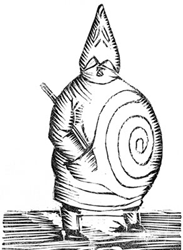
ubuTheater of the Absurd...

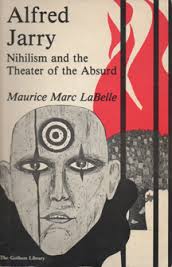
The image on the left above is a sketch by Afred Jarry of Ubu Roi. The book cover on the right is from Maurice Marc LaBelle’s excellent study of the Theater of the Absurd. As a poet who happens to have a disability (this, in the vein of: as a writer who has green eyes, since its both a differentiating feature, and, simultaneously of little provenance, save there are some who think witches are most likely to have green eyes…a dilemma for some of us…) ahem, yes, as a poet with a disability I always bounce off the frontal carapace of Ubu-ableism, (you have to hand it to me, that was a strikingly coagulated sentence.)

Ubu-ableism differs from your run of the mill ableism. The latter is simple. It says, “there are places for these people.” ROM ableism is nothing more than rehabilitation sequestration. It survives everywhere, from the University of Iowa where the office of disability services is hidden in the basement of a dormitory and can only be reached by elevator. Or at Syracuse University where the office of disability services is on the top floor of a building and can only be reached by elevator. In the event of fire you must imagine there will be especially competent emergency personnel who are remarkably trained, who will especially save you, if you’re one of those disabled people, who only wanted to arrange some extra time to take a printed test. And now you’re in an emergency where you can’t roll out the door. Imagine. In any event, ROM ableism is essentially institutional thinking. Certainly the real estate is cheaper in the basement or on the top floor of an underutilized building. Come on, you wouldn’t want to put disability services smack dab in the center of your campus. People might see. They might think you don’t have a good school. I’m not wrong to say this. If you believe in your university and believe that students with disabilities are a source of excellence, than you’ll put your office of disability student services at the center of campus, as they did long ago at UC Berkeley.

Ubu-ableism is enhanced discrimination. It works like this: Ubu is in charge. He is (or she is) only concerned with greedy self-justification. Think of Ubu as Donald Trump wearing a military outfit.

Ubu thinks that the Americans with Disabilities Act is an unfunded mandate.

He thinks that the disabled are not “us” but those people.

He ardently believes they possess insufficient value in support of his quest for more goodies.

He is never shy about saying they should go away.

He sometimes runs academic conferences.

Sometimes he runs a chain of restaurants or a division of the Veterans Administration.

He advises on political campaigns.

He can be a pretend liberal like Ira Glass.

He’s certainly on the faculty of many universities.

His smile and his sneer are identical.

He calls for the end of social security.

Or she.


Alice Dreger, Academic Freedom, Northwestern University, and Borges

Academic freedom is always under attack in the US and abroad. One might conceivably write a joke about the subject which would end, “Oh, so it’s an old story.” Years ago I heard the Argentine poet Jorge Luis Borges confound a moist and utterly cerebral undergraduate at Cornell University—the occasion, a “symposium” on the work of Vladimir Nabokov; the poor kid with his ball cap backwards—by saying, “what about Nabokov?” Borges had been the “keynote” speaker, the star, who was expected (or so one imagined) to close the proceedings in Ithaca with a tight, eloquent, “proof” on the Nabokovian Éminence grise. Instead he spoke for fifteen minutes about play as the core ingredient of imagination. He alluded to card tricks. And never once did he mention the author of “Lolita”. He stopped. That is, he said something about  playfulness and stopped. He stopped like an old fashioned gramophone record. Borges’ needle had struck the paper label. There was wide silence. And it was long. There were perhaps 300 people in the auditorium. No one moved and no one spoke.

There were some in that room who must have thought Borges was having them on—a reflex at Cornell where the institution’s super-ego always imagines they’re not quite as good as the rest of the Ivy League. Borges must have been making fun of the assembly. (He was.) Or he may have been delivering an elementary sermon on inventiveness which true academics certainly didn’t feel they needed to hear. (He was.) Surely some of the faculty thought Borges was senescent. Ableism works that way. Perhaps the blind poet was out of his depth. But as I say, the silence of the crowd was substantial. I liked it. It was a Victorian silence, the absence of words was balanced on a tight line of epistemic bifurcation. One one side was the serious purpose inherent—Nabokov with a monumental Czarist “N”; on the other, a scurrilous Borgesian joke.

I was fresh back from a Fulbright year in Helsinki where I’d been studying the work of Pentti Saarikoski, A Finnish poet who many now consider to be the first truly post-modern writer. Saarikoski studied Greek and Latin, then Ezra Pound, James Joyce, and Karl Marx—and perhaps not in that order but it doesn’t matter. What matters is the play that held his many influences together, and the principle was Heraclitus. Logos resists polarities. In any event I enjoyed the scholastic silence in that hot auditorium.

Then the kid said: “But what about Nabokov?” And Borges said: “Who is he?” “Well,” said the student, “you know, he wrote Lolita?” (By the mid-eighties American students everywhere had adopted that mannerism whereby all assertions must end with question marks—the aim, presumably, either to avoid being wrong, or to never offend anyone with a firm position—god knows.

“Who is Lolita?” Borges asked.

“Well you know,” said the student, “it’s the story of a teenaged girl maybe she’s 13, and she has an affair with a disreputable older man…?”

“Ah,” said Borges, “so it’s an old story.”

That was it for Nabokov. The show was over. A more perfect tribute to the master could not have been delivered.

Let’s be clear: freedom in the realm of inquiry is always a matter of playful risk. It can never be a matter of public relations.

I’m in mind of these things because this morning I read that Professor Alice Dreger, one of this nation’s pre-eminent scholars in the Medical Humanities has resigned her position at Northwestern University because the university has allowed its journal in medical ethics to become a vehicle for PR as opposed to free inquiry. You can read her story here.

It is an old story. Alice Dreger is principled and brave. I admire her.

I solemnly renounce Northwestern University’s medical school and its proprietary censorship.

I Have to Write Fast

I have to write fast. I’m theorizing extramundane fantasies. For instance: starlight takes shape of man, then decides this was a mistake, goes back to stars. True story if you’re Christian, I suppose.

Writing fast. People on Facebook still argue “who was better, the Beatles of Stones?” Aging Victorian Baby Boomers. Ugh. Who was better, Jefferson or Hamilton? Ben Franklin of course.

Dang. Need to read some Robert Browning. It’s been too long. Hey, Uncle Ez.

Jumping on wholly imagined trampoline for my friend Ralph who has a real one and isn’t feeling well.

when you open the book of life

if I hear my name

do I get to go look at it?

–Niilo Rauhala

translated from the Finnish by SK