Landscape

There’s always something remaining, that’s the trouble—

this book for instance, with its woods and one dark house.

Someone’s always talking and he’s not from this world.

Breathe at the window, draw with a finger

words of no consequence, give it a go—

autumn rain wind childhood,

don’t forget eyes behind the leaves…


The Whole Story

Once when I was in a very dark time, having lost my job and losing my eyesight, I received a cruel letter from Mia Berner, a Swedish writer, who’d been married to the late Finnish poet Pentti Saarikoski. I’d sent her some of my Saarikoski translations. Her letter was exceedingly vicious. She said I was a fraud. (The translations were good.) She went on and on about what an execrable writer I was.


My mistake? I’d signed my original letter to her as “Professor” Kuusisto.


I was depressed for days. I couldn’t get out of bed.


**


There’s no “nowadays” nowadays. & I’m unbowed by the past. I can imitate stones if need be.


Always there’s a new part of time.


**


If the world comes true…

If you ramble home…

If whatever we passed…

If the self will never be right…

If you study the floor…


**


Stranger, my actions, only a long life can explain.


If you are oppressed, wake up early.


On the Playground with Dog and Cops

I ventured one evening onto a school playground and spun on the sandlot carousel. Corky was pleased with the game. We went around in slow, breezy loops.

Headlights appeared and two policemen approached.

They saw a blind man and his dog spinning and smiling.

“What are you doing, sir?” asked one of the cops.

“We’re just having a look around,” I said.

It was an old joke.

To the cop’s credit, he laughed.

I told them the old joke—the one about about the blind man who goes into a department store, hoists his dog over his head and turns in all directions. The manager approaches and asks what he’s doing and he says—“just having a look around.”

The first cop hadn’t heard it. The second one knew it. We were briefly, eccentrically happy. The police were relieved I wasn’t an amphetamine addict haunting the schoolyard. I was relieved because they saw the innocence of my nocturnal merry go round ride.

“Oh the bright calligraphies of talk,” I thought, “under stars, with strangers, no one threatened, and all of us united by a dog.”

And we are. United. By dogs. Dogs and humans have gathered in the dark for over 15,000 years. From the ancient temples of Tibet to the steppes of Mongolia…

So I said, “you know this is the oldest human occasion, three people talking alongside a dog in the dark.”

One of the cops laughed, said, “I don’t know where I’d be without dogs.”

The other said, “I’m putting in for K-9 training.”


We were three men, just having a look around.


Morning Notes, Late June

Some mornings rain and apple trees.

Some mornings wisdom and chance.

And here I am, says the horse.

And the jaunty dog says here we are.


**


Dreamt last night I was in a winter house.

My only friend was a very old rat.

I played a song for him on a found guitar.

Damned wakefulness, I can’t recall the song…


**


Street performance, always, when you’re disabled.

A woman walks up to me outside a supermarket.
“That’s a nice dog,” she says.

“What dog?” I say.


**


“I’ve had it with these cheap sons of bitches who claim they love poetry but never buy a book.”


—Kenneth Rexroth


**


“I did a test in my life path, on the way from the cradle to the grave, but as an object, a container, which gradually fills up and after being shattered.”


—Pentti Saarikoski


Herr Doktor! Look! I'm a Disabled Smoker!

Disability falls between two divides—between the normal body and whatever that isn’t, and between practicality and archetype. Generally people ignore this quaternity because normality is easily deconstructed and practicality is a money making idea. (Accessible technology; racy wheelchairs; bionic prostheses; service animals—all utilitarian and reassuring.) The archetypes are liminal, pejorative and truly devastating. In my first memoir Planet of the Blind I described a cab driver who informed me that my blindness was most certainly a product of voo doo—he couldn’t be convinced otherwise. If you don’t believe archetypes play a role in the abjection of the disabled think again. But the quaternity has a more serious aspect: ableism depends on the normal and the archetypes being paired against practicality (prosthesis, rehabilitation, etc) and the very nature of physical difference. The cab driver really believed I couldn’t be part of the world. For him, the physical (deviant) trumps all rehab. Why? Because there are no normal archetypes.


Sometimes a cigar is just a cigar. But not if you’re disabled.


An Unsolicited Phone Call from a Professor

One afternoon I got a phone call from a professor of engineering who said he wanted to assign a problem for his students–they were to build a robotic guide dog. “What?” he wanted to know, “does a guide dog do?”


“Well,” I said, “they’re trained to guide blind people along sidewalks and stop at curbs–both the down curb and the up curb.”


“Check,” he said.


“They’re also trained to stop for stairs.”


“Check.”


“In addition,” I said, “they must account for the combined width of the dog-human team–they won’t squeeze through a narrow space just because they might navigate it if they were on their own. They stop and search for another way.”


“Check,” he said. I could tell he was feeling pretty good about his chances. He probably had some experience with the Mars rover program.


“But here’s the kicker,” I said. “Guide dogs are trained in a thing called ‘intelligent disobedience’. When a blind person thinks its safe to cross the street he or she issues the ‘forward’ command. And if the dog thinks its unsafe it won’t move. It may even back up.”


“Oh,” he said. “Oh.” He was silent for a time and then said: “I guess we’ll have to come up with something else.”


Self-Interview, June 22, 2014


Dear Buddha:


I do not believe that being reborn as an animal represents a spiritual setback.


Yours,


Mr. Spruce Grove


**


Spruce Grove is the English translation of the Finnish name “Kuusisto”.


**


In short: every ritual should astonish human arrangements.


**


At the famous arts colony as the artists were finishing dinner I explained my seeing-eye dog—the “ins and outs” of interacting with her. The speech wasn’t long but I realized it was miniature  soapbox address, my little corner of Hyde Park. I didn’t know—couldn’t conceive really, that in the coming years I’d give this admonitory micro-lecture daily and in every part of the world. Nor did I realize that the reception of my dog among the artists would reflect elements in broader life.


Immediately after dinner a woman composer wanted to know why she couldn’t break the rules and pet my dog anytime she wished because, in essence, she was a unique human being. The guide dog school hadn’t prepared me for interactions with a special category of vanity—what I’d eventually call “auto-biophilia”—the Romantic belief that because you think you’re special, in turn you have a unique intuitive bond with animal life.


If you have a service animal you frequently meet people who are materially unfulfilled and projective where animals are concerned. The Doctor Doolittles; the PETA propagandists; New Age types. I do agree with Edward O Wilson, the Harvard entomologist who coined the term biophilia.  He wrote: “Humanity is exalted not because we are so far above other living creatures, but because knowing them well elevates the very concept of life.” I agree that our animals enrich us. But don’t touch my dog. I smiled at the composer and walked away.


**


I went to the river to find my old Moses basket.

Went to the river to scoop up mirror neurons.

Went to the river to talk to an old horse.


**

My favorite Tony Blair joke:


Tony Blair, the British Prime Minister, is being shown around a hospital. Towards the end of the visit, he is shown into a ward with a number people with no obvious signs of injury or disease. He goes to greet the first patient and the chap replies: “Fair fa’ your honest sonsie face, Great chieftain e’ the puddin’ race! Aboon them a’ ye tak your place, Painch, tripe, or thairm; Weel are ye wordy o’ a grace as lang’s my arm.” Tony, being somewhat confused (easily done) goes to the next patient and greets him. The patient replies: “Some hae meat, and canna eat, and some wad eat that want it, but we hae meat and can eat, and sae the Lord be thankit.”The third starts rattling off as follows: “Wee sleekit, cow’rin, tim’rous beastie, O, what a panic’s in thy breastie! Thou need na start awa sae hasty, wi bickering brattle! I wad be laith to rin an chase thee, wi murdering pattle!” Tony turns to the doctor accompanying him and asks what sort of ward is this. A mental ward? “No,” replies the doctor, “It’s the Burns unit.”
 

Me and Marty Feldman

Abby NormalMarty Feldman as Eye-gore


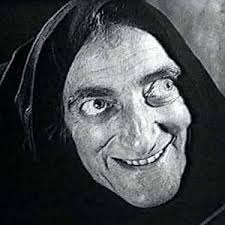
How does one have some modicum of fun as a blind person? Or, to put the matter succinctly, “how fun is fun?” When I was a child they called me “Mr. McGoo” and taunted me. I would never dream of dressing as Mr. McGoo. But Marty Feldman, he’s my brother. We each underwent primitive strabismus surgery as children. In case you don’t know, “strabismus” is the term for crossed eyes. The children of the 1950’s who had this surgery were typically transformed from cross-eyed to “cock-eyed” which is what’s known in the literary world as a pyrrhic victory and in the world of ophthalmology as “well, I guess that’s the best we can do–now go outside and be humiliated…” And though McGoo was bad, there was always the infinitely meaner chorus of “Barney Google, with the goo goo googley eyes” sung block after block as you walked home from school. So Marty is my pal. Feldman was not blind and he had Grave’s Disease which often produces exophthalmic or bulging eyes. But  just like me his eyes were always looking off kilter. In the ancient world he’d have been a shaman. He’d have been the guy who knew how to get the wheat growing again. He most certainly would have known how to talk to horses.

Praying for Peace: A Lesson from My Dogs

Harley and guide dog, Nira

The little dog loves the big dog and she in turn loves him. Don’t tell me that animals don’t have depth of feeling.

This morning Lhasa “Harley” chased guide dog “Nira” because she snuck up on him and stole his tennis ball. She ran in widening circles and then, when the little guy was almost frenzied, she gently put the ball in front of him and wagged her tail.

Let all the dog love glide noiselessly forth on this world day of prayer.