Inscription

When I was a boy there was a place in the woods I liked to go. There was a granite boulder that seemed like a mountain and I’d climb it and press my face into the skin of moss that grew on the summit. Strange today to think that was one of the happiest moments of my childhood.


Did I know as a child I was celebrating my tiny-ness? I think I must have known.


My friends were the crickets who lived inside an abandoned stove.


I did not, in those days, love my own wisdom. I merely loved shapes and sounds.


And the odor of the moss, like bread baking, with just a hint of pepper…


How We Live

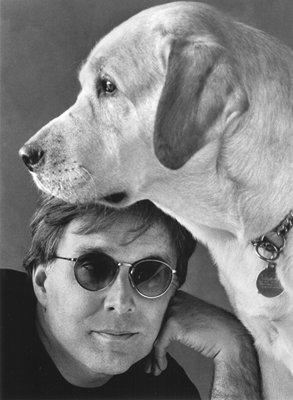
Its hard to be beautiful all the time but I accept it. I’m short, round, hairy, overweight. I’m cross eyed and bent. I’m beautiful. I’m beautiful because I’m an incomparable mockery of fashion. Because when I walk with my dog (who’s trained to guide me) I’m dancing. I paint the world with my inner eyes. I make up Boolean equations about chance and fate. I glide. I talk loudly or I don’t say a thing. I’ve walked all over New York City on a net of moonbeams like most blind people do. Tendresse. So vulnerable. So alive…


Daumier's Dog and My Own First Days at Home with Corky, Now So Long Ago…


Once at the Metropolitan Museum of Art in New York a friend, a writer, described for me the intricate pencil sketches of Honore Daumier. When she came to a drawing of a rough looking man being followed by a small dog she stopped talking for a moment. Then she said: “The dog is so delicate—he’s a curlicue, he looks like he’s bouncing on tiny springs.”


“Its as though the dog is the principle of life itself; the old man—he looks like a judge—he’s the opprobrium of public life. And its like Daumier is saying the two should be together though they aren’t. The dog’s just dancing along. He doesn’t belong to the man.”


I walked the hills of Ithaca with Corky and was flooded with reveries. The dog in Daumier’s sketch didn’t belong to the man. If only he’d turned around. A better life is sometimes that simple. And then again, of course, it isn’t. Honore Daumier died penniless and blind, and I imagine he had no dog. I felt a oneness with his ghost. I appreciated my own luck and good fortune.


We went to the gym and I ran on a treadmill, Corky lying beside me on a towel. Spring was coming on and the trees outside the windows were like green smoke.  The winter people were all hitting the exercise machines and there was joviality in the air. Maybe it was just that I was feeling good so, in turn, I noticed other people who were happy. Again strangers wanted to talk. One guy said in passing: “You better get into shape to keep up with that dog! You can tell that’s a fast one!” A woman said: “That dog’s so beautiful you ought to get someone to paint her!” Then she added: “Its her face. She’s an angel!”


“Everyone here is trying to reclaim his or her body,” I thought. “Everyone in this gym is still naively fond of life.”


That was the thing—I was unaffectedly fond of everything. This is what Corky was doing for me.

**


In the Moosewood vegetarian restaurant, a well known Ithaca haunt, I ate curried potato soup and felt a wobbly splendor—I thought, “What will happen if I cry for joy at this table?” I broke a guide dog training rule and slipped Corky a torn piece of French bread. “Deep inside every man or woman is a seed,” I thought. “It grows and determines how we will love or fail to love.” I was opening. I’d never been so happy. Corky put her paw on my knee. My friend “W” who worked at the Moosewood came and sat with us. “Can we make Corky our mascot?” she asked.

It seemed as if the moment, just there, sitting in a sunbeam, made up for all the cruelties of grade school looks and childhood snickers. Who knew that soup, a dog, and easeful conversation were the ingredients of alchemy?


**


Walking in the long April afternoons I started rewriting Pablo Neruda’s poem “Walking Around”—turning the famous surreal cry of despair into an anthem of joy…


It so happens I’m walking with a dog and singing in a key of softness,

No longer afraid of the precipitating fashions

Proud to be blind with a rich animal,

An unclasped necklace swinging from my fingertips,

A long sequence of memories I no longer require…


“I can give things away,” I thought. “Italicized emotions, dark ones—just let them go.”

I had no idea what a talent for happiness might look like or how it might feel, but I was in that place—a zone as sports writers call it—a place of spirited aptitude and dog feet. Corky and I walked all over Ithaca with our heads up. I’d bought a ridiculous CD—“Vienna, City of My Dreams” by by the tenor Placido Domingo—the album was filled entirely with Viennese love songs by Franz Lehar with cream puff orchestral arrangements. The opening song, from the operetta “Paganini” was titled “Girls Were Made to Love and Kiss”—the entire piece was so sappy and lush I had to give in to it. I was in a boat, a gypsy with wine and a handsome woman. I was a Frohliche Wanderer. Corky noticed and often turned her face to me, her dog smile like something out of a reverie. Almost forty, I was wandering for the first time. I saw that wandering is to walking as whims are to stated plans. I was following whims.


Who says dogs don’t understand the most delicate feelings? Before I could say, “Let’s go,” Corky was at the door. Even at midnight she was at the door, anticipating my move. I felt the lure of the all night drugstore and we left our cozy apartment and headed to the half sinister streets in search of vitamins, Mars bars, bubble bath, a styptic pencil. Yes we were walking for the sake of walking.  There really were no goods we needed to buy. Down on the dark sidewalk we moved with muscularity, like movie a cowboy and his horse—honestly I thought for a moment of Roy Rogers and Trigger as we pounded down the sidewalk, crossing the prairie of night.


Frohliche Wanderer entered the 24 hour pharmacy.The little bell rang as I opened the door. I swiveled my hips, turning my back to the opened door, assuring it wouldn’t close on Corky’s tail, performing the technique just as the guide dog school had taught me. Always protect the tail. Then we were across the threshold, standing in the unforgiving light of the average drug store amid the soaps and ten thousand plastic bottles; pastel shades assaulted me; there was the odor of newsprint and nail polish. We went up and down the aisles. I didn’t want anything. And yet what a curious  thing to realize I liked doing this. Just being in a common public spot with its useless products was a kind of empiricism. I was in love with wakefulness in a vulgar commercial space. I couldn’t properly see the products but toured every corner of the store praising Corky and smiling the dazed smile of a night time walker. No one spoke to me. There were three or four other customers and one cashier. I circled and left.


“You see?” I said to my dog. “you’ve taught me to relish the easy things—Daumier’s lesson…”
 

Ratify the CRPD

From the Association on Higher Education and Disability

On Tuesday AHEAD posted a brief statement explaining how the Supreme Court’s decision in Bond vs. the U.S. addressed and removed concerns that ratification of the Convention on the Rights of Persons with Disabilities would impinge on American sovereignty or the balance between State and Federal authority (https://www.facebook.com/AHEAD.org). In response many disability organizations, veteran’s groups, civil rights groups and congressional leadership from both sides of the isle are calling on the Senate to bring the CRPD to the floor and ratify it. The following statement released by Senator’s Kirk, McCain, Ayotte and Barrasso is a good example.

“The Supreme Court’s unanimous ruling in Bond is a positive development that should clear the way for Senate action on the Convention of the Rights of Persons with Disabilities (CRPD). The Court has made it clear that the Bond case should not in any way impede the ratification of the CRPD, and that the Senate can provide advice and consent to this important treaty while preserving American sovereignty and maintaining our Constitution’s balance of powers between the Federal government and the States. The CRPD will ensure that our wounded warriors and disabled citizens are entitled to the same rights and protections around the world that they enjoy here at home. We hope our Senate colleagues will join us to ratify the CPRD as soon as possible.”

It is true that Section 504 of Rehabilitation Act and the ADA provide virtually the same protections to both citizens and visitors to the United States while they do not apply beyond the U.S. territorial waters (see Archut v. Ross University School of Veterinary Medicine 46 NDLR 73, D.N.J. 2012 and Arizona State University 22 Nat’l Disability L. Rep. 239, O.C.R. Region VIII 2001). The protections of the CRPD are based on whether the country you are in has ratified the treaty, not the status of your country of origin. So, why is the CRPD important to AHEAD’s membership, their institutions, over 2,320,000 matriculated postsecondary students with disabilities, and America?

 U.S. ratification encourages the countries where our students study to ratify.

 Unless Congress wants to address extraterritoriality of the ADA, ratifying the CRPD is a way to ensure access and protect the rights of students with disabilities studying abroad, even when they are in federally sponsored programs.

 Ratifying is an opportunity to demonstrate leadership in the human rights arena.

 America helped craft the CRPD using the ADA as a model; ratification would allow us to come back to the table and influence the CRPD as it matures.

 Enhanced credibility when we take a principled stance in world politics.

 It is the right thing to do.


For more information visit Http://www.disabilitytreaty.org

I encourage you to form and opinion and to share it with your Senators and the foreign relations committee.


L. Scott Lissner, President, AHEAD

My Favorite Scandinavian Joke

A Norwegian man wanted a job, but the foreman wasn’t too keen to hire him.

He told the Norwegian that first he would have to pass a math test.
The Norwegian agreed.

“Here’s your first question, the foreman said. “Without using numbers, represent the number nine.”
“Without numbers?” the Norwegian says, “Dat’s easy.” and proceeded to draw a picture of three trees.
“What’s this?” the boss asked.
“Ave you got no brain? Tree and tree and tree make nine,” said the Norwegian.
“Fair enough,” said the foreman, while thinking to himself that he had been outsmarted. “Here’s your second question. Use the same rules, but this time the number is 99.”
The Norwegian stares into space for awhile, then picks up the picture that he has just drawn and makes a smudge on each tree. “Ere you go.”
The boss scratches his head and says, “How on earth do you figure that to represent 99?”
“Vell, each of dose trees is dirty now. So, it’s dirty tree, dirty tree, and dirty tree, and dat is 99.”
The foreman is now worried that he’s actually going to have to hire this Norwegian, so he says, “all right, last question. Same rules again, but represent the number 100.
“The Norwegian stares into space some more, then he picks up the picture again and makes a little mark at the base of each tree and says, “Ere you go. One hundred.”
The boss looks at the attempt. “You must be nuts if you think that represents a hundred!”

The Norwegian leans forward and points to the marks at the base of each tree and says, “A little dog came along and crap by each tree. So now you got dirty tree and a turd, dirty tree and a turd, and dirty tree and a turd, which makes one hundred…..So, when I start?!”


The Mortar Board Disability Blues

Back when I was in college a friend who lived across the hall wrote a poem about sadness. I don’t remember it exactly but I remember his characterization of the “blues” as being inside his sleeves. There are lots of blues—some walk around our beds or get in our bread as Leadbelly sang. Some blues creep inside our shirts. My experience of the blues often reflects a consistent and winnowing wish to cry. The world is too much with me. I feel the pain of friends and their families, the sorrows of students, and the terrible ache of world grief—from Nigeria to Los Angeles, Syracuse to Sao Paolo. Static, oxygenated suffering surrounds me—us.


The blues in my sleeves or crawling up my neck are worsened by the information age. One hour of online reading can so entirely damage me I can scarcely move. I get up, go outside, walk the dogs, visit people, push steady and exhausting abstractions of mind into engagements. We are tribal beings. We’re meant to be in the longhouse or sit around a fire. If we’re involved in the world the blues will go dormant at least for a time.


You might ask “how can something be static and oxygenated at the same time?” Unmoving things and oxygenation seem incompatible—isn’t oxygenation a saturation process? I’ve mixed my metaphor. But if you have the “disability blues” you know about this mix. Today I found out a conference being hosted at my university doesn’t have accessible materials for disabled participants. There’s the usual after the fact finger pointing but what anyone with a disability knows is these oversights are products of the atmosphere of normative activity. Last fall I attended a symposium at Hobart and William Smith Colleges only to discover it wasn’t accessible. The American Philosophical Association doesn’t think it needs to make its events accessible. The academic atmosphere at all too many colleges and universities will paralyze you if you weren’t already feeling paralyzed. Or if you don’t like that analogy—it will blind you. What? No sign language interpreters? What? Only one interpreter and no signing at break out sessions? What? You need an accessible rest room? I see these things all the time.


So I have the blues. They’re spread from my sleeves. They’re in my mortar board…


Sleep Drug Advertising Aimed at the Blind

When I was a kid I used to think there were monsters in the attic, and unfortunately for me, the attic door was in my bedroom. I’m telling you it was a bad scene.


There was a burned clock in the attic—a strange, haunted souvenir from my mother’s childhood house which had suffered a bad fire. My mother kept this badly charred clock, a tall thing with horribly scorched wood. By day I’d tiptoe into the attic and touch the clock, make its bells chime by moving the burnt hands.


By night I’d think of Satan inside that clock.


There was also a closet in my room inside of which was a hanging garment bag—one of those giant ones with a plastic window on the side. I thought it was a robot. Or a portmanteau filled with ghosts.


I seldom slept.


All of this came to mind the other night when I saw a commercial on MSNBC during the Politics Nation show with the Rev. Al Sharpton. The ad pictured a blind woman walking with a white cane, then a man with a guide dog. The voiceover said that blind people are known to experience profound sleep deprivation and there’s a new drug that can help.


I thought this was actually rather interesting—both because there aren’t that many blind people in the United States—and then, additionally, “the blind” (a term I don’t like) are largely unemployed.


In other words there’s not a huge market for sales and yet here was an expensive prime time commercial aimed at the blind.


I still don’t know what to make of this.


One good thing though, is that the video depiction of two blind travelers was dignified.


My Favorite Blind Joke

A snake and a rabbit were racing along a pair of intersecting forest pathways one day, when they collided at the intersection. They immediately began to argue with one another as to who was at fault for the mishap. When the snake remarked that he had been blind since birth, and thus should be given additional leeway, the rabbit said that he, too, had been blind since birth. The two animals then forgot about the collision and began commiserating concerning the problems of being blind. The snake said that his greatest regret was the loss of his identity. He had never been able to see his reflection in the water, and for that reason did not know exactly what he looked like, or even what he was. The rabbit declared that he had the same problem. Seeing a way that they could help each other, the rabbit proposed that one feel the other from head to toe, and then try to describe what the other animal w as. The snake agreed, and started by winding himself around the rabbit. After a few moments, he announced, “You’ve got very soft, fuzzy fur, long ears, big rear feet, and a little fuzzy ball for a tail. I think that you must be a bunny rabbit!” The rabbit was much relieved to find his identity, and proceeded to return the favor to the snake. After feeling about the snakes body for a few minutes, he asserted, “Well, you’re scaly, you’re slimy, you’ve got beady little eyes, you squirm and slither all the time, and you’ve got a forked tongue. I think you’re a lawyer!”

Dogs are the Leaders of This Planet

I woke this morning with my guide dog standing directly over me. She’d climbed into the bed with stealth. She was staring into my sleep wrinkled face. “Its time to get up, rare man.” So I got up.


You can feel a dog’s stare. It is canine electricity. I think the ancients escaped calamity because their dogs could wake them silently. Dog-stare receptors are in our DNA.


This morning there was no ambush. My yellow lab just wanted her breakfast. But if you take the poetry out of animal relationships all you have left is poop and appetite. (Everyone do your own joke.)


On the subject of dog poop I’ve always liked this observation by Jerry Seinfeld:


“Dogs are the leaders of the planet. If you see two life forms, one of them’s making a poop, the other one’s carrying it for him, who would you assume is in charge?”


Disability and the Flowers of Pathos

When I was in my early twenties I had the opportunity to travel some, and I did. Travel is broadening of course, but its also difficult if you have a disability. In my case I was both seriously impaired visually and unable to discuss the matter. Picture walking in strange cities hunched over, feigning sight, playing with shadows. That was my shtick.


The problem with a shtick is what it does to you on the inside. You know you’re dishonest. And walking along a big thoroughfare like Kurferstendam in Berlin you feel your dishonesty step by step. Why Berlin? I remember walking with five or six young scholars, all Fulbrighters like myself. They were admiring the sights. I was pretending to admire the sights.


On the inside I was scarcely able to trust myself. In Berlin I thought of Goethe’s axiom:  “Trust yourself, then you will know how to live.


If you don’t know how to walk safely you’re not living. In my twenties I lived a pantomime of freedom. I’ve written a great deal about this. What I haven’t said, at least not precisely, is that hiding a disability is another disability—the first is physical, the second is self-administered through an abeyance to culture. The culture doesn’t like your abnormality and you ingest that dislike, much like those cattle in France who eat poisonous flowers in the autumn. And you get used to eating the damned flowers. Goethe again: “Few people have the imagination for reality.

Giving up the flowers is the imagination. Do not, I repeat, do not eat the culture’s flowers.


Of course being “out” with a disability doesn’t save you. Oprah, etc. Being “out” means you’ve traded the shtick of passing, of invisibility, for adventitious and hourly discourses with opposition.

Yum yum! You’re not eating flowers. You’re in a Starbucks in the Newark airport eating a blueberry muffin and your guide dog eyes you and twelve other people, strangers all, are eyeing you because you’re significantly different and roving eyeballs enjoy novelty and you’re the novelty de jour. So even eating your muffin you’re a discourse of difference and sometimes the whole thing is silent—you hear the muffin going down your throat—and sometimes the thing becomes vocal as one of the strangers can’t resist and opens a conversation this way:


Stranger (business man type, with London Fog overcoat): “I knew a blind person once…”


(There’s nuance to this—he knew a blind guy in college, or a blind person who lived down the street.)


Sometimes the stranger asks me if I actually knew the aforementioned blind person because after all, shouldn’t all blind people know each other?


You’re chewing your muffin and thinking “what if I asked him if he knows all the other men wearing London Fog raincoats?”


Stranger man sees your blindness. His language is cultural. He sees your difference. He may be sincerely interested. But by definition he isn’t talking to you with full intelligence. And you think about the reasons why this should be so: his bad schooling, his parochial experiences with physical difference; years of bad movies and TV; a vaguely decent neo-Victorian sentimentality pulsing through his veins. But no matter, you’re now a figure of difference and now you must decide how to avoid the self-administered abeyance to culture that once upon a time marked your efforts to “pass” as a sighted person and which now, threaten you with the “flip side”—your role when “out” is to make physical abnormality seem like a snap. My muffin tastes like dark flowers. I take a sip of house blend. I chew.


Do you see how mediocre this is?


Now you’re in a fix. The stranger’s invitation to talk is also an invitation to participate in conversational pornography—“inspiration porn” whereby you, the disabled one, say moderately inspirational things. Or majorly inspirational things. Or the stranger says inspirational things, like, “I knew a blind guy once who could take apart a radio and put it back together.”


Dang.


I knew a blind guy who climbed a mountain. I knew a blind guy who went sky diving. Who caught more fish than the rest of us combined…


And you want to say—I knew a short guy once. I knew a short guy who could reach the peanut butter on the top shelf with a special device called a step-ladder. He was amazing. Really inspirational. 


But you don’t because its easier to get out of the intrusive moment by being as mono-syllabic as possible. Or you use the dog as a ploy. I’ve got to go. The dog needs to go out.


And you walk around the bloody monolith of the airport feeling the trap of performativity. Your script is handed to you and you can tear it up if you wish. You could screw with the guy’s head and say:


Yeah all blind people know each other. We have psychic powers as the Greeks well knew.


You could eat the flower arrangements on the table.


You could tell him you’re a misanthrope and urge him to go away.


But the best of you is empathetic.


What you say has become more refined over the years.


I don’t talk about blindness. There are agencies for that. Lets talk about neutrinos.