Dandelion Greens

By Andrea Scarpino


My mother tells a story of my father picking dandelion greens from the front lawn of the Women’s Club up the street from their house when they were married. My father, who wore dress pants and a dress shirt even to mow the grass, kneeled on the front lawn, digging up weed after weed. 


“The women would get so angry,” my mother says, laughing. “This man kneeling in the grass of the Women’s Club.” 


Spring, finally, in Marquette: trees budding leaves, forsythia in bloom, blue skies and warmer temperatures. Zac and I bought starter plants for the tiny garden next to our apartment’s driveway: Lucia and slicer tomatoes, all kinds of spicy chilies. Dandelions are in bloom everywhere, hillsides of tiny suns not yet mowed away. 


Walking home from a run, I tell Zac the story of my father and the dandelion greens. 


“I guess we could pick these,” I say, pointing to dandelions in the grass along a public walkway. 


And then we are bending, pulling dandelions by the roots, collecting bunches of greens in our hands. At home, I trim the leaves, soak them in batch after batch of water. Zac mixes them into salad greens— “Like chewing an IPA,” he says—I blend them into my smoothies. 


Gay Talese tells a story of immigrant Italian Americans refusing to eat arugula because poor Italians back home used to pick it from country hillsides. When I was raving once to my cousin about buying purslane at a farmer’s market in Santa Monica, she informed me purslane grew as a weed in most southern Californian yards. 


What is a weed, after all, but a plant we’ve decided we don’t want? 


How and when we label something “food” or “weed.” How and when we label most things: disability, gender, race. How and when we choose what we value, what we throw away. 
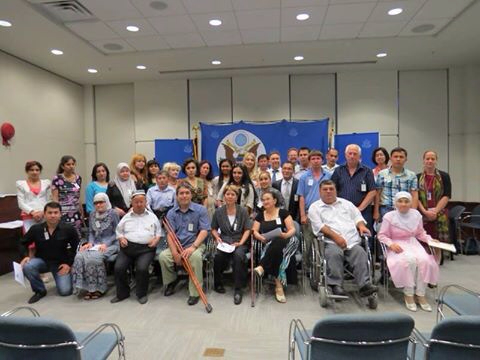


A couple of days ago I had the pleasure to lead a panel of American writers in a discussion at the American Embassy with Uzbek disability rights advocates about identity and imagination. This was a powerful experience for me on many levels. Perhaps the most significant thing was the challenging level of conversation we had with people with disabilities from Tashkent. One man wanted to know why the US Senate refused to ratify the UN charter on the rights of people with disabilities. I told him that there was widespread outrage about this in America and the issue isn’t over. But still they wanted to know why. Sitting in the embassy, facing an audience of people with many types of impairments I felt embarrassed for my country, embarrassed because by voting down the simple ratification of the treaty the Senate abandoned people with disabilities around the world, both literally and figuratively. They asked me a second time how this could happen and I had to explain the hostility that certain hard line politicians have about the United Nations. As the poet Theodore Roethke said: “such waltzing was not easy” and I wanted Jim DeMint in that room so he might see with his own eyes what American exceptionalism costs in the global village.


Grieving Across the Lines

News that an immigration bill has passed committee in the senate by tabling immigration rights for same sex couples is devastating. There is, of course, no reason to prohibit people from immigrating according to sexual orientation–it’s as absurd as blocking people because of their height. Senators (even in these despicable times) wouldn’t dream of an overt prohibition on people who are 5’2″.

I have always known that as a person with a disability I’d have been thrown out at Ellis Island. I’m sad for my gay and Latino brothers and sisters.

Consider the Able Bodied

Here comes a man who’s unaware he’s a hominid. We may forgive him as he’s wearing a New York Yankees tee shirt. The shirt says he likes the bodies of others, envies them, and accordingly he scarcely thinks of his own corporeality–why bother, there’s nothing special about him, as he would surely tell you if you asked the right question. Right now we’re not asking. Consider the pure play of his “nothing-special-going-nowhere-unconscious” shuffle. He’s able bodied, vaguely determined, unathletic, inchoate in his thinking, and largely without ambulatory suspicions. You might say he’s a dufus. I think I like him. He’s just another of God’s creatures.

Back in the 19th century, when “normal” bodies became a commodity, when Britain and America were first industrialized and needed lots of indistinguishable dufus men to run the spindles, the great scientists decided to manufacture dufus men. You can look it up–check out the Disability Studies Reader–but the point is that unassuming, dull, standardized, “mean” bodies were suddenly absolutely necessary for the factories. There must be no one too tall or too short; no one too bright or too dull. “How do we get lots of dufus men?” asked the great ones, the Charles Babbages and Jeremy Benthams and Alexander Graham Bells.

Eugenics of course. Selective breeding. Improvement of the working stock. Forget Hitler, all the nationalistic jingo about good worker bees and bad bees started with the Anglo-American push for factory fodder. This is pretty well known stuff but consider the normative, able bodied dufus more than a century later. Look at him with his “one size fits all” portable lifestyle, the yurt of his standardized imagination. Poor dufus! He’s a turtle with a Madison Avenue shell. And because he’s a cog he’s certainly going to want to invest in his own cogness. “Cogness, ergo sum”, “in cog we trust”.

When I see a dufus wearing his dufus duds I feel rather inspired. Look at him! He’s really doing the very best he can.

Talking and Walking the Silk Road

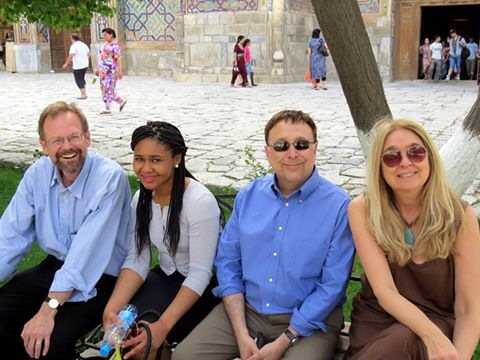
The photograph below shows from left to right, poet Christopher Merrill, fiction writer Chinelo Okperanta, yours truly, and novelist Ann Hood. It was taken in the ancient city of Samarkand where we spoke to young people at the local language institute and toured the glorious and historic centers of Muslim learning and worship. Walking the paving stones and navigating rough hewn stairs with the help of my friends I thought of how spiritual life, momentum, faith, and words frame our every step, how walking with the help of friends and a few clear well chosen words makes life possible.


Talk to Me, Just Talk

Today I will be speaking to people with disabilities here in Uzbekistan at an event sponsored by the US Embassy. I’ve been thinking about one of the global dynamics of disability–the averted eye and whispering associated with physical difference. In many parts of the world blindness is still imagined to be caused by spiritual forces or worse, is thought to be a product of sorcery. At home in the United States I’ve had people block my way on the street and insist on praying for me. Sometimes I let them do it, sometimes I don’t.

As time goes by and my travels accrue I see the solution–the response–has to do with lingo. You can’t be put in a closet if you are singing.

Hello! What Are You Doing Here?

I like this paragraph from the Stanford Encyclopedia of Philosophy:

It is in the social construction of disability that we move from the particularity of any one disability toward the common social experiences of people with disabilities. Stigma, discrimination, and imputations of difference and inferiority are all parts of the social experience of disability. Being greeted at a party or a conference not by “hello” but by “do you need any help?” and having virtually every aspect of one’s interests, tastes, and personality attributed to one’s disability are also parts of the disability experience. As one writer describes it, if he cooks it is because he doesn’t want to be seen in public; if he eats in restaurants it is because he can’t cook (Brickner, 1976). Disability becomes a “master status,” preventing people from playing any adult social role and eclipsing sex, race, age, occupation, or family (Goffman, 1963; Gliedman and Roth, 1980). Many nondisabled people assume that people with disabilities won’t make good partners and cannot or should not become parents (Safilios-Rothschild, 1970; Shakespeare, 1996; Asch and Fine, 1988; Wates, 1997). People with disabilities are perceived to be globally helpless based on their need for assistance with some facets of daily life (Wright, 1983), fueling the conviction that they are unable to render the help needed for successful partnership or parenting. Most nondisabled people, after all, are not told that they are inspirations simply for giving the correct change at the drugstore. Perhaps there would not even be a “disability experience” in a world without the daily indignities, barriers, and prejudices that characterize life with disability almost anywhere.


Silk Road, White Cane

Traveling blind involves a terrifying sense of immanence: even a casual walk through an unfamiliar airport can produce, at least in me, a small vertigo. In the Istanbul airport I found my white cane, that universal emblem of blindness, produced no cautious response. I was pushed, shoved, bumped, and in some cases walked over by travelers impatient and hustling to their flights. I felt like I was walking a thin ledge.

**

White cane incident: in Taskent, visiting the Writer’s Union, the tip of my cane got trapped in the elevator door. I let go. It stood straight out, horizontal, caught in the closed mechanism. Several men shouted in Uzbek. Embarrassing international incident in south Central Asia. Three men attempted to pry the door open and succeeded in freeing my stick. The whole thing was vaguely Freudian in a quasi utilitarian way.

**

Heading to Samarkand on the fast train. Going to a place of turquoise domes! Capital of the ancient Silk Road! Capital of the silk empire. I wonder about the blind who surely recited stories in the old city. I will ask my writer hosts about this.

Random thought: Spinoza, had he been acquainted with Darwin, would have relegated the idea of god to a minor category of thought. Darwin explains unlike ness.

Azam Abidov, Uzbek poet tells me there was a tradition of blind story tellers in Samarkand. I want to find out about them and honor their spirits.

Sweet black coffee on the train. A small cardboard container of orange juice named “Bliss”.

Last night the Russian speaking poets of Taskent hosted us American writers at the Sergei Yesinin museum and writing center. Was pleased to see Yesenin had a Victrola and some Caruso records. Od course Yesenin loved music. Was married for a time to Isadora Duncan. I pictured them dancing together to opera records.

A local poet, Russian speaking, who vaguely resembled Frank Zappa played his acoustic guitar and sang a devotional song in memory of Yesenin. The poetry of earth is never dead.

Helpful strangers clutch at me as if I might break with every step.

Random thought number two:

Be it resolved the future is slippery. A man on the street corner reads the entrails of birds. All his happiness is contained by sinister forces of blood and feathers. When you see him he looks like a banker: business suited, vaguely efficient. But the bird intestines have him, they are his true religion, even though he’s never touched a bird, never captured a crow in a trap. The future is wet. Be it resolved the wet pages of the calendar are the oldest devotional book. Be it resolved birds can never fly fast enough.


Silk Road, White Cane

Traveling blind involves a terrifying sense of immanence: even a casual walk through an unfamiliar airport can produce, at least in me, a small vertigo. In the Istanbul airport I found my white cane, that universal emblem of blindness, produced no cautious response. I was pushed, shoved, bumped, and in some cases walked over by travelers impatient and hustling to their flights. I felt like I was walking a thin ledge.

**

White cane incident: in Taskent, visiting the Writer’s Union, the tip of my cane got trapped in the elevator door. I let go. It stood straight out, horizontal, caught in the closed mechanism. Several men shouted in Uzbek. Embarrassing international incident in south Central Asia. Three men attempted to pry the door open and succeeded in freeing my stick. The whole thing was vaguely Freudian in a quasi utilitarian way.

**

Heading to Samarkand on the fast train. Going to a place of turquoise domes! Capital of the ancient Silk Road! Capital of the silk empire. I wonder about the blind who surely recited stories in the old city. I will ask my writer hosts about this.

Random thought: Spinoza, had he been acquainted with Darwin, would have relegated the idea of god to a minor category of thought. Darwin explains unlike ness.

Azam Abidov, Uzbek poet tells me there was a tradition of blind story tellers in Samarkand. I want to find out about them and honor their spirits.

Sweet black coffee on the train. A small cardboard container of orange juice named “Bliss”.

Last night the Russian speaking poets of Taskent hosted us American writers at the Sergei Yesinin museum and writing center. Was pleased to see Yesenin had a Victrola and some Caruso records. Od course Yesenin loved music. Was married for a time to Isadora Duncan. I pictured them dancing together to opera records.

A local poet, Russian speaking, who vaguely resembled Frank Zappa played his acoustic guitar and sang a devotional song in memory of Yesenin. The poetry of earth is never dead.

Helpful strangers clutch at me as if I might break with every step.

Random thought number two:

Be it resolved the future is slippery. A man on the street corner reads the entrails of birds. All his happiness is contained by sinister forces of blood and feathers. When you see him he looks like a banker: business suited, vaguely efficient. But the bird intestines have him, they are his true religion, even though he’s never touched a bird, never captured a crow in a trap. The future is wet. Be it resolved the wet pages of the calendar are the oldest devotional book. Be it resolved birds can never fly fast enough.