Grieving Across the Lines

News that an immigration bill has passed committee in the senate by tabling immigration rights for same sex couples is devastating. There is, of course, no reason to prohibit people from immigrating according to sexual orientation–it’s as absurd as blocking people because of their height. Senators (even in these despicable times) wouldn’t dream of an overt prohibition on people who are 5’2″.

I have always known that as a person with a disability I’d have been thrown out at Ellis Island. I’m sad for my gay and Latino brothers and sisters.

Consider the Able Bodied

Here comes a man who’s unaware he’s a hominid. We may forgive him as he’s wearing a New York Yankees tee shirt. The shirt says he likes the bodies of others, envies them, and accordingly he scarcely thinks of his own corporeality–why bother, there’s nothing special about him, as he would surely tell you if you asked the right question. Right now we’re not asking. Consider the pure play of his “nothing-special-going-nowhere-unconscious” shuffle. He’s able bodied, vaguely determined, unathletic, inchoate in his thinking, and largely without ambulatory suspicions. You might say he’s a dufus. I think I like him. He’s just another of God’s creatures.

Back in the 19th century, when “normal” bodies became a commodity, when Britain and America were first industrialized and needed lots of indistinguishable dufus men to run the spindles, the great scientists decided to manufacture dufus men. You can look it up–check out the Disability Studies Reader–but the point is that unassuming, dull, standardized, “mean” bodies were suddenly absolutely necessary for the factories. There must be no one too tall or too short; no one too bright or too dull. “How do we get lots of dufus men?” asked the great ones, the Charles Babbages and Jeremy Benthams and Alexander Graham Bells.

Eugenics of course. Selective breeding. Improvement of the working stock. Forget Hitler, all the nationalistic jingo about good worker bees and bad bees started with the Anglo-American push for factory fodder. This is pretty well known stuff but consider the normative, able bodied dufus more than a century later. Look at him with his “one size fits all” portable lifestyle, the yurt of his standardized imagination. Poor dufus! He’s a turtle with a Madison Avenue shell. And because he’s a cog he’s certainly going to want to invest in his own cogness. “Cogness, ergo sum”, “in cog we trust”.

When I see a dufus wearing his dufus duds I feel rather inspired. Look at him! He’s really doing the very best he can.

Talking and Walking the Silk Road

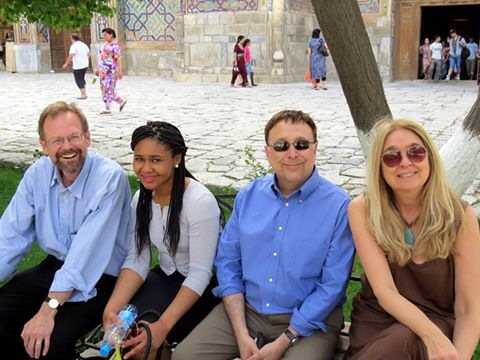
The photograph below shows from left to right, poet Christopher Merrill, fiction writer Chinelo Okperanta, yours truly, and novelist Ann Hood. It was taken in the ancient city of Samarkand where we spoke to young people at the local language institute and toured the glorious and historic centers of Muslim learning and worship. Walking the paving stones and navigating rough hewn stairs with the help of my friends I thought of how spiritual life, momentum, faith, and words frame our every step, how walking with the help of friends and a few clear well chosen words makes life possible.


Talk to Me, Just Talk

Today I will be speaking to people with disabilities here in Uzbekistan at an event sponsored by the US Embassy. I’ve been thinking about one of the global dynamics of disability–the averted eye and whispering associated with physical difference. In many parts of the world blindness is still imagined to be caused by spiritual forces or worse, is thought to be a product of sorcery. At home in the United States I’ve had people block my way on the street and insist on praying for me. Sometimes I let them do it, sometimes I don’t.

As time goes by and my travels accrue I see the solution–the response–has to do with lingo. You can’t be put in a closet if you are singing.

Hello! What Are You Doing Here?

I like this paragraph from the Stanford Encyclopedia of Philosophy:

It is in the social construction of disability that we move from the particularity of any one disability toward the common social experiences of people with disabilities. Stigma, discrimination, and imputations of difference and inferiority are all parts of the social experience of disability. Being greeted at a party or a conference not by “hello” but by “do you need any help?” and having virtually every aspect of one’s interests, tastes, and personality attributed to one’s disability are also parts of the disability experience. As one writer describes it, if he cooks it is because he doesn’t want to be seen in public; if he eats in restaurants it is because he can’t cook (Brickner, 1976). Disability becomes a “master status,” preventing people from playing any adult social role and eclipsing sex, race, age, occupation, or family (Goffman, 1963; Gliedman and Roth, 1980). Many nondisabled people assume that people with disabilities won’t make good partners and cannot or should not become parents (Safilios-Rothschild, 1970; Shakespeare, 1996; Asch and Fine, 1988; Wates, 1997). People with disabilities are perceived to be globally helpless based on their need for assistance with some facets of daily life (Wright, 1983), fueling the conviction that they are unable to render the help needed for successful partnership or parenting. Most nondisabled people, after all, are not told that they are inspirations simply for giving the correct change at the drugstore. Perhaps there would not even be a “disability experience” in a world without the daily indignities, barriers, and prejudices that characterize life with disability almost anywhere.


Silk Road, White Cane

Traveling blind involves a terrifying sense of immanence: even a casual walk through an unfamiliar airport can produce, at least in me, a small vertigo. In the Istanbul airport I found my white cane, that universal emblem of blindness, produced no cautious response. I was pushed, shoved, bumped, and in some cases walked over by travelers impatient and hustling to their flights. I felt like I was walking a thin ledge.

**

White cane incident: in Taskent, visiting the Writer’s Union, the tip of my cane got trapped in the elevator door. I let go. It stood straight out, horizontal, caught in the closed mechanism. Several men shouted in Uzbek. Embarrassing international incident in south Central Asia. Three men attempted to pry the door open and succeeded in freeing my stick. The whole thing was vaguely Freudian in a quasi utilitarian way.

**

Heading to Samarkand on the fast train. Going to a place of turquoise domes! Capital of the ancient Silk Road! Capital of the silk empire. I wonder about the blind who surely recited stories in the old city. I will ask my writer hosts about this.

Random thought: Spinoza, had he been acquainted with Darwin, would have relegated the idea of god to a minor category of thought. Darwin explains unlike ness.

Azam Abidov, Uzbek poet tells me there was a tradition of blind story tellers in Samarkand. I want to find out about them and honor their spirits.

Sweet black coffee on the train. A small cardboard container of orange juice named “Bliss”.

Last night the Russian speaking poets of Taskent hosted us American writers at the Sergei Yesinin museum and writing center. Was pleased to see Yesenin had a Victrola and some Caruso records. Od course Yesenin loved music. Was married for a time to Isadora Duncan. I pictured them dancing together to opera records.

A local poet, Russian speaking, who vaguely resembled Frank Zappa played his acoustic guitar and sang a devotional song in memory of Yesenin. The poetry of earth is never dead.

Helpful strangers clutch at me as if I might break with every step.

Random thought number two:

Be it resolved the future is slippery. A man on the street corner reads the entrails of birds. All his happiness is contained by sinister forces of blood and feathers. When you see him he looks like a banker: business suited, vaguely efficient. But the bird intestines have him, they are his true religion, even though he’s never touched a bird, never captured a crow in a trap. The future is wet. Be it resolved the wet pages of the calendar are the oldest devotional book. Be it resolved birds can never fly fast enough.


Silk Road, White Cane

Traveling blind involves a terrifying sense of immanence: even a casual walk through an unfamiliar airport can produce, at least in me, a small vertigo. In the Istanbul airport I found my white cane, that universal emblem of blindness, produced no cautious response. I was pushed, shoved, bumped, and in some cases walked over by travelers impatient and hustling to their flights. I felt like I was walking a thin ledge.

**

White cane incident: in Taskent, visiting the Writer’s Union, the tip of my cane got trapped in the elevator door. I let go. It stood straight out, horizontal, caught in the closed mechanism. Several men shouted in Uzbek. Embarrassing international incident in south Central Asia. Three men attempted to pry the door open and succeeded in freeing my stick. The whole thing was vaguely Freudian in a quasi utilitarian way.

**

Heading to Samarkand on the fast train. Going to a place of turquoise domes! Capital of the ancient Silk Road! Capital of the silk empire. I wonder about the blind who surely recited stories in the old city. I will ask my writer hosts about this.

Random thought: Spinoza, had he been acquainted with Darwin, would have relegated the idea of god to a minor category of thought. Darwin explains unlike ness.

Azam Abidov, Uzbek poet tells me there was a tradition of blind story tellers in Samarkand. I want to find out about them and honor their spirits.

Sweet black coffee on the train. A small cardboard container of orange juice named “Bliss”.

Last night the Russian speaking poets of Taskent hosted us American writers at the Sergei Yesinin museum and writing center. Was pleased to see Yesenin had a Victrola and some Caruso records. Od course Yesenin loved music. Was married for a time to Isadora Duncan. I pictured them dancing together to opera records.

A local poet, Russian speaking, who vaguely resembled Frank Zappa played his acoustic guitar and sang a devotional song in memory of Yesenin. The poetry of earth is never dead.

Helpful strangers clutch at me as if I might break with every step.

Random thought number two:

Be it resolved the future is slippery. A man on the street corner reads the entrails of birds. All his happiness is contained by sinister forces of blood and feathers. When you see him he looks like a banker: business suited, vaguely efficient. But the bird intestines have him, they are his true religion, even though he’s never touched a bird, never captured a crow in a trap. The future is wet. Be it resolved the wet pages of the calendar are the oldest devotional book. Be it resolved birds can never fly fast enough.


What We Owe

What We Owe

By Andrea Scarpino

My mother told me this story when I called her on Mother’s Day: she slid open the backyard’s glass door, and the cat ran inside with a cardinal in her mouth. She cornered the cat in the laundry room, and was able to pry the cardinal free. The bird seemed wounded or in shock—it wasn’t moving, although it was clearly alive—so she stroked its head and spoke softly to it before putting it outside on the deck table. She went back into the house and when she looked out again, she saw another cardinal had joined it. Its mate maybe, its friend. The second cardinal stood next to the first on the table, seemed to be nudging it with its head; offering comfort, my mother imagined. Protection maybe. Finally, after almost an hour, they flew off, one after the other.


What we owe one another: presence. Two bodies instead of one. How we care for one another: as best as we are able.


“We’re going to have to hold one another’s hands and walk through this together,” my friend and colleague Nancy said. Our Associate Dean has just died, and with her an incredible dedication, an incredible wealth of knowledge. The university where we teach is changing. The ground feels like it’s shifting under me. I don’t have enough time each day to accomplish what I need to accomplish. I struggle to sit quietly.


Before my brother was born, my mother and I played Mama Bird and Baby Bird in her bed each morning. She was the Mama Bird, and she would feed me worms from her pinched fingertips. I would chirp under the covers, her bed a huge nest. When I visited my father, I would climb into my grandmother’s bed each morning and chatter away before we went downstairs for breakfast. “Girl talk,” she called our mornings together. “We’re just having some girl talk,” she would tell my father.


When I am overwhelmed, I often retreat to my bed. My partner Zac comes and lies with me, lets me rest my head on his chest. He makes me elaborate dinners, indulges my fascination with silly reality TV. Yesterday, he spent two hours scanning documents that I need to teach next semester.


What we owe one another: time to talk and listen. Time to sit quietly. How we care for one another: by being present. By giving of ourselves what we can.


Disability in Neo-Liberal America

An article in today’s New York Post, that deleterious rag, offers the provoking headline: “Rich Manhattan Moms Hire Handicapped Tour Guides so Kids Can Cut Lines at Disney World”. Gotcha! By God! What a scandal! Something’s rotten in the Magic Kingdom! I smell perfervid mendacity and liniment. Christ! I’m about to faint. And then I read: “Some wealthy Manhattan moms have figured out a way to cut the long lines at Disney World — by hiring disabled people to pose as family members so they and their kids can jump to the front, The Post has learned.”  “Hortense, get the smelling salts! The cripples are conning Minnie and Mickey! Help, Hortense, I have the vapors!” 

Yep, there’s some real investigative journalism. Forget the dubious claim that people with disabilities are posing as family members–it might actually be true, but let’s be clear–the tour guide in question who uses a wheel chair, has the right to earn an honest living. If her wheelchair gets her and her charges to the head of a line, well, whoop dee do. The article is piffle, jazzed up, electrified, powered by the oldest ableist outrage of them all–the notion that there are people faking disability.

But on the other hand, a wheel chair using tour guide has a right to work. Period. Who says there’s a real scandal? Judge for yourselves. I think the reporting is rather weak when it comes to supporting its claims. All of which leads me to my point: there’s a lot of able bodied outrage going on right now in the US. It’s all over the place. The cripples are getting all kinds of advantages. Whether the source is NPR or Planet Money or creepy editorials arguing that children with learning disabilities are amateur criminals tricking school systems into giving them unwarranted accommodations–the list is legion and growing. 

The Post? Not a reliable source when it comes to disability. Trust me.