Whose Closet Are You In?

A legendary guide dog trainer once told me about finding a blind man who’d hidden himself in a closet on a Sunday afternoon. Guide dog schools are residential places with dormitories and shared meals. Blind people work with dogs and trainers six days a week. But on Sunday there’s leisure time and visitors often come, either to see students or, as is sometimes the case, have a guided tour of the school. But at the end of the day a student was missing. Trainers and housekeepers looked for him everywhere, and finally they found the man hiding in the closet of his room. “Why are you hiding in the closet?” they asked. “Because,” said the blind man, “this is where they tell me to go when visitors come.”

via www.planet-of-the-blind.com

I first understood the neo-liberal closet when I appeared on Oprah…

Whose Closet Are You In?


A legendary guide dog trainer once told me about finding a blind man who’d hidden himself in a closet on a Sunday afternoon. Guide dog schools are residential places with dormitories and shared meals. Blind people work with dogs and trainers six days a week. But on Sunday there’s leisure time and visitors often come, either to see students or, as is sometimes the case, have a guided tour of the school. But at the end of the day a student was missing. Trainers and housekeepers looked for him everywhere, and finally they found the man hiding in the closet of his room. “Why are you hiding in the closet?” they asked. “Because,” said the blind man, “this is where they tell me to go when visitors come.”


Now closets are strange things for they have heartless architectures. The Catholic confessional and rooms with moth balls are alike as their builders assume true suffering or joy occur elsewhere. If a man or woman is in a closet, he or she is reverently, passionately waiting for something else as Auden would say. If a man or woman builds his or her own closet, it’s for reactionary pleasures or meditations, which means its a superscription for suffering. Most agree closets are worth getting out of. But listen, you can hear the hammers in every quarter: people building closets. Old industries don’t die easily, especially when there are plenty of complicit sufferers and architects around. 


Say what you like about closets, they have unhappy histories. Nevertheless, from a Disability Studies standpoint, there are real closets and metaphorical ones and if you’re crippled you better know the difference. One might even argue you should know the history of closets. An “armoire” was where the knight kept his armor and a chiffonier was a wardrobe for the storing of scraps of cloth–furniture for rag pickers. The chiffonier was also the place where servants could have sex. The history of stand alone closets is tawdry. The semiotics of the chiffonier are ugly. If you’ve read To Kill a Mockingbird you know the chifferobe. Like the ark of the covenant its something you shouldn’t touch.  


**


The metaphorical closet is the one we’re concerned with. Who tells you to hide there? In Disability Studies we say the Industrial Revolution sent cripples to real closets and Jeremy Bentham and Charles Babbage helped launch eugenics and voila, next you’ve got asylums. The Victorian age also launched home built closets and these continue to exist all over the world. In the film “Scent of a Woman” we first see Al Pacino as a blind veteran living in a darkened apartment attached to a garage, a home built closet familiar to disability history. People with disabilities are hidden away all over the world and make no mistake about it, there’s a solid economic determinism behind every single instance.   


Bad is this may be, there’s something worse: the quasi-aleatoric machinery that turns real closets into metaphorical ones. The machine looks like its operating by chance which is the devilish thing about it. Chief Bromden, a principle character in Ken Kesey’s iconic novel about mental illness “One Flew Over the Cuckoo’s Nest” sees this thing and calls it the “combine”. Kesey presents the machine as though its a hallucination–a likely scenario in mental hospitals in the 1950’s as patients were in fact given LSD for many sinister reasons. The Chief sees the machine turning real closets into metaphorical ones through the language of the medical cure industry. 


“This is what I know. The ward is a factory for the Combine. It’s for fixing up mistakes made in the neighborhoods and in the schools and in the churches, the hospital is. When a completed product goes back out into society, all fixed up good as new, better than new sometimes, it brings joy to the Big Nurse’s heart; something that came in all twisted different is now a functioning, adjusted component, a credit to the whole outfit and a marvel to behold. Watch him sliding across the land with a welded grin, fitting into some nice little neighborhood where they’re just now digging trenches along the street to lay pipes for city water. He’s happy with it. He’s adjusted to surroundings finally….”


**


Nowadays, what with neo-liberalism the closet has a picture window which means you’re disabled difference is perfectly ok provided there’s a profit in it. 


The metaphorical closets of neo-liberal capitalism are trickier than those built by Victorians because they require complicity with commodification–each model of difference is for sale nowadays. In the era of self-promotion what this means is that you “are” your closet–the individualized and sustaining “fixed up as good as new, better than new sometimes” portable difference machine. 


But don’t forget my premise: all closets have heartless architectures. Nowadays it’s not enough to “overcome” a disability–one must be singularly heroic, non-inspirational, vaguely anti-communitarian, and above all else, “sellable”–Aimee Mullins on the Today Show comes to mind. The metaphorical closet equals corporate capital. Corporate capital likes differences that can be appropriated and contained for profit. 


The best book on this subject is Robert McRuer’s Crip Theory: Cultural Signs of Queerness and Disability


Who produces value? What performative roles of physical difference convey utility? How complicit are you in the construction of your metaphorical closet? Why do these questions matter? The short answer is that neo-liberalism’s models of difference are concerned with containments and that even rebellion is commodifiable. Worse, selling your difference is now an expectation.


Which returns us to the lonely matter of closets. It is a far better thing to claim you’re a metonymy for freedom than to say you “are” freedom.  


In Praise of Big Pictures

Speaking of biographers and the writing of biographies Jacques Derrida once said: 


“We should not neglect the fact that some biographies written by people who have authority in the academy finally invest this authority in a book which—for centuries sometimes—after the death of an author represent the truth, “the truth.” Someone interested in biography writes a life, “life and works” . . . well documented, apparently consistent, and it’s the only one published by—under the authority of—a good press. And then . . . his life image is fixed and stabilized for centuries. That’s why I would say that the one who reads a text by a philosopher, for instance a tiny paragraph, and interprets it in a rigorous, inventive, and powerfully deciphering fashion is more of a real biographer than the one who knows the whole story.” 


This is a disarmingly solipsistic view of culture of a kind one might expect from Derrida and which helps to explain why Paul DeMann’s fascism was so easily overlooked throughout the American academy. The “whole story” is as much an interpretive and political act as reading a good paragraph with a jeweler’s loop. 


Which do you prefer as a reader? Must I have a preference? May I please read Wordsworth’s “Resolution and Independence” and still crave knowing the history of his autodidacticism? 


What is it about postwar 20th century French intellectuals that they would splice apprehension so easily? One reason is that deconstruction’s fundamental assertions about language depend on a reified notion of the analytic process. The other? Its the oldest story of them all–a man has something to hide. 


I prefer “big candor” and analytic philosophy to Derridean attacks on authority. And guess what? I can do this without being bourgeois. Why? Because I believe reality is composed of the true objects of our acquaintance. I’m still a peasant. 


The Dog Who Loves You

The dog who loves you turns up in your dreams. Last night she was a woman on a train who said her name was “Evensong” (I kid you not) and she was old and dignified. The dog who loves you is part of your soul (I kid you not) and she insists that mirth never dies. That is, as they say, how things stand. Carl Jung had it wrong: the anima or animus is the dog who loves you; the one who first loved you; who loves you now. Sorry Yeats, here’s how the poem should go: 


“Young man lift up your russet brow,

And lift your tender eyelids maid,

And brood on dogs and dogs who love…”


I only like Odysseus because of his dog. 

I’m suspicious of men who walk their dogs while wearing business suits–Nixon.

I feel great empathy for people who know nothing about dogs but want one anyway, as they haven’t given up on the soul.


Jesus didn’t have a dog which is a red flag. 

Mohammed had hundreds of doggie hang ups.

Buddha had an open heart but only insofar as the dog stood for reincarnation. Silliness. Dogs know we don’t come back. That’s why they live for the moment.

Dogs in Judaism–well, the Old Testament isn’t pretty.

Dogs in Hinduism–keep them away from altars and weddings…


Dogs are the perfect antidote to religion–they have empathy. 


Here’s to the avenue of dogs, the one inside and the one before you. 


Spring Cleaning in the Cave of Making

I’ve spent the day puzzling over the intersections of reason and mysticism in my life–perhaps the exercise is like spring cleaning. I’m straightening up the Cave of Making. 


Nowadays I’ve more affection for intersections of contrarian and comic ironies than in my twenties. I went to college in the last days of the Vietnam War and was hotly pissed at imperial America, the invulnerable fascism of Kissinger, and inclined to admire Dadaists. I agreed with Mallarme’s assertion that newspapers are only fit for wrapping fish. I still feel these things.


But to recollect means savoring and if self awareness has value it brings to light satisfactions larger than the individual. And long ago, reading in the college library, I saw Bertrand Russell was right to say philosophy is the intersection of mysticism and science. In a primitive way I figured thinking might, insofar as I was capable of it, comprise both scientific doubts and intuition’s hopes. I saw early on that I wanted to remain angry and doubtful–as Neruda would say, “fully empowered” but that one also needs Carl Jung’s oceanic unconscious. 


If you have a disability you know a lot about abjection and the acculturated marginalizing of physical differences. You also know irony. And you start to ask questions. You say things like: “Well if Jesus could cure a blind man, why didn’t he just get rid of blindness?” What’s a self-respecting man-god good for after all? Contrarian irony is a quality or caste of mind and ever since it was unlocked in me–unlocked quite early–I’ve been inordinately suspicious of cant. (For my blind readers that’s “cant” with a c and not with a k–though I have my suspicions about him as well.) 


Comic irony is different since its a reactive brand of thinking–less suspicious perhaps. It’s the faculty you want if you’ve made an ass of yourself and hope to profit by it. It’s one of the ingredients of humility, though not in a Christian sense, its more the humility that comes because you’ve made a discovery by accident. There are other ingredients of humility, most of them appear in the Dhamapada. Comic irony is a good start. 


But these qualities of thought are necessary beyond reason and if you tend to an affection for mysticism, to believe things are more mysterious than dear science supposes, you will need them all the more. What after all is worse than the humorlessness of the devout? And if organized religion gives you pause, the disorganized ones, all the New Age industries are almost entirely without irony. In my memoir “Eavesdropping” I wrote about a “fire walker” who proposed he could heal my blindness at his desert ranch if only I put aside my fears and walked across the hot coals. He was so insufficiently ironic he was predatory. But what about spiritual hope? 


You take your shoes off to enter a temple. I take off my rational thought shoes, tell myself the moon and birch are brothers. These are two examples of inspiration’s hopes. Both are concerned with the mindfulness of the earth itself. Doubt may “will out” but not with my permission. 


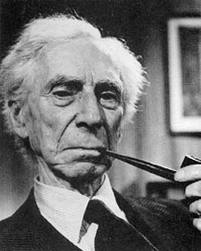
And that pesky Bertrand Russell again:


My conclusion is that there is no reason to believe any of the dogmas of traditional theology and, further, that there is no reason to wish that they were true. Man, in so far as he is not subject to natural forces, is free to work out his own destiny. The responsibility is his, and so is the opportunity.


Dreaming of Deliberate Reason

NewImage


I dreamt last night of Bertrand Russell. The furniture was outdoors. We spoke of the uselessness of war. A good dream, without the false neo-liberal moue of disgust at positivism. 


“In America everybody is of the opinion that he has no social superiors, since all men are equal, but he does not admit that he has no social inferiors, for, from the time of Jefferson onward, the doctrine that all men are equal applies only upwards, not downwards.”

With no social inferiors in the public’s imagination the Cato Institute would be out of business. 

Nowadays America is the land of expert marginalization. Perhaps we could call it the marginalization-industrial-complex. Academics contribute to this by sanctioning separatist nomenclatures, usually in the name of identity politics. This is the principle failure of neo-liberalism in higher education. Meanwhile the poor get poorer and medicare dependent cancer patients are deprived of treatments under sequestration. Make no mistake: sequestration is a policy and not a bargaining chip. The politics of all men are created equal applies only upwards. 

“The man who has no tincture of philosophy goes through life imprisoned in the prejudices derived from common sense, from the habitual beliefs of his age or his nation, and from convictions which have grown up in his mind without the co-operation or consent of his deliberate reason. To such a man the world tends to become definite, finite, obvious; common objects rouse no questions, and unfamiliar possibilities are contemptuously rejected.”


National Federation of the Blind Comments on Amazon Kindle App


FOR IMMEDIATE RELEASE CONTACT: Chris Danielsen Director of Public Relations National Federation of the Blind (410) 659-9314, extension 2330 (410) 262-1281 (Cell) Cdanielsen@nfb.org Baltimore, Maryland (May 1, 2013): The National Federation of the Blind (NFB), the nation’s leading advocate for access to technology and education for the blind, commented today on Amazon’s incorporation of new accessibility features into its application for the iPhone and other devices using Apple’s iOS operating system. Dr. Marc Maurer, president of the National Federation of the Blind, said: “We are pleased that Amazon has taken advantage of the inherent accessibility of Apple products and Apple’s clear guidelines for creating accessible applications by finally releasing a version of its Kindle app that allows blind readers to access Kindle content on Apple devices. Continued improvement of this app is needed, however, in order to make it appropriate for use in educational settings, and Amazon must also make its Kindle devices fully accessible. Amazon should also make its future software, devices, and content available to the blind when these products are released to the general public rather than implementing accessibility at an unspecified later time. Today’s app release is a significant step on the journey to full access to Kindle content by the blind, but that journey is not over, and the National Federation of the Blind will not rest until its completion.” The National Federation of the Blind has advocated for full access to Kindle devices and Kindle e-books since Amazon introduced the Kindle. Most recently, NFB members staged an informational protest in front of Amazon’s Seattle headquarters to explain why Kindle e-books should not be used in schools because they do not provide equal access to all of the same information and features by both blind and sighted students. For more information on this issue, please visit http://www.nfb.org/kindle-books.

On the Advantages of Learning

There are many days when I feel the pull of the subconscious, little Kali with her necklace of skulls. “This is normal,” I tell myself. Something delicate–a doll’s chair breaks in my hand. “This is customary,” I say. I feel like a man trapped in a tool shed, fingering the bolts and broken tools. 


“Well,” I tell myselves, “We Got It Bad, and That Ain’t Good”. How about a nice, cold glass of logical positivism?” Little Kali hates this. Nature doesn’t like the Romantic idealization of nature. 


Etcetera.

Udacity, San Jose State, and Disability

An article in today’s New York Times by Tamar Levin “Colleges Adapt Online Courses to Ease Burden” describes the rapid rise of companies providing distance learning courses for colleges. As the number of students who are unprepared for college rise, and cutbacks to public education grow, the advent of new online course providers seems like a natural development and even, perhaps, an egalitarian one, for surely lowering the costs associated with the pursuit of a college degree is laudable.

But reading Levin’s article I found myself wondering if one of the highlighted companies now being contracted by San Jose State, (Udacity) has any provisions for assuring courses are accessible for students with disabilities. A quick look online reveals that Udacity currently is not accessible but, given its new state contract with San Jose State they’re vowing to become accessible. Once again a major academic institution has blundered into systemic digital ableism, a story that seems repeated ad nauseum. What precisely is it about digital environments that causes college administrators to abandon equal access to education?

The president of San Jose State is quoted by Ms. Levin as saying:

“We’re in Silicon Valley, we breathe that entrepreneurial air, so it makes sense that we are the first university to try this,” said Mohammad Qayoumi, the university’s president. “In academia, people are scared to fail, but we know that innovation always comes with the possibility of failure. And if it doesn’t work the first time, we’ll figure out what went wrong and do better.”

How does “entrepreneurial spirit” become a metaphor for ADA non-compliance? One answer lies in the country club nature of IT inside higher education–a provincialism which guarantees designers and engineers are insufficiently engaged with what we broadly call diversity and, in a stricter sense call compliance.