Consomme and Toast

When I was young I imagined a just and improvable world even though Bobby Kennedy was murdered in middle of the season of my innocence. Then Dr. King was murdered and my optimism was shaken by the first sorrows of a believer. The election of Richard Nixon was a crushing cultural moment and I wept in our suburban living room in Delmar, New York. I was only 13 when Nixon beat Humphrey. I remember being inconsolable. 


Because I am not a conspiracy theorist I’ve never believed in a concerted effort to destroy progressive values in the United States. I think JFK was killed by a chinless psychopath. Was the FBI involved? Yes, to the extent they covered up their own failures to keep tabs on Oswald. Was there CIA collusion? No. But it makes a good movie. 


What I do know about the war on progressive values is that it sustains itself on religious intolerance. The insistence by a sizable majority of Republican voters that President Obama is a Muslim is not a matter of there being an insufficiency of biographical material about the Obamas, but rather an adopted fundamentalist Christian canard that once properly fitted excuses hatred. 


As a 13 year old I’d have thought this makes sense–the bigoted and aggressive behavior of southern whites and the predatory and imperial war machinery that brought us Viet Nam were ubiquitous. 


So its as an older man that I feel the disappointment because there’s a truth drought now. I have taken heart from the occupy movement and the evident dismay at the rightward tilt that so many people are sharing. But I’m sickened by the lack of accountability in the public square, particularly in the fifth estate–public lies are not sufficiently scrutinized, or scrutinized at all. 


I’ve never seen a politician lie as much as Mitt Romney. To paraphrase the poet Robert Bly, he lies about the time the sun comes up. He lies about everything from the president’s record on the economy to his own positions. He lies in a kind of giggling fit. In the past, flagrant lying was called to account.   


Better analysis than mine abounds, and the genealogy of the corporate consolidation of the media and the cancerous growth of tabloid journalism both in print and on television are well documented. I remember arguing with a media studies professor almost twenty years ago because I said Neil Postman’s Amusing Ourselves to Death was unassailable in its thesis that a video-centric culture has overtaken a print literate society and accordingly critical thinking is in danger in the US. The film professor was caught up in the sexy ardor that many people felt for Picket Fences and she saw me as reactionary. Fox News was then in its infancy. 


So I go back and forth between overt panic over the state of our nation’s affairs and a sense of cautious hope. This is like seasickness but without the ship. On a ship they bring you consommé and toast. 
 

So much happens to the crows when fall comes–

the democracy of dying things is clear 

the indifference of daylight is torn

they watch without need.

Crows on the street, in grass

silent with harmony

I don’t know what to call it

talking to myself on the roof. 


Now and Then I Am Happy

Now and then I am happy and owing to the era in which I live I believe I ought to be able to explain this. That the impulse is a mistake doesn’t matter. I am the great great grandson of rationalists. I can explain to you how a lever works–I have always liked Archimedes–and I can also explain how the Roman aqueducts were built and therefore, by God I ought to be able to explain happiness.


In our present decade we’re advised that feelings of contentment or hopefulness are chemical products, and no doubt this is true. My feet are also chemical products and I see no reason to dispute the matter. The human brain is mostly carbon. So happiness is serotonin, dopamine, and electricity. This is certain. 


Gandhi said: “Happiness is when what you think, what you say, and what you do are in harmony.” 


Then I have to ask, does the happy work I perform come from chemicals or somewhere else? Are the words I cherish nothing more than hydrogen bonds? Sense and sensibility and their achievement are the major ingredients of happiness and consciousness is fueled by electrolysis but not fed by it. In other words, beauty is twice beauty when you’re awake. 


Of course I mean awake as Thoreau used the term. The man who is awake is richly alive and curious.


Happiness is curiosity.  Obscurity and music are resolvable with curiosity. This is what makes tyrants bite the rug: no one can take curiosity from you. 


There's Something About August

By Andrea Scarpino


In Marquette, the weather has begun to turn cool—cooler, at least, than I expect, barely 50 degrees this morning. The light is changing, growing darker earlier in the evening, and taking on a softer, less direct glow. The trees are getting ready to change colors—bursts of yellow leaves hide here and there among the green. There’s something about the end of August that makes me feel contemplative, as if my psyche’s inward turn mirrors nature’s gearing down from summer. 


The last August of his life, I wrote to David Citino, one of my mentors at Ohio State, about how I felt like I should be getting ready to go back to school, should be drinking apple cider and eating donuts. He replied that late August reminded him of corduroy pants and a new lunchbox. And I remember thinking, yes. Exactly. So late August is here again, and I’m feeling contemplative, feeling like I need a new pair of corduroys, feeling like I should take advantage of every moment of sunlight while it lasts, feeling like I should get ready for new teachers, another year of learning. 


My dear friend Carrie visited this weekend from Wisconsin. We talked poetry, Olympics, our various animals, drank beer, ate Thai food. We walked around Marquette’s abandoned orphanage, a five-story red sandstone building with plywood boards across the windows. We tried to find a way in, but found graffiti and some abandoned mattresses instead. We hiked along Lake Superior, went to the farmers’ market, bought new clothes, sat in my living room. 


To me, at least, it was the perfect end-of-August visit, the perfect way to wrap up the summer, to move into autumn’s particularities. I know there is still some summer left—later in the week, the temperature is supposed to rise to the high 70s again. But there’s a definite change in the air, a shifting of light. A definite move away from summer’s noisy abundance into the quieter, more contemplative autumn. And I’m beginning to realize I welcome it. 


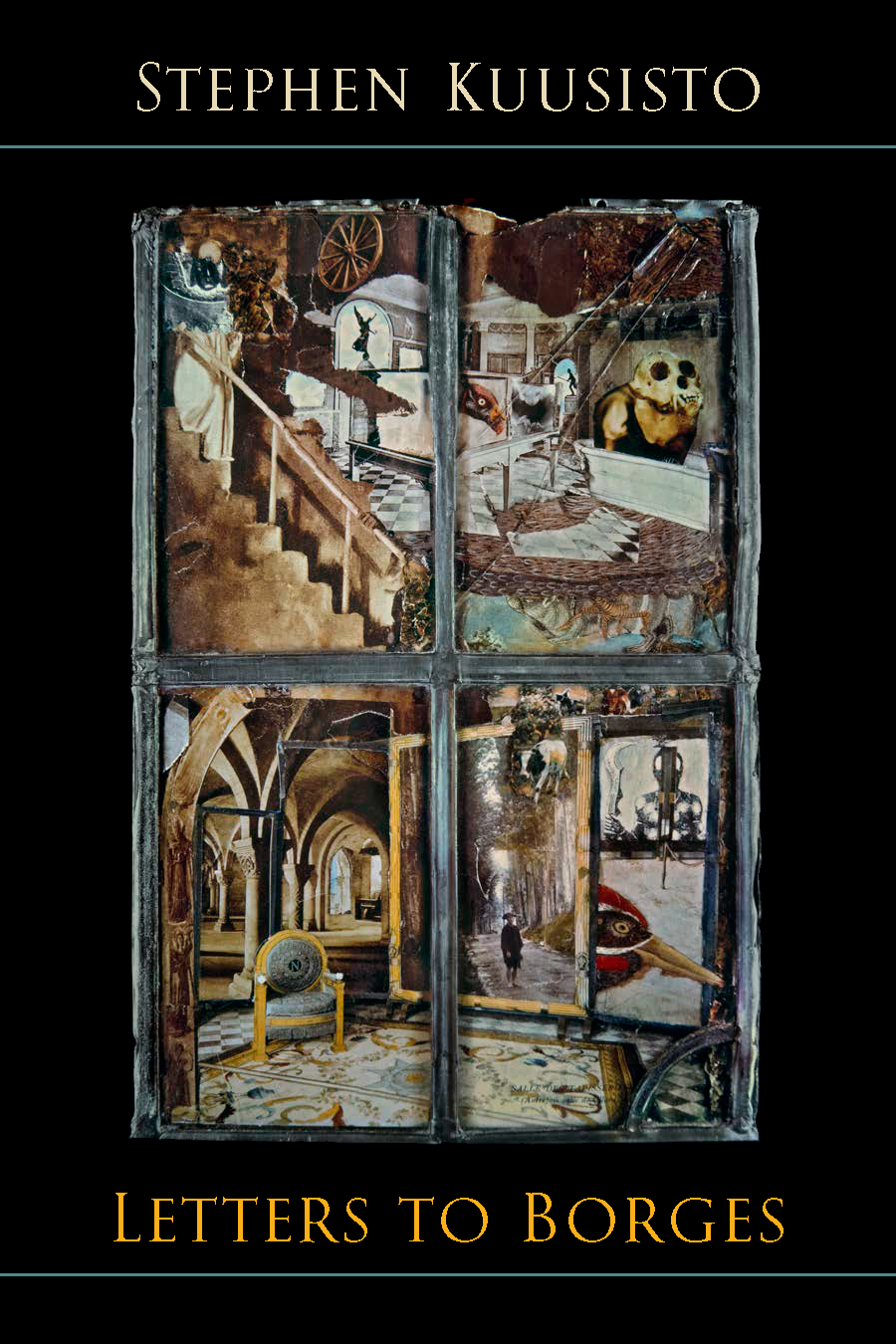
Cover Image: "Letters to Borges" forthcoming from Copper Canyon Press

KuusistoCoverImage


The cover image is like a series of boxes by Joseph Cornell–each box like the mullion of a window. The effect of the respective landscapes is surreal, skulls, birds, arm chairs, gothic hallways, stars that are like the staris in dreams going ever upward…

Coffee, Oranges, Sunny Chair


In the morning I smoke an imaginary cigarette, return to youth, recall a certain girl.

By noon I’m taller or shorter according to the witches of memory,

We are at the mercy of magic, don’t laugh. Outside, high in the oak

A black squirrel raises an acorn in its paws.

Though I am sad, I honor innocence, 

Soft cousin of appetite,

The one with weak eyes.

Autumn, Finland, Poetry and the Sea Horse's Coordinates

Something is happening to me. The mind, mine, is obedient to the seasons and I’m suddenly very Finnish. Autumn comes like ice to a pond. Last night it was 40 degrees in Syracuse. I slept deeply. 


By day I’ve been reading the poems of Risto Rasa and translating a few. I like the stoic and quirky wisdom of Finland’s poets–this and the economy of Scandinavian poetry. Here are bits:


**

you touch my hair

saying:  Great Crested Grebe


among reeds

a floating nest


**


You sew

I study your statistical method

Your formula sheet is a map of stars

I use

the seahorse’s coordinate system


**


The gardener cherishes a black flower–

sad napkin: it is a Lepidopterist’s poem


**


Night,

day’s

print.


**


brightest reality:

a walking song

before the vast migration

brings back memories


**


in the open attic

a pregnant woman

hangs laundry


a vision of

this woman

as a child again


I do not take a single step

ahead of her


**


In the first shadows of autumn these poems feel like refugee graffiti–quick sketches of the heart. 


My Finnish Father

Images of Finland


Like any middle-aged man or woman I find myself puzzling over the mysteries of my late father. He was a scholar and his subject was the Cold War seen through the lens of Finnish realpolitik. Later in life he became a college president. He died 12 years ago and he remains an enigma to me because he was jovial with strangers but silent inside his own house. This morning I wrote a short poem or a draft of a poem about his nordic solitude:


Tracks 


Winter, you committed me to loving my father

and though he was cruel, he knew the snow of night.

When lights came on and windows blazed, 

his radio roused from obscure physics

and played Mahler–what a thing!  

I argued with force for news of the day

but your hour had come, 

the penitent notes were yours.  


How do you say something like: he was weeping on the inside? That his thoughts remained fixed on points in the past? He was not a man of nostalgia.  He was more a practical refugee. The refugee knows that the past is not prologue, its too dark for that. The past is the perilous front of a lost battle.  

These days we would say he was depressed but I don’t think this is true. My father lived by a manifesto of bitter fragments. His childhood as an immigrant kid during the great depression had been hard. His parents were unloving people–his father was a lutheran minister in the deeply conservative Finnish laboring communities in Minnesota and later in Massachusetts. Fun, the having of it, was out of the question when he was growing up. Then what? He went straight into WW II. Then he went to Harvard and got his Ph.D.

Some people have no talent for happiness which is why they live vicariously in the music of silence. That is the story of my father. There might be more to the story but he left no record.

My father was a man of deep winter. I think in his silence he was also a man of humble discoveries. That’s what surviving is about. I will never know enough about his secret animals.