When I was too young
To know better when the days went
Unplanned and even the exquisite flowers
Were nameless I knew
To find the lutier’s house
Where Segovia shopped—
Where a thin light
Lit the instruments
And hinted of unplayed music.
When I was too young
To know better when the days went
Unplanned and even the exquisite flowers
Were nameless I knew
To find the lutier’s house
Where Segovia shopped—
Where a thin light
Lit the instruments
And hinted of unplayed music.
Last night I dreamt I was under an orange tree. And under that tree I was reading a book. And in the book? More orange trees. More versions of me. More books. And there was a friend in the dream, one of those oneiric undisclosed friends, foggy, but you know he’s a pal, and I said to him: “Take that Wallace Stevens!”
Now, morning, I’m drinking coffee. I don’t have a sunny chair, but I have sun on the inside like any good Finn.
Back to my dream: it’s rare for me to have literate dreams. Usually I’m being pursued by the Three Stooges and I’m running through a construction project wearing only my underpants.
Since only the dreamer can change the dream, avec Carl Jung, etc, maybe the next time I have the Stooges dream I should imagine I’m Nijinsky. Nijinsky dancing through chaos in his tighty whiteys.
That’s obviously the ticket.
**
Once, thirty years ago, I stood under a tree with a magpie’s nest. I talked to the emerging magpies. This was in a a park in Helsinki. I was wearing a business suit. When you talk to magpies you click your tongue. Together we made wonderful tones, the bent man and the wooden birds of pure appetite. Strangers walked by, thought nothing of it, it was Helsinki after all…
**
I do not want my day to be filled with stuffed, categorical imperatives. I want just a corner of a page bearing Beethoven’s final giddiness.
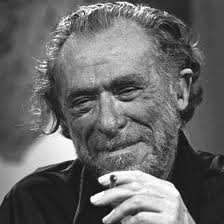
Today was Charles Bukowski’s birthday. All kinds of things have been said about him but for my money he was a poet first and foremost, and more especially, he was a poet of what could very well be described as obsessive projections of nostalgia.
Forget the alcohol and the miserable, even execrable efforts to find love, Bukowski’s world was always about the stars in space and the unshakable beauty of Beethoven on a cheap radio, the symphony heard while alone late at night.
A faded green field, tall grass and weeds, a few trees. And a movement—bright white. I slowed the car. Light made physical, bodied: an all-white deer. White from head to toe, two slightly pink ears. It grazed in a herd of other deer, the one white deer among a dozen. I stopped by the side of the road, tried unsuccessfully to take a photo: white blur, faded green grass, tall weeds.
Since moving to the Upper Peninsula, I’ve seen dozens and dozens of deer—while driving, while running trails, hiking. Every time, I gasp, slow down to watch them. Their slight but muscular legs, the way their ears twitch with the slightest sound, the way their eyes look soulful, take my whole body in. Once, while running along a quiet road, I came upon a doe eating. I stopped, stood quietly, only a car-length away. Her mouth ground back and forth, I could hear the dry twig in her teeth. I reached out my hand, palm up, as if that showed her I meant no harm. And she stood, watched me, kept eating. Her ears twitched constantly but she showed no sign of running away, totally unfazed by my presence. It felt like magic to be so close to a deer, to have her watch me too. When I finally walked away, I wished her well, safety.
But a white deer—even more rare. Even more at risk from predators, hunters. Totally without camouflage—except, I guess, when it snows. I sat by the side of the road and watched it move, white body among a herd of brown. White light made physical. And I wished it safety, that the herd would keep it safe. That they’d move as one around it. That they’d help it live a long life.
In the meditation world (at least in the limited bit I know of meditation), I was practicing loving kindness, sending loving kindness to another being, wishing another being safety, peace. I know this sounds crazy—to expect that thinking kind thoughts for another will change anything. But it also sometimes feels just right—and sometimes feels like the only thing we can do anyway.
Because what do we have but our thoughts and the herd to keep us safe? The herd we build around ourselves, the herd we trust to do the best it can. How else can we move through the world successfully? Maybe I’m stretching things a bit, romanticizing nature—something I’m loathe to do. Growing up, my mother always told me, “Mother Nature isn’t kind.” And she was right. The Earth couldn’t care less that we’re here—it’s just moving along through space. So what do we have? What light?
Maybe only our own kindness. Holding others with the highest regard, whether or not we know or like them. Maybe the beauty of a single white deer, grazing. Maybe calling on the herd to keep it safe. Calling on the herd to keep each one of us safe, to help us live in peace.
(ADAPT)
August 14, 2012
DENVER, COLORADO– [Excerpt provided by Inclusion Daily Express] When President Obama visited Denver on August 8th, Colorado ADAPT was there with a message for him — Nothing about us without us!
The Department of Labor is in the process of writing new federal labor rules that will affect how attendant services are provided. Though the changes would hurt, even devastate, folks in the disability community, we were not consulted about the proposed changes.
When we learned that President Obama was coming to the Auraria Events Center in Denver to talk about women’s health care, Colorado ADAPT saw an opportunity to deliver our message directly to the President, and jumped at the chance! A group of us got tickets the day before the event, and the planning began.
Because literally thousands of people were expected to attend the event, we wanted to get there early and did! The first three people in line were all ADAPTers!
Entire article:
Colorado ADAPT Sends Message to President Obama — Nothing About Us Without Us!
http://www.dimenet.com/hotnews/archive.php?mode=A&id=7550;&sort=D
Red Sox legend Johnny Pesky dies
Stephen Kuusisto
Director
The Renee Crown University
Honors Program
University Professor
Syracuse University
My mother fed caramels to the squirrels.
She didn’t like her own mother. She didn’t like people very much. She claimed to like animals.
Strictly speaking this shouldn’t concern you. You have your own troubles. It is likely that you want to clean up the garden, burn the old plantings, maybe talk to your cat about Ezra Pound. Ezra Pound who tried to paint Paradise on the inside of his eyelids.
We are all students of doubtfulness and of its moods.
Unlike my mother I tend to enjoy people. I’ve been known to bake bread and leave it on the doorsteps of near strangers. This is no joke. I bake good bread. I listen to Verdi while working the dough.
Ah but now in middle age I find I’m cut off on the inside. And though I can stand in a room and smile, tell a joke, sing a homemade song, even so, standing before the tall glass of my life, there under that moon I am lonely.
I am in no way singular because of it. The man across the street who is picking the last tomatoes of the summer is lonely. The woman I met this morning who teaches linguistics at the university is lonely. My friends, my wife, all my relatives are quietly alone though we are trained to withhold this even from the psychiatrist or the priest.
The poet William Carlos Williams said in one of his poems “I am lonely. I am best so.” I remember reading those words as a college sophomore and I felt the proper fit in my soul.
The feeling of estrangement is not a social matter as the boy or girl would imagine. The “difference” as Emily Dickinson wrote “is internal, where the meanings are.”
Our human souls are needy as empty pockets. They are thirsty as flesh itself but this condition cannot be quenched with drink or a good home in a nice neighborhood.
Now the full moon rises and as the Spanish poet Federico Garcia Lorca wrote: “the heart feels it is a little island in the infinite.”
Make no mistake every heart is in a condition of static or pure loneliness. This is why Jesus said to his disciples: “My father’s house has many mansions. If it were not so, I would not tell you.”
Of all the lines in the New Testament those are for me, the most comforting. This is according to my soul. My soul, that forlorn intelligence hugging my tissues and bones. My soul that cannot get used to life. That insists on sleeplessness so that together we can work out the geometry of mutual being in our common and threshed hours.
Once I harvested the last sunflowers of autumn because the frost was coming.
I did this with some friends.
We brought half living, stately sunflowers into an old house and we propped them against the hearth. We sang songs and drank wine. Unspoken? Every one of us had Lorca under his or her ribs and we could, it turned out, give our souls a warm room and some fading flowers.
My mother died without knowing this feeling of shy, unasked for communion. I think her story is legion.
John Donne writes in one of his elegies:
“Xerxes’ strange Lydian love, the platane tree, Was loved for age, none being so large as she ; Or else because, being young, nature did bless Her youth with age’s glory, barrenness.”
Surely the aim of living is to craft a fruitful spirit.
Not long ago I discovered a boy jumping on discarded bedsprings on a Chicago sidewalk. He was making a stripped down music from solitude and trash. It was the song of a woodcutter’s axe in the empty woods. He saw me listening. He sensed an audience. He threw everything he had into making rare music with ruined steel coils and shoes. He was releasing invisible spirits into the morning air of Wabash. Avenue.
At first I thought his effect was obscene. The bed springs sounded like the furtive, metallic groans of forgotten trysts. I thought of a bordello in the Wild West. I laughed at the salty bravado of the performance. Then I saw flashes of light. The broken springs flashed like the undersides of leaves. His bed springs were tuned in harmony with the sky and the local trees.
I saw sparks—heard 16th notes; 8th notes; the found music and electrolysis of dance…
He was dancing at the epicenter of first light—that overcast sun that always hangs in the mornings above Lake Michigan.
Then he was in an island of trees. Low notes came suddenly: the notes signified a bent path. The way forward was harder for some reason. The dance had taken a darker turn. I could tell this was now a steep narrative. Somehow he’d figured out how to make the springs sound like a tuba. Then he made the metal groan like a cello.
I remembered that as a boy in Naples, Enrico Caruso sang in the streets. When he made a little money he would eat a blood orange sorbet outside the café Risorgimento. They called this dessert the “frozen sunset” –a dish of scarlet juice and ice, misted with lemon.
I like to imagine the scene: the boy and future tenor singing love songs to the fiancée of a very rotund man from Caserta. “Only a boy can carry my heart,” said the fat man to his beloved. “Boys are still sweet as the baby Jesus!” Then I picture him clapping his hands the way impresarios do: a fleshy sound of exaggeration.
And surely the girl was embarrassed. This was a street urchin, a boy in a dirty shirt. A child hired to sing love songs! This thing was a joke! But there on the via Carraciola in the din of carts and boats and street hustlers the boy sang Bellini’s Ma rendi pur contento his black eyes shining with joy and concentration so that passersby stood still. Two men, twin brothers from Rome stopped eating their sugared almonds. There in the heat of the day in that unforeseen place was a prodigy. What could surpass the unassuming purity of such a child’s voice?
The boy performed as if the edge of his heart was catching flame.
The fat man from Caserta was delighted and bobbed his head like a pheasant, then strutted, ruffled his feathers. His fiancée tipped her head in wonder, her features softening, a portrait reversing to a sketch. Her enormous hat with its absurd ribbons could not hide the smile.
Then the boy sang Bella Nice, che d’amore, his hands stretched out, palms up, without irony. Could anything be this sweet again? Vin santo and peaches? Cloves in the boiled sugar?
The boy Caruso and the hot Neapolitan day were working together, visioning ice, ice on the fat lip of a hungry lover.
**
The kid on the bedsprings spoke with his feet, said: there’s no iridescent glow of escape beyond the dancing and you got to hear it for yourself.
This is the secret of growing old profitably in spirit. We can do this.
For Immediate Release: August 9, 2012
Media Contacts: Chris Hilderbrant, 585-267-0343
Stephanie Woodward, 585-269-9184
Disability Activists Secure Agreement from RIT President After Protesting Local Hotel’s Resistance to Equal Access
Rochester, NY – In response to national efforts by the hotel industry to block full accessibility to swimming pools for Americans with disabilities, local disability rights activists took action today to protest against a local member of the American Hotel & Lodging Association (AH&LA). The protest was coordinated by Rochester ADAPT, in collaboration with disability rights activists across the nation. The action took place in Rochester Institute of Technology (RIT) President Bill Destler’s office, and was focused on the RIT Inn & Conference Center’s failure to give a firm commitment to make its swimming pools accessible to people with disabilities.
After making the group’s grievances clear and after a very constructive conversation with President Destler, the group of disability rights activists secured a firm commitment that the RIT Inn & Conference Center has ordered permanent lifts for its pool, and that the lifts will be installed immediately after they arrive on campus. RIT will also ask the manager of the inn to examine AH&LA’s role in resisting the installation of permanent lifts in pools across the country, and to examine the inn’s relationship with AH&LA.
On September 15, 2010, the U.S. Department of Justice published updated Americans with Disabilities Act (ADA) regulations. The regulations required pools operated by hotels and other public entities to become accessible by March 15, 2012, unless to do so would not be readily achievable. As the implementation deadline approached earlier this year, the hotel industry and its lobbyists at the AH&LA fought hard to extend the deadline, therefore prolonging pool access for Americans with disabilities. The Department of Justice has extended the deadline to January 31, 2013. Despite this extension, the hotel industry continues to fight against full access to pools for people with disabilities.
In July, disability rights activists across the nation began a boycott of hotels and chains which do not have pools with permanent lifts that make pools fully accessible to all paying guests. Today’s action in Rochester is the first local direct action in the nation against a hotel with an inaccessible pool, though more are planned. “This is about more than pools,” said Bruce Darling, organizer with ADAPT. “This action marks the beginning of the next phase in a campaign to protect the ADA. Hotels can expect this to be a guerilla campaign. They won’t know where we are going, but they’ll definitely know when we’re there!”
The RIT Inn & Conference Center is represented on the board of AH&LA and, given that RIT is the home to the National Technical Institute for the Deaf, ADAPT and its allies across the country have asked RIT to take a leadership role in fighting for equal access to hotel facilities for all Americans, regardless of physical ability.
###
ADAPT is a national grass-roots community that organizes disability rights activists to engage in nonviolent direct action, including civil disobedience, to assure the civil and human rights of people with disabilities to live in freedom. See more about ADAPT and ADAPT’s work at www.adapt.org.
Some years ago I was asked to make a few comments at the mayor’s mansion in New York City. The occasion was a fund raiser for Guiding Eyes for the Blind and the mayor was Rudolph Giuliani. This was a long time ago, now, 14 years give or take a few minutes.
On the way to the mayor’s residence I was denied a taxi ride because of my guide dog. This is nothing new to people with disabilities–cab drivers will avoid you because they don’t want the hassle of your wheelchair or they don’t want your dog in their cab. Maybe they think we all have cooties. No matter, despite laws that should guarantee us equal access we’re screwed all the time in the taxicab roulette.
At the ceremony with Mayor Giuliani I quoted some lines by the Spanish poet Unamuno: “We die of cold and not of darkness.” That is, in effect, in my interpretation, it’s cultural ostracism that kills people and not the lack of light.
The current mayor of New York has shown tremendous disdain for the disability community in the city–saying that people in wheelchairs who want accessible cabs maybe ought to stay home. (His precise quote escapes me now, but that’s pretty much the ticket.)
Simi Linton and a group of wheelchair users in NYC have been fighting to make sure that all cabs in the city are wheelchair accessible, which means among other things that they’d be accessible for baby strollers and scooters and steamer trunks. The fact that the mayor doesn’t like this idea doesn’t change the fact that accessible cabs should be on the streets. I’ve walked with Simi in New York and I know how hard it is for wheelchair users to get around. Yesterday Simi and friends were arrested for blocking traffic outside Gracie Mansion.
Back to Unamuno.
I was denied entry to a restaurant in New York City not long ago. The doorman didn’t want my guide dog in his establishment. We’ve since resolved the matter and the staff will be having training on the ADA next week.
But I don’t think its an exaggeration to say that public attitudes can be shaped by people at the top. Fish stinks from the head. Isn’t it easier to send people with disabilities packing or haul them off to jail for protesting than to honor the spirit of community? Mayor Bloomberg is a cynic and a boor. And he’s on the wrong side of history.
 Posted with Blogsy
 Planet of the Blind