A Call To Focus On Finding Jobs For Those With Disabilities

(PBS)
July 25, 2012

WASHINGTON, DC– [Excerpt provided by Inclusion Daily Express] As the United States prepares to observe the anniversary of the Americans with Disabilities Act Thursday, it’s tempting to say, “hold the celebration.” That’s because for those with disabilities, the employment picture has, sadly, not improved since the ADA was signed into law 22 years ago.

In fact, during the recent recession, it deteriorated five times as badly as did employment for the rest of American workers. While the non-disability workforce shrank by about 2 percent, for people with disabilities, the number working fell by over 10 percent. And according to the Bureau of Labor Statistics, the picture has remained grim as the economy has begun its recovery: While 3 million new jobs were added to the able-bodied work force, workers with disabilities have seen their ranks shrink further.

The chief voice spreading the word about this depressing situation is Sen. Tom Harkin, D-Iowa, the chairman of the health, education, labor and pensions committee, and a long-time passionate advocate for those with disabilities.

Harkin has just released a report that calls on Congress, the president and his administration, private business and Americans everywhere to make finding jobs for people with disabilities a national priority. What sets the report apart is that it’s not limited to an assault on our guilty consciences.

Entire article:
A Call to Focus on Finding Jobs for Those with Disabilities

http://tinyurl.com/ide0725122a
Related:
Reports to the President Disability Employment Statistical Reports (U.S. Office of Personnel Management)

http://www.opm.gov/diversityandinclusion/reports/disability/index.aspx

Turner Classic Movies Showcases Films About Disability

TCM to Examine Hollywood’s Depiction of People with Disabilities in The Projected Image: A History of Disability in Film in October

Lawrence Carter-Long Joins TCM’s Robert Osborne for Historic Month-Long Film Exploration, Presented in Collaboration with Inclusion in the Arts

Turner Classic Movies (TCM) will dedicate the month of October to exploring the ways people with disabilities have been portrayed in film. On behalf of Inclusion in the Arts, Lawrence Carter-Long will join TCM host Robert Osborne for The Projected Image: A History of Disability in Film. The special month-long exploration will air Tuesdays in October, beginning Oct. 2 at 8 p.m. (ET).

TCM makes today’s announcement to coincide with the 22nd anniversary of the signing of the Americans with Disability Act (ADA) on July 26. And in a first for TCM, all films will be presented with both closed captioning and audio description (via secondary audio) for audience members with auditory and visual disabilities.

The Projected Image: A History of Disability in Film features more than 20 films ranging from the 1920s to the 1980s. Each night’s collection will explore particular aspects, themes, or types of disability, such as blindness, deafness and psychiatric or intellectual disabilities. In addition, one evening of programming will focus on newly disabled veterans returning home from war. 

TCM’s exploration of disability in cinema includes many Oscar®-winning and nominated films, such as An Affair to Remember (1957), in which Deborah Kerr’s romantic rendezvous with Cary Grant is nearly derailed by a paralyzing accident; A Patch of Blue (1965), with Elizabeth Hartman as a blind white girl who falls in love with a black man, played by Sidney Poitier; Butterflies Are Free (1972), starring Edward Albert as a blind man attempting to break free from his over-protective mother; and Gaby: A True Story (1987), the powerful tale of a girl with cerebral palsy trying to gain independence as an artist; Johnny Belinda(1948), starring Jane Wyman as a “deaf-mute” forced to defy expectations; The Miracle Worker (1962), starring Anne Bancroft as Annie Sullivan and Patty Duke as Helen Keller; One Flew Over the Cuckoo’s Nest (1975), with Jack Nicholson as a patient in a mental institution and Louise Fletcher as the infamous Nurse Ratched; The Best Years of Our Lives (1946), the post-War drama starring Fredric March, Myrna Loy and real-life disabled veteran Harold Russell; and Charly (1968), with Cliff Robertson as an intellectually disabled man who questions the limits of science after being turned into a genius.

The Projected Image: A History of Disability in Film also features several lesser-known classics ripe for rediscovery, including the atmospheric Val Lewton chiller Bedlam (1946), the intriguing blind-detective mystery Eyes in the Night (1942); A Child is Waiting (1963), with Burt Lancaster and Judy Garland; the British family drama Mandy (1953); and a bravura performance by wheelchair user Susan Peters in Sign of the Ram (1948). A complete schedule is included.

Each year since 2006, TCM has dedicated one month toward examining how different cultural and ethnic groups have been portrayed in the movies. Several of the programming events have centered on Race and Hollywood, with explorations on how the movies have portrayed African-Americans in 2005, Asians in 2008, Latinos in 2009, Native Americans in 2010 and Arabs in 2011. TCM looked at Hollywood’s depiction of gay and lesbian characters, issues and themes in 2007.

“The Projected Image: A History of Disability in Film is a valuable opportunity to take a deeper look at the movies we all know and love, to see them from a different perspective and to learn what they have to say about us as a society,” said Osborne. “We are very proud to be working with Inclusion in the Arts on this important exploration. And we are especially glad to have Lawrence Carter-Long of the National Council on Disability with us to provide fascinating, historical background and thought-provoking insight on how cinematic portrayals of disability have evolved over time.”

“From returning veterans learning to renegotiate both the assumptions and environments once taken for granted to the rise of independent living, Hollywood depictions of disability have alternately echoed and influenced life outside the movie theater,” said Carter-Long, who curated the series. “Twenty-two years after the passage of the ADA and over a century since Thomas Edison filmed ‘The Fake Beggar,’ TCM and Inclusion in the Arts provide an unprecedented overview of how cinematic projections of isolation and inspiration have played out on the silver screen – and in our lives. When screened together, everything from The Miracle Worker to One Flew Over the Cuckoo’s Nest reveals another layer where what you think you know is only the beginning.”

Joe Scarborough We Hardly Knew Ye

“As soon as I hear about this shooting, I knew who it was. I knew it was a young, white male, probably from an affluent neighborhood, disconnected from society — it happens time and time again,” said Scarborough. “Most of it has to do with mental health; you have these people that are somewhere, I believe, on the autism scale. I don’t know if that’s the case here, but it happens more often than not.”

Really? Joe? Did you know that people with mental illness or disabilities are less likely to commit acts of violence than the general population? Of course you didn’t know this. I’ve seldom seen facts get in your way as you opine about everything from the economy to women’s rights to the tax code. 

But there are real lives in the balance. People with autism or asperger’s (which I like to call “aspirer’s syndrome) have a hard enough time navigating in this world without you, Mr. Joe, adding to the misconceptions about neurological differences. 

Joe: here’s a hint. Switch to decaf. 

Here’s another hint: use your program to have a thoughtful segment on the fact that people with mental illnesses and neuro-differences are in fact less likely to commit crimes. 

In general this is called a teachable moment. I’m happy to help. Meantime, try the Starbuck’s “blonde” de-caf, okay?


The Ryan Plan will make People with Disabilities the Biggest Losers

This article is part of a Huffington Postseries on the global impact of austerity — “A Thousand Cuts” — from affordable housing funds lost in San Francisco to increasing class sizes in New York, food inspector cuts in Canada, disability benefits taken away in the United Kingdom, decimation of France’s solar industry, and more. Click here for information on how you can help people affected by these measures.


A Friendship Beyond Understanding

Image

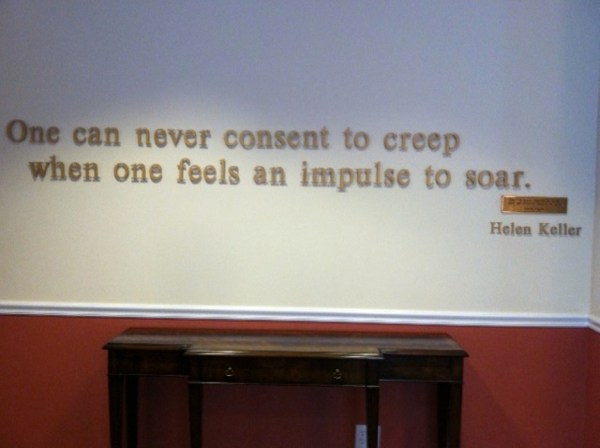
Photo: “One can never consent to creep when one feels an impulse to soar.” Helen Keller (Quote on wall at Guiding Eyes)


Talking with K.P. who is a blind activist from Hong Kong and who is getting his first guide dog atGuiding Eyes for the Blind in New York, I learn that there is considerable interest among the Honk Kong blind in having their own guide dog school. This news excites me because it’s about the spirit of hope. Every day we need stories about the indomitable “thing with feathers”. Or in this case, the things with wagging tails. 


In urban life a guide dog gives a visually impaired person a tremendous edge. Frankly I’ve long thought that even sighted people should have guide dogs, especially in the age of cell phones. These days sighted people are practically blind. But humor aside, the guide dog is a blessing and the human animal bond is a profound thing. I like what it says on the back of a Guiding Eyes brochure:


“Guiding Eyes dogs are carefully paired with their blind or visually impaired owners to ensure that they will become successful and independent teams. The results are intense bonding, newfound freedom, and a friendship beyond understanding.”


Got that right!   

DeMint Delays Senate Consideration Of U.N. Treaty On Rights Of People With Disabilities


(The Hill)

July 23, 2012

WASHINGTON, DC– [Excerpt provided by Inclusion Daily Express] Sen. Jim DeMint (R-S.C.) is delaying Senate consideration of the United Nations treaty on people with disabilities amid growing opposition from home-schooling advocates.

The Senate Foreign Relations Committee was scheduled to take up the U.N. Convention on the Rights of People With Disabilities on Thursday, with the goal of getting it passed in time for the 22nd anniversary of the Americans With Disabilities Act (ADA) on July 26. Instead, Chairman John Kerry (D-Mass.) announced that he will hold the markup next Thursday, July 26.

A spokesman for DeMint said several Republicans on the committee joined him in asking for the delay.

“Part of this treaty deals with abortion and the rights of children, issues that should be addressed by states, local governments and American parents, not international bureaucrats,” DeMint spokesman Wesley Denton told The Hill in an email. “Sen. DeMint strongly opposes this treaty, as the United States is already the world leader in addressing the needs of the disabled and it’s foolish to think Americans need to sign away our sovereignty to exert our influence around the world.”

The treaty has broad bipartisan support, with many senators — including Sens. John Barrasso (R-Wyo.) and John McCain (R-Ariz.) — arguing that it would merely extend the protections of the ADA to people with disabilities around the world, including Americans living abroad.

Entire article:

Sen. DeMint taps brakes on UN treaty as home-school opposition grows

http://tinyurl.com/ide0723122a


Support Disability Rights

TELL YOUR SENATORS TO SUPPORT DISABILITY RIGHTS EVERYWHERE!!

 Ratify CRPD NOW!

 ATTEND THE SENATE MARKUP ON THURSDAY, JULY 26, 2012 IN SENATE DIRKSEN OFFICE BUILDING ROOM G50 AT 9:30AM

The Convention on the Rights of Persons with Disabilities (CRPD) is an international treaty that outlines the obligations of ratifying countries to promote, protect, fulfill, and ensure the rights of persons with disabilities. It embodies the American ideals that form the basis of the Americans with Disabilities Act (ADA) by empowering persons with disabilities to be independent and productive citizens.  The US signed the CRPD on July 30, 2009 and after numerous attempts by the Home School Legal Defense Association to block this important treaty, it will finally receive a markup THIS THURSDAY! 

But we still need your help convincing the Foreign Relations Committee to VOTE YES and send the treaty to the Senate floor for a vote! 

We need you to fill the room at the hearing to show our support for the CRPD!

Send any accessibility accommodation requests to Susan_Oursler@foreign.senate.gov 

Let our voices be heard over the opposition … make a call to your Senator on the Foreign Relations Committee and tell them that the disability community needs their support!

MESSAGE: “Senator, I am a constituent from your state and I support the CRPD.  I look to you to attend the Foreign Relations Committee markup and vote on July 26th and to support ratification.  The CRPD is in the United States’ interests, protects our citizens and veterans abroad, and honors the Americans with Disabilities Act.”

CONTACT:

Chairman: Senator John Kerry (D-MA) SUPPORTS CRPD!
(202) 224-4651
Chief counsel: Andrew Keller andrew_keller@foreign.senate.gov ORwww.kerry.senate.gov/contact/

Ranking Member: Senator Richard Lugar (R-IN)
(202) 224-6797
Chief counsel: Michael Mattler michael_mattler@foreign.senate.gov ORwww.lugar.senate.gov/contact/

Senator John Barrasso (R-WY) COSPONSOR OF CRPD!!
(202) 224-6441
Foreign Relations Legislative Aide: Amber Bland ( amber_bland@barrasso.senate.gov) ORhttp://www.barrasso.senate.gov/public/index.cfm?FuseAction=ContactUs.ContactForm

Senator Barbara Boxer (D-CA)
(202) 224-3553
Foreign Relations Legislative Aide: Ann Norris ( ann_norris@boxer.senate.gov) OR 
www.boxer.senate.gov/en/contact/

Senator Ben Cardin (D-MD) SUPPORTS CRPD!
(202) 224-4524
Foreign Relations Legislative Aide: Katharine Beamer ( katharine_beamer@cardin.senate.gov) OR www.cardin.senate.gov/contact/

Senator Bob Casey, Jr. (D-PA)
( 202) 224-6324
Foreign LA: Damian Murphy ( damian_murphy@casey.senate.gov) ORwww.casey.senate.gov/contact/

Senator Chris Coons (D-DE) COSPONSOR OF CRPD!!!
(202) 224-5042
Foreign LA: Halie Soifer ( halie_soifer@coons.senate.gov) OR www.coons.senate.gov/contact/

Senator Bob Corker (R-TN)
(202) 224-3344
Foreign LA: Stacie Oliver ( stacie_oliver@corker.senate.gov) ORwww.corker.senate.gov/public/index.cfm?p=ContactMe

Senator Jim DeMint (R-SC)
(202) 224-6121
Foreign LA: Lydia Morgan ( lydia_morgan@demint.senate.gov) ORwww.demint.senate.gov/public/index.cfm?p=ContactInformation

Senator Dick Durbin (D-IL) COSPONSOR OF CRPD!!!
(202) 224-2152
Foreign LA: Chris Homan ( chris_homan@durbin.senate.gov) ORwww.durbin.senate.gov/public/index.cfm/contact

Senator Jim Inhofe (R-OK)
(202) 224-4721
Foreign LA: Joel Starr ( joel_starr@inhofe.senate.gov) ORhttp://www.inhofe.senate.gov/public/index.cfm?FuseAction=Contact.ContactForm

Senator Johnny Isakson (R-GA)
(202) 224-3643
Foreign LA: Chris Sullivan ( chris_sullivan@isakson.senate.gov) ORwww.isakson.senate.gov/contact.cfm

Senator Mike Lee (R-UT)
(202) 224-5444
Foreign LA: Miriam Harmer ( miriam_harmer@lee.senate.gov) ORwww.lee.senate.gov/public/index.cfm/contact

Senator Bob Menendez (D-NJ)
(202) 224-4744
Foreign LA: Jodi Herman ( jodi_herman@menendez.senate.gov) ORmenendez.senate.gov/contact/

Senator Marco Rubio (R-FL)
(202) 224-3041
Foreign LA: Victor Cervino ( victor_cervino@rubio.senate.gov) ORwww.rubio.senate.gov/public/index.cfm/contact

Senator Jim Risch (R-ID)
(202) 224-2752
Foreign LA: Chris Socha ( chris_socha@risch.senate.gov) ORwww.risch.senate.gov/public/index.cfm?p=Email

Senator Jeanne Shaheen (D-NH) SUPPORTS CRPD!
(202) 224-2841
Foreign LA: Chad Kreikmeier ( chad_kreikemeier@shaheen.senate.gov) ORwww.shaheen.senate.gov/contact/

Senator Tom Udall (D-NM) COSPONSOR OF CRPD!!!
(202) 224-6621
Foreign LA: Matt Padilla ( matthew_padilla@tomudall.senate.gov) ORwww.tomudall.senate.gov/?p=contact

Senator Jim Webb (D-VA) SUPPORTS CRPD!
(202) 224-4024
Foreign LA: Marta Ross ( marta_mclellanross@webb.senate.gov) ORwww.webb.senate.gov/contact.cfm

Children Writing About the Ocean


1) – This is a picture of an octopus. It has eight testicles. (Kelly, age 6 ) 
  
2 ) – Oysters’ balls are called pearls. (Jerry, age 6) 
  
3) – If you are surrounded by ocean, you are an island. If you don’t have ocean all round you, you are incontinent. (Mike, age 7) 
  
4) – Sharks are ugly and mean, and have big teeth, just like Emily Richardson. She’s not my friend any more. (Kylie, age 6) 
  
5) – A dolphin breaths through an asshole on the top of its head. (Billy, age 8) 
  
6) – My uncle goes out in his boat with 2 other men and a woman and pots and comes back with crabs. 
(Millie, age 6) 
  
7) – When ships had sails, they used to use the trade winds to cross the ocean. Sometimes when the wind didn’t blow the sailors would whistle to make the wind come. My brother said they would have been better off eating beans. 
(William, age 7) 
  
8) – Mermaids live in the ocean. I like mermaids. They are beautiful and I like their shiny tails, but how on earth do mermaids get pregnant? Like, really? (Helen, age 6) 

  9) – I’m not going to write about the ocean. My baby brother is always crying, my Dad keeps yelling at my Mom, and my big sister has just got pregnant, so I can’t think what to write. (Amy, age 6) 
  
10) – Some fish are dangerous. Jellyfish can sting. Electric eels can give you a shock. They have to live in caves under the sea where I think they have to plug themselves in to chargers. (Christopher, age 7) 
  
11) – When you go swimming in the ocean, it is very cold, and it makes my willy small. (Kevin, age 6) 
  
12) – Divers have to be safe when they go under the water. Divers can’t go down alone, so they have to go down on each other. (Becky, age 8) 
  
13) – On vacation my Mom went water skiing. She fell off when she was going very fast. She says she won’t do it again because water fired right up her big fat ass. (Julie, age 7) 
  
14) – The ocean is made up of water and fish. Why the fish don’t drown I don’t know. (Bobby, age 6) 

  15) – My dad was a sailor on the ocean. He knows all about the ocean. What he doesn’t know is why he quit being a sailor and married my mom. (James, age 7)