Italian Trouble

By Andrea Scarpino

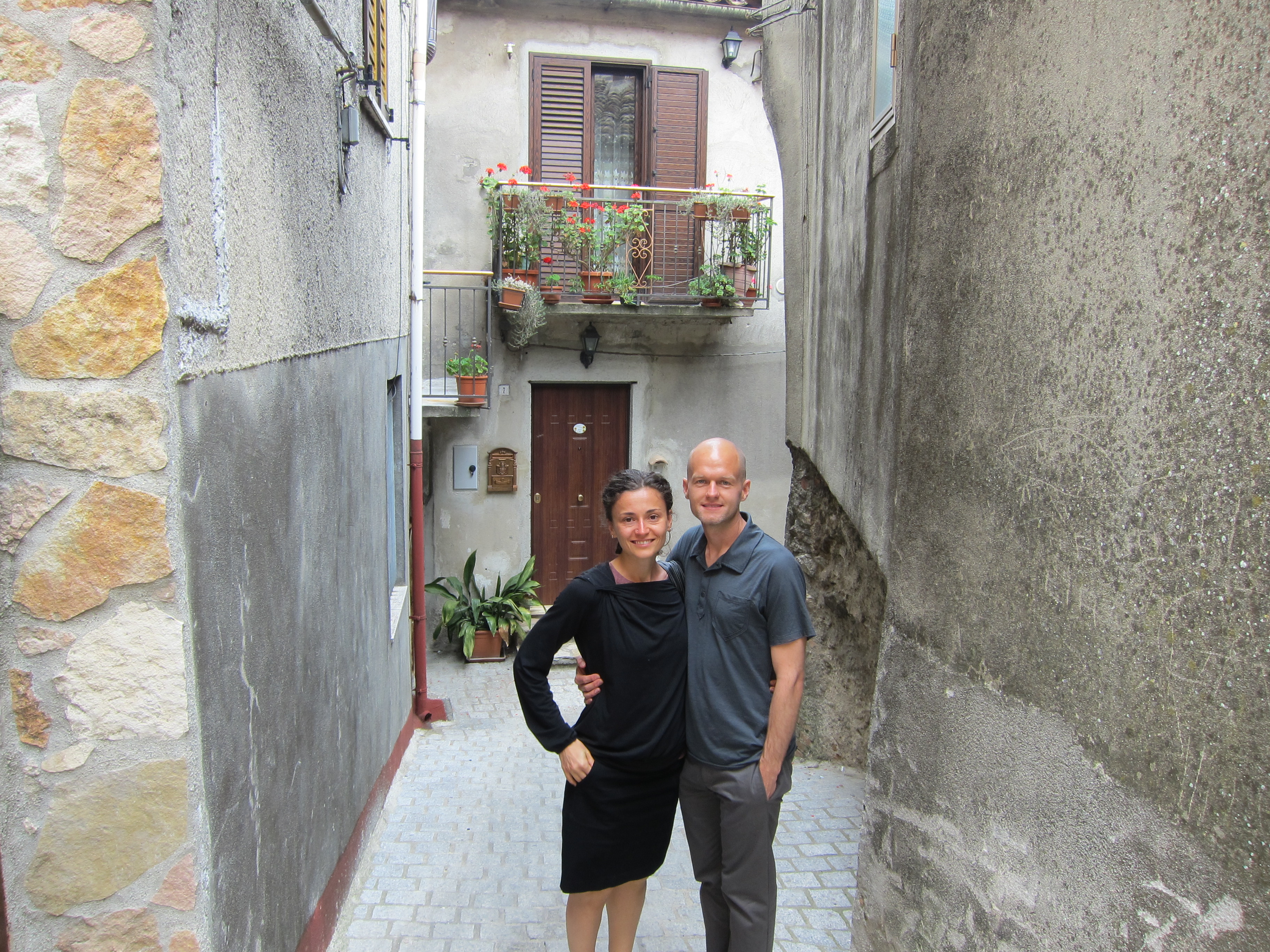
The only trouble with being in Crotone is that I never really know what’s about to happen–which means, in part, that I never know how much food I may be expected to eat. I don’t speak Italian well enough for complex conversations, and even though I’ve dusted off my French to speak to one cousin, and Zac has gone professional in Google Translate iPad-style, we’re still often fumbling from place to place and person to person, not entirely sure what’s going to happen next.


Case in point: lunch in Sersale, which is the town from which my grandfather moved when he came to the US in the 1920s. We eat lunch with one of my father’s first cousins who, even though she’s in her 80s, has prepared a feast: two kinds of spaghetti, two kinds of eggplant, zucchini parmesan, sautéed wild mushrooms, green salad, fresh ricotta, six other cheeses, bread, olives, bowls of fresh cherries, and two kinds of pastries. We’re also served–at lunch, mind you–white wine and artisanal sparkling red wine, as well as homemade cream limoncello. My stomach becomes physically sore, stretched beyond any normal limit. Not eating, however, is clearly not an option–as soon as I say “no thank you,” my father’s cousin looks devastated and asks, “You don’t like it?” So I pile more on my plate.


Lunch begins at 1pm, and by the time we leave her house with home-dried chili peppers and oregano, three pieces of lace that she has crocheted especially for us, and a homemade soap that I’m pretty sure is made from pig, it’s almost 4pm. We’ve been eating for three hours. But, it turns out, we’re not done. We’re taken to another of my father’s first cousins for a visit, and as we chat about all that we’ve just eaten, his wife disappears from the living room. A few minutes later, she returns with lemon sorbet that she’s just purchased from a grocery on the corner. “This will help with your digestion,” she says.


Again, it’s clear that we can’t refuse, so I spoon the sorbet into my mouth as quickly as I can, hoping she may actually be right. My stomach has reached baby-bump proportions and shows no signs of retracting because of additional food, sorbet or otherwise. At one point, Zac slips into a sugar coma, and from across the room, I try to will him awake. But there’s more to come: thick almond milk at the home of another cousin.


Again, Zac and I try to refuse, but my relatives throw an all-out tantrum. My cousin, a man in his late 70s, actually begins to stomp his feet, while his wife (who can’t be any younger) whines, her voice becoming frantic and high pitched. I finally manage to say something like, “Okay, we drink” so that the tantrum ends, but I’m growing more and more confident that an emergency room visit from a ruptured stomach is in my future.


When we finally head home to Crotone, a dinner of pizza, fried calzones, focaccia, and beer awaits us. By bedtime, we’ve been eating for 9 straight hours. Which I might have thought blissful had I not actually endured it. On the plus side: I’m pretty sure I’ve carb loaded enough for every run I do the rest of the year.

From Disability Rights International: Calling for Justice

<![CDATA[


The United Nations calls again for investigation of JRC’s shock treatments

http://platform.twitter.com/widgets/tweet_button.1338995330.html#_=1339159735463&count=horizontal&counturl=http%3A%2F%2Fwww.disabilityrightsintl.org%2F2012%2F06%2F05%2Fthe-united-nations-calls-again-for-investigation-of-jrcs-shock-treatments%2F&id=twitter-widget-0&lang=en&original_referer=http%3A%2F%2Fwww.disabilityrightsintl.org%2F&size=m&text=The%20United%20Nations%20calls%20again%20for%20investigation%20of%20JRC%E2%80%99s%20shock%20treatments%20&url=http%3A%2F%2Fwww.disabilityrightsintl.org%2F2012%2F06%2F05%2Fthe-united-nations-calls-again-for-investigation-of-jrcs-shock-treatments%2F%23.T9H0tnYMPj4.twitter

https://plusone.google.com/_/+1/fastbutton?bsv=pr&url=http%3A%2F%2Fwww.disabilityrightsintl.org%2F2012%2F06%2F05%2Fthe-united-nations-calls-again-for-investigation-of-jrcs-shock-treatments%2F&size=medium&count=true&origin=http%3A%2F%2Fwww.disabilityrightsintl.org&hl=en-US&jsh=m%3B%2F_%2Fapps-static%2F_%2Fjs%2Fgapi%2F__features__%2Frt%3Dj%2Fver%3Dl9xafNDlycA.en_US.%2Fsv%3D1%2Fam%3D!PemfnfjrL2yI81ARQg%2Fd%3D1%2Frs%3DAItRSTPblCJvoWHsMeVNOsKiKGakP1copQ#_methods=onPlusOne%2C_ready%2C_close%2C_open%2C_resizeMe%2C_renderstart&id=I0_1339159735221&parent=http%3A%2F%2Fwww.disabilityrightsintl.org

June 5, 2012–Washington, DC– A scathing article concerning the abuses against children with disabilities at the Judge Rotenberg Center (JRC) was published Saturday by the Guardian of London. Juan Mendez, the United Nations Special Rapporteur on Torture, told the Guardian he is “very concerned,” about the use of electric shocks as aversive treatment on children with disabilities at JRC. “I feel very strongly that electricity applied to a person’s body creates a very extreme form of pain. There are a lot of lingering consequences including mental illness that can be devastating,” Mendez said.

According to the Guardian, Mendez has opened discussions with the US mission to the United Nations, plans on contacting the US State Department, and has the option of reporting the abuses to the UN human rights council. In 2010, Mendez’s predecessor as the Special Rapporteur, Manfred Nowak, responded to an urgent appeal filed by DRI finding that the electric shocks at JRC constituted torture. “I have no doubts about it,” said Nowak, “It is inflicted in a situation where a victim is powerless. And, I mean, a child in the restraint chair, being then subjected to electric shocks, how more powerless can you be?”

Following DRI’s 2010 report, the controversy over JRC has reached a critical tipping point. Most recently, the family of Andre McCollins, a former student and victim of electric shocks for 7 hours sued the Rotenberg Center for malpractice. The case was settled for an undisclosed amount; however, as a result of the lawsuit, a horrifying video of Andre being shocked was released to the public for the first time and has brought JRC into the national and international spotlight once again. The electric shocks used at the school are “a horrific form of torture,” DRI President Laurie Ahern is quoted as saying in the Guardian. “What happened in that video is worse than anything I have ever seen done to a prisoner of war or a political victim around the world.]]
>

La Famiglia Scarpino

By Andrea Scarpino

Calabria

Photo

Zia Antonietta is my father's first cousin and the keeper of Scarpino family history. She is the one who asked Salvatore to look for me on the internet, and she is who Zac and I are staying with in Calabria, the region from which my grandfather moved. Really, she is the one responsible for this entire trip, as she immediately wrote me (through Salvatore) about visiting, immediately offered her home to me, immediately made sure I would be taken care of.

So far, we have explored Crotone in depth–home to Pythagoras' university, to millennia of artifacts from Greek and Roman and Turkish invaders, to destructive earthquakes, to centuries of poverty. To the sea–Ionian. To mountains and twisting roads built into them. One day, we visit Zia Antonietta's summer home in a national park one hour above Crotone. She builds a fire in the fireplace to warm her unheated house, and immediately makes us an amazing meal–without the use of running water. My cousins' boys play soccer with Zac in the yard, dried thistles litter the grass from last summer, and cows wander from neighboring pastures at will, eating the herbs and grass as they go, the bells around their necks ringing.

Another day: the sea. The Ionian has very high salinity–I taste salt immediately when I dive in–and it feels like you could float for hours without getting tired. We sunbathe and play games and eat lunch in a pine forest near the beach. Then we visit the remains of a nearby castle and eat the best gelato I've ever had–dark chocolate and coffee and vanilla and pistachio. One cousin, Ottavio, eats his gelato in a brioche bun–a hamburger made from ice cream.

A third day: Sersale, my grandfather's town. We visit his house and the houses of many other relatives, the name "Scarpino" on apartment doors and businesses everywhere. Zia Antonietta brings drawers and suitcases of old photographs out of storage for us to look through–photos of my father I've never seen before, photos of my grandfather before he moved to the US, photos of his brothers who remained in Italy. She tells stories I've never heard about my father's sister Lucy, raised her first seven years speaking nothing but Sersale's dialect and terribly punished once she began school in New York for not knowing any English. My father was younger than Lucy and Zia and I wonder if that's why he never spoke Italian–maybe his family learned from Lucy's school experience and didn't instill in him the same love for the country they had left behind.

"I think," Zia says, "your father was tired of Italy." And that is an explanation I understand. For me, Italy is a luxury–I can visit when I want, claim my Italian heritage when it suits me, look at photographs–or not. For my father, maybe the weight of Calabria was too much; maybe he felt more oppressed by our history than enamored with it. Whatever the case, when Zia tells people in Sersale that I am Pasquale's daughter, they immediately smile. One even bursts into tears, says, "Pasqualino"–little Pasquale–and grabs my hand, shaking. 


National Federation of the Blind Urges Boycott of Goodwill Industries

FOR IMMEDIATE RELEASE

CONTACT:

Chris Danielsen

Director of Public Relations

National Federation of the Blind
(410) 659-9314, extension 2330
(410) 262-1281(Cell)
cdanielsen@nfb.org

National Federation of the Blind Urges Boycott of Goodwill Industries

Condemns Practice of Paying Subminimum Wages to Workers with Disabilities

Baltimore, Maryland (June 7, 2012): The National Federation of the Blind (NFB), one of the oldest and largest organizations of Americans with disabilities, today called for a boycott of Goodwill Industries International, Inc., the nonprofit manufacturer and retailer, for its payment of subminimum wages to many of its workers with disabilities. Freedom of information requests filed by the NFB confirmed that Goodwill Industries employees have been paid as low as $1.44 an hour. The NFB and over forty-five other organizationssupport legislation, the Fair Wages for Workers with Disabilities Act (H.R. 3086), which would phase out and then repeal the nearly seventy-five-year-old provision of the Fair Labor Standards Act that permits special certificate holders to pay subminimum wages to workers with disabilities.

Dr. Marc Maurer, President of the National Federation of the Blind, said: “Goodwill Industries is one of the most well-known and lucrative charitable organizations in theUnited States, yet it chooses to pay its workers with disabilities less than the federal minimum wage. While this practice is currently legal and many entities engage in it, many other nonprofit organizations have successfully transitioned to paying their employees the minimum wage or higher. That Goodwill Industries exploits many of its workers in this way is ironic, because its president and chief executive officer is blind. Goodwill cannot credibly argue that workers with disabilities are incapable of doing productive work while paying its blind CEO over half a million dollars a year. Goodwill should be ashamed of such blatant hypocrisy. We are calling upon all Americans to refuse to do business with Goodwill Industries, to refuse to make donations to the subminimum-wage exploiter, and to refuse to shop in its retail stores until it exercises true leadership and sound moral judgment by fairly compensating its workers with disabilities.”

For more information on this critically important issue, please visitwww.nfb.org/fairwages.

United Nations To Address U.S. Government Over JRC Skin Shocks


(The Guardian)
June 5, 2012

UNITED NATIONS– [Excerpt provided by Inclusion Daily Express] The UN’s special rapporteur on torture has made a formal approach to the US government over a special-needs school near Boston that inflicts electric shocks on autistic children as a form of behavioural control.

Juan Mendez has told the Guardian that he has opened discussions with the US mission to the UN in Geneva as a first step towards investigating the school.

The rapporteur plans to contact the US state department and has the option of reporting the matter to the UN human rights council.

Mendez said he was “very concerned” about the use of electric shocks, which are inflicted on autistic children through pads applied to their skin.

“The use of electricity on anyone’s body raises the question of whether this is therapeutic or whether it inflicts pain and suffering tantamount to torture in violation of international law,” he added.

Entire article:
UN calls for investigation of US school’s shock treatments of autistic children

http://tinyurl.com/ide0605121a
Related:
The United Nations calls again for investigation of JRC’s shock treatments (Disability Rights International)

http://tinyurl.com/ide0605121b
Community Alliance for the Ethical Treatment of Youth
http://www.cafety.org
Judge Rotenberg Center — Facility Uses Electric Shock To Change Behavior (Inclusion Daily Express Archives)
http://www.inclusiondaily.com/news/institutions/ma/jrc.htm

On Blogging, Then Not Blogging, A Disability View

So I admit, I've got the blues. Was it Dr. Phil? His show entitled "Deadly Consequences" managed to advocate for euthenizing children with disabilities and when I heard about it I felt like a man who eats his own marrow for supper–the poverty of ideas and of compassion that the episode displayed was spiritually overwhelming, or almost. I say "almost" because I'm not alone in my anger and disgust. It's easy however to stop writing. It's easy to say, "Well, the Fascists are all about us, let's stop thinking about them for awhile." It's advisable to take some time, keep calm, breathe, rebuild your motorcycle or whatever else you generally do when its time to take care of your unconscious. I've been playing with my guide dog and talking to my wife's horse. 


I'm comforted by many sources. Thank you Bill Peace for your abiding and shrewdly tempered blog "Bad Cripple" where we recently read the following:

"To me, disability rights is fundamentally a civil rights issue. This is as obvious to me as is the need to breath. Unfortunately the vast majority of people do not equate disability rights with civil rights. Disability for most people is a medical problem and the notion of disability rights as civil rights requires a theoretical leap they are unable or unwilling to accept. Such a leap in logic requires one to disregard all they have been explicitly taught and absorbed about disability. The inability or refusal to consider disability rights as akin to civil rights is an increasing danger to all people–not just those with a disability."


Casey Martin Qualifies for U.S. Open, To Use Golf Cart at San Francisco's Olympic Club

NESN

It’s been a while since the golf world has heard from Casey Martin. Last he showed up on the radar, he was successfully suing the PGA Tour — in PGA Tour, Inc. v. Martin, a case that made it all the way to the Supreme Court — under the Americans With Disabilities Act to allow him the use of a golf cart during tournaments.

Martin was born with a defect in his right leg, Klippel–Trénaunay–Weber syndrome, which affects circulation in the limbs. He played his college golf at Stanford University, where he was a teammate of Tiger Woods.

During the ongoing case (while he was allowed a cart) and after its resolution, Martin enjoyed only marginal success in golf, earning a full PGA Tour exemption for only the 2000 season. However, he competed in many Nike Tour events (now the Nationwide Tour), and currently serves as the golf coach for the University of Oregon.

On Tuesday, however, Martin, now 40 years old, earned a spot in the 2012 U.S. Open at San Francisco’s Olympic Club by making it through local and sectional qualifying, culminating with a 5-foot par putt at Emerald Valley Golf Club in Creswell, Oregon. And yes, Martin will be using a cart at Olympic Club next weekend.

Push Girls on Sundance: Summer's Most Surprising Show


(Daily Beast)
June 1, 2012

LOS ANGELES, CALIFORNIA– [Excerpt provided by Inclusion Daily Express] When the Push Girls roll into a room, your eyes do not focus on the shiny wheelchairs underneath them. That’s because you really haven’t seen anything like this formidable posse before — five women bonded by the common obstacle life has thrown at them, but even more so by how they’ve chosen to handle it. Gorgeous, joyous, and sentenced to sit for the rest of their lives, it’s easy to comprehend why the Sundance Channel would find them worthy of their own series.

Push Girls, which premiereson June 4, isn’t like other unscripted franchises that put women together in the hopes of headline-grabbing catfights. The show, produced by Gay Rosenthal (Little People, Big World), depicts the reality of living with paralysis and how it doesn’t have to define a person’s life. That may sound really hokey, but spend some time with knockouts Angela Rockwood, Auti Angel, Mia Schaikewitz, Tiphany Adams, and Chelsie Hill, and you might be left pondering how you’ve handled your own setbacks.

“The people in our immediate lives have been able to deal with the paralysis and realize that this is not a tragedy,” said 33-year-old Schaikewitz, who became paralyzed at 15 when an arteriovenous malformation ruptured in her spinal cord. “It’s uplifted us and uplifted them. Only people we’ve had these intimate relationships have experienced it. What’s great about the show is the audience is going to be able to see that, whether they met us in person or not.”

The five women didn’t know each other when they were able to walk but now they’re as inseparable as Carrie Bradshaw and her Sex and the City cohorts. Angel, Schaikewitz, and Adams, who all live in Los Angeles, met serendipitously through Rockwood, a model and actress who became a quadriplegic nearly 11 years ago following a car accident. Two years ago, they all met 20-year-old Hill at a benefit and fast became the older sisters she always wanted.

Entire article:
Push Girls on Sundance: Summer’s Most Surprising Show

http://tinyurl.com/ide0601125a
Related:
Wheelchairs can’t slow these powerful ‘Girls’ (Washington Post)

http://tinyurl.com/ide0601125b
Push Girls (Sundance Channel)
http://www.sundancechannel.com/push-girls/

THE PUSH GIRLS ARE HERE

All new original series premiering June 4th at 10p!

http://c.brightcove.com/services/viewer/htmlFederated?&width=370&height=250&flashID=myExperience1920013242345&bgcolor=%23FFFFFF&playerID=625479735001&playerKey=AQ~~%2CAAAAAGLt-No~%2C6QdLGNH5aG496sKnwGoc32dieXcWivgq&isVid=true&isUI=true&dynamicStreaming=true&wmode=transparent&adServerURL=http%3A%2F%2Fad.doubleclick.net%2Fpfadx%2Fsundance.video%2Fpushgirls&%40videoPlayer=1630320044001&autoStart=&debuggerID=&showNoContentMessage=&startTime=1338893893003&refURL=http://www.google.com/url?sa=t&rct=j&q=push%20girls&source=web&cd=1&ved=0CF0QFjAA&url=http%3A%2F%2Fwww.sundancechannel.com%2Fpush-girls%2F&ei=OubNT7GfG4n56QGcv-yODA&usg=AFQjCNEc6wirK8DXZQScSWT4QuFgLTzm3A

30 National Disability Organizations Blast 'Deadly Consequences' Segment Of Dr. Phil Show


(Not Dead Yet)
May 31, 2012

ROCHESTER, NEW YORK– [Excerpt provided by Inclusion Daily Express] On May 29, thirty national disability organizations lead by Not Dead Yet issued a letter to the Dr. Phil Show, criticizing its April 13th segment entitled “Deadly Consequences.”

According to the letter, the segment “presented the idea that parents should be able to euthanize their children who have intellectual disabilities” and did so in “such an extremely unbalanced manner as to amount to a promotion of such a deadly proposition.”

National organizations signing onto the letter include ADAPT, the American Association of People with Disabilities, Autistic Self Advocacy Network, Bazelon Center for Mental Health Law, Disability Rights Education & Defense Fund, Easter Seals, National Association of the Deaf, National Disability Rights Network, Self-Advocates Becoming Empowered (SABE), The Arc of the United States United Spinal. Over sixty state and local disability organizations also joined in the letter.

The organizations call upon Phil McGraw and the Dr. Phil Show “to publicly apologize for the ‘Deadly Consequences’ segment and to give equal time to individuals with intellectual disabilities and organizations advocating their equal rights.”

Entire press release:
Thirty national disability organizations blast “Deadly Consequences” segment of the Dr. Phil show

http://www.prweb.com/releases/2012/5/prweb9551185.htm
Related:
Text of Response to Dr. Phil Segment ‘Deadly Consequences’ with List of National, State and Local Signons.

http://tinyurl.com/ide0531121b
Video clip:
Deadly Consequences — April 13, 2012 (Dr. Phil)

http://drphil.com/shows/show/1826