Snow in the morning, early, memories of Finland when a boy, genuine reindeer
In red blankets–& silver bells embroidered
So that strange animals made music
Ghost of a baby’s brain late November
Time to walk the dog
S.K.
Snow in the morning, early, memories of Finland when a boy, genuine reindeer
In red blankets–& silver bells embroidered
So that strange animals made music
Ghost of a baby’s brain late November
Time to walk the dog
S.K.
I was attending a University of Iowa football game when it happened. An ass grabbing woman groped me while I was standing in the hot chocolate line. There were a lot of people in that hot chocolate line because the weather was very cold. The Iowa fans looked larger and pinker than usual. (And that's saying something, for this is the epicenter of oversized pink people.)
She grabbed my booty with both hands, swayed for a second, then walked briskly away.
My friend Gary was with me. I looked his way and said: "That woman just grabbed me arse!"
A woman who was next to us said: "I saw that! She definitely grabbed it!"
We speculated, ever so briefly as to why a stranger would grab my ass, sway like a tango dancer and then run away. What kind of fetish might that be? How does she decide to strike?
O the languages we share which prove what we are! Yes, my ass was a clean slate. Do you suppose that strange woman works for the TSA?
S.K.
Thirty years ago today I translated a short poem by the Finnish poet Jaarko Laine into English. The poem in translation goes like this:
The streetlamp sways.
Withered leaves fly above the street:
Death’s butterflies.
**
Poetry is unlike the sister arts in it’s compression–call it Vorticism, Imagism, Amygism–Zen Plop–the attenuated, hypno-Tibetan lives of all and of our ancestors can be played out in a mere 3 lines. One can never get enough of that.
Especially in autumn with the mad leaves.
S.K.

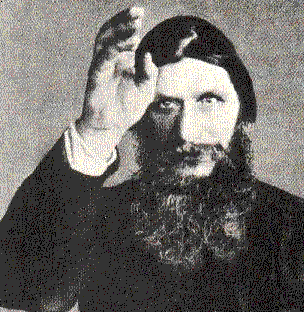
Once upon a time I was strip searched in Russia. That was back in the Reagan years. The “Gipper” had just called the Soviet Union an evil empire as I was trying to get in. And of course the Soviet border guards didn’t like the way I looked. I had John Lennon granny glasses and a bushy beard and in fact I did look somewhat like Rasputin “the mad monk” save that I was wearing blue jeans.
We face cross roads all the time–choices between freedom and grief. The national security governance of America is choosing grief with its insistence on “full body scanning” in airports. America has always been driven by terrors invisible and manufactured and just so, it has always had toadies like Senator Joe Lieberman to apologize with avuncular brio for the utilitarian necessity of suborning civil rights–what’s a toady to do?
James Ridgway’s piece “Who’s Getting Rich from the Naked Full Body Scanner Boom?” makes for good reading.
Americans are right to resist scans of their bodies and frankly to resist groping by TSA agents. To paraphrase Ronald Reagan, I’d rather die free than under communism. Reagan was of course talking about the right to worship, and I’m talking about your damned ass.
How much money fits up Joe Lieberman’s ass? Is it as much as fits up Newt Gingrinch’s hole? Can we scan this?

S.K.
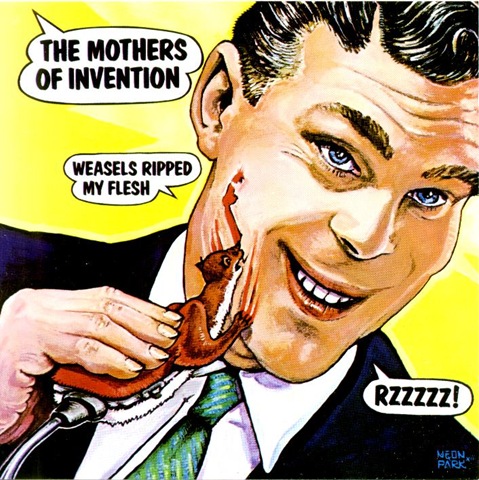
Back when I was a teenager and blind, depressed, living in a provincial culture so insufferable the air could give you hives–Nixon in the White House, Viet Nam spreading to Laos and Cambodia, stupid teachers like bell hops pulling their filthy cold war luggage, back then I sat up late thinking of particles. Vast magnetic streams sweeping through cosmic dust clouds. This was the perfect time to discover the music of Frank Zappa.
Of course no one discovers an artist in a vacuum. I was reading Fuck You: A Magazine of the Arts, edited by the poet Ed Sanders:
“Dedicated to pacifism, national defense thru nonviolent resistance, total assault on the culture, vaginal zapping, multilateral indiscriminate apertural conjugation, Hole Cons, Crotch Lake, Peace Eye, mad bands of stompers for peace, & all those groped by J. Edgar Hoover in the silent halls of congress.”
The particles, discordant, were me–they wouldn’t cohere to dopey television; particles of mind were apolitical, dancing through blackness, resting in zero and growing hot; one could have animated dreams.
Outside in the streets was the ossuary of America. In my room I played Zappa, especially early Zappa over and over.
I still hum and half sing “Who Are the Brain Police?” in the shower.
American media is an unintelligible cluster-quarrel of corporate war machines and religious hostilities. But painted across the half obliterated signs of our universe “outside” are beautiful darknesses of mother particles.
Here’s to the wide awake cold color of your eyes.
S.K.
By Andrea Scarpino
“Love is the most complex sensation in the world, partly because it’s a mix of everything there is to feel. Finding a definition for it could take a lifetime, and in the end, it’s still only a theory.”
~Gracie James
I’ve been in Boston more than three weeks with my friends whose daughter Gracie was killed in a car accident. Another girl was also killed. The car rolled twice. This beautiful girl, who was only 17, who was deciding for herself how to live, struggling to see her own future, this beautiful girl who was a writer, a skater, a music lover, a compassionate and thoughtful person, this beautiful girl.
And the love, these three weeks: a bouquet of flowers from the parents of the other girl who was killed, a dozen donuts delivered on the morning of Gracie’s memorial service, offers to bring Gracie’s little sister to and from school, a hired cleaning and laundry service, anonymous cash donations to the foundation begun in Gracie’s name. Again and again, the love has stunned me, brought me to my knees: Gracie’s skating friends brought dozens of flowers to her memorial, have offered to collect money for her foundation, are dedicating their spring show to her. Friends of her parents, people Gracie barely knew, ordered vegetarian meals be delivered, worked tirelessly to make the memorial service a healing and peaceful event. Church members baked dozens of cookies and brownies, pans of lasagna and macaroni and cheese so that we could eat her favorite foods after the memorial. A local Mexican restaurant that sponsors her boyfriend Sam’s soccer team donated burritos because they understood it was important to Sam.
Again and again, I have heard, “I just don’t know what to do.” But again and again, exactly what was needed has been done. An embrace. A cup of coffee. The creation of the memorial program. Photographs. Music. Offers of respite, a weekend away, a dinner with friends, drinking wine by a fire. Stories about Gracie, her many kindnesses. Donations for her foundation.
In one of Gracie’s writings, she says, “I hope to learn . . . to accept my past, to embrace my future. I want to learn to see beauty in the world again.” I’m not normally someone who believes in love-at-all costs, in unconditional love. I’m also not someone who has much faith in humanity, who thinks people are generally good or kind or loving. Often, when I think about love, I think about its fracturing, the moment it splinters in our hands. Often, I think about the worst humanity has to offer, the worst we do to one another.
But in these past three weeks, something has shifted, some opening of my heart. People I’ve never met responded to requests I made on behalf of my friends—trusted me, jumped into action. People who Gracie never knew—a high school English teacher from a neighboring town who read her story in the newspaper, friends of her grandmother, friends of her aunts and cousins—sent the most eloquent cards, gave generously. I’ve seen love firsthand, seen how it can manifest.
I want to be clear: Gracie was supposed to live. She was supposed to have an amazing career. We were supposed to meet for lunch throughout her life to gossip about her parents, exchange writing. Nothing can happen to make her death less senseless. But as I’ve slept in her room, as I’ve read her writing, as I’ve answered the front door again and again to friends, donations, flowers, food, I have to admit something in my heart has shifted. Gracie has helped me see “beauty in the world again.” Even amidst this horrifying loss. Even amidst this sadness.
Poet and essayist Andrea Scarpino is a frequent contributor to POTB.
One writes all my days
Living in the nameless world
Of mud and fire—
Wish I could tell you Father
How remarkably well
It goes…Winter coming
& growing old
With plain bravery
Saltiness of mind
Music in shadow
Larger contexts
Being ahead of premises
Like the best poets
Be your own flight
Walked across new ice today
S.K.
In memory of Allan A. Kuusisto who encouraged me to be a poet as opposed to an attorney…
The following brilliant excerpt comes to us via Inclusion Daily:
Aspergirls: We Are Creative, We Are Organized, And We Are Everywhere
(Psychology Today)
November 11, 2010
SAN FRANCISCO, CALIFORNIA– [Excerpt] There are those who want to “wipe out autism” vs. the “neurodiversity” advocates. There are advocacy groups like Autism Speaks vs. self-advocacy leaders like Ari Ne’eman. There are the vaccine controversies and more.
Autism is believed to be caused by a combination of genetic and environmental factors and researchers are really just beginning to hone in on what those factors might be. Of course it is good to know what they are and eliminate or reduce them. I understand the heartache of parents wanting to find out why their “once normal” child has become unreachable.
But to eliminate autistic traits altogether, as if it were some sort of plague is a very bad idea. As Temple Grandin often says, “eliminate my autism and you take away my genius.” Whenever I hear the words “defeat autism now” I feel like one of those bugs in the Raid commercials, scurrying to hide. I for one, do not want to lose my autistic traits and I can safely say, after interviewing hundreds of people on the spectrum, neither would most. The same spectrum that has me running from social situations is the same spectrum that has allowed me to publish hundreds of thousands of words in the last two years, illustrate my novel, learn a graphics program overnight and take up jazz singing and stand up comedy successfully within months….because I took a mind to.
I know I am not a ‘classic’ autistic and I don’t get involved in politics. But we, people with Aspergers, are cultural ambassadors; the bridge between neurotypical and autistic. We know what it’s like to be autistic and are high-functioning enough to express it. Any organization that has to do with autism simply must have aspies on its board. I believe that is the main criticism of the organization Autism Speaks – they had no autistic people on its board until recently and I believe, still have very few (translate: one).
Entire article:
The politics of autism: finding a cure vs. neurodiversity
http://www.InclusionDaily.com/news/2010/red/1111e.htm
Related:
Washington DC Chapter of Autism Self Advocacy Network planning on protesting Autism Speaks during November 6th fundraiser walk (Disabled World)
http://www.disabled-world.com/news/events/2010/autism-protest.php
It’s no secret that the late autumn rain is harder on people with disabilities just as it’s harder on the poor and homeless. In Heaven there will be no rain though the fruit trees will magically produce all the apples you want–with or without knowledge. Meantime it’s raining in Iowa and I must go out and stand a long time waiting for the bus, dog at my side, the two of us sagging like hanging laundry.
**
The disabled body is a political body. The rain is apolitical. The bus and its infrequency is political rain. The anthropology of political rain is nigh. Or the rain, a co-determinate of global warming is thoroughly political. Oh how helpless we are before these forces! Look at Obama stumbling around on the issue of climate change. Meantime we hunch into our coats.
**
This morning I’m thinking of the world’s poorest people, all of them in the rain and its not a rain of their own making.
S.K.

In America the busses that take children to school are painted bright yellow. Of course they are. Pointing this out is hardly the stuff of Heraclitus. But who was the first man or woman to paint the damned school bus and why yellow? Why does this preoccupy me? The latter question is the easiest: I’ve been blind for for most of my life, and now that I can see a little I’m largely flabbergasted by the commonplace. This morning, out walking, spying children clamoring aboard their bus I shuddered at the dreadful color of the thing.
The American school bus is the color of grief. It is the tint of failure. The shade of compromise and of committees.
One can say it’s the safest color. Americans would of course say this. But I guarantee that a bus can stand out with purple and scarlet roses–one need not read of Ken Kesey’s adventures to know this.
What I’m suggesting is that this yellow is the color of failure, of peaceable despond, of fitful illuminations without hope.
Do you find this color anywhere else?
I rest my case.
S.K.
 Planet of the Blind