Swimming at Noon

What happens is this: I go swimming at noon and while I do my laps I think about the failures of American foreign policy. I think about Iran and Iraq and the inhumane circumstances of imperial meddling—so much do I think on these matters that I ship some water into my lungs around lap 10 and my dog gets up (she’s leashed to the lifeguard’s stand) and surveys my situation, worried that I might be doing down for the count.

Yep. I worry when I swim. I think of Saddam Hussein’s ascendancy with CIA help; I think of “shock and awe” and the wholesale destruction of civilian life in Iraq; think of Iran’s long darkness—all a direct result of our installation of the Shah—and above all, the collective immateriality of human beings vs. big oil. I ship a little more water.

I remember that when W’s war in Iraq got underway that as far as I could tell, none of the writers at that year’s Associated Writing Programs conference were talking about the matter. I remembered in turn these lines by the Finnish poet Claes Andersson:


When cities and villages are burning

when rice fields are burning

poets light their candelabra

and write: “freedom burns

in my heart”

But the heart aflame

does not smell burnt

Burning villages do, however, smell

just as burning people do


S.K. 

What Ever Became of Me?

This was the first week of classes at the University of Iowa and somehow, what with meeting new students, attending meetings, and navigating a new computer that actually has Satan in its operating system, well, I've managed to drop off the blogosphere. I really hate dropping off the blogosphere because doing so makes me feel the old Lutheran panic of my upbringing. That is, there's a whiff of failure about the whole affair. This has nothing to do with my readers or even with the reality principle. The condition I speak of is analogous to having something troubling in your shoe.

Meantime I'm off to a good semester with students both undergrad and grad, and we're talking about poems and essays and what could be better?

I told my students in the undergrad class that Walt Whitman was very likely a frotteurist–a person who has orgasms from casual touch with strangers. In general terms one wants the students to get their money's worth out of a liberal education.

I must now contend with new information. Expand! Rouse the wits!

I told my students in the grad class that the word "fud" exists in the Oxford English dictionary and it means a "rabbit's rectum" –I wanted the MFA students to get their money's worth as well.

It is possible that my early fascination with the writings of Kurt Vonnegut Jr. has mangled my sensibility.

If I ask the question "whatever became of me?" there will be no end to the inquiry.

S.K.


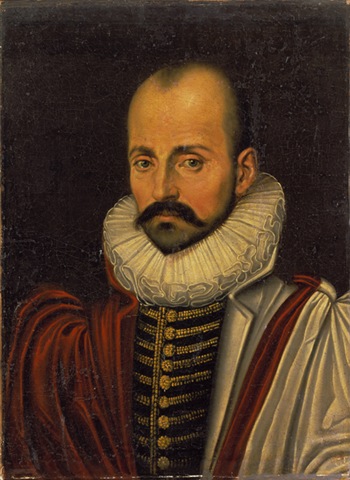
Thinking of Montaigne at the Summer House

montaigne


Such as accuse mankind of the folly of gaping after future things, and advise us to make our benefit of those which are present, and to set up our rest upon them, as having no grasp upon that which is to come, even less than that which we have upon what is past, have hit upon the most universal of human errors, if that may be called an error to which nature herself has disposed us, in order to the continuation of her own work, prepossessing us, amongst several others, with this deceiving imagination, as being more jealous of our action than afraid of our knowledge.

–Michel de Montaigne


I must confess to a lifetime’s worth of early morning restiveness, for I too gape after future things and this state is upon me with the first light. I grasp at what I imagine is to come. Accordingly I start my days in error. My mind is no freshly scrubbed tabula rasa. Early. The sun up. The mink is fighting down by the dock. He’s presumably fighting another mink. Me? I wake to the catterwaul and begin making mistakes of the deceiving imagination–being more jealous of action than afraid of knowledge.

Oh what the minks and Montaigne have done to me!

The first mistake–mine–is to imagine the future. The imagination–mine–is caught in fancies of poor or ghastly outcomes. The knowledge that these outcomes never materialize, indeed that my every deleterious fancy has failed to occur does not matter for Montaigne is correct: we are, when in a state of imagination, afraid of our knowledge. Who will imagine a good life? Perhaps Montaigne is also correct to infer that nature prevents us from living restfully in the present. No wonder the apes groom one another.

I have no grasp upon that which is to come. Please comb my hair for me.

Of course Montaigne would have us ponder these lines from Ovid:


“Scilicet ultima semper Exspectanda dies homini est; dicique beatus Ante obitum nemo supremaque funera debet.”

[“We should all look forward to our last day: no one can be called happy till he is dead and buried.”—Ovid, Met, iii. 135]

Of course the consolations of Philosophy are meager. Please comb my hair for me.  

I must tell you that these are my thoughts before I rise from bed.

Let the favors and disgraces of fortune stand for nothing. I told you Philosophy was meager.

Oh but you should see me when I’m not on vacation.

“Qui capite ipse suo instituit vestigia retro,”

[“Who in his folly seeks to advance backwards”—Lucretius, iv. 474]

I will not worry today about my graying hair, my bad back, or the compound brutish uncivil qualities of public life.

I will advance without a thought by taking a long swim.


I have no evidence of Montaigne’s swimming life.


S.K.

The Essay in Vitro


Abandoned House


“Moments and places, despite physical limitation and narrow localization, are charged with accumulations of long-gathering energy. A return to a scene of childhood that was left long years before floods the spot with a release of pent-up memories and hopes. To meet in a strange country one who is a casual acquaintance at home may arouse a satisfaction so acute as to bring a thrill.”

–John Dewey


1.

Start with a numerical arrangement—like Wallace Stevens with his blackbird. We’re flying over Connecticut in a glass coach.

2.

My step-daughter said to me one night when she was in high school that she had to invent a brand name for a hypothetical drug that would cure cancer. She was sixteen and had been volunteering at the university hospital. While riding in one of the hospital’s elevators when she met a young woman who announced that she’d recently shot herself in the head. “On purpose!?” cried my step-daughter, uncomprehending. And there she was, doing her homework in a circle of lamplight, wanting a good name for the megatheric cure. She was flying over Columbus, Ohio in a glass coach.

3.

When did schools figure that brand names and their creation should be part of a chemistry class? What if James Watson and Francis Crick had patented a name for the molecular structure of D.N.A.? What would the world be like if the double helix had a trademark? What if people had to pay a licensing fee to reproduce? Is this a Keynesian idea? Market driven expansion won’t exceed the means of production. There would be no overpopulation. The rain forest would still be intact. There’d be no global warming. The farmers of Jamaica could still grow their own food. There would be no international monetary fund.

4.

Essays require free play. Atta boy! He sells widgets coast to coast. Ain’t got no bus here a long time. I want to visit the foot of old Chestnut Street. I want to play the guitar like Elizabeth Cotton.

5.

In classical rhetoric there’s still this love of elasticity in the art of “assaying” the surround. Dionysius of Halicarnasus had the reggae and backbeat. Say what you will. The mind creates its crystal of divination. Analogy: anyone can carve a clump of shrubbery into the shape of a rabbit. Envisioning the shrub in the first place is more thrilling. Don’t underestimate delirium in the essay and remember that being somber is the topiary act, important but less important than you might think.

6.

Deep winter. The boys skated on a pond on the back forty of an honest to god nunnery. I was one of them. We skated by night, glancing occasionally at the tall, dark house of the nuns.

They went to bed early, those nuns. They were frugal. Their house was completely black.

7.

One of us had a bottle of whisky stolen from a father’s cabinet. Someone else had a box of miniature cigars. We were four boys, each in his sixteenth year, loose now under winter constellations, pretending at recklessness on a hidden pond.

8.

Writing of Auden, Dylan Thomas said he favored the mature and religious poet over the “boy bushranger”. I suspect that if Thomas could have survived his alcoholism, he’d have seen that they are one and the same. Quickness is prayer for some boys. We skated hard. The pond was smooth as onyx. The stars were available for naming. The stars were absolutely side-splittingly funny.

J. R. said there was a “Crab Nebula” –but with a cigar he sounded like Edward G. Robinson: “Yeah, yeah, listen here, see, there’s a Crab Nebula see, and it’s getting bigger because the universe is expanding, see…” He paused, the red ember of his cigar appeared to widen. “A crab fucking nebula, see…”

This led to further speculation concerning the “Pubic Nebula” and the far antipodes of the “Big Anus”.

Jack suggested that Richard Nixon had landed on the earth having journeyed directly from the “Big Anus”.

Carl opined that Spiro Agnew was a “spirochete”.

I’d say we were generally apolitical, but like most boys in 1971 we knew we were cannon fodder. We also read a bit. I’d found these lines by Stephen Spender in the high school library:

Who live under the shadow of a war

What can I do that matters?

Such questions are answered hormonally. Teenagers dive headfirst into shallow pools or walk the railings of bridges. They know that human worth is achieved only through the glory of narrow escapes. The lads take up night skating without testing the ice.

I stood up and felt the pinch of my hockey skates—they were never comfortable, and scraped forward through bunched snow. Smooth ice was coming. And bourbon. The prose-song of hot blood and liquor. The canto puerisque as Horace called it. And yes, there’s more than a little of death whispering in your ears. The stars have never been so beautiful as they are just now. The Crab Fucking Nebula…

9.

We drove the back roads with the headlights off and the heater turned up. The fields were sown with winter rye. Orchards glittered; a thousand apple trees stood covered with ice. There would be houses out here that we knew had been abandoned. In the years since World War II this part of Western New York had been forgotten. There were hundreds of farmhouses standing empty just waiting for us. We bounced and bumped the car down rutted paths until we found them, boarded up and mournful. Houses dark as artesian wells. We stared from the security of the car. Nothing stared back.

10.

“On the whole I’d rather be in Philadelphia,” I said. We sat in the Oldsmobile with our cigars– “Swisher Sweets” –the tobacco cured with cherry brandy. The station wagon belonged to Jack’s father. I wondered if on Sunday mornings Mr. Nyquist noticed the stale odor of burnt socks while driving to church.

“Hey if there’s a radio in there it’s mine!” said Carl.

“Hey if there’s a trunk of money in there, it’s mine!” said Jack.

“Yeah, and if there’s a fuck you in there, it’s mine,” said J.R..

The house was a three-story 19th century frame affair. It had a mansard roof that sloped above tiny attic windows. Those black little windows looked like eyes. The porch was sagging beneath some invisible weight. Chokecherry trees and locusts leaned where the steps should have been. It was time to go in. We made our way over the frozen snow to a basement bulkhead. We’d decided to go in through the cellar. One of us said the basement would be the safest approach. That’s the way it is with boys, they display a kind of ersatz rationality while doing things the hard way. Faced with a sagging house we concluded the cellar was the best way in.

11.

The bulkhead door fell away revealing broken stairs that led straight into utter blackness.

“The black hole of Calcutta,”” said J.R.

“Jesus, that’s really fucking sinister,” said Carl.

We tied a rope to the Oldsmobile’s bumper and clambered down the stairwell one by one.

Abandoned houses have a smell unlike your average neglected quarters. The latter are mildewed and smell of soaked wool. A house long empty smells like the earth. I had a college roommate who worked as a gravedigger for a time because he’d tired of studying economics. He said that there’s a change in the fragrance of the earth when you dig below five feet. “It’s a lithic odor,” he said, “the smell of the earth that doesn’t need us.”

Deserted farmhouses have that scent. I’m guessing that a house needs to stand empty and largely unvisited for at least thirty years before it acquires a smell that says human affairs have been forgotten. Find an old house still floating alone on its forsaken river and you’
ll find this scent.

12.

The houses I liked best were those that seemed like the Marie Celeste, a ship found adrift without any sign of its crew, yet with every object aboard still in its place and hinting of normalcy. Our flashlights scoured the basement walls and floor. A dressmaker’s dummy froze us in place, a headless, dun colored torso wearing a white button down shirt, a shirt ready for Monday, its owner still upstairs and stepping from the shower. Caught in the circle of a flashlight’s beam the mannequin appeared to stand.

It’s good to have whisky in those circumstances. We passed the Old Granddad. We could hear the house swaying above us, its timbers adjusting in the wind.

Looking back on it I see now that we were each persuaded in his way that the dead matter. One believed in an afterlife of Georgian architecture; one believed that we are returned to a mineral blank; one hoped that there might be a place for conversation, a kind of limbo, where sorrows are ameliorated. One believed with moderation in the transmigration of souls. We scarcely talked about any of this. Boys who collect things have no time to talk.

13.

We climbed broken stairs and stood in the ruined, moonlit kitchens and fingered dishes and spoons, a woman’s turban with black feathers…a Life magazine with Claudette Colbert…a cardboard box of phonograph records… a red wig, apparently made of human hair… A tin canister labeled “Parisian Depilatory” distributed by the Sears, Roebuck Company, “Cheapest Supply House on Earth, Chicago, Illinois”.

“What’s a depilatory?” said Carl,

We passed the tin and held it before our flashlights.

“It’s a laxative,” said Jack.

“O shit! Here, you take it,” said J.R. He thrust the can into my hand. I held it up to my nose since my vision wasn’t good, and saw the highly stylized face of a Victorian girl with luxuriant, raven tresses. There was corrosion where her nose should have been.

“I think it’s some sort of woman thing,” I said, putting the can gently on the windowsill where the moon could shine on her rusting face.

Carl had discovered a tall, steel bound wooden steamer trunk and was busily fidgeting with the hasps.

Inside, folded neatly were infant’s dresses, a small pearl handled brush and comb. A hat draped with poppies and foliage…a man’s brier pipe with a tiny egg-shaped bowl…And embroidery, white lace and black. Carl raised the embroidery before his pink face and spoke the signature line of A Streetcar Named Desire: “I’ve always depended on the kindness of strangers!”

14.

During the Second World War the military bought land throughout the Finger Lakes region of western New York. Then they gave the farm families just a few days to get out. The army air corps built an air base in the bean fields overlooking Seneca Lake. In the meantime the abandoned houses stood just as they’d been left, far back from the roads, surrounded by trees.

By the early 1970’s the air base was also abandoned. Weeds grew in the concrete barracks. Boys drove from neighboring towns, often with nothing more on their minds than breaking windows.

But the old houses had to be sought after. They required forethought and research.

“Do you remember a farm house up this way?” we’d say to a woman at a roadside corn stand. “My grandparents used to live up there.”

We looked nice enough. Four boys.

When we found a lost house we’d make plans to come back after skating by starlight.

C.S. Lewis said, “When I was ten I read fairy tales in secret, and would have been ashamed of being found doing so. Now that I am fifty I read them openly. When I became a man, I put away childish things, including the fear of childishness and the desire to be very grown up.”

We worked our way through kitchens, and bedrooms, sewing

rooms, the old front parlors. Jack hoisted a huge, nickel-plated deep blue accordion and squeezed out weighty groans. We laughed like mad. The fear of childishness was upon us. The fear of outfitting ourselves as men was upon us. The fear of foreign wars was upon us. In one parlor we found “The Billhorn Telescope Organ” –a portable church organ that could be folded into a trunk. It was popular with the “circuit riders” –ministers who drove across rural counties during the Great Depression. J.R. sat at the dusty keys and worked the pedals with oversized shoes and played Bach, serviceably, with a dead man’s cap tilted on his head.

15.

Dana paramita is the Sanskrit phrase for the perfection of charity. Even teenage boys have it in their oversized, half awake hearts. We left the house that night, and drove by moonlight to our own homes, and we hadn’t taken a single thing. We had respect for those missing people. There’s more to the souls of boys than we commonly suppose.

16.

I wanted to write an essay but feared I had nothing to say. My step-daughter is is a serious girl. She wants to be a scientist. I’m happy about this. She doesn’t like to skate—doesn’t care for the cold. Belongs to a church group. I think she has things figured out. But I fear for her orderliness. And she hates writing. Begin with numbers, I tell her. Imagine each numerical paragraph as a mysterious house…


S.K.

Prop 8 as Seen from Blueberry Ridge

wild blueberries


By Andrea Scarpino


US District Judge Vaughn Walker has ruled unconstitutional California’s Proposition 8 that denied marriage to same-sex couples. In his ruling, Judge Walker wrote, Indeed the evidence shows Proposition 8 does nothing more than enshrine in the California constitution the notion that opposite sex couples are superior to same sex couples. Because California has no interest in discriminating against gay men and lesbians, and because Proposition 8 prevents California from fulfilling its constitutional obligation to provide marriages on an equal basis, the court concludes that Proposition 8 is unconstitutional.

Last weekend, Zac and I picked blueberries in Marquette along a trail called Blueberry Ridge. When we left the house, we didn’t know where we were going; people kept telling us it was a great year for wild blueberries but weren’t specific about where to pick them. So we started driving. We pulled off of the highway a couple of times to look along the side of the road before we came upon a sign for Blueberry Ridge. If any place was going to have good berries, that seemed like it. So we pulled into the trail parking lot, jumped out of the car, and started picking. In the parking lot. Eventually, a fellow blueberry picker came out of the woods and led us to a better place, and there we wandered for over an hour, bending into the low bushes, delighting when we found a hot spot with dozens of berry bundles clumped together.

When a log presented itself, we sat on it. When the mosquitoes started attacking, we paused to apply bug spray. And we came home with container after container of wild blueberries. Some we immediately made into celebratory cocktails, but the majority we froze to eat throughout the winter.

Zac and I are not married—for political reasons I say when someone asks. Neither of us believes we should marry when everyone in this country isn’t allowed the same. Even though Judge Walker provided a giant step forward in this country’s fight for marriage equality, larger legal battles are brewing. I am optimistic that gay marriage will be legalized in my lifetime, but I am not optimistic enough to believe that this ruling signals a definitive change. And even when marriage is legalized for everyone—even those who don’t identify themselves as gay or straight—then will Zac and I marry?

One definition in the Oxford English Dictionary of to marry is to handcuff together. Another is, (of whisky, wine, etc.) to age or mature. And finally, my favorite: Naut. To splice (two ropes) together without any resulting increase in girth; to bring together (two ropes) so that they can be hauled together equally.

The truth is, blueberry picking is laborious and uncomfortable. Blueberries grow close to the ground and picking them involves a lot of bending over, trying to find the right way to stand as you reach through the underbrush. By the time we left Blueberry Ridge, my back and neck were sore, my fingers stained blue. But together, Zac and I had picked hundreds of berries. I support a legalizing of marriage for everyone, no matter what. But I also think that loving another person should be more like blueberry picking and less a handcuff together. More like fresh air and dirt trails. More like hauling together equally.


Poet and essayist Andrea Scarpino is a frequent contributor to POTB. You can visit her at www.andreascarpino.com

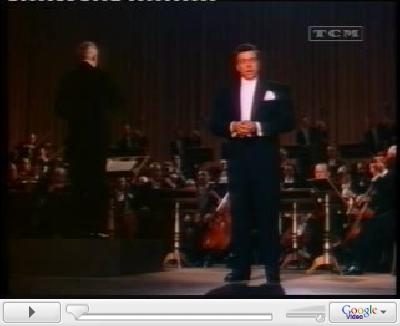
Mario Lanza as "The Great Caruso"


I have been thinking of the movies of my childhood and “The Great Caruso” starring Mario Lanza came to mind when I thought about the flicks that have in some way “steered” my life. I first saw this film when I was around 9 years old and home from school for some reason and watching the afternoon movie on one of the three TV stations we could get with our rabbit ears atop our black and white Zenith. I had earlier discovered Caruso while listening to old Victrola records in my grandmother’s attic. I was in short, already in love with Caruso. If you haven’t seen “The Great Caruso” it’s really worth your time and a click with Netflix. Of course Mario Lanza had matinee idol good looks like the young Placido Domingo and Caruso did not. But Lanza has the voice and in some moments sounds eerily like Caruso. What’s clear is just how much Lanza loved the great tenor from Naples. And that’s what I love about the film: it’s a devotional study rendered in music of the joys of influence in art. In short the film is poetry. By God. We are once more in love.


S.K.

Watching "To Kill a Mockingbird" with My Sister

http://movieclips.com/watch/embed/to-kill-a-mockingbird-1962/scout-meets-boo-radley/0/94.636

Last night my sister Carol and her partner Michelle and my guide dog Nira gathered on the sofa to watch the classic film “To Kill a Mockingbird”. I was on that sofa too. It’s amazing how many people and creatures you can squeeze on an old couch at the summer house. But I digress.

It’s been many years since I last saw TKAMB or last read the novel by Harper Lee. I’ll bet the last time I read the novel was when I was in high school, or perhaps even earlier. So it’s been since 1968. I think that’s a pretty good guess. I was 13 in ’68. That was also the year I read “Animal Farm” and “1984” and the stories of Franz Kafka. I had to hold the books about an inch and a half from my left eye. Nowadays I can hold them three inches from my left eye. But I digress.

1968 was the worst year in American history if you discount 1861-65 or 1929-39 or 2010’s “Depression” which is still leaving some 30 million of our citizens unemployed, perhaps permanently, but I digress. I digress.

My sister (who is a physician) and I grew up in a disturbingly dysfunctional family. Our mother was outright scary though brilliant. Our dad was a highly successful college president but he was largely an absentee persona, leaving us to fend for ourselves with his terrifying wife. Although I owe much of my irreverence and nerve to my mother I also inherited from her a furtive and uncomfortable depression that segues with my vision impairment. Like tens of millions of Americans I work hard every day to navigate this depression with grace and candor and steadfastness. Who knows how far back our collective depressions go? Perhaps in ancient times depression kept you in the cave on days when going outside was statistically unsafe. Cheerful Ogg went out and was devoured by the saber toothed tiger but depressed Oog stayed inside on that day, probably licking the stalagmites for natural lithium. So Oog went out the next morning when the tiger was asleep.

Last night watching TKAMB I saw for the first time how the movie is about the capacity of children to stake a claim to a soulful and nurturing inner life against the backdrop of sinister adults. At 13 I understood it only as a story of racial intolerance and injustice. But watching it again with Carol and MIchelle and Nira I saw the remarkable individuated intelligence of Harper Lee who crafted a narrative of magic stones, sub-conscious empathy, childhood curiosities, and deep love and compassion. We are living in a time now when the these human qualities need as much narrative dispensation as they did in the 60’s. Post-modernity and political factionalism cannot take the place of brotherly and sisterly love. Of course. And yet, and yet, watching the film you feel it–a marrowed sense of loving’s urgencies and that Harper Lee’s summer long ago can get you right.

Saving the women and children of Afghanistan?

I want our troops out of there now!  I want the war over now! I want our troops to come home and the war to be over and all the women and children of Afghanistan to be safe from retaliation by the Taliban when they take over after we go and…

via lancemannion.typepad.com

The moral calculus for American troops to stay in Afghanistan is drawn rather clearly on Lance Mannion's chalkboard. Which is to say that the story is as muddy as Dick Cheney had hoped.

On Being Heartened: Applause for School Inclusion In Madison

The following article comes to us by way of the Inclusion Daily Express. The full article is in the NY Times.


A School District That Takes The Isolation Out Of Autism
(New York Times)
August 2, 2010

MADISON, WISCONSIN– [Excerpt] Garner Moss has autism and when he was finishing fifth grade, his classmates made a video about him, so the new students he would meet in the bigger middle school would know what to expect. His friend Sef Vankan summed up Garner this way: “He puts a little twist in our lives we don’t usually have without him.”

People with autism are often socially isolated, but the Madison public schools are nationally known for including children with disabilities in regular classes. Now, as a high school junior, Garner, 17, has added his little twist to many lives.

He likes to memorize plane, train and bus routes, and in middle school during a citywide scavenger hunt, he was so good that classmates nicknamed him “GPS-man.”

He is not one of the fastest on the high school cross-country team, but he runs like no other. “Garner enjoys running with other kids, as opposed to past them,” said Casey Hopp, his coach.

Entire article:
A School District That Takes the Isolation Out of Autism

http://www.nytimes.com/2010/08/02/education/02winerip.html