Seeing Without Looking Day


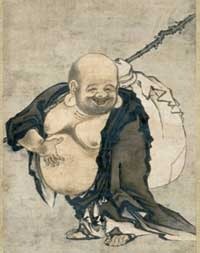
Zen Monk with Knap Sack


As I believe that disabilities offer ways of knowing and as I see no distinction between able-bodied-ness and bodies that are customarily thought “broken”–(for the “temporarily abled” think about disability always–fear it, pay billions in insurance, hence are socially disabled) just so, by virtue of the power given unto me I declare today “Seeing Without Looking Day”. Here are some lines from the Tao Te Ching:


Without opening your door,

You can open your heart to the world.

Without looking out your window,

You can see the essence of the Tao.


The more you know,

The less you understand.


The Master arrives without leaving,

sees the light without looking,

achieves without doing a thing.


–translation by Stephen MItchell


**


The first thing you’ll discover after you’ve tied on your blind fold is that nothing in the world prevents you from opening your heart. Sure, you will find lots of hard furniture. And cooking without looking will, at first seem impossible (though it gets better). And of course as you navigate your way down the street with your white cane you’ll meet people who want to pray for you or try to help you by grabbing your arm–hence you will have to learn an almost supernatural grace in the company of pedestrians. Ah, but you will say to yourself:  “The Master arrives without leaving, sees the light without looking…”


**


I’m not a big fan of those campus events where able-bodied students get to try out a wheelchair for a day or don a blind fold or what have you. The point about disability is that its permanent and for such an exercise to have any meaning it would have to last for at least a year, thereby guaranteeing the participant the opportunity to experience disability in all seasons. Stand in the pouring rain waiting for the bus with your guide dog. Try to make your way in a wheelchair in winter in a place where there’s snow. The Tao again: “See the world as yourself. Have faith in the way things are…”  

Have faith in the way things are.


**

Another way to say this is: “Have faith in the way things “are not”–this is the disability way. Perhaps you think I’m kidding, but I’m not kidding. The wheel chair user must navigate the injustices of architectures and the sloppy habits of store managers. If the wheel chair user allows her day to be ruined she will lose the wealth of her mind. Just so: if she does not protest she will lose the righteousness of her cause. What to do? Well, just as it says in the Tao: “the best General enters the mind of his enemy”. Yes. You must become the sloppy store manager. Become the lackluster university disability services administrator. Yes, the very thought is like thinking of swallowing iodine. But remember, the aim here is to not let obstacles ruin your mind. And so you say to the miscreant store manager (for thus we shall call him): “Say, good sirrah, my way is blocked in your aisles, can we work together on this problem?” Yes, sometimes you will have to call the police.


**


Yes. “Seeing Without Looking Day” will test your Tao. It well test your Tao the way a string gets caught in the vacuum cleaner and you must spend a solid hour on your knees and fumbling with your fingers imagining that failure is an opportunity. Yes. Not going mad is an opportunity. Not living your life envying others is an opportunity. If you think I am crazy then that’s also an opportunity. The world is not “blind friendly”–if you blame someone else there is no end to the blame. Therefore the Master fulfils her own obligations and corrects her own mistakes. She does what she needs to do and demands nothing of others. (Tao 79)

Do you think I’m giving up on civil rights? Not on your life. But “Seeing Without Looking Day” teaches you how to choose your fights. The lamp post is not your enemy. The lamp post is just a fact. The waiter who won’t let you into the restaurant with your guide dog seems like an enemy. But he is just a fact. To keep sane, argue hardly at all but call the police. Let them explain the matter. Do not give away your soul-power by arguing with a lamp post. The lamp post is not a comment on your life.


Do you think I’m crazy? The Tao again: Whoever can see through all fear will always be safe.”


S.K.
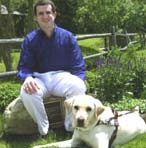
Jeff Dunn, We Hardly Knew Ye

Jeff Dunn


I received word yesterday that my friend Jeff Dunn has passed away after a long struggle with cancer. Jeff was the “Computer Czar” of Guiding Eyes for the Blind and an enthusiast of assistive technology for people with disabilities.

I first met Jeff when I attended a Guiding Eyes for the Blind “walkathon” in October, 1994 and discovered he was my “room mate” at the Marriott Hotel. Jeff was a non-stop fountain of knowledge about computers and he also knew more about science fiction than I could absorb in a lifetime. I knew instantly that I was in the company of someone who relished the idea that machines could and would change the lives of people with disabilities forever.

Jeff was tireless in his pursuit of knowledge about technologies for pwds (people with disabilities) and he knew which software patches were necessary if you wanted JAWS to work with instant messaging (though he could also tell you why you didn’t “want” instant messaging in the first place–always recommending something better). 

To say that Jeff will be missed is too simple. To say that he’s in Heaven now with Charles Babbage (the Victorian inventor of the forerunner of the computer, “The Difference Engine”)  is too easy. I think Jeff would like it if we imagine him in an afterlife where we get to be reunited with our loved ones and our dogs and where the machines are as infallible and user friendly as they are on Star Trek: The Next Generation

Boy! Could Jeff talk about Star Trek! And boy did he love his people and his dogs! And boy did he love Guiding Eyes for the Blind!

And boy do we miss him.

I used to crack Jeff up with a joke about an octopus in a bar. I can’t tell it here. But I will remember most of all Jeff’s wonderful laughter.


S.K.


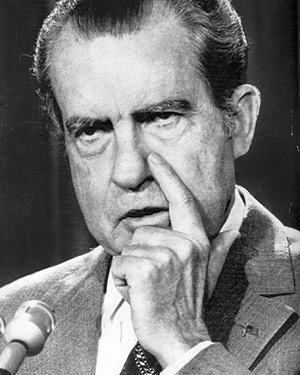
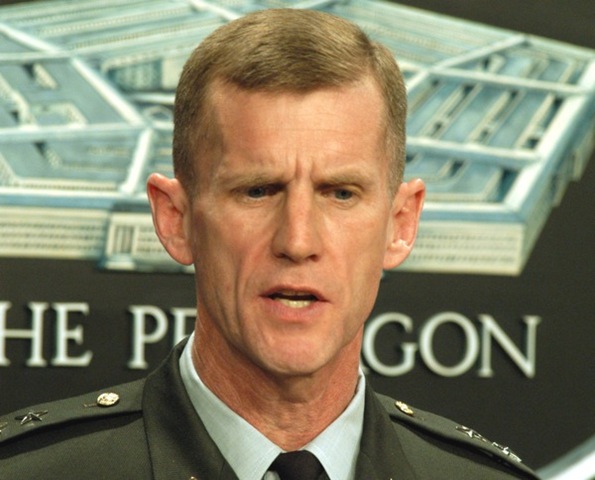
The New Rule of Thumb? What Would Nixon Do?

Nixon mcchrystal1


It was in the steam room where men achieve greatness that my friend Geronimo said that President Obama should ask himself “What would Nixon do?” as he contemplates the fate of Gen. Stanley McChrystal. I think that’s a “spot on” idea, a capital idea, a non-pareil–and I don’t mean movie candy. I call this the WWND principle.

Nixon of course would call the general to the Oval Office for a bowl of cottage cheese with ketchup.


S.K.

Disability Terminology 101


The following article by S. E. Smith on disability terminology and popular media comes to us via the Inclusion Daily Express. You can read the whole piece by going to Inclusion Daily. 


S.E. Smith: A Starter Kit For Nondisabled People And The Media

(Feministe)

June 21, 2010
FORT BRAGG, CALIFORNIA– [Excerpt] I thought I’d write a very brief primer on some disability terminology in US English, to familiarise nondisabled readers with the language that has arisen as disability rights activists fight for the right to self identify, to resist ableist language, and to confront problematic framings of disability embedded in the way we talk about disability.

The disability rights movement is much older than many people realise and from the start, people were tackling, confronting, and challenging language. Respectful language is already here; it’s been developed, refined, and used by people with disabilities for decades, it’s just disseminating to the general population very slowly.

It’s important to remember here that self-identification trumps all — if you are talking to or about a particular person, please ask how that person identifies or would like to be referred to.

It’s also important to remember that there are different frameworks for thinking and talking about disability, not just around the world, but in the United States. While this primer is broadly useful for talking about disability in the US, because that is where I am writing, your mileage may vary.

Entire article:
Disability Terminology: A Starter Kit for Nondisabled People and the Media

http://www.InclusionDaily.com/news/2010/red/0621e.htm
Related:
The media’s struggle with disabilities (Chicago Now)

http://www.InclusionDaily.com/news/2010/red/0621f.htm

Poets are Vindicated at Long Last! Metacognitive Skill is THE THING! (If a "thing" were possible) etc.


Darwin Awards CartoonConfucius

Back in 1995 a man named McArthur Wheeler was quickly arrested after he robbed two banks in Pittsburgh. He’d smeared lemon juice on his face believing it would prevent surveillance cameras from recording his image. An article in today’s New York Times by writer and film maker Errol Morris entitled the Anosognosic’s Dilemma: Something’s Wrong But You’ll Never Know What It Is takes a delightful look at what is now known as “The Dunning-Kruger Effect“. The gist of the Dunning-Kruger effect is that people who don’t know what they don’t know are prone to inflated self-assessments. See this link for Professor Dunning’s original paper on the subject.

I’ll quote the abstract of Dunning’s paper in full:

People tend to hold overly favorable views of their abilities in many social and intellectual domains. The authors suggest that this overestimation occurs, in part, because people who are unskilled in these domains suffer a dual burden: Not only do these people reach erroneous conclusions and make unfortunate choices, but their incompetence robs them of the metacognitive ability to realize it. Across 4 studies, the authors found that participants scoring in the bottom quartile on tests of humor, grammar, and logic grossly overestimated their test performance and ability. Although their test scores put them in the 12th percentile, they estimated themselves to be in the 62nd. Several analyses linked this miscalibration to deficits in metacognitive skill, or the capacity to distinguish accuracy from error. Paradoxically, improving the skills of participants, and thus increasing their metacognitive competence, helped them recognize the limitations of their abilities.


As they say in a popular TV commercial: “Dogs don’t know its not bacon!” 


The direction of Errol Morris’ piece in the Times is that not knowing what you don’t know frames an epistemological opportunity but only if one recognizes the limits of self-knowledge. “Real knowledge is to know the extent of one’s ignorance.” (Confucius)   

One thinks of Wallace Stevens‘ famous concluding line from his poem “The Snow Man: “the nothing that is not there and the nothing that is.” We know who we are and who we are not provided we possess sufficient skepticism about the consolations of sentiment and the errors of consciousness.


All of which is to say that none of this is news to poets. Consider the following short poem by Charles Simic:


Bedtime Story


When a tree falls in a forest

And there’s no one around

To hear the sound, the owls

Have to do all the thinking.


They think so hard they fall off

Their perch and are eaten by ants

Who, as you already know, all look like

Little Black Riding Hoods.


Or these lines by Anselm Hollo:


wherever there is a hole

in a metaphysical fabric

you are sure to find a

hundred metaphysicians

attempting to fill it


but above our residence

on earth the sky

is clear, an

uncommitted

avantgardist


**


What we do not know is the framing or incitement principle of poetry in the 20th century. Here are some lines by Gunnar Ekelof that I particularly like:


This music is like ankle rings

if nothing is the ankle and nothing the rhythm…


S.K.


Unemployment, Disability Awareness and Higher Education

no_access_symbol Old Capitol Building U of Iowa


The article below comes to us via Inclusion Daily Express. It is interesting that twenty years after the passage of the Americans with Disabilities Act that “stigma and misconceptions remain in some workplaces, making it challenging for the disabled to even land interviews”. My argument is that the failure of higher education to create strong, seamless disability inclusion in all areas of academic life has meant that students with disabilities largely remain outsiders in the customary diversity dynamics of campus life. My own university (the University of Iowa) has a student disability services office located in the basement (I kid you not) of a dormitory–a basement that can only be accessed via elevators. I’ll leave it to you to imagine how a wheelchair user would get out in a fire, or how a blind person might even locate the place.)

Bad as that is, the UI also has major academic buildings that remain non-compliant with Title II of the ADA. Title II requires that bathrooms and adjacent public facilities (water fountains, doors, telephones, and the like) be made accessible whenever a renovation occurs in an older building. If you renovate a classroom (or even a broom closet) you must renovate the bathrooms adjacent to that classroom or broom closet. The UI’s student union has floor after floor of inaccessible restrooms. Recently the university put an art museum on the fourth floor of the building. You guessed it: no accessible bathrooms. My own academic building (the English-Philosophy Building) has been renovated on every floor and still has no accessible restrooms though there’s a plan to install them on one floor this summer. That installation will be of little help if you’re in a wheelchair on the fourth floor and you have a catheter and the elevators are busy. All of these problems represent a violation of the law but I’ll argue that this is less a matter of jurisprudence than it is a matter of culture. What lessons do universities teach future business leaders by relegating people with disabilities to the basement and by insisting that that pesky ADA is to be honored only rhetorically?

Occasionally I hear from some abstract administrative source that things at the UI are going to get better. Meantime I’m supposed to take the stage this summer in Iowa City with Iowa Senator Tom Harkin (who co-authored the ADA) to celebrate the ADA’s 20th anniversary. That is of course an honor and one that I will cherish. But I know and now my blog’s readers know that my university is complicit in training its future graduates to think of people with disabilities as a problem. Small wonder then, that real people with real disabilities continue to struggle with stigma and misconceptions in the workplace.    


Stephen Kuusisto


People With Disabilities Continue To Face Higher Jobless Rate
(Boston Herald)
June 18, 2010
BOSTON, MASSACHUSETTS– [Excerpt] Nearly two decades after the passage of the Americans with Disabilities Act, advocates for the disabled say much work remains to train disabled job-seekers and match them with employers, especially during the jobless recovery.

Stigma and misconceptions remain in some workplaces, making it challenging for the disabled to even land interviews, advocates say. While the May unemployment rate in the United States for the general population was about 9 percent, the rate among the disabled was nearly 15 percent.

Businesses slammed by the recession have made cuts that have hit the disabled particularly hard, eliminating the part-time and temporary work that many disabled workers seek, said Jay Himmelstein, a professor of family medicine at University of Massachusetts Medical School.

Cindy Higgins of Jamaica Plain, who has cerebral palsy, worked as a peer counselor at Boston Self Help, a nonprofit group that serves the disabled, for 15 years before her job was cut several years ago due to state budget cuts, she said.

Entire article:
High jobless rate burdens disabled

http://www.InclusionDaily.com/news/2010/red/0618b.htm


Boredom is the Best Defense

Writing in the UK’s Daily Telegraph, Mark Borkowski observes that while testifying before the United States Congress, BP CEO Tony Hayward looked “like a tired undertaker who was rather bored with having to look mournful.”


Tony Hayward testifies in front of a key Congressional committee.


The history of boredom has yet to be written but here are some highlights offered in a sincere effort to contextualize  Mr. Hayward’s performance: 


Thomas Carlyle

Thomas Carlyle:

“I’ve got a great ambition to die of exhaustion rather than boredom.”


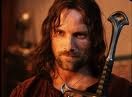
Viggo Mortensen

Viggo Mortensen:

“There’s no excuse to be bored. Sad, yes. Angry, yes. Depressed, yes. Crazy, yes. But there’s no excuse for boredom, ever.”


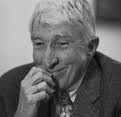
John Updike


John Updike:


“A healthy male adult bore consumes each year one and half times his own weight in other people’s patience.”


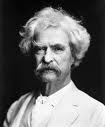
Mark Twain

Mark Twain:

“Let us live so that when we come to die even the undertaker will be sorry.”


Of course when you mix the advice of attorneys with a penchant for the appearance of upper class disinterestedness you’ve got a helluva a PR cocktail.


The best book on boredom (in my view) is Patricia Meyer Spacks’ Boredom: The Literary History of a State of Mind.

If boredom is a modern preoccupation–one that is a co-efficient of leisure and of dramatic or comic narratives (the novel) then yesterday’s performance by Mr. Hayward was an engagement in cynicism and despair. Boredom as a condition means that the bored “subject” no longer believes in the future–either his or anyone else’s. It remains to be seen whether Mr. Hayward is in this camp. But the infusion of legal discretion as a necessary dynamic of public testimony invariably must lead to a dire absence of personal narrative–and hence the hyper- cognition and soiled drama of the politicians.


Boredom for everybody!


Sic semper borianus!


S.K. 


Matt Eddy and Ron Steenbrugen "On the Road"


An article in the Albany Times Union highlights the cross country journey of Matt Eddy who is crossing the United States in his motorized wheelchair to highlight the independent living movement. Matt is being accompanied by his friend Ron Steenbrugen who is following him on a mountain bike.


There are still tens of thousands of people with disabilities warehoused in hospitals and state institutions who have the desire and the ability to live in their own communities. The independent living movement and groups like ADAPT are on the front lines advocating for the rights of citizens with disabilities to live like, well, “citizens”. 


As the Marines would say: “improvise, adapt, and overcome…”


S.K.