Home Fires

Today’s New York Times carries a reprinted post from Home Fires, a blog that carries writing by military men and women who have recently returned to the U.S. from foreign deployments. The writer of the Times piece is a fellow named Roman Skaskiw and his description of the mind numbing bureaucracy that precedes a battlefield deployment is so darkly funny that I was in fact reminded of Kurt Vonnegut Jr. I was further delighted to discover tht Mr. Skaskiw lives in Iowa City. Perhaps I will meet him one of these days. Happy reading!


S.K.

Talking with Lance Mannion

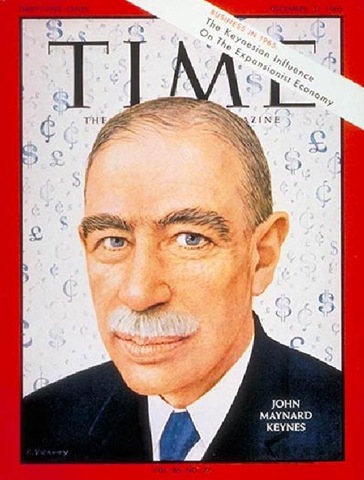
Popeye the Sailor    Time Magazine Cover featuring John Maynard Keynes


I spoke early this morning with Mr. Mannion who is currently revisiting the films of the late director Robert Altman. We laughed about one of Altman’s oddest flicks, his film adaptation of the comic strip “Popeye” starring Robin Williams and Shelley Duvall as Popeye and Olive Oyl. Lance, ever discerning, observed that aside from the movie’s general oddness, it’s chief failing resides in the script’s reliance on a plot that’s essentially extrinsic to the variorum life of the comic strip that inspired the undertaking. Now I confess to occasional abstruse thoughts, for instance I wonder if the world of post-industrial economics would ever have been possible without John Maynard Keynes’ general theory of employment, interest, and money–which is a long way of saying that sometimes I’m looking for someone to blame for our current mess and if it isn’t Keynes its going to be some other poor bastard as I sit in my study and practice my kama sutra of umbrage. But the fact that Popeye the film stinks owing to Jules Feiffer’s infidelity to the Sunday comics is an example of perspicacity gone wild and I’m in awe. And all this time I thought it was just a dumb movie.

“It sure is a complex woild, ain’t it Olive? Ca-ca-ca-ca-ca-ca! Deviated septum cleared up yet Olive?”


S.K. 

A Largely Lonely Triumph: Disability and Contemporary Higher Education


vintage photo of Victrola with listening dog

I have lately been reading "Helen Keller: A Life" by Dorothy Herrmann. The following passage jumped out at me:

It was largely a lonely triumph. As the twenty-year-old Helen soon discovered, college was not the "romantic lyceum" that she had envisioned. At Radcliffe, which had been forced to accept her as a student, she was more profoundly aware than ever before of her blindness and deafness. Only one of her classmates knew the manual finger language. Another girl had learned to write Braille, copying as a present Elizabeth Barrett Browning's Sonnets from the Portuguese, but Helen never heard from her after graduation. The other students tried to be friendly whenever they saw her at a local lunchroom, and according to Helen, "Miss Sullivan spelled their bright chatter into my hand." But she was painfully aware of the gulf between them, even though her classmates tried to bridge the gap by such lavish, awkward gestures as buying her a Boston terrier, which she promptly named Phiz. Presumably the dog would compensate her for what they were either too timid or too busy to give and what she secretly longed for: "the warm, living touch of a friendly hand."

And here's another revealing passage:

Of Helen's professors, only one, William Allan Neilson, who later became the president of Smith College, took the time to master the manual finger language so he could communicate directly with her. As Arthur Gilman was closely associated with the college, she and Annie were politely ignored by the rest of the faculty and administration, including the autocratic Agnes Irwin, the dean of Radcliffe, and the august Dr. Charles W. Eliot, the head of Harvard.

The snub did not surprise Annie, who was still furious about the plot at the Cambridge School to separate her from Helen. "I would much prefer to have people despise me as they certainly would if they guessed how full of distrust and contempt my heart is towards my fellow beings," she wrote to Hitz. "I know it pains you to hear me speak in this way and doubtless it will hurt you still more to have me write it: but I want you to know just how detestable I am. I find people hateful and I hate them. Mr. Gilman seemed to me a fair specimen of our noble race. . . ."

"Radcliffe did not desire Helen Keller as a student," Dean Irwin later explained to an interviewer. "It was necessary that all instruction should reach her through Miss Sullivan, and this necessity presented difficulties. They were overcome and all went well if not easily."

Helen was wounded whenever her classmates passed her on the stairs and in the lecture halls without a sign of acknowledgment. Most of her teachers were "impersonal as Victrolas," she recollected years later, and "the professor is as remote as if he were talking through a telephone."

**

I have a recurring sense that the realities of campus life for people with disabilities may not have changed much when it comes to what we nowadays call "inclusiveness" in higher education. We have laws of course, and assistive technologies, and surely we do better at providing reading materials in alternative formats. Yet for all that I think that at far too many colleges and universities in these United States one will find that where disability is concerned the faculty and administrators are still "impersonal as Victrolas". One need only visit the web site LD Online for an overview of the struggles that students with learning disabilities have faced and continue to face as they struggle to gain accommodations in the classroom. Or one can visit the U.S. Department of Justice page and see findings against American colleges and universities. See in particular Duke University but also Chatham University or University of Michigan or Swarthmore College or Colorado College or Millikin University or University of Chicago–each of these cases of discrimination against students or staff with disabilities is fairly representative of the landscape in post-secondary education–what we might call the "Autocracy of the Victrola" if you will. And if you believe (as I surely do) that these problems start earlier, you can visit the DOJ's web pages on school district discrimination settlements.

The issue of inclusion for people with disabilities in higher ed is a matter of culture: far too many colleges and universities fail to imagine that people with disabilities represent a cultural movement. (Let's leave aside for the moment the powerful statistical urgencies represented by the finding that nearly 10 per cent of matriculating freshmen are self-identifying as having a disability.)

A cultural understanding of disability means at its very core that students or staff with disabilities are our children, our sisters, daughters, sons, fathers and mothers, our veterans, our colleagues. But it means more than that: an academic or curricular awareness of disability means that our nation's institutions of higher learning will finally sense that what they "do" they do for all and with no oppositional and expensive and demeaning hand wringing. Such a position requires that disability services and academic culture–matters of curricular planning and cultural diversity be wedded as they should be.

In the meantime there are autocratic talking machines aplenty. One senses their steady banishment to the attics of history. Those of us who labor in higher education should do all we can to grease the skids.


S.K.



A Landscape, My Desk

IMG00001-20091208-1542


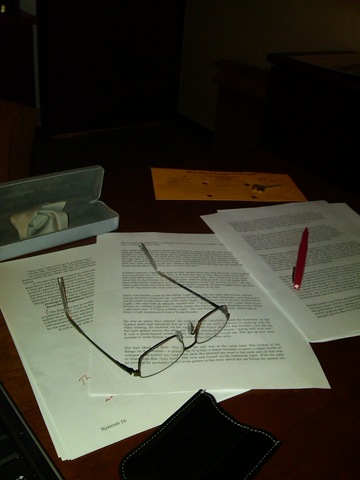
The photograph above was taken two days ago. It is a simple photo depicting my desk in the Nonfiction Writing Program at the University of Iowa. Several pages of an essay are spread across the desk and there’s a pair of wire framed reading glasses and a red felt tipped pen atop the scattered pages. There’s a glasses case with a lens cleaning cloth and a manila envelope with a door key. There’s nothing remarkable about this photograph: its just a professor’s desk. And yet to me this photo is utterly remarkable because I took it myself. And yes, I was reading those pages with those reading glasses and I was writing comments in the margins. I am only one small man and I am the bearer of one small life and surely this is a wide world with a billion narratives of joy or by turns of terrible injustice. Yet I like to think that getting some usable vision back means that others will also have their vision restored. I say this not because blindness is a bad thing–far from it, for indeed I’ve been writing for over a decade now about the ways that blindness functions as a form of epistemology–all disabilities offer the normative world riches of mental diversity. I have said so and will continue to say it. Yet for all that I can say that seeing, even if its not quite perfect (residual vision, low vision, call it what you will) is a marvel and working as I do with the University of Iowa’s College of Ophthalmology I know that the cures for many kinds of blindness are very near. Perhaps we are living in dark times. But then again perhaps not. Some days I think it takes greater daring to say “perhaps not”. So this is the landscape from my desk today in winter as a semester draws to a conclusion here in Iowa City.


S.K.

Learning to Skate


By Andrea Scarpino


Los Angeles


I figure skated when I was younger, and spent many hours dreaming of the Olympics, planning routines in my head to music on the radio, imagining elaborate costumes. My favorite thing to do on the ice was spin, and when I spun, I could feel the world move away from me. I pulled my hands to my chest and forgot everyone around me. I felt free for those moments on the ice, like the world outside didn’t matter nearly as much as the world pulled close to my chest.

This past weekend, I taught my niece how to ice skate at Santa Monica’s outside winter rink. Even though I haven’t been on the ice in more than ten years, after a glide or two, I felt my weight shift under me and that old feeling of freedom come back again. I reminded myself how to spin, how to skate backwards, and tried out the little jumps I used to know so well. I felt fluid. I felt like I was dancing.

But what surprised me most wasn’t how easily I slipped back into that love of skating, but the teaching approach I took with my niece. She’s only five, and wanted to hold on to the railings along the side of the rink. A lot of kids were pulling themselves along the railing, but they weren’t really skating; their feet were moving in strange directions and they weren’t learning to balance themselves on the skate blade.

I made my niece hold my hand instead. She didn’t like this approach at first, and wasn’t eager to leave the safety of the wall. I felt myself becoming annoyed. I’m not taking you around if you don’t let go of the wall, I said. She looked worried, and at first preferred to stay put rather than skate with me. I tried to figure why it mattered to me that she actually learned to skate if she was having a perfectly good time on her own along the wall. Eventually, she let me take one hand and let Zac take the other so we could lead her around the rink. Then she let just one person hold her hand as she skated. And finally, she let go of our hands entirely. She skated all by herself, with no help from anyone. As we passed a child who got on the ice when we did and who was still pulling herself along the wall, my niece pointed and said, The wall is bad. And that was almost the best part of the evening.

I realized in that moment that what I most learned from figure skating was my body’s fluidity and ability to adjust, to center myself among the chaos of the world. That falling makes us better, failing makes us work harder. That the risk of participating is more rewarding than the safety of the sidelines. I wanted to teach my niece to skate, but I also wanted to teach her to trust in her own ability to succeed. To push away from the world’s confines and be entirely free for a while. To experience fluidity, movement, the body gliding forward without anything slowing it down. Even if she never skates again, my niece will still have that memory of leaving the wall behind, of pushing herself away from the safety of the wall and finding success one glide at a time.


Andrea Scarpino is the west coast Bureau Chief of POTB. You can visit her at:

www.andreascarpino.com

A Wartime Vision


Because I often think about the dead I see the caissons rolling into view

As if leaving us is prologue

To returning—though I don’t see Christians

& there is no ascendant light

Above the Capitol

The streets of Washington glow with the precious inset stones of everywhere

& nowhere; there is a muted sound of dance music

& voices

A swarm of golden bees hums in the hive of the nation—non serviam is the sound

& then the storied dead come

From nothing through nothing

Their heads bent

& all that was inexpressible and distant grows inexpressible and near


S.K.

Sorry, Sir, But We’ve No More Bullshit


This morning while shaving I was thinking.

Who stole our nation’s good, old fashioned phony-ness?

Bzzzzzz! My razor kissed my nose.

Who swiped our beautiful, dopey self-imposed credulity?

Bzzzzz! I extinguished a warlock’s hair growing on my forehead.

Forget the media. Forget Pee Wee Herman. I was forced to conclude that we’ve stolen our ability to bullshit ourselves from ourselves.

Okay, so my next thought was: “Why do we have to learn this the hard way?” Sure I was thinking of Tiger Woods but look around you—hell, there’s your neighbor who tried to sell his children on e-bay until the FBI showed up. (You can’t sell people, even in jest. And this is altogether correct as a law, human trafficking is a scourge, but really, can’t a man have some fun?)

Now all we have left in America is ugly, dopey self-imposed credulity. (The tea party types are a sufficient example.)

But beautiful, dopey self-imposed credulity is in short supply. “Like what,” you ask?

See? No one can remember.

I missed a hair. I have to go.

S.K.

How to Be a Good American


The following excerpted article comes to us from The Inclusion Daily Express. We at Planet of the Blind shiver at the apparition of Teddy Roosevelt’s ghost. Remember him? He believed that the dark races worldwide were inferior to white Americans and he sanctioned the slaughter of tens of thousands of Mexicans and Filipino civilians during our nation’s imperial adventures. We picture TR’s ghost swaggering up and down just behind the so-called “doctor” mentioned below. 


Newspaper Runs Series On Breakdowns At Immigration Facilities
(Texas Tribune)
December 3, 2009
AUSTIN, TEXAS– [Excerpt] The detainee at the South Texas Immigration Detention Facility was put on suicide watch after she cut herself with a razor and tried to strangle herself with a shoelace. A physician’s assistant recommended hospitalizing her.

Instead, the chief physician put the physically disabled woman in an isolated cell and took away her crutches, according to inspection reports that don’t name the woman. She was strip-searched and denied feminine products. For days, the woman slid around the floor of the cell on scraped knees, covering herself and the cell in menstrual blood.

When inspectors with Immigration and Customs Enforcement (ICE) came out to investigate the 2007 incident, they found not a single psychiatrist on staff and a facility poorly equipped to provide mental health treatment to its nearly 1,500 detainees.

The South Texas facility, one of several federally monitored Texas lock-ups for immigrants awaiting deportation hearings, is hardly the only one with mental health staffing problems. A Texas Tribune review of five of these facilities found just three had a staff psychiatrist, despite housing a combined 5,500 detainees.

Entire article:
Detaining Care, Part One: Mental Hell

http://www.InclusionDaily.com/news/2009/red/1203f.htm
Related:
Part Two: Health Scare

http://www.InclusionDaily.com/news/2009/red/1203g.htm
Part Three: Andre’s Story
http://www.InclusionDaily.com/news/2009/red/1203h.htm


S.K.

Secretary General Calls For 'Disability-Inclusive' Global Goals

(United Nations)
December 1, 2009
From The Inclusion Daily Express

UNITED NATIONS– [Excerpt] Following is UN Secretary-General Ban Ki-moon’s message for the International Day of Persons with Disabilities, observed 3 December:

The theme of this year’s International Day of Persons with Disabilities is “making the Millennium Development Goals disability-inclusive”.

We are all vulnerable to disability, temporary or permanent, especially as we grow older. In most countries, at least 1 person in 10 is disabled by physical, mental or sensory impairment. A quarter of the global population is directly affected by disability, as caregivers or family members.

Persons with disabilities encounter many disadvantages. They are often among the poorest and most excluded members of society. Yet they routinely show tremendous resilience, and achieve great heights in all spheres of human endeavour.

Experience shows that when persons with disabilities are empowered to participate and lead the process of development, the entire community opens up. Their involvement creates opportunities for everyone — with or without a disability.

Entire article:
Empowering Persons with Disabilities Indispensable Means for Achieving Anti-Poverty Goals, Development for All

http://www.un.org/News/Press/docs//2009/sgsm12639.doc.htm

Trader Joe’s and the Menstrual Taboo


By Andrea Scarpino


Los Angeles


I love shopping at Trader Joe’s late in the evening right before it closes. The crowds thin out, restocking of shelves begins, and the employees start pumping some raucous dance music. They also start gossiping, about their shifts and managers, about which area is the most boring assignment, about budding employee romances and new products.

Last night, though, I eavesdropped on another customer. Standing in the aisle with toothpaste and other personal products, I heard a masculine sounding voice in back of me say, Do you need any tampons? And then laugh. I turned around. Both the speaker and the friend to whom he was speaking looked like adult men. One was bald, for god’s sake. The friend made eye contact with me. It’s always funny to joke about tampons, I said to him with my saucy-teenager-perfected sarcasm. The speaker kept laughing, but started to blush. His friend looked uncomfortable. You know, he said, I was just looking at hand soap.

I smiled. You can tell that you’ve reached maturity when you’re still joking about tampons, I said. That’s my tried and true method for sassing people—smile big while you’re doing it. Both men looked at the ground. As I walked away, I thought about the fact that menstruation can be funny—just like Steve has said before about blindness. Remembering first period stories with friends now that we’re adults can be pretty amusing. I use reusable cloth menstrual pads, and on more than one occasion, have found a missing pad folded neatly on top of my apartment’s shared washing machine, left behind from a load I had washed the night before. Imagining one of my macho, muscled, BMW driving neighbor-men folding my missing pad on the washer for me to reclaim totally cracks me up.

But the statement I overheard last night wasn’t an attempt at “honest” humor, so to speak. It was a man mocking his friend by engaging in our cultural menstrual taboo. You know, the thing that makes women use words like “time of the month” to describe their period. My good friend Chris Bobel researches menstruation and has many more insightful things to say about the menstrual taboo than I could ever muster (she contributes to the blog re: Cycling which I highly recommend) but suffice it to say that making women uncomfortable in their bodies is a continually acceptable cultural phenomenon. Sure, we have much more “plus-size” model visibility than we’ve had in the past (and by “plus-size,” I mean still-thinner-than-the-average-American-woman) but on the whole, there is much money and power to be gained from teaching women to hate their bodies.

And the menstrual taboo is part of that. Menstruation is a biological process that almost half the human population experiences at some point or another and yet, it’s so infrequently discussed that a joke about buying tampons is still considered kosher by grown men. Seriously?

Leaving Trader Joe’s last night, I reconfirmed my commitment to speaking up when presented with the menstrual taboo and to refusing the many ways women in our culture are taught that our bodies don’t matter, need fixing/quieting/conforming/etc, or should be the sites of shame. There is power, after all, in speaking up, in refusing to participate in culturally constructed taboos. As one of my favorite poets, Adrienne Rich, says, “Lying is done with words and also with silence.”


Andrea Scarpino is the west coast Bureau Chief of POTB. You can visit her at:

www.andreascarpino.com