The Original American Good Man: Walt Whitman Discovers Disability

As we honor the 200th birthday of Walt Whitman it’s worth recalling the poet who praised the human body was also our nation’s first writer of disability memoir. This often surprises people since his great opus “Leaves of Grass” famously celebrates strapping health. In fact one may say Whitman turned physical desire into a sexy religion: America’s body was ecstatic, eternal and spiritually orgasmic. In Walt’s nation there were no bad couplings. That was Whitman circa 1855. Then came the Civil War.

One response to crisis is the making and shaping of a new imaginative body. In his seventies, and having suffered paralysis from a series of strokes, Whitman began collecting, arranging, and then supplementing his civil war prose written while he served as a nurse in the terrible army hospitals in Washington. Revisiting his old journals, their pages literally blood stained, he worked both with his paralysis—he could barely write—while giving shape to a historical moment of national crisis. In effect, Whitman created the first American disability autobiography.

His response to social and personal crises is expertly detailed in a marvelous essay by Robert J. Scholnick entitled, “‘How Dare a Sick Man or an Obedient Man Write Poems?’ Whitman and the Dis-ease of the Perfect Body.” This essay appears in the breakthrough collection, Disability Studies: Enabling the Humanities edited by Sharon L. Snyder, Brenda Jo Brueggemann, and Rosemarie Garland-Thompson.

Scholnick examines Whitman’s early positioning of the healthy body as a metaphor for a strong democracy and shows how the poet used disability to represent political failure as America headed into the Civil War. Referring to Whitman’s unpublished 1856 essay “The Eighteenth Presidency!” Scholnick notes that Whitman is: “Expressing his belief that a healthy body is a metonym for a healthy nation and, the converse, that an enfeebled body reflects a failure within the body politic…” (248). Scholnick correctly observes that Whitman, who is writing about the political failure of the Buchanan presidency to stop the spread of slavery into the western territories resorts to disabling metaphors:

…[Whitman] deployed a rhetoric of health, disease, and disability to address the national crisis. Describing the supposedly enfeebled political class as “blind men, deaf men, pimpled men scarred inside with the vile disorder, gaudy outside with gold chains made from the people’s money,” in “The Eighteenth Presidency!” he summoned what he imagined as a generation of vigorous young men to take charge. “Poem of the Road” (later titled “Song of the Open Road”) warned that “None may come to the trial till he or she bring courage and health” (Leaves 232). (248) Scholnick observes that Whitman’s disabling metaphors are balanced by a call not just to political health in the United States, but also by a prescriptive exhortation to America’s citizens to practice the art of good health:

Whitman’s urgent summons to his fellow citizens to adopt the practices of healthy living constituted a significant portion of his agenda for America. “All comes by the body only health puts you in rapport with the universe,” he wrote in “Poem of Many in One” (later titled “By Blue Ontario’s Shore”). “Produce great persons, the rest follows,” he affirmed (181). “Poem of the Road” stated flatly, “He travelling with me needs the best blood…” and warned that only the healthy are eligible to join him in the great American procession. (249)

Scholnick quotes Whitman in “Poem of the Road:

Come not here if you have already spent the best of yourself! Only those may come who come in sweet and determined bodies, No diseased person no rum- drinker or venereal taint is permitted here. (249)

In turn, Scholnick details Whitman’s reified and “schizoid” body politic:

In promoting physical health as a means of fostering national stability, control, and improvement, Whitman excluded those lacking the best blood. This exclusion raises the question of just how he and his contemporaries understood the etiology of sickness and disability. (249)

Robert Scholnick’s essay explores how the language of Whitman’s later notebooks displays the poet’s alteration from rhetorical inattentiveness about the disabled body to a position of cultural empathy. By ministering to the maimed and dying soldiers, Whitman faced unimaginable physical suffering. The poet’s prose reveals Whitman’s new and profound appreciation for the literal suffering of men and the spiritual suffering of the nation.

I agree with Scholnick that Whitman is the progenitor of the “disability memoir.” He created a new and wholly conscious rendering of altered physicality in prose. Whitman begins his reminiscence (which he called “Specimen Days”) in a wholly new mode. This is not the metaphorized body of the ideologically constructed man of robust, democratic labor:

Specimen Days

A HAPPY HOUR’S COMMAND
Down in the Woods, July 2d, 1882. — If I do it at all I must delay no longer. Incongruous and full of skips and jumps as is that huddle of diary-jottings, war-memoranda of 1862-’65, Nature-notes of 1877-’81, with Western and Canadian observations afterwards, all bundled up and tied by a big string, the resolution and indeed mandate comes to me this day, this hour, — (and what a day! what an hour just passing! the luxury of riant grass and blowing breeze, with all the shows of sun and sky and perfect temperature, never before so filling me body and soul) — to go home, untie the bundle, reel out diary-scraps and memoranda, just as they are, large or small, one after another, into print-pages. (Whitman 689)

This is Whitman, the disabled poet working to shape and re-shape his memories as well as his present circumstances. He does so with fragments, jottings, things untied, things untidy, nature notes, bureaucratic memoranda… He is announcing his intention to create a “lyric collage” –and by announcing that this is for the printed page he is also announcing that this is a work of art, one created out of a new urgency.

Here is Whitman again, writing of his increasing paralysis and its effect on his ways of living:

Quit work at Washington, and moved to Camden, New Jersey — where I have lived since, receiving many buffets and some precious caresses — and now write these lines. Since then, (1874-’91) a long stretch of illness, or half-illness, with occasional lulls. During these latter, have revised and printed over all my books — Bro’t out “November Boughs” — and at intervals leisurely and exploringly travel’d to the Prairie States, the Rocky Mountains, Canada, to New York, to my birthplace in Long Island, and to Boston. But physical disability and the war- paralysis above alluded to have settled upon me more and more, the last year or so. Am now (1891) domicil’d, and have been for some years, in this little old cottage and lot in Mickle Street, Camden, with a house-keeper and man nurse. Bodily I am completely disabled, but still write for publication. I keep generally buoyant spirits, write often as there comes any lull in physical sufferings, get in the sun and down to the river whenever I can, retain fair appetite, assimilation and digestion, sensibilities acute as ever, the strength and volition of my right arm good, eyesight dimming, but brain normal, and retain my heart’s and soul’s unmitigated faith not only in their own original literary plans, but in the essential bulk of American humanity east and west, north and south, city and country, through thick and thin, to the last. Nor must I forget, in conclusion, a special, prayerful, thankful God’s blessing to my dear firm friends and personal helpers, men and women, home and foreign, old and young. (1298)

In lyric terms this prose is necessary to assure the poet’s survival. Gregory Orr’s useful polarities of lyric incitement come to mind: Whitman is experiencing “extremities of subjectivity” as well as the “outer circumstances [of] poverty, suffering, pain, illness, violence, or loss of a loved one.” As Orr points out: “This survival begins when we “translate” our crisis into language–where we give it symbolic expression as an unfolding drama of self and the forces that assail it” (4).

It’s interesting in this context to note that Whitman imagines his paralysis as part of the unfolding drama of family loss as well as the national trauma of the civil war:

1873. — This year lost, by death, my dear dear mother — and, just before, my sister Martha — the two best and sweetest women I have ever seen or known, or ever expect to see. Same year, February, a sudden climax and prostration from paralysis. Had been simmering inside for several years; broke out during those times temporarily, and then went over. But now a serious attack, beyond cure.

Dr. Drinkard, my Washington physician, (and a first-rate one,) said it was the result of too extreme bodily and emotional strain continued at Washington and “down in front,” in 1863, ‘4 and ‘5. I doubt if a heartier, stronger, healthier physique, more balanced upon itself, or more unconscious, more sound, ever lived, from 1835 to ’72. My greatest call (Quaker) to go around and do what I could there in those war-scenes where I had fallen, among the sick and wounded, was, that I seem’d to be so strong and well. (I consider’d myself invulnerable.) But this last attack shatter’d me completely. (1297-1298)

One notes Whitman’s use of military metaphors to describe the onslaught of paralysis: the disease “broke out” and “then went over” –figures that suggest the illness has scaled the healthy wall of his body, the fortress of self. It’s interesting also to note that Whitman arrives at this correspondence between his paralysis and the national trauma of the civil war by way of his doctor who believed that the strain of working in wartime hospitals was the likely cause of Whitman’s stroke.Describing his youthful and healthy body Whitman writes, “I doubt if a heartier, stronger, healthier physique, more balanced upon itself, or more unconscious, more sound, ever lived, from 1835 to ’72” (1297-1298).

By distinction Whitman as the writer of lyric prose is no longer unconscious and balanced but self-conscious and obviously unbalanced. This “imbalance” is reflected by the unevenness of the memoir. Sentences read like fragments. Memories and the contemporary circumstances of the writer are narrated “paratactically” –the past and the present are presented side by side.

One is reminded of the contemporary American poet Gregory Orr’s assertion that:

…our instability is present to us almost daily in our unpredictable moods and the way memories haunt us and fantasies play themselves out at will on our inner mental screens. We are creatures whose volatile inner lives are both mysterious to us and beyond our control. How to respond to the strangeness and unpredictability of our own emotional being? One important answer to this question is the personal lyric, the ‘I’ poem dramatizing inner and outer experience. (4)

In the case of Whitman’s lyric prose this instability links with the art of memory to address the very meaning of the lyric self: the self that possesses comic irony—a self that understands it is a shaped thing. It can be shaped by personal or physical suffering or by social forces. Whitman ends “Specimin Days” by speculating about the divine or philosophical nature of suffering:

Just as disease proves health, and is the other side of it. . . . . . . . . The philosophy of Greece taught normality and the beauty of life. Christianity teaches how to endure illness and death. I have wonder’d whether a third philosophy fusing both, and doing full justice to both, might not be outlined. (1300)

Here Whitman, writing in paralytic bursts, wonders about the construction of normalcy and its origins in stoic philosophy Then in one swift lyric shift, he wonders about the Christian view of illness, a view which leads in Western civilization to the so called “medical model” of disability. This is the “I” of lyric prose, working its way through inner and outer experience. The “I” of lyric prose assembles its greater sense of irony from scraps.

Whitman’s lyric prose is more than the short hand for a self help book. The prose he wrote in crisis lead him away from his early figurative representations of the muscular
democratic body. He wrote in the civil war hospitals on pages stained with the blood of dying soldiers. He wrote fast and he wrote about something larger than ideological metaphor:

FALMOUTH, VA., opposite Fredericksburgh, December 21, 1862. — Begin my visits among the camp hospitals in the army of the Potomac. Spend a good part of the day in a large brick mansion on the banks of the Rappahannock, used as a hospital since the battle — seems to have receiv’d only the worst cases. Outdoors, at the foot of a tree, within ten yards of the front of the house, I notice a heap of amputated feet, legs, arms, hands, &c., a full load for a one-horse cart. Several dead bodies lie near, each cover’d with its brown woolen blanket. In the door-yard, towards the river, are fresh graves, mostly of officers, their names on pieces of barrel-staves or broken boards, stuck in the dirt. (Most of these bodies were subsequently taken up and transported north to their friends.) The large mansion is quite crowded upstairs and down, everything impromptu, no system, all bad enough, but I have no doubt the best that can be done; all the wounds pretty bad, some frightful, the men in their old clothes, unclean and bloody. (712)
In the Preface to Leaves of Grass Whitman wrote, “All beauty comes from beautiful blood and a beautiful brain” (11). As the writer of lyric prose Whitman writes:
I must not let the great hospital at the Patent-office pass away without some mention. A few weeks ago the vast area of the second story of that noblest of Washington buildings was crowded close with rows of sick, badly wounded and dying soldiers. They were placed in three very large apartments. I went there many times. It was a strange, solemn, and, with all its features of suffering and death, a sort of fascinating sight. I go sometimes at night to soothe and relieve particular cases. Two of the immense apartments are fill’d with high and ponderous glass cases, crowded with models in miniature of every kind of utensil, machine or invention, it ever enter’d into the mind of man to conceive; and with curiosities and foreign presents. Between these cases are lateral openings, perhaps eight feet wide and quite deep, and in these were placed the sick, besides a great long double row of them up and down through the middle of the hall. Many of them were very bad cases, wounds and amputations. Then there was a gallery running above the hall in which there were beds also. It was, indeed, a curious scene, especially at night when lit up. The glass cases, the beds, the forms lying there, the gallery above, and the marble pavement under foot — the suffering, and the fortitude to bear it in various degrees — occasionally, from some, the groan that could not be repress’d — sometimes a poor fellow dying, with emaciated face and glassy eye, the nurse by his side, the doctor also there, but no friend, no

relative — such were the sights but lately in the Patent-office. (The wounded have since been removed from there, and it is now vacant again.) (717-718)

Think of Whitman writing after a series of strokes, revisiting his old notebook pages, tying them together with seasoned reflections on his diminished body. By gathering “Specimen Days” and arranging its pages, Whitman claimed disability—both for himself as well as the civil war veterans. Claiming disability requires claiming the lyric. If people with disabilities have been exiled by history, by the architectures of cities and the policies of the state, then the lyric and ironic form of awareness is central to locating a more vital language. The lyric mode is concerned with momentum rather than certainty. This is the gnomon of lyric consciousness: darkness can be navigated. The claiming of disability is the successful transition from static language into the language of momentum. But of particular importance in this instance is the brevity of the lyric impulse. The urgency of short forms reflects the self-awareness of blocked paths and closed systems of language. The lyric reinvents the psychic occasion of that human urgency much as a formal design in prosody will force a poet to achieve new effects in verse. Igor Stravinsky put it this way: “The more constraints one imposes, the more one frees one’s self. And the arbitrariness of the constraint serves only to obtain precision of execution.” We are in a hurry. We must tell the truth about the catastrophe that is human consciousness. And like Emily Dickinson who feared the loss of her eyesight we will tell the truth but “tell it slant”—the lyric writer may not have a sufficiency of time.
Twice then we see Walt Whitman, lacking a sufficiency of time, writing the lyric claim.

Citations:

Orr, Greogry. Poetry As Survival. Athens: The University of Georgia Press, 2002.
Scholnick, Robert J. “‘How Dare a Sick Man or an Obedient Man Write Poems?’ Whitman and the Dis-ease of the Perfect Body.” Disability Studies: Enabling the Humanities. Ed. Sharon L. Snyder, Brenda Jo Brueggemann and Rosemarie Garland-Thomas. New York: The Modern Language Association of America, 2002. 248-259.
Whitman, Walt. Complete Poetry and Collected Prose. Ed. Justin Kaplan. New York: Library of America, 1982.

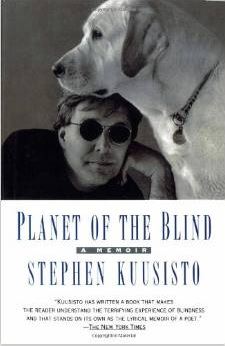
Stephen Kuusisto and HarleyABOUT: Stephen Kuusisto is the author of the memoirs Have Dog, Will Travel; Planet of the Blind (a New York Times “Notable Book of the Year”); and Eavesdropping: A Memoir of Blindness and Listening and of the poetry collections Only Bread, Only Light and Letters to Borges. A graduate of the Iowa Writer’s Workshop and a Fulbright Scholar, he has taught at the University of Iowa, Hobart and William Smith Colleges, and Ohio State University. He currently teaches at Syracuse University where he holds a University Professorship in Disability Studies. He is a frequent speaker in the US and abroad. His website is StephenKuusisto.com.

Have Dog, Will Travel: A Poet’s Journey is now available for pre-order:
Amazon
Barnes and Noble
IndieBound.org
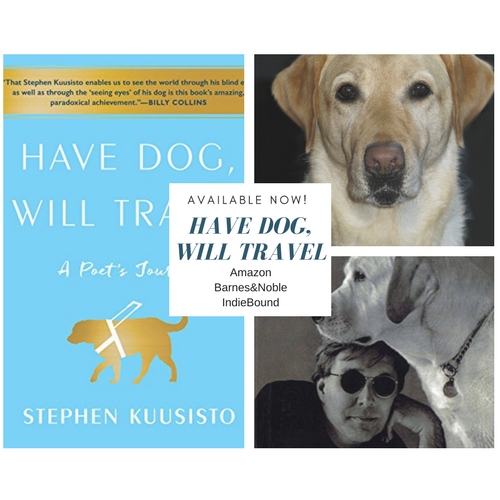
Have Dog, Will Travel by Stephen Kuusisto

(Photo picturing the cover of Stephen Kuusisto’s new memoir “Have Dog, Will Travel” along with his former guide dogs Nira (top) and Corky, bottom.) Bottom photo by Marion Ettlinger 
Your Astrology

If you were born on this date

It was likely wartime

And hardly your fault

Though it was likely wartime.

America eats with a baby spoon

But this is not your fault

A violent infant state

Is scarcely your fault.

It was wartime

And the pond where you were born

With its oxidizing auto

Was not your fault.

An infant state

Is not your fault.

A violent state

Is scarcely your fault.

No one can blame you

For the martial music.

Yes I stare at my mirror

Leaning close as the blind do

And I declare

This isn’t mine

Though it is

As Poe knew—

This telltale

War-heart

Mine and yours

You can look it up.

Stephen Kuusisto and HarleyABOUT: Stephen Kuusisto is the author of the memoirs Have Dog, Will Travel; Planet of the Blind (a New York Times “Notable Book of the Year”); and Eavesdropping: A Memoir of Blindness and Listening and of the poetry collections Only Bread, Only Light and Letters to Borges. A graduate of the Iowa Writer’s Workshop and a Fulbright Scholar, he has taught at the University of Iowa, Hobart and William Smith Colleges, and Ohio State University. He currently teaches at Syracuse University where he holds a University Professorship in Disability Studies. He is a frequent speaker in the US and abroad. His website is StephenKuusisto.com.

Have Dog, Will Travel: A Poet’s Journey is now available for pre-order:
Amazon
Barnes and Noble
IndieBound.org

Have Dog, Will Travel by Stephen Kuusisto

(Photo picturing the cover of Stephen Kuusisto’s new memoir “Have Dog, Will Travel” along with his former guide dogs Nira (top) and Corky, bottom.) Bottom photo by Marion Ettlinger 
On the Pleasures of Hating, American Style

“The white streak in our own fortunes is brightened (or just rendered visible) by making all around it as dark as possible; so the rainbow paints its form upon the cloud.”

—On the Pleasure of Hating, William Hazlitt

The leaders of nations are again whipping up hatred and though one may stoutly observe this circumstance is customary I don’t think the American variant of it is time worn. Donald Trump represents a national vanity, the disdain that comes at the ends of empires. The white streak in America’s fortunes is soiled and Trump’s boys fear they’re losing control of the census. Trump’s aspersions are steeped in rhetorics of scarcity and the terror of dark hordes. This is not to say that prior empires have been without their particular gloating rancor but Trump’s possessed by a vision of absolute scarcity built on a racialist proposition of thievery. He believes the colored peoples of the earth are stealing from America’s hard working white people. Victorian bigotry was built in large part around the idea that foreigners were sinister carriers of disease or represented chaos that must be contained—Dracula is a novel about the British fear of the east more than anything else. Trump’s Dracula is a hydra of ethnicities and yes, women and cripples and queers who seek to steal America’s vitality. In this way his hatred and its expression are vampiric. It is altogether fair to wonder if “The Donald” has ever donated blood.

Now another word for this kind of hatred is despair. After the murder MacBeth says: “For, from this instant,/ There’s nothing serious in mortality:/ All is but toys — renown and grace is dead.”
It’s the age for cowards. The hating coward feels no guilty remorse. it’s enough to have power. If this power is based on despair and has no nobility that is the way of it. Another way of saying there’s nothing serious in mortality is not to say life is cheap but that it has no grand purpose beyond the acquisition of personal power. It’s the rage of humiliation. In her unjustly overlooked book “Metaphysics as a Guide to Morals” Iris Murdoch wrote: “the condition (for instance as humiliation) may, almost automatically, be ‘alleviated’ by hatred, vindictive fantasies, plans of revenge, reprisal, a new use of energy. There is, which can be no less agonising, a guiltless remorse when some innocent action has produced an unforeseeable catastrophe. A common cause of void is bereavement, which may be accompanied by guilt feelings, or may be productive of a ‘clean’ pain. In such cases there is a sense of emptiness, a loss of personality, a loss of energy and motivation, a sense of being stripped, the world is utterly charmless and without attraction.” There can be no better description of Donald Trump and his gestalt than this.

The fish in the sea is not thirsty and Trump doesn’t know how stripped he is. He strips others—in every way. This is why his political imagination is joyless. He hates and his “base” as it’s called on television is thrilled. This is what Simone Weil called “malheur” a type of affliction. Hillary Clinton was wrong when she called Trump’s most enthusiastic supporters “a basket of deplorables” because most of them feel neglected, powerless, betrayed by the powerful, and so want little more than vengeance. All is but toys—Trump gives them the nursery of rage and it makes them real. One thinks of the commercial where an elderly woman has fallen and can’t get up. The poet Paul Valery: “the desire for vengeance is the desire for balance.”

Vengeance and balance, vindictive fantasies, cowardice, a loss of energy and motivation are the essential ingredients of the Trump pleasure principle. You might say these are primordial factors in the rise of Fascism but in America it is more accurate to call it a fetishized pissing contest.

Stephen Kuusisto and HarleyABOUT: Stephen Kuusisto is the author of the memoirs Have Dog, Will Travel; Planet of the Blind (a New York Times “Notable Book of the Year”); and Eavesdropping: A Memoir of Blindness and Listening and of the poetry collections Only Bread, Only Light and Letters to Borges. A graduate of the Iowa Writer’s Workshop and a Fulbright Scholar, he has taught at the University of Iowa, Hobart and William Smith Colleges, and Ohio State University. He currently teaches at Syracuse University where he holds a University Professorship in Disability Studies. He is a frequent speaker in the US and abroad. His website is StephenKuusisto.com.

Have Dog, Will Travel: A Poet’s Journey is now available for pre-order:
Amazon
Barnes and Noble
IndieBound.org

Have Dog, Will Travel by Stephen Kuusisto

(Photo picturing the cover of Stephen Kuusisto’s new memoir “Have Dog, Will Travel” along with his former guide dogs Nira (top) and Corky, bottom.) Bottom photo by Marion Ettlinger 
G.K. Chesterton’s Free Thinking

There should be a place in the public’s mind for G.K, Chesterton. The great Victorian writer understood better than most that absurdity and discernment are intellectual bulwarks against tyranny. He wrote: “Poets have been mysteriously silent on the subject of cheese.” Let’s be clear: poets are mysteriously silent about many things.

I was yesterday joking with a friend, a poet, who was lamenting a tendency in contemporary verse—how does one put it? The kind of poem where the poet tells us someone has been murdered right before his or her or they eyes and then goes on to tell us what’s for breakfast.
The personal is political until it isn’t. In other words: claiming a political life isn’t the same as living one.

Chesterton: “The Bible tells us to love our neighbors, and also to love our enemies; probably because generally they are the same people.”

What a relief he often is.

“The word “good” has many meanings. For example, if a man were to shoot his grandmother at a range of five hundred yards, I should call him a good shot, but not necessarily a good man.”

**

A disabled poet I know thinks the entire able bodied civilization despises the cripples. She’s right of course. We rely on social programs, trouble the architects, bother administrators charged with the enforcement of normalcy. There just ain’t no way around it, the lame and the halt are trouble.

Chesterton; “Dear Sir: Regarding your article ‘What’s Wrong with the World?’ I am. Yours truly,”

I’m for the democratic ideal of wrongness. This is where true equality resides.

Perhaps my favorite Chesterton quote is this one:

“The whole modern world has divided itself into Conservatives and Progressives. The business of Progressives is to go on making mistakes. The business of Conservatives is to prevent mistakes from being corrected. Even when the revolutionist might himself repent of his revolution, the traditionalist is already defending it as part of his tradition. Thus we have two great types — the advanced person who rushes us into ruin, and the retrospective person who admires the ruins. He admires them especially by moonlight, not to say moonshine. Each new blunder of the progressive or prig becomes instantly a legend of immemorial antiquity for the snob. This is called the balance, or mutual check, in our Constitution.”

One is reminded of the late poet James Tate who wrote:

“Curses on those who do or do not take dope.”

**

Chesterton was a fierce opponent of eugenics. He famously said:

“There exists today a scheme of action, a school of thought, as collective and unmistakable as any of those by whose grouping alone we can make any outline of history. It is as firm a fact as the Oxford Movement, or the Puritans of the Long Parliament; or the Jansenists; or the Jesuits. It is a thing that can be pointed out; it is a thing that can be discussed; and it is a thing that can still be destroyed. It is called for convenience “Eugenics”; and that it ought to be destroyed I propose to prove in the pages that follow. I know that it means very different things to different people; but that is only because evil always takes advantage of ambiguity. I know it is praised with high professions of idealism and benevolence; with silver-tongued rhetoric about purer motherhood and a happier posterity. But that is only because evil is always flattered, as the Furies were called “The Gracious Ones.””

Excerpt From: “Eugenics and Other Evils.” Apple Books.

Who takes advantage of ambiguity in our time?

I Live in No Country

I spent a dark month translating poetry in the far north and the poems followed me into sleep. Saarikoski’s snakes talked to my dream ears. I don’t always remember dreams but the snakes stayed with me. They followed me in the department store and came with me on the bus. I thought perhaps I should change my name to Asklepios. I also considered the bones inside the snakes. Those glassine springs with their electricities and appetites.

**

If you’re a reasonable woman or man or child you know you belong to no country.
This is the thing—poetry’s reification if you will—I belong in no room, no meeting, no tent.

**

The saddest poets are the ones who keep trying to put up a tent when there isn’t any rain in the forecast.

**

Walking early today thinking of Immanuel Kant, his a priori intuition and the elegance of reason. The snakes’ skeletons still following me down the street.

Grievance in America, 24-7, No Matter Who You Think You Are

Americans are uncomfortable with their bodies which means they become militant when they claim the body as a marker of identity. I have done this. I’m blind. I’ve written extensively about the joys of being who I am. The body is not receptive to what I may say about it. That’s a sad fact. Society is only conditionally receptive to what I may say about it.

I identify as disabled. I have to. I’m not going to navigate the world with safety if I don’t use the proper accommodations for vision loss. Then I say, “I have no loss.” I claim my utility and Jeffersonian right to pursue happiness. I’m not lost. I don’t need to be found. I don’t need salvation.

When you claim your body in America you enter a honeycomb of some complexity. How many billions of dollars are spent on advertising that urges people to feel more than passing disdain for their very physicality? No, I don’t want to look it up.

I’m for all the body rights movements but I’m never tricked into thinking that by hugging my body I’m free of the contempt mechanism. It tends to have the last laugh.

If you claim to love your body but spend all your time hating the compulsory normative complex—you shouldn’t be gay; fat; a wheelchair user; blind; deaf; get a cure or purgative—you know the drill, you will spend your life railing against the dominant culture to such an extent you’ll become, quite possibly, a victim of your own identity rage and to such an extent you may not be able to function outside of a small colony.

Which leads me to the problem I’m struggling with. The small colony habituation of Americans who struggle with self-contempt, which is never overcome with slogans or cultural theories alone, lends itself to unhappy clusters of victimhood. This is fully democratized which means Trump voters, Bernie voters, civil rights activists of every calling, can all be classified as either potentially or fully against civics.

You’re not supposed to like your body. You’re encouraged to prefer happiness to the daily grind. Americans are conditioned to feel deprived of easy joy. Someone else is always getting happy. If you believe advertising, you’ve a big and weak superego. I think it was Kurt Vonnegut who pointed out that Americans have so much self contempt that when they jumped out of airplanes in WW II they shouted: “Well, here goes nohin’!” He also noted that the chief expression of interpersonal disdain in the USA is: “If you’re so smart why ain’t you rich?”

Enter Trump voters. Vonnegut would understand them. Trump both deflects and extends their self-contempt. They’re not happy because others are stealing their joy potential. They’re not rich and Trump tells them over and over it’s not their fault it’s because of foreigners or elites or people of color or you name it. “If you’re so smart why ain’t you rich?” becomes a license to bitch, rage, be violent, taunt anyone who you believe is in your way.

These ghosted body-contempt dynamics are equally true across the proverbial aisle. Bernie Sanders voters believe others are stealing their wealth, their autonomy, their hopes and dreams. Again it’s others who are doing this—and again there’s the license to bitch, rage, and taunt anyone you believe is in your way.

One sees this on the contemporary college campus where progressive students rage against multiple systems they believe are stealing their joy potential. Capitalism, classist society, patriarchy, big pharma, polluters—all of which are very real mind you—are given undue positions in the honeycombed privacies of the mind (to borrow from Melville) until, yes, one has a license to bitch, rage, be violent, and taunt anyone who you believe is in your way. I’ll argue that these reactions are deleterious to students for it gives them the false assurance that aggrieved identity is all anyone needs in the village square.

Body claiming is crucial as a first line of defense against racism, homophobia, ableism, misogyny, and all other commodified disdain for our physical lives.
But it can become amber to the fly. Grievance is in the glue. The best thinkers acknowledge oppressive systems and live beyond mere victimhood.

In a recent review of some new books about the opioid epidemic in the USA Emily Witt quotes a writer who goes by the moniker “Anxious Dope Fiend” who writes of the joys of oxycodone:

The oxycodone experience is difficult to describe to an opiate virgin. Personally, I feel as if I have suddenly gained all that I want in life and no longer have anything to fear. I am perfectly content both mentally and emotionally. All the tension slips from my body and I feel warm and utterly comfortable, as if I were sitting beside a roaring fire, wrapped in a delicate cashmere blanket, rocking gently back and forth. Communication is pleasant but unnecessary. Under the influence of oxycodone, no companionship is needed. I accept myself and the world just as we are, not begrudgingly, but eagerly, ecstatically even.

Is it just me or do any of my readers also wonder if this passage represents the perfect synthesis of grievance culture?

What the Imagination is For: Reflections on Boyhood Cruelty

I make jokes like most people. When I was young I made some cruel jokes as I was bullied for my disability and I looked for children more vulnerable than I was in order to humiliate them and gain a modicum of status. Status is a fragile thing when you’re twelve years old. Having it or not depends on the temporary love of brutish schoolmates and in my case gaining this required art. I remain ashamed of the story I’m about to tell. I make no excuses. If being a blind kid in public school was rough, if I was pushed down stairs, if my glasses were stolen, if I was targeted with nicknames, well so what? I was clever and desperate.

I picked out a kid who sat next to me in math class. His name was Norman and that was bad enough. But he was also gangly, awkward, ill at ease in his skin–just like me. Talk about Carl Jung’s “shadow”–I saw in him everything I hated about myself. He wore maladjusted spectacles and had uncombable hair. There was really nothing wrong with him. It didn’t matter. I could see he was defenseless. He stammered slightly. He was shy. He became my target.

What did I do, you ask? I made him legendary. I drew cartoons depicting him as an ostrich boy with a bird’s body, a periscope neck and a wide grinning face and I named this creature “Normanure.” I even made fun of his stammer with a cartoon bubble that said “Duh!” Though I could scarcely see I could draw serviceably and quickly. I plastered Normanure all over the school. This ugly episode lasted about a week before a school official caught me sticking a cartoon on a bulletin board. But here’s what I recall most vividly. Before being apprehended for assholery Norman himself accosted me and rather than punching me out he asked the most basic and fair question anyone can ask his tormentor: “Why are you doing this?”

I couldn’t answer him. I slunk away. I had no language to describe the starved mice eating my nervous system or my shame at being blind or my terror when thinking about how I might live. I was dehumanizing a perfectly good person.

That was fifty years ago. I remain sorry to this day. And the terrible ugliness of online trolling; the name calling spurred on by the current putative president; the sorrows of people with disabilities who are still largely unemployed and unappreciated–these are never far from my thoughts. And no, I can’t expiate my miniature “Lord of the Flies” moment with a blog post. Nor can I tell you that nowadays I’m an exemplary man. But I do believe in emotional candor and ethics of care. I’m alarmed by all the big bodied twelve year olds I see in the public square. But I’m alarmed also by the knowledge that my insecurities can produce cruelty. It is altogether proper to know what the imagination is really for.

Typing Mister Roberts

As a ten year old who though he’d become a writer I attempted a novel. My model was “Mister Roberts” which meant that I was writing about the Navy and imagining the doings of grown men at sea. How I wish I had those pages now and could see what a blind kid thought the maritime world of wholly fictive adults would be like. I suspect I imagined an adult world that was honorable as a distinction to my grade school life of constant bullying. As a disabled child in public school I was a target for physical and emotional abuse. The novel “Mister Roberts” and the film based upon it suggested shipboard life was decent.

I think of this now because I know better. As Wallace Stevens famously wrote: “the world is ugly and the people are sad”—and while that may not be a life’s goal, that is, to live in wantoness and depression—these are factors in the reality principle. The Navy may have honorable men and women but their stories and presences aren’t always probable. We’ve a land of permanent wars and poverty and bigotries of every kind. And the grade school bullying I once endured still goes on for children everywhere and I even experience adult forms of it in the workplace.

It’s the utopian hope of writing that’s so compelling to me. When I write I clean streaked windows with vinegar. Animals come. Some eat from my hands. Strangers come to understand each other. And these things are not entirely of imagination Wallace Stevens notwithstanding.

Yesterday I took an Uber ride. My driver spoke very little English. He was from Central America. He loved my guide dog Caitlyn, a yellow Labrador. Suddenly he said in his halting English: “I wish her long life!”

The world is ugly but people still have love. In turn I’m not certain I’m all that different from my ten year old self. That kid was insisting on decency.

His grown up variant still does.

Eric Hobsbawm, the Welsh, Brexit, and Donald Trump

In his excellent memoir “Interesting Times” the Marxist historian Eric Hobsbawm says of the Welsh, circa 1960: “For most of the mountain people the Welsh language was chiefly a Noah’s Ark in which they could survive the flood as a community. They did not so much want to convert and converse: people looked down on visiting South Walians with their ‘school Welsh’. Unlike Noah, they did not expect the flood to end. ”

Excerpt From: “Interesting Times: A Twentieth-century Life.” Apple Books.

There is a practical sense though a dark one to be found in provincial communities, a noir pragmatism that the flood (whatever it stands for) will never end. In rural Wales the English built summer houses and despoiled the landscape. Enterprising locals burned those houses down rather frequently. The constabulary never caught a single arsonist and yet the flood kept coming. Ironic then that Brexit is among other things a response to the post-colonial flood of foreigners and their influences on Britain, and a simultaneous self-induced house burning. Unable to stand the flood the English are burning their house down.

In the United States the flood is largely a fiction which Donald Trump has borrowed from the language of white nationalists and because of this he knows in whatever it is that passes for his heart that he must burn the government down rather than negotiate the terms of his wall. If the wall—the need of a wall—which is really a dyke against the flood of foreigners—is based on fictive presumptions than any negotiation about it will quickly fall apart. Better to burn the houses of government.

This is made all the easier because the Republicans have campaigned against government for decades. Their rhetoric has devolved from Reagan’s call for smaller government to Trump who scarcely knows what governing is and like most real estate criminals imagines the governance of a nation to be a blight on his own ambitions. That’s a view he inherited from his racist father who was fined for discriminating against people of color in his public housing projects. Government t will make you do the right thing. All hail the collapse of the government.

I suspect there was never a Noah. I do like the idea of him. Lord knows he was an optimist. He preserved life in a dark time. There’s no evidence he burned houses. He didn’t arrive on dry land and slaughter the locals like Columbus. I have no idea what he thought about governance but the birds liked him.

Disability by Any Other Name

I’ve been disabled all my life and I hate the term. Beneath it, like Poe’s tell tale heart, is the pulse of loss. The “d” word is Karl Marx’s term: a 19th century mark for injured workers. It originally meant the lack of utility or earning power owing to a broken body. I prefer to be called a citizen.

That I’m a blind citizen should matter not at all. Did you know that blindness is nothing more than being born left handed? Disability is a false name which pulses underneath us and continues to cause human beings with diverse bodies terrible harm.

Of course there are cutesy efforts to fix the d word like putting the “dis” in parentheses to emphasize ability. This has always seemed to me like putting antlers on a cat. Diversions are seldom more than gestures and unless you’re using sign language gestures don’t mean much. Most if not all disabled will agree we’ve had enough of gestures.

The d word can’t describe me or the hundreds of d people I know. My band is made up of practical men, women, and children who have imaginations, wisdoms, loves, sorrows, tastes, and ambitions. For them the d is a horse collar—outdated, heavy. No one needs a horse collar anymore. Blind I’m disabled by the idea I’ve nothing to give. Disabled I’m doubly blind—not seeing becomes figurative worthlessness.

Citizen is better. I’d like my value to be understood as a matter of the hive. And yes, “value” is another tell tale heart. Value for whom? What does value mean? Why should the tax payer pay for a kid with Down syndrome to go to school?

Hitler called the disabled “useless eaters” to suggest the state shouldn’t support the unproductive. The presumption of competence, that the disabled have potential can’t co-exist in a purely industrial and essentialized vision of human bodies. It’s a terrifying vision. The d word is outworn, dangerous, and like the horse collar above, unsuited to a century when work itself is being reexamined.

I believe the future of work will involve more and more autonomous systems—robotics, driverless cars, supply chains that are fully automated. What will work mean for humans? It’s possible that deconstructing the d word will be important for everyone. Or it already is.