About Yesterday or What Teachers Must Teach…

Yesterday I wrote a blog post about the perils of single issue politics and the erosion of critical thinking especially as these things pertain to teaching. Here are the things I suspect I’ll be accused of saying which I absolutely did not say: that racism doesn’t exist; that white people don’t have inordinate privileges; that minority opinions are fanatical; that the only way forward in the civic square is to become some kind of moderate.

I do not believe any of those things.

What I do think is that the common good has been demoted to fantasy. Listening to others is considered a waste of time. Any position that’s front loaded with rage is good.

Because these things are largely the case teaching is more important now than ever. From pre-school to grad school teachers have the opportunity to promote what Paolo Freire described as entering into reality:

“The more radical the person is, the more fully he or she enters into reality so that, knowing it better, he or she can transform it. This individual is not afraid to confront, to listen, to see the world unveiled. This person is not afraid to meet the people or to enter into a dialogue with them. This person does not consider himself or herself the proprietor of history or of all people, or the liberator of the oppressed; but he or she does commit himself or herself, within history, to fight at their side.”

Notice Freire’s fascinating disavowal of the egoistic considerations that accompany the impulse toward dogmatism.

Here’s another Freire quote I find useful:

“Because love is an act of courage, not of fear, love is a commitment to others. No matter where the oppressed are found, the act of love is commitment to their cause–the cause of liberation.”

**

I fervently believe love—a true experience of love—is abstaining from seeing the self only through singular positions. Liberation is knowing that disability, blackness, queerness, gender are bio political rhetorics of social constraint. Every. Last. One. Is an impoverishing tale.

Rage from a narrow ledge but you will be bitter and exploited.

**

My friend, the poet Preston Hood, who, among other things is a wounded war veteran writes about piercing through the illusions that separate us in a poem entitled “The Vocabulary Between Us:—

There is a thin covering
Between us & the world.

Sometimes it is the inward blue
Of our souls learning what to become.

Other times I hold you before me
Able to love all of what I have now.

**

Succumbing to individualized or identity rage is what the oppressors want of you.
This is what teachers must teach.

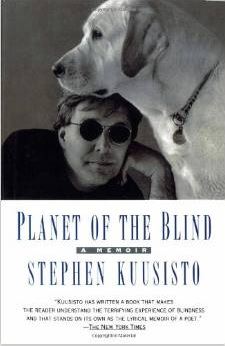
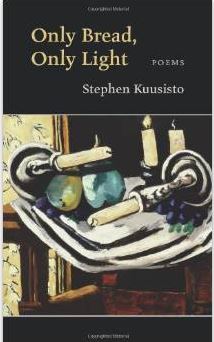
Stephen Kuusisto and HarleyABOUT: Stephen Kuusisto is the author of the memoirs Have Dog, Will Travel; Planet of the Blind (a New York Times “Notable Book of the Year”); and Eavesdropping: A Memoir of Blindness and Listening and of the poetry collections Only Bread, Only Light and Letters to Borges. A graduate of the Iowa Writer’s Workshop and a Fulbright Scholar, he has taught at the University of Iowa, Hobart and William Smith Colleges, and Ohio State University. He currently teaches at Syracuse University where he holds a University Professorship in Disability Studies. He is a frequent speaker in the US and abroad. His website is StephenKuusisto.com.

Have Dog, Will Travel: A Poet’s Journey is now available for pre-order:
Amazon
Barnes and Noble
IndieBound.org

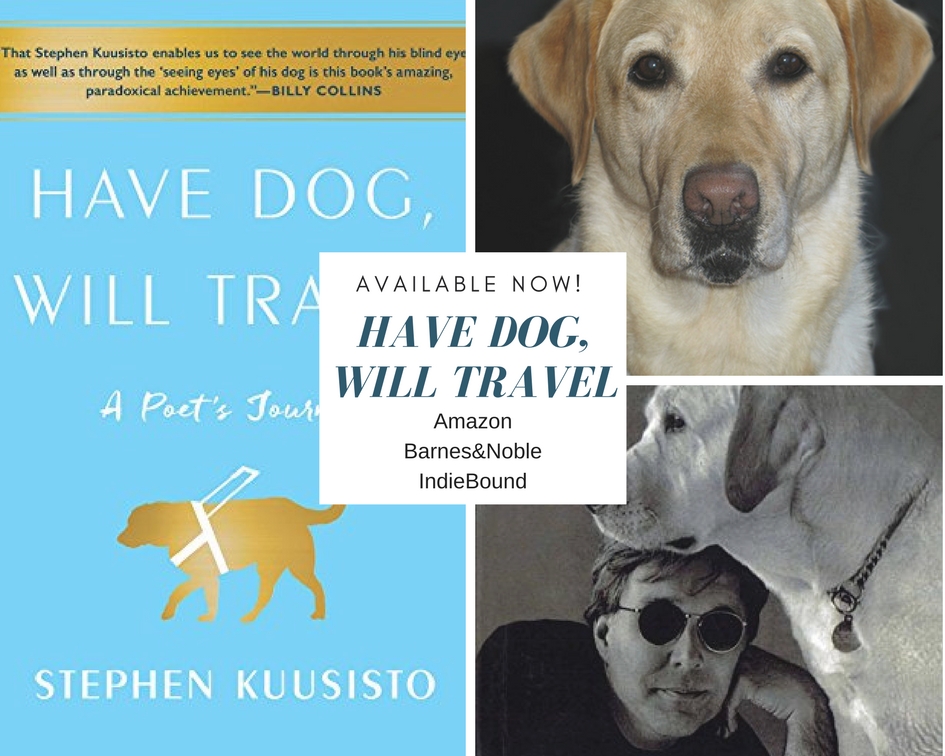
Have Dog, Will Travel by Stephen Kuusisto

(Photo picturing the cover of Stephen Kuusisto’s new memoir “Have Dog, Will Travel” along with his former guide dogs Nira (top) and Corky, bottom.) Bottom photo by Marion Ettlinger 

On Critical Thinking, Disability, and the Academy

One of the ironies about the current state of academe is that universities propose to introduce students to what is called “critical thinking” as if most teaching faculty are available and capable to do this very work. I remember a biology professor wagging his finger in my face because, he said, biology students really don’t need to know how to write. That he was a well regarded professor made the moment doubly remarkable. “Don’t you want your students to be successful grant writers?” I asked. “You don’t need to take writing courses to do that!” he sniffed. Opposition to writing and the teaching of same is fundamentally a resistance to the teaching of nuance, scruple, irony, and pesky associative questions like “why is this problem interesting; confounding; worthwhile; perhaps even utopian?” Whatever we mean by the term critical thinking behind the term must lie a hope that students will bloom beyond being students. If this isn’t your hope as a member of the professoriate—which is to say a wish that your students will master their own curiosities no matter their chosen profession, then you’ve no business teaching. And there. I’ve said it. I believe far too many faculty are insufficiently inclined to engage with students as potential contrarians which is what we all should be after.

How many department meetings have I attended over the years? Lordy. And scarcely a discussion about students or what we hope they’ll gain. Worse perhaps is the cynical shorthand of “outcomes assessment” that’s been adopted for inclusion on syllabi and which now occupies senior administrators from the accreditation complex—themselves former faculty who’ve little experience teaching critical thinking. In this way the contemporary academy is like the singsong monkey that chases its tail around the flagpole. There’s a lot of talk about critical thinking and little actually happening. Instead there is essentialism about any number of topics. Here’s a popular one: Capitalism is the source of all suffering. I think one should say it’s the source of many problems. But critical thinking demands probing the assertion: was there ever a civilization without some kind of capitalism? Are there capitalist countries where the people are happy? These questions are not popular in essentialist teaching circles. Essentialism requires agreement, a prescriptive shared narrative. I know disabled students who think all able bodied citizens are their enemies and that able bodied people believe in compulsory able-bodiedness.

Remember “The Combahee River Collective Statement” of 1977?

“This focusing upon our own oppression is embodied in the concept of identity politics. We believe that the most profound and potentially most radical politics come directly out of our own identity, as opposed to working to end somebody else’s oppression.”

As Mark Lilla puts it in his book “Once and Future Liberal” the left, following Reagan’s election failed to unite and instead augured into separate coverts of bitterness:

“Instead, they lost themselves in the thickets of identity politics and developed a resentful, disuniting rhetoric of difference to match it. ”

**

Three weeks ago I watched the televised memorial for President George H.W. Bush. I found the occasion moving. Bush 41 signed the Americans with Disabilities Act into law in 1990 and that moment still stands for me and many others as a watershed in American politics as it was perhaps the last time the left and right worked assiduously to promote the well being of millions upon millions of citizens. The law was fiercely opposed then and still is now. That Bush signed it says a good deal about his willingness to resist calls from the Chamber of Commerce to let the disabled continue living without rights as they’d always done.

When I posted on social media my appreciation for Bush’s role in promoting the ADA I was besieged by Facebookers and Twitterers informing me Bush was a moral coward, a bigot, a war criminal, a homophobe, a liar, a groper—all to edify me. Having said he’d done something good I must be obtuse or utterly ignorant about his life in its entirety. This is the sloppiness of identity politics—its execrable cheapness of thought, adopted formally at the Combahee conference and now a laziness disguised as moral advantage. If critical thinking is to be taught let’s ask what it might actually mean.

I’ll venture it may require a willingness to give up first response finger wagging—the “gotcha” which is now everywhere on both the right and left. Someone who teaches disability studies told me on Facebook (in response to my observation that much about racism I find hard to absorb having grown up in a very liberal environment) I “must be” racist as I’m white. Her proof? I’m soaked in white privilege. Gotcha works this way. It substitutes paradigms within an argument. Example: “You believe you’ve a personal identity which is moral and possesses Enlightenment values of nuance and rationality but actually you’ve no personal identity since postmodern culture assures this. Therefore you can’t be immune to racism, if say, you’ve gotten a bank loan at any time during your life.”

If you’ve white privilege you’re a de facto racist. The essentialism behind the argument—the confirmation bias—is that this has been entirely decided by people who recognize oppression better than I do.

Forget that I grew up blind; have lived on food stamps and unemployment and have spent time living in Section 8 housing. Dispose of the fact I’ve been discriminated against in education and employment over and over during my “career”—that fancy term for what the Buddhists call the “meat wheel.”

That I’ve been harmed owing to disability doesn’t change the fact that I have advantages over others. If you believe this than you also have to imagine that human beings are just flies in amber, mere products of ancient entrapments with no hope of escape.

**

Why is this “gotcha” so attractive?

Fundamentalism is easier than scruple.

Amos Oz died this week. I’ve been reading his book “Dear Zealots” with considerable interest. He is at pains to understand how fanaticism works and why it’s the illness of our time. He writes:

“Fanaticism is not reserved for al-Qaeda and ISIS, Jabhat al-Nusra, Hamas and Hezbollah, neo-Nazis and anti-Semites, white supremacists and Islamophobes and the Ku Klux Klan, Israel’s “hilltop thugs” in the settlements, and others who would shed blood in the name of their faith. These fanatics are familiar to us all. We see them every day on our television screens, shouting, waving angry fists at the camera, hoarsely yelling slogans into the microphone. They are the visible fanatics. A few years ago, my daughter Galia Oz directed a documentary film that probed the roots of fanaticism and its manifestations in the Jewish underground.

But there are far less prominent and less visible forms of fanaticism around us, and perhaps inside us, too. Even in the daily lives of normative societies and people we know well, there are sometimes revelations, albeit not necessarily violent ones, of fanaticism. One might encounter, for example, fanatic opponents of smoking who act as if anyone who dares light a cigarette near them should be burned alive. Or fanatic vegetarians and vegans who sometimes sound ready to devour people who eat meat. A few of my friends in the peace movement denounce me furiously, simply because I hold a different view of the best way to achieve peace between Israel and Palestine.

Certainly, not everyone who raises a voice for or against something is suspected of fanaticism, and not everyone who angrily protests an injustice becomes a fanatic by virtue of that protest and anger. Not every person with strong opinions is guilty of fanatic tendencies. Not even when such views or emotions are expressed very loudly. It is not the volume of your voice that defines you as a fanatic, but rather, primarily, your tolerance—or lack thereof—for your opponents’ voices.

Indeed, a hidden—or not so hidden—kernel of fanaticism often lies beneath various disclosures of uncompromising dogmatism, of imperviousness and even hostility toward positions you deem unacceptable. Righteousness entrenched and buttressed within itself, righteousness with no windows or doors, is probably the hallmark of this disease, as are positions that arise from the turbid wellsprings of loathing and contempt, which erase all other emotions there is nothing wrong with loathing in and of itself: in Shakespeare and Dostoyevsky and Brecht, Chaim Nachman Bialik and Y. H. Brenner and Hanoch Levin, we find a stinging component of loathing. A blazing component—but not an exclusive one. In the works of these great writers, loathing is accompanied by other feelings, too—by understanding, compassion, longing, humor, and a measure of sympathy.)”

**

If the American university hopes to embrace critical thinking it must examine righteousness entrenched. In literary writing courses we talk of comic or dramatic irony—those moments when a literary writer asks “what do my characters or my narrator know “now” that they did not know even just a few moments ago? In a dramatic stage play comic irony is when the audience knows more than the figures on stage. All of Shakespeare’s comedies depend on this device.

If the American university hopes to embrace critical thinking it must offer courses that show students how to work across divides. My suggestion is to look at the history of the Americans with Disabilities Act—it has a long back story, driven by veterans wounded in foreign wars, pushed by political activism—cripples crawling up the Capitol’s steps; grassroots politics of the best and worst kind; and perhaps most remarkable of all its demonstration that intellectual and dogmatic buttresses can come down just as architectural barriers can.

If the American university wants to embrace critical thinking it should look at the peacemakers.

Amos Oz again:

“There are varying degrees of evil in the world. The distinction between levels of evil is perhaps the primary moral responsibility incumbent upon each of us. Every child knows that cruelty is bad and contemptible, while its opposite, compassion, is commendable. That is an easy and simple moral distinction. The more essential and far more difficult distinction is the one between different shades of gray, between degrees of evil. Aggressive environmental activists, for example, or the furious opponents of globalization, may sometimes emerge as violent fanatics. But the evil they cause is immeasurably smaller than that caused by a fanatic who commits a large-scale terrorist attack. Nor are the crimes of the terrorist fanatic comparable to those of fanatics who commit ethnic cleansing or genocide.
Those who are unwilling or unable to rank evil may thereby become the servants of evil. Those who make no distinction between such disparate phenomena as apartheid, colonialism, ISIS, Zionism, political incorrectness, the gas chambers, sexism, the 1 percent’s wealth, and air pollution serve evil with their very refusal to grade it.

Fanatics tend to live in a black-and-white world, with a simplistic view of good against evil. The fanatic is in fact a person who can only count to one. Yet at the same time, and without any contradiction, the fanatic almost always basks in some sort of bittersweet sentimentalism, composed of a mixture of fury and self-pity.”

“The urge to follow the crowd and the passion to belong to the majority are fertile ground for fanatics, as are the various cults of personality, idolization of religious and political leaders, and the adulation of entertainment and sports celebrities.

Of course there is a great distance between blindly worshiping bloodthirsty tyrants, being swept up by murderous ideologies or aggressive, hateful chauvinism, and the inane adoration of celebrities. Still, there is perhaps a common thread: the worshiper yields his own selfhood. He longs to merge—to the point of self-deprecation—with the throng of other admirers and unite with the experiences and accomplishments of the object of worship. In both cases, the elated admirer is subjugated by a sophisticated system of propaganda and brainwashing, a system that intentionally addresses the childish element in people’s souls, the element that so longs to merge, to crawl back into a warm womb, to once again be a tiny cell inside a huge body, a strong and protective body—the nation, the church, the movement, the party, the team fans, the groupies—to belong, to squeeze in with a crowd under the broad wings of a great father, an admired hero, a dreamy beauty, a sparkling celebrity, in whose hands the worshipers deposit their hopes and dreams, and even their right to think and judge and take positions.

The increasing infantilization of masses of people everywhere in the world is no coincidence: there are those who stand to gain from it and those who ride its coattails, whether from a thirst for power or a thirst for wealth. Advertisers and those who fund them desperately want us to go back to being spoiled little children, because spoiled little children are the easiest consumers to seduce.”
Stephen Kuusisto and HarleyABOUT: Stephen Kuusisto is the author of the memoirs Have Dog, Will Travel; Planet of the Blind (a New York Times “Notable Book of the Year”); and Eavesdropping: A Memoir of Blindness and Listening and of the poetry collections Only Bread, Only Light and Letters to Borges. A graduate of the Iowa Writer’s Workshop and a Fulbright Scholar, he has taught at the University of Iowa, Hobart and William Smith Colleges, and Ohio State University. He currently teaches at Syracuse University where he holds a University Professorship in Disability Studies. He is a frequent speaker in the US and abroad. His website is StephenKuusisto.com.

Have Dog, Will Travel: A Poet’s Journey is now available for pre-order:
Amazon
Barnes and Noble
IndieBound.org
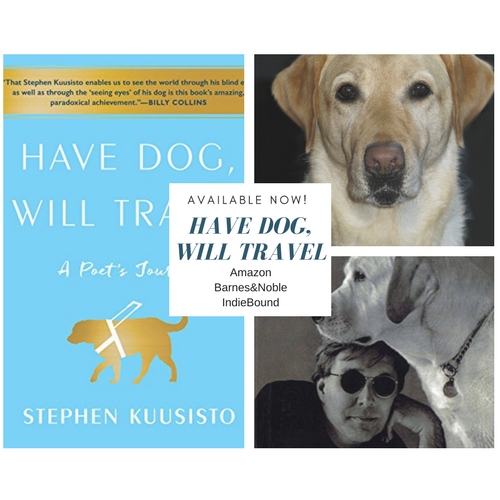
Have Dog, Will Travel by Stephen Kuusisto

(Photo picturing the cover of Stephen Kuusisto’s new memoir “Have Dog, Will Travel” along with his former guide dogs Nira (top) and Corky, bottom.) Bottom photo by Marion Ettlinger 
The Blind Eyes are Lonely Hunters: My Life in Higher Education

1.

They come late. They had some way to travel. The blind eyes enter a room. Sighted colleagues have read all the reports before them. And the man with the blind eyes sits down. Accessible materials are not provided. The others call him “professor” though it means little. He’s without info like a cat without whiskers; like a ghost without living people to haunt; a ballplayer without a glove. Now in his early sixties he comprehends how improbable his professional life really is. He’s not meant to be here. He’s been told so all his days.

Nevertheless…

He reads everything he needs to. Since the committee never gives him the materials in advance he must read the agenda and the report while everyone else has already digested them. In this way he is sub-literate and it proves their point, their implicit bias for atopic literacy is questionable. Reading differently, slowly, after the fact, from the margins, why that isn’t reading at all.

2.

That he’s lonely in the academy is unquestionable. Because he studied poetry in his youth he knows a good deal about loneliness and understands its spiritual and secular effects. He loves Jesus for his brave solitudes and his sacrificial acceptance of pain. That Christ never abandoned empathy, never unclenched the burning rose of love, he keeps in mind always.
But he’s lonely as a lost shoe, like a fish still respiring in ice. He’s a bird flying underground.
You see, he did study poetry. Analogies are his anodyne. He’s lonely as the rains arriving on time.

3.

Poetry, the writing of it, the study of it, was for him a reasonable accommodation. If he couldn’t read forty books in a semester he could read three poems well. He knew the smell of rotting pears and why it broke Goethe’s heart. He understood why Byzantine louts secretly hated their libraries. He saw in the Codex Sinaiticus proof of the inalienable wisdom that we’re small. We are very very small.

Human beings are questions asked of another question. Yeats: “The world is full of magic things, patiently waiting for our senses to grow sharper.”

As his eyes will never grow sharper he will open to magics.

More Yeats:

“Come away, O human child!
To the waters and the wild
With a faery, hand in hand,
For the world’s more full of weeping than you can understand.”

4.

So poetry was my first educational accommodation. And a beautiful irony it is, for poetry is not reasonable at all.

Tone ex nihilo.

I’m familiar with all those songs that start from nothing.

5.

I am a senior faculty member with a distinguished professorship at Syracuse University. I’m also conditional in the agora. Just two weeks ago a man who I assume was a professor, for he had the angular characteristic gestures of privileged catastrophe, came unbidden into my personal space (such a lovely modernist, cosmopolitan conceit, personal space) and told me that by not picking up my guide dog’s feces I was “antisocial”—which is of course confirmation bias at best, and unsympathetic gibbering at worst—but either way, it was snowing hard, I had no idea where a trash can might be, and who in their right mind picks on a blind person?

I’m contingent on my campus. Alright. Alright. I know all about the first handwritten manuscript in a Slavic tongue. Old Finn Vainamoinen is my secret friend. I know how to enter and leave the guts of dead shamans and steal their secrets.

6.

There’s a tremendous freedom to the imagination. Though I’m often not welcome in academic environs (insisting on accessible web pages; inclusive software; descriptive videos; braille signage ((of which Syracuse has very little))) demanding my dignity; I know all about the cuneiform implications of sharp edged shadows and all their ironic and skeptical intelligences.
Around me everything is alive.

All my poetic currencies stay at the right rate.

Stephen Kuusisto and HarleyABOUT: Stephen Kuusisto is the author of the memoirs Have Dog, Will Travel; Planet of the Blind (a New York Times “Notable Book of the Year”); and Eavesdropping: A Memoir of Blindness and Listening and of the poetry collections Only Bread, Only Light and Letters to Borges. A graduate of the Iowa Writer’s Workshop and a Fulbright Scholar, he has taught at the University of Iowa, Hobart and William Smith Colleges, and Ohio State University. He currently teaches at Syracuse University where he holds a University Professorship in Disability Studies. He is a frequent speaker in the US and abroad. His website is StephenKuusisto.com.

Have Dog, Will Travel: A Poet’s Journey is now available for pre-order:
Amazon
Barnes and Noble
IndieBound.org

Have Dog, Will Travel by Stephen Kuusisto

(Photo picturing the cover of Stephen Kuusisto’s new memoir “Have Dog, Will Travel” along with his former guide dogs Nira (top) and Corky, bottom.) Bottom photo by Marion Ettlinger 

Able-splaining 101

If you’re disabled you know all about it. The apparently “normal” person who tells you what you need to know is legion. BTW this figure can be anyone. Despite feminism, women can be able-splainers just as often as men. I recall distinctly the associate provost at my university who told me that a software package was “robust” when it comes to accessibility when in fact it was junk. Able-splainers have no shame. All they need is a cocksure belief that the disabled are deficient which means of course we’re dismissible and voila!

But did you know that silence is also a form of able-splaining? When the disabled say something is unusable silence is often the best able-splaining of all. And so economical!
Nothing says “that’s the way it is little dude” better than a good old fashioned round of silence.

The other day I got able-splained in a new way which trust me is a remarkable thing as I’ve pretty much heard or not heard it all. An elderly professor accused me of being antisocial because he saw me scoop my guide dog’s waste into a plastic bag and then gently place the bag in a snow drift.

I was carrying a harness, a briefcase, holding a leash, and having a conversation with another faculty member all at the same time.

And there I was. Busted. Imperfect. A hater of humanity.

What he was really saying was I don’t belong on his campus.

You know, us cripples with our animals, breathing tubes, mechanical devices galore, our irregular invisible needs—how polluting we are.

Ableism likes the world clean.

Stephen Kuusisto and HarleyABOUT: Stephen Kuusisto is the author of the memoirs Have Dog, Will Travel; Planet of the Blind (a New York Times “Notable Book of the Year”); and Eavesdropping: A Memoir of Blindness and Listening and of the poetry collections Only Bread, Only Light and Letters to Borges. A graduate of the Iowa Writer’s Workshop and a Fulbright Scholar, he has taught at the University of Iowa, Hobart and William Smith Colleges, and Ohio State University. He currently teaches at Syracuse University where he holds a University Professorship in Disability Studies. He is a frequent speaker in the US and abroad. His website is StephenKuusisto.com.

Have Dog, Will Travel: A Poet’s Journey is now available for pre-order:
Amazon
Barnes and Noble
IndieBound.org

Have Dog, Will Travel by Stephen Kuusisto

(Photo picturing the cover of Stephen Kuusisto’s new memoir “Have Dog, Will Travel” along with his former guide dogs Nira (top) and Corky, bottom.) Bottom photo by Marion Ettlinger 

1963

Another day, another mass shooting in America. Sometimes I think if I were the kind of poet who adopts classical rhetorical forms I might say, “I lived in the age of gun violence” as opposed to “the age of gold” or even “of plastic” and should there be a future civilization more refined than ours they will say “that must have been very painful—how did they manage?”

There’s prescience in childhood of course. I recall the first day of school after John Kennedy’s funeral. Our teacher asked us to share our feelings about the president’s assassination. I was in the third grade and barely 8 years old. Some of us cried of course. Some of us expressed fear.
And then a kid stood up and said “they killed him with dum dum bullets!” He was thrilled to share this information. “My brother is in the marines, he said they used dum dums!” “Yeah, his head really exploded!”

No one of course knew what to say. I think our teacher said “let’s move on….”

But I remember being repulsed by my classmate’s enthusiasm for bullets and heads exploding. And I also remember understanding that Americans may like violence. I was eight for god’s sake.

Nowadays I think of my 1963 classmate rather frequently for with every mass shooting there’s someone reveling in a testosterone soaked dance about the bullets and the guns used.

I disliked that classmate.

And yes, he beat me up one day just because I was blind.

And the Wind a Grain of Salt

I’m going to let the kitty out of the wrapper and admit I’ve never believed the teaching of creative writing is more than a pastime. Like baseball, academic discussions of poetry and fiction, nonfiction and playwriting tend toward exquisite minutiae and nostalgia but without regard for what’s happening outside the stadiums or sports bars. I’m employing nostalgia with irony of course—using it in the Greek sense meaning returning home in pain. Odysseus is nostalgic. In turn he’s single minded.

**

Odysseus is more than nostalgic. He’s religious in the worst way, Huck Finn praying for a fishing hook. Athena is his familiar and gets him “home” on rage. Most religious pastimes are about nothing more than this.

Justice is absent from Homer save for divine vengeance that good old Olympian smack down.

We better know what we mean about the effects of poetry, what we mean by justice, where the study of poetry or literature stands in relation to human rights.

At the poetry conferences save for very few, human rights are not discussed at all. It is assumed by the writing workshop crowd that just thinking about writing elevates.

**

I told a fine poet last evening that I’m running out of time. At 63 I need to turn my prow toward the far shore, away from time, to that place where coins are useless. That I’ve long been in the fight for disability rights (which are all human rights insofar as disability admits everyone) means I’ve had to sculpt and shape my anger into productivity. Just anger admits justice and eschews vengeance. Just anger is not nostalgic. It’s also a form of ambition. Pentti Saarikoski wrote: “I want to be the sort of poet whose words build houses for people….” Amen. Meanwhile, how to let go of anger, or just enough of it to die happy?

**

“Life is a hospital where all the patients want to change beds,” said Baudelaire. I want to pick up my bed and walk—not because I’m cured but because I learned (am learning) to make my burdens light and my rest easy. I want this for you and you.

**

So I gravitated away from the teaching of creative writing to work in the eddies of human rights. 80% of the disabled remain unemployed in the United States. Some will tell you its only 70%. Some will tell you they’re a drain on society. (Hitler: the disabled are useless eaters.)

If human rights mean anything they stand for the manifest opportunity to think, believe, examine, eat, sleep, all unencumbered. And as I think about the bow of my boat I’m remembering these lines by the Norwegian poet Olav Hauge:

“Don’t give me the whole truth,
don’t give me the sea for my thirst,
don’t give me the sky when I ask for light,
but give me a glint, a dewy wisp, a mote
as the birds bear water-drops from their bathing
and the wind a grain of salt.”

The Cage We’re Forced to Watch

My neighbor is eating good ham. He drives a nice car. He voted for Trump. He’s a stand up guy. Just ask him. He’ll tell you he loves America. In fact he loves it more than you do. You describe problems with the USA. He only sees timeless verities: cowboys and Indians; slaughter on behalf of the railroads; local jobs based on environmental destruction. While the Colorado River basin runs out of water he says global warming is a hoax.

Sleeping he dreams of a wide cushiony bed where no one has sex, it’s a white, protestant cloud if you will.

When he wakes he turns on Fox News and tells himself America is great again because “those people” are getting their comeuppance.

**

Yesterday I hosted film maker Federico Muchnik and poets Doug Anderson and Preston Hood at the 15th annual Syracuse International Film Festival.

Federico’s film “Hunter in the Blackness: Veterans, Hope, and Recovery” details the experiences of American soldiers—veterans with traumatic brain injury, PTSD, and other poly-traumas. Doug Anderson and Preston Hood, both veterans of the Viet Nam War are featured in the movie alongside vets from America’s involvement in Bosnia, Iraq, and Afghanistan. It is a haunting film. The lack of awareness of civilians is a recurring theme. We send boys and girls to wars while America shops at the mall. When troops return with grievous conditions many Americans don’t want to know.

22 veterans commit suicide daily in these United States.

Last evening, after I bid farewell to my new found friends, I took an Uber home. My driver was a veteran of the war in Iraq. He has PTSD and traumatic brain injury. He told me how his best friend from his time in the military recently committed suicide.

And there we were, riding in a Dodge pickup, through the gritty nighttime rainy streets of Syracuse, NY, and it was impossible for me to blink away the machinations of my country. My driver told me about his TBI, his facial disfigurement, his stress condition, and the ongoing difficulties he has had with the VA to get the help he needs.

Rain spattered the windshield.

**

Swedish poet Lars Gustafson writes: “And a cage/which never held a bird can easily give/a feeling of disorder.”

I’ve not been to war. But I know the cage we’re forced to stare at.

Stephen Kuusisto and HarleyABOUT: Stephen Kuusisto is the author of the memoirs Have Dog, Will Travel; Planet of the Blind (a New York Times “Notable Book of the Year”); and Eavesdropping: A Memoir of Blindness and Listening and of the poetry collections Only Bread, Only Light and Letters to Borges. A graduate of the Iowa Writer’s Workshop and a Fulbright Scholar, he has taught at the University of Iowa, Hobart and William Smith Colleges, and Ohio State University. He currently teaches at Syracuse University where he holds a University Professorship in Disability Studies. He is a frequent speaker in the US and abroad. His website is StephenKuusisto.com.

Have Dog, Will Travel: A Poet’s Journey is now available for pre-order:
Amazon
Barnes and Noble
IndieBound.org

Have Dog, Will Travel by Stephen Kuusisto

(Photo picturing the cover of Stephen Kuusisto’s new memoir “Have Dog, Will Travel” along with his former guide dogs Nira (top) and Corky, bottom.) Bottom photo by Marion Ettlinger 

Stop With Your Ableist Lazy Rage

Over the course of the last two years (post election and the year prior) I’ve watched people throw ableist insults. From the right the favored term is “libtard” and from the left one hears “moron” “idiot” and “imbecile” all echoing eugenics both in Germany and the United States when the disabled were marked for elimination.

When disability must be employed to register rage then its nothing more than lazy rage. Rather than call a Trump supporter an imbecile why not say: “there’s a person who doesn’t understand his shadow.” Not so much fun as ableizing him or calling him a pig or weasel.

Lazy rage is fun rage. Even in their discontent Americans like to have fun. Trump knows this. Its perhaps the only thing he knows.

We’re got rape culture to worry about; children in cages; wholesale destruction of the environment at hand; black men in the school to prison pipeline; eroding medical services for veterans and the poor; unending American involvement in ruinous wars; the collapse of public education; big Pharma slinging opioids in every corner of the nation; religious extremism attacking science; an outright war on the Americans with Disabilities Act—I’m just getting started.

And all I see on facebook is callow name calling with an especially able bodied smugness.

As John Lennon might say: here’s another clue for you all. You are as much the problem as the problem.

Read Carl Jung on “the shadow” and know your own deep despairs before saying someone else is “lame” and for god’s sake join a volunteer organization of some kind.

More About Hating Smokey the Bear

I don’t like Smokey the Bear. I’ve already written about it. He’s a slick defier of logic. Children are powerless to prevent forest fires and telling kids they’ve a singular moral responsibility fo forestall contagion is the kind of cartoon horse shit Americans are forced to grow up with.

Meanwhile the forests are being systematically cut down by Weyerhaeuser and fried by acid rain from “clean coal”—a phrase I’m sure Smokey the Bear would approve.

Now you will say: “But Kuusisto, is it Smokey the Bear you don’t like, or is it the fatuous, bloated, running dogs of the bourgeoisie who created him who you dislike?”

Of course I dislike Madison Avenue. But it’s the cartoon Bear I hate. He’s the kind of anthropomorphic dungaree wearing shovel toting ranger hat wearing dingus who will pick your pockets if you’re not careful. He’s out to mess with your conscience. He wants you to feel responsible when bad things happen in nature.

Only you can prevent hurricanes.

Only you can prevent global warming.

He’s anti-democratic and the purveyor of superstition.

Thomas Jefferson would have despised Smokey the Bear.

Why am I “on” about this?

Because when you make a woman who’s survived sexual abuse stand alone before a room fool of smug, pink, hostile men on Capitol Hill, you’re saying, “only you can prevent sexual assault”—the American social lie…the idea that the culture isn’t responsible, only you, only you.

Stephen Kuusisto and HarleyABOUT: Stephen Kuusisto is the author of the memoirs Have Dog, Will Travel; Planet of the Blind (a New York Times “Notable Book of the Year”); and Eavesdropping: A Memoir of Blindness and Listening and of the poetry collections Only Bread, Only Light and Letters to Borges. A graduate of the Iowa Writer’s Workshop and a Fulbright Scholar, he has taught at the University of Iowa, Hobart and William Smith Colleges, and Ohio State University. He currently teaches at Syracuse University where he holds a University Professorship in Disability Studies. He is a frequent speaker in the US and abroad. His website is StephenKuusisto.com.

Have Dog, Will Travel: A Poet’s Journey is now available for pre-order:
Amazon
Barnes and Noble
IndieBound.org

Have Dog, Will Travel by Stephen Kuusisto

(Photo picturing the cover of Stephen Kuusisto’s new memoir “Have Dog, Will Travel” along with his former guide dogs Nira (top) and Corky, bottom.) Bottom photo by Marion Ettlinger 
This is the Smokey the Bear Social Lie Complex.

The corridors of power depend on this.