No to H.R. 620, No to the GOP, Defend the Disabled!

Some days are hard to bear—you’re a single mom and rent is due. You don’t know where that money is coming from. Child care is hit or miss. Your children are sick and what meagre health insurance you have is being depleted by politicians who imagine poverty is a moral weakness.

There’s a lot of “moral weakness” going around these days in the United States. If you listen to GOP senators, and house representatives you hear that the lame, the halt, the poorest among us are undeserving of public help. There’s something wrong with them, according to the right wing narrative. They’re lazy. Feckless.

The disabled are part of this objectified collection of wanton souls. We’re costly. What with our needs for ramps and Braille and breathing tubes. What with our claims on health care. It’s hard to escape the lingering horror of Adolf Hitler’s dictum that the disabled are just “useless eaters.” The aggressive, rightward tilt of the GOP leans toward the wholesale elimination of Medicaid and deep cuts in medicare. This isn’t some kine of fiction—fake news—the GOP is working overtime to make sure the elderly, the poor, and the disabled have no supports to help them live. Pro-life party indeed.

Right now the GOP is pushing in the house a bill (H.R. 620) which is the product of long standing and relentless lobbying by organizations like the Better Business Bureau, and which is designed to eliminate the capacity of the disabled and their allies to sue businesses for willfully ignoring the accessibility provisions in the Americans with Disabilities Act. Here are some basic bullet points that have been shared nationally by The Disability Rights Education and Defense Fund.

HR 620 will eliminate the need for businesses to be accessible until a complaint is received; there will be no need to make a business accessible until someone complains; that will mean many groups building new buildings, renovating buildings, opening new businesses will not make their services accessible

HR 620 shifts the burden of accessibility from those who offer services to the person with a disability; no other group needs to prove their right to access to publicly offered services

We should not be gutting the rights of people with disabilities; if there is a problem, we should be limiting the actions of a small number of lawyers who are bad actors

HR 620 will take away the civil rights of people with disabilities; would we ever think about eliminating the rights of any other group of Americans? This is disgraceful.

You can read more about H.R. 620 and the cover language the GOP is using to confuse the public about the bill here:

https://dredf.org/wp-content/uploads/2017/08/myths-and-truths-about-the-ada-education-and-reform-act.pdf

**

What does it mean when a nation decides that the most vulnerable of its citizens should be stripped of their rights to participate in civic society? What’s the deep text underscoring predates of the weak?

The answer lies in right wing melodrama. Like the Third Reich, today’s Republicans have a scarcity narrative which is predicated on the idea that Mom and Pop America won’t get what’s due them if we take care of these obviously non-productive people. That we’ve come down to this just 28 years after the wholly bi-partisan adoption of the ADA is both horrifying and quite telling. Not long ago I was at an event in Washington, DC where former U.S. Senator Bob Dole, a wounded veteran, who championed the ADA said openly, “Today I fear that law could never pass on Capitol Hill.”

Please, if you’re reading this, call your local U.S. Representative and say “No!” to H.R. 620.

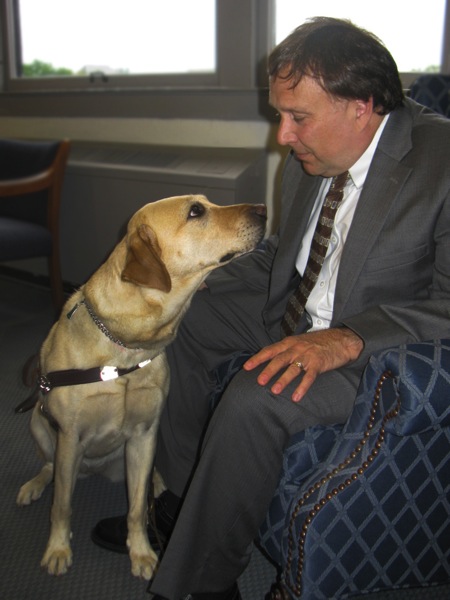
Stephen Kuusisto and HarleyABOUT: Stephen Kuusisto is the author of the memoirs Have Dog, Will Travel; Planet of the Blind (a New York Times “Notable Book of the Year”); and Eavesdropping: A Memoir of Blindness and Listening and of the poetry collections Only Bread, Only Light and Letters to Borges. A graduate of the Iowa Writer’s Workshop and a Fulbright Scholar, he has taught at the University of Iowa, Hobart and William Smith Colleges, and Ohio State University. He currently teaches at Syracuse University where he holds a University Professorship in Disability Studies. He is a frequent speaker in the US and abroad. His website is StephenKuusisto.com.
Have Dog, Will Travel: A Poet’s Journey is now available for pre-order:
Amazon
Barnes and Noble
IndieBound.org


The ADA is Under Attack

The ADA is under attack.  Next week, the House will be voting on a bill, H.R. 620 that would undermine the protections of the ADA and take away the rights of people with disabilities.  Please call your Representative and ask them to #VoteNo and #ProtectTheADA

Here are talking points:
·         HR 620 will take away the civil rights of people with disabilities

·         It will make people with disabilities wait for up to 180 days for services that other people have immediate access to

·         The wait may be even longer than 180 days because a business that is making “substantial progress” toward fixing a problem can take even longer than 180 days

·         HR 620 will eliminate the need for businesses to be accessible until a complaint is received; there will be no need to make a business accessible until someone complains; that will mean many groups building new buildings, renovating buildings, opening new businesses will not make their services accessible

·         HR 620 shifts the burden of accessibility from those who offer services to the person with a disability; no other group needs to prove their right to access to publically offered services

·         We should not be gutting the rights of people with disabilities; if there is a problem, we should be limiting the actions of a small number of lawyers who are bad actors

·         HR 620 will take away the civil rights of people with disabilities; would we ever think about eliminating the rights of any other group of Americans? This is disgraceful.

And here is a fact sheet from our colleagues at Disability Rights Education and Defense Fund (DREDF) about the myths and realities of this bill.

Stephen Kuusisto and HarleyABOUT: Stephen Kuusisto is the author of the memoirs Have Dog, Will Travel; Planet of the Blind (a New York Times “Notable Book of the Year”); and Eavesdropping: A Memoir of Blindness and Listening and of the poetry collections Only Bread, Only Light and Letters to Borges. A graduate of the Iowa Writer’s Workshop and a Fulbright Scholar, he has taught at the University of Iowa, Hobart and William Smith Colleges, and Ohio State University. He currently teaches at Syracuse University where he holds a University Professorship in Disability Studies. He is a frequent speaker in the US and abroad. His website is StephenKuusisto.com.

Dogs, Hats, and Faith

As the new year dawns I’m doing my best—that is, I’m drinking coffee. And since I went to bed last night at 9:30 (at the insistence of a small dog who thought it was the right thing when the outside temperature was 5 degrees Fahrenheit) well because of this I’m wide awake sans hangover.

To be fair the dog didn’t make me go to bed. It’s good to distrust people who say dogs make them do anything other than feeding them and taking them outside. I went to bed early because it seemed like a good idea.

I’ve been taking antidepressants for over twenty years. They help me stay “in the game” but they also make me tired at night and that’s just the way it is. By taking Celexa I live on dog time. Early to bed, early to rise. I’m Ben Franklin with pills and dogs.

What are dogs and antidepressants for? I imagine they’re about hope. Even facing the aborning year which cannot be promising, what with the looting of the planet, corporatized warfare, slavish and corrupt politicians of every stripe, human trafficking, the new slavery, which is old slavery tied to offshore banking—I’ll stop in a moment—even with the assault on the poor, the infirm—here I am again tossing my moth eaten chapeau onto a fountain of hope knowing one of my two dogs will retrieve it.

Dogs teach us to put our wet hats on again.

They teach us to avoid rising to the level of our expectations, but fall to the level of our training, as Archilochus would have it and which I’ve always taken to mean “get on with it brother.”

The wet hat has some toothmarks.

Lots of people sneer at hope. It is for one thing akin to faith and nothing gets kicked more often than faith, even the faithful do it.

I agree with Maxine Hong Kingston: “In a time of destruction, create something.”

Dogs say wet hats are better than no hats.

Dogs say you can indeed get there from here.

Dogs say even wearing that hat you’re not as bad as you appear.

Or they say, well, you might be as bad as you appear—so throw your hat again and we’ll bring it back. You can try for a new look.

A hat damp with hope is still a hat.

A damp hat is expectation halved, still wearable.

The hat your dog brings means you have a plan.

My Guide Dog is Dreaming

Her name is Caitlyn and she’s a yellow Labrador. Ten minutes ago she was eating her breakfast and now, curled on her bed, she’s talking in her sleep. It’s winter and very cold in Syracuse, New York and my canine pal has managed to take sustenance and go back to sleep in record time. 

Dogs found us thirty thousand years ago. One theory about this is that they coveted our midden heaps and then they stuck around. I won’t argue for or against this, save to say it’s possible dogs believed we were interesting and they liked us better than we liked ourselves. In turn they helped us hunt and stave off intruders. 

A dog dreaming by the fire is an ancient matter. A dog dreaming is a sign of love between us. Simple to say but most people don’t understand this. 

Love has many expressions. 

“Now” in the Disability Dictionary….

Now is faux past prologue, an advertisement so false even your pineal gland knows it. Now is the most favored word in capitalism. Worse of course is the expression “now and then” which implies a stricture on tomorrow, governed by nothing as “now” has little predictive value. “Right now,” say the tyrants, “things couldn’t be any better.” Now says global warming isn’t real. Now says the poor are imprisoned and they’re meant to be so. Now, in America, is shorthand for “there isn’t any future unless you’re already in the now club.” We used to say a salubrious person was “in the know” but, well, you get my drift.

In disability circles there’s no future planned beyond this: your tomorrows are being erased in the halls of Congress. After health care and social security are gutted will they bring back the ugly laws? Will they lock up the disabled in ruined shopping malls?

This morning I found myself thinking of Aristophanes who I read assiduously in college. Here he is:

“Look at the orators in our republics; as long as they are poor, both state and people can only praise their uprightness; but once they are fattened on the public funds, they conceive a hatred for justice, plan intrigues against the people and attack the democracy.”

Now wants what it has to stay always. The plan is to take down future democracy always.


George Will and Yale’s Indians

There’s nothing like the prospect of overreaching do-gooders in higher education to stir the dormant juices of conservative pundits. In today’s Washington Post one finds George F. Will’s starchy prose condemning liberal insensibility at Yale University: “Yale Saves Fragile Students from a Carving of a Musket”–a bromide that’s so nearly insensible I wonder about Will’s civic future as it’s obvious he’s forgoing the potential value and goodness of human beings.

Will is incensed that administrators at Yale are concerned about the placement of an altogether remnant and ugly bas relief on the facade of Sterling Memorial Library. In truth it’s a hideous thing, a carving of a thick lipped Indian and a gnashing pilgrim, each clutching their cliched weapon—a bow and arrow and a musket. Make no mistake, they’re in combat, and no love is lost in this stupid, rebarbative vignette. George Will thinks it’s art, or at least, something to be cherished. You wouldn’t know that when the carving was made the curriculum at Yale (and elsewhere) centered on “the white man’s burden” and featured a heaping helping of Social Darwinism. Will cannot imagine that this mise en abyme has an untoward semiotic history. He’s chosen to read discomfort with the stone cartoon as a pean to the contemporary (perceived) coddling of emotionally needy college students, a link that’s about as sensible as saying wolves often dress up as grandmothers and this is why union wages are declining.

Poor Yale students! Poor babies! They can’t take a racist carving! Look! They require campus counseling services because they have mental illnesses! What weaklings! How permissive college administrators are! Will offer us the usual suspects—permissive parents, dewy eyed faculty, and a general decline in our nation’s moral fiber. You’d never know that the sculpture in question is actually quite despicable.

Detestable or ignominious art always lacks scruple and nuance. It’s purpose is to cement common opinion. Both the left and the right can create repellent art. I’d like Will better if he simply said: “Ugly art ye will always have with ye, and get over it.” That might be a defensible position but of course we know who’s paying for Will’s lunch and it’s not the art historians. The basic conservative tenet is this: “racism’s in the past, get over it. They’re just statues, dude.”

Trouble is (as theologian John Lamb Lash puts it) “You can die from kitsch. And we’re close to it.”  And you can certainly die on Native American reservations where healthcare is third rate and poverty is numbingly omnipresent. And images depicting old race wars are provably malign.

No. In Will’s stifling mental pup tent the problem is today’s students have permissive mommies.

Syracuse

Cotillions of empty, odd pairings of local wines

And a general absence of conversation.

Printed handbills announce silent auctions—

Half lives burn down in clay, sweetie,


Just how it is; rebarbative Barbies

For sale in a garage; children grown

They didn’t take them; some woke,

Left home; a crow with one wing


Ambles, looking pissed,

Gets another day; winter oft

Sharpens teeth, yes,

Those are infant coffins.


Learning to Be Afraid, A Manuel for Outlier Bodies

In her latest novel The Burning Girl Claire Messud has her protagonist, a young woman named Julia observe the following: “Sometimes I felt that growing up and being a girl was about learning to be afraid,” Julia says. “You came to know, in a way you hadn’t as a kid, that the body you inhabited was vulnerable, imperfectly fortified.”

Julia’s words passed through me like a scalpel. Talk about intersectionality! This fits disability, the actual living of it, to a T. All disabled people know this story—the crawling inner sense of contingency, the stares of appraisal, the shrugs, the outright dismissals that happen at any moment. One can add to this “early or late”—my first dismissal came when I was four years old. Here’s how I describe it in my forthcoming memoir about life with guide dogs:

When I was very small I didn’t know I’d meet people who wouldn’t like me until one afternoon, climbing stairs with my father, my hand in his, we met an elderly Swedish woman who lived just below us and who said, “Tsk, Tsk” because I was blind. I was only four and it was winter in Helsinki. This had been a foundational moment for me as such moments are for all sensitive children–it’s the very second we sense we’re not who we’ve met in the mirror, or having no mirror, we’re not who our parents say we are. Cruelty is one way we arrive. It comes without warning like branches tapping a window. “She’s a fool,” my father said as if that solved the riddle of human embarrassment.  

The body I inhabited was vulnerable.

“Imperfectly fortified.” Black bodies, trans bodies, diminutive bodies, let’s be democratic about the matter. So great is the stranglehold of tacit agreement about embodied value, anyone who’s not white, male, at least of average stature, lacks the automatic agency that opposes the vulnerability Julia describes.

When Trayvon Martin, the American teenager who was murdered while minding his own business, who was shot to death for being black in a gated community, I wrote about the tragedy from a disability perspective. I said, among other things:

I know something about being “marked” as disability is always a performance. I am on the street in a conditional way: allowed or not allowed, accepted or not accepted according to the prejudices and educational attainments of others. And because I’ve been disabled since childhood I’ve lived with this dance of provisional life ever since I was small. In effect, if you have a disability, every neighborhood is a gated community. 

Last week the Rev. Al Sharpton counseled Trayvon’s parents that the engines of disparagement would start soon–that Trayvon’s character would be run through the gutter. He was right. And he was properly forecasting what happens whenever a member of a historically marginalized community speaks up for “blaming the victim” is a handy way of sidestepping issues of cultural responsibility. In a way, isn’t that what “gated communities” are all about? Aren’t they simply the architectural result of cultural exceptionalism? Of course. But as a person who travels everywhere accompanied by a guide dog I know something about the architectures and the cultural languages of “the gate” –doormen, security officers, functionaries of all kinds have sized me up in the new “quasi public” spaces that constitute our contemporary town square. I too have been observed, followed, pointed at, and ultimately told I don’t belong by people who are ill informed and marginally empowered. Like Trayvon I am seldom in the right place. Where precisely would that place be? Would it be back in the institution for the blind, circa 1900? Would it be staying at home always? 

Now the forces of revision are saying that Trayvon was a violent pot smoker. Forget that pot smokers are generally not violent and that the vast majority of teens in America have tried it–forget that it’s not a gateway drug. Forget that having been suspended from high school for minor marijuana possession isn’t an advertisement for criminal psychosis. (Didn’t we dismiss that stupid idea along with the film “Reefer Madness” some thirty years ago?) The reality here is that Trayvon is being predictably transformed from an ordinary kid into an aggressor. The evidence doesn’t support this. He was stalked and threatened and the efforts in recent days to recast him as a crazed gangsta are predictable and laughable. But I’m not laughing. I too was an “outsider” teenager. My place in every social and public environment was always conditional. Hell, I even smoked marijuana as a form of self medication. I’m not ashamed of the kid I used to be. I’m not ashamed to count Trayvon Martin as my soul mate. 

There’s a war against black men and boys in this country. There’s also a backlash against women and people with disabilities and the elderly. The forces in all these outrages are the same. The aim is to make all of the United States into a gated community. On the one side are the prisons and warehousing institutions; on the other side, the sanitized neighborhood resorts. I hear the voice: “Sorry, Sir, you can’t come in here.” In my case it’s always a security guard who doesn’t know a guide dog from an elephant. In Trayvon’s case it was a souped up self important member of a neighborhood watch who had no idea what a neighborhood really means. I think all people with disabilities know a great deal about this. I grieve for Trayvon’s family. I haven’t been able to stop thinking about him and will never forget.  

Learning to be afraid, to sense your vulnerability, is to recognize, in whatever neighborhood or room your very immanence is bothersome at best—and really that’s the best you can count on. From bothersome you descend quickly to the status of a foreign problem, and then to mild or medium hot threat or worse. Consider the tragedy of Keith Lamont Scott; consider Charleena Lyles; Brian Claunch; Robert Ethan Saylor; consider that half of the people killed by police in the United States are disabled.

One wish of mine is that Americans will pay attention to the fact that all outlier bodies have been essentially criminalized—that is, the foreign body is now imagined to be illegal.

Jerry Lewis and “The Crippler”

In his book “Telethons” the disability historian Paul Longmore observed that in the late twentieth century, “nearly everyone who talked about telethons—whether they were defenders or critics, including most disability rights activists—focused on the MDA Telethon and its host, comedian Jerry Lewis. That was not surprising. In the intensely competitive arena of televised charity solicitation, the MDA’s became the most successful and praised of the programs, as well as the most scorned. In 1989 National Public Radio’s Scott Simon described it as “the largest, single-day, private fundraising effort in the world, an extravaganza of entertainment, and fundraising sensation.”

The scorn came from the growing disability rights movement which saw Jerry Lewis as a pitchman for pity and whose language “about” disability presented children as hostages to illness without seeing disablement as merely one factor among many that constitute a life. Now that Jerry Lewis has passed away, as we think about his long and remarkable career, it’s altogether proper to reflect on the damage he did to real disabled people. The harm wasn’t just his—the charity industry in the United States came of age through a combination of forces, a new mass media, first film, then broadcasting houses, direct mail appeals, and a post-war cult of nearly instant celebrity, the likes of which hadn’t been seen much before World War II.

In fact, Dean Martin and Jerry Lewis had become famous overnight. They went from performing in second string nightclubs to the famed Copacabana within weeks, and then to Hollywood. Martin was a lounge singer from Steubenville, Ohio, a town of blast furnaces along the Ohio River. Lewis was a skinny, peripatetic, wisecracking Jewish kid from Newark, New Jersey, whose parents were minor vaudevillians and he longed to be on a stage, any stage. The war was over. America was still young. Anyone could be anything. Martin and Lewis were overnight sensations. Not since the Great Caruso crossed the Atlantic to sing opera in New York had we seen such a meteoric rise from poverty to stardom.

Jerry Lewis had grown up in a town of crippled kids—the nation was a country of crippled kids. Newark was a polio city. In his novel “Nemesis” Philip Roth describes Polio-Newark circa 1940 as a city where “a paralytic disease…left a youngster permanently disabled and deformed or unable to breathe outside a cylindrical metal respirator tank known as an iron lung—or that could lead from paralysis of the respiratory muscles to death…”

As a teenager attending the movies Lewis would invariably have seen the infamous “short” starring Raymond Massey as “The Crippler”—the sinister, looming shadow of polio who lurks at the edge of the schoolyard to capture innocent children. “Please, Mister! Let me go!” they’d cry.  Then: “Oh, I can’t move!” The theater lights would go up. Ushers came around to collect donations for the March of Dimes, the charitable organization co-founded by the President of the United States, Franklin D. Roosevelt, the nation’s most famous polio survivor.

Lewis saw disability as most Americans of his time did—as an implacable thief, a menacing, unnameable dread. When Martin and Lewis began in showbiz the disabled were not generally out in public. Polio victims were kept out of sight. Any disabling condition was understood as a dreadful thing. But fighting “The Crippler” meant displaying children. Roth writes:

“During the annual fund drive, America’s young donated their dimes at school to help in the fight against the disease, they dropped their dimes into collection cans passed around by ushers in movie theaters, and posters announcing “You Can Help, Too!” and “Help Fight Polio!” appeared on the walls of stores and offices and in the corridors of schools across the country, posters of children in wheelchairs—a pretty little girl wearing leg braces shyly sucking her thumb, a clean-cut little boy with leg braces heroically smiling with hope—posters that made the possibility of getting the disease seem all the more frighteningly real to otherwise healthy children.”

Paul Longmore describes the post-war emergence of televised charity programming:

“The telethon was invented just after World War II by private health charities as a tool to tap into the emerging mass medium of broadcast television. “Telethon” is a portmanteau word combining “television” and “marathon.” The first “television marathon” aired in April 1949 on behalf of the Damon Runyon Cancer Fund. Transmitted by the National Broadcasting Company (NBC) to twelve cities in the eastern United States and hosted by TV’s first major star, comedian Milton Berle, it was a broadcast sensation.”

A broadcast sensation indeed. Americans wanted to be generous to those in need and following the war people had disposable income for the first time in years. Helping the ill was understood to be unambiguously good, even a national trait.

This is how Jerry Lewis got his start with the Muscular Dystrophy telethon. His first was in 1956. HIs last came in 2010. What Lewis “got” about disability came from his formative years. He was being charitable. He didn’t want to hear from contrarians who felt there was more to disability than kids on crutches and cures. By 1981 the nation’s views about disability were growing more sophisticated. Longmore relates how Evan Kemp, a man with a neuromuscular condition, a Republican, and a civil rights attorney, and whose parents had helped to found the MDA, wrote in the New York Times that the telethon’s pity approach to fundraising” “bolstered social prejudice against people with disabilities.” Longmore writes:

“He (Kemp) accused it of dealing in stereotypes that only served to hinder their independence and alienate them from the rest of society. In addition, claimed Kemp, the telethon reinforced “the public’s tendency to equate handicap with total ‘hopelessness,’ ” thereby intensifying “the awkward embarrassment” of interpersonal interactions, as well as strengthening public fears and buttressing social barriers. Kemp called on the telethon to instead depict the countless examples of independent disabled people who worked, raised families, and actively participated in community life. This new message, he concluded, would “be a service to the disabled and to the country.”

Lewis didn’t respond kindly to his critics. He said famously on CBS “Sunday Morning” in response to hearing disability rights advocates had accused him of marketing televised pity: “Pity? You don’t want to be pitied because you’re a cripple in a wheelchair? Stay in your house!”

He also said: “It just kills me to think about these people getting publicity. These people are leeches. They all glommed on to being Jerry-bashers. What did they have before that? They’re disabled people who are so bitter at the bad hand they’ve been dealt that they have to take down somebody who’s doing good. There’s 19 of them, but these people can hurt what I have built for 45 years. There’s a million and a half people who depend on what I do!”I’ve raised one billion three hundred million dollars. These 19 people don’t want me to do that. They want me to stop now? Fuck them. Do it in caps. FUCK THEM.”

In Jerry Lewis’s case, thinking charitably and the charitable entertainment industry weren’t necessarily compatible. Defenders of Lewis, notably columnist Bob Greene, tried to assemble some scruples. Greene wrote: “Regardless of what you think of Lewis’ tactics and style, the one undisputed fact is that, for a few days at the end of each summer, he manages to make millions of people think about others less fortunate than themselves. You may be appalled at how he does it. … But you can’t stop thinking about what he wants you to think about… .”

In other words, “don’t shoot the messenger.”

The problem was—and is—that the disabled were not obstructive. The critics of Mr. Lewis asked for greater sophistication and nuance from his telethons. Jerry Lewis treated them with contempt.

Jerry wanted to call his poster children “Jerry’s Kids” and that was pretty much that. In his groundbreaking memoir “Miracle Boy Grows Up” Ben Mattlin writes about being an MDA “poster child” and points out how demeaned he felt, for even a kid knows when he’s being employed as a symbol, and a pejorative one at that:

“On a fall Saturday afternoon Mom takes me to a studio downtown—a large, mostly empty windowless space. At the back, under very bright lights, a quiet girl a few years older than I am stands awkwardly with the aid of crutches. She has short, dark hair and wears a short green pinafore dress that exposes leg braces. Mom says she’s the outgoing model. I should speak to her for tips about what it’s like to be a poster child.

I watch silently. The girl doesn’t do much, just stands there as a camera clicks. Then a stout man in a dull tan suit waves for Mom to bring me over. I’m parked in my wheelchair next to the girl. An even fatter man in shirtsleeves starts snapping photos of the two of us. Am I supposed to do something? Besides squint at the bright light, that is. After a while, we’re told we’re done. I wonder, is this what it means to be a poster child?”

The trouble is, that’s exactly what it meant.