“With” Disability, or, the Phenomenology of Zoom

“With” a disability has always struck me as a very odd expression as the preposition is transformed by it’s company. A bottle of claret with your steak; a scissors with the paper, each conveys a cathected, sub-transitive eidon; “with” is in tandem, in situ, and peradventure going nowhere, for though the wine may be drunk and the paper sliced “with” is obedient. Static. It remains so in social terms—“she’s with him; they’re with the team; it assumes a giving away. He’s a fan because he’s with the team. Your personhood goes nowhere save in concert with the Yankees.

“With” disability strains the preposition, twists it like a spine with scoliosis because disablement is, no matter what many may think, never static. Since disability is never fixed or steady the preposition is tacitly broken—a woman is not with her multiple sclerosis but instead must, necessarily have a phenomenological experience of it—enact it, inspirit, intention it, and thereby make it artful. Disability is, as the phenomenologists say, “categorical intuition” and there cannot be a “with” where escape enjoys primacy.

Person first language is faulty because it’s reliance on prepositions is so entirely imprecise.  Ezra Pound once said something like “the poet is the antennae of the race” which as a figure suggests the imagination is intuitive, probative, and out ahead of the culture. I am ahead of my disability, not with it. This is disability as phenomenological and intellectual action.

In my forthcoming book about the art of living and working with a guide dog I write about precisely this awareness…

We talk about the art of getting naked or of flower arranging, but we never speak of the art of becoming disabled. In America disability is discussed simply as rehabilitation, as if living is no more complicated than lighting a stove. 

The art of getting disabled is a necessary subject. When we look to history we find examples of this art everywhere. Disabled makers stand against loss.  They make something of difference. When traveling in France Thomas Jefferson broke his wrist. A surgeon set the break badly. A major facet of his life was changed forever.  He was forced to put aside his treasured violin. In turn he took up long, slow, leisurely horseback rides as a meditative practice. 

Blind people don’t necessarily need dogs. White cane travel is a very fine way to get around. But I say guide dog travel is an art. It’s a means toward living much as Jefferson learned to live. Moving in consort with an animal is one way to make a life. Art is mysterious. Some find a path to a certain form. Some find an unlike form. 

Thomas Jefferson sang to his horses. He was very fond of singing. Moving in consort requires it I think.

It’s hard to imagine singing to a white cane. 

I sang all kinds of things to Corky. For her the singing meant contentment. Often I went into my bad operatic mode and sang Neapolitan love songs to her. Cardilo’s “Core N’grato” was one of my repeated offenses:

Catarí, Catarí, pecché me dici

sti parole amare;

pecché me parle e ‘o core me turmiente,

Catari?


The Great Caruso I was not. I reckon the sight of a man with sunglasses singing in bad Italian to a harnessed dog may well have been amusing to many. 

**

Do you need to sing to live well? No. I’ve a great good friend who is nonspeaking. But in turn his whole body is music. 

My deaf friends sing. 

Many of my wheelchair pals are dancers. 

Several of my disabled friends are comedians. 

We crackle, zip, exhale, inhale, sport with our fingers, flap, jump, pop wheelies, and jingle with harnesses.

Resourceful life is practiced. Sometimes it is silly. Art can and often should be frivolous. With permission from curators at the Museum of Modern Art I was once allowed to spin Marcel DuChamp’s famous wheel, a bicycle fork with front wheel mounted upside-down on a wooden stool. DuChamp was a DaDaist. He made art by placing things side by side that did not formally belong together. A MOMA staff member handed me a pair of latex gloves and I pulled them on and with Corky watching beside me, I reached out and gave DuChamp’s aluminum wheel a spin. “This is the steering wheel of my life,” I thought. Frivolous motion.

I certainly know some blind folks who’d say I’m over the top talking about art in the context of service dog life and to each his own. All I know for sure is what a guide dog can do. Though the stationary wheel of your life seems forever stopped, your dog says give it a turn.


**

I am no more “with” a disability than I am “with” a tire iron. One understands both the preposition and the noun fail to describe anything.
 

Disability and Faculty Self-governance in the Age of Neoliberalism

When talking to faculty, students, and staff with disabilities who work or study at America’s colleges and universities, one quickly learns that higher education is broadly disinclined to treat disability in a concerted and efficient manner, but instead engages in widespread administrative deflection. From architectural barriers to simple pedagogical modifications colleges routinely drop the ball where equal access is concerned. So ubiquitous have these stories become one can browse the web for hours reading of school after school that has violated basic civil rights protections guaranteed by the Americans With Disabilities Act. From the University of Michigan, to Penn State to Harvard, one finds dramatic instances of disability discrimination. As a disability rights activist and professor who teaches that incorporating physical difference in the village square creates powerful opportunities and advantages I’m often asked why higher education performs so poorly. For many years I imagined these failures had simply to do with a basic financial resentment of the ADA, as one hears the widespread complaint from college administrators that it’s simply an “unfunded mandate.” The idea that barriers should be removed as a matter of civil rights is represented as a violation of libertarian principle. This seemed reasonable enough until over time I realized there’s a broader delegitimization of disability in the Ivory Tower and it’s only loosely connected to money.

In a recent interview at TruthOut Henry Giroux observes of Neoliberalism:

As a form of public pedagogy and cultural politics, neoliberalism casts all dimensions of life in terms of market rationality. One consequence is that neoliberalism legitimates a culture of cruelty and harsh competitiveness and wages a war against public values and those public spheres that contest the rule and ideology of capital. It saps the democratic foundation of solidarity, degrades collaboration, and tears up all forms of social obligation.


The past quarter century has seen the American academy shift from collaborative and democratic agreements about social obligations toward an embrace of monetized aggression. During this period the ADA has been overtly ignored by colleges of every kind. The two developments are syncretic, reflecting what Giroux rightly calls the failure to contest the rule and ideology of capital. It’s relevant to note in this context that “disability” first appeared in the mid-19th century as a term for laborers who’d been rendered unfit to work. The 20th century saw sustained advances in rehabilitation and employment services for people with disabilities, improvements which culminated in the passage of the ADA in 1990.

Neoliberal pedagogy and campus politics depend on limited faculty governance, the erosion of public debate, and the establishment of a culture of severe economic competition. Disability is re-inscribed as a 19th century problem. Accommodation services are sequestered—students are “sent” to ancillary offices for accommodations which they may or may not receive; faculty are taught nothing about pedagogy and disability; basic services like sign language interpreting or accessible technology are hard to find, and sometimes non-existent. At one liberal arts college where I recently spoke, a disabled student told me, “the disability office is hidden like an asylum.” Indeed. Disability is a drain on capital. Not because it’s an unfunded mandate but because after all is said and done, neoliberal visions of success are built as Giroux rightly says on cruelty and competitiveness.

Harvard and MIT are contesting the demands of deaf students and staff that instructional videos be captioned. Harvard’s opposition is symptomatic of the neoliberal university’s war on basic public values. In terms of governance Harvard’s resistance represents perfectly the academy’s abandonment of the principles of social obligation. But institutions only arrive at such a place when faculty are deterred from self-governance by the obligation to write endless grants and compete for provenance in the marketplace of capital ideas, when teaching and idealism are considered quaint and immaterial. In turn the civil rights of academic communities are “handled” by offices that are both physically and culturally distant from the “agora” or academic life of the campus.

The neoliberal campus relies on distention of self-governance and enforces centralized administration. Moreover it thrives on factionalism. A faction, as James Madison famously wrote in essay 10 of The Federalist Papers is a group “who are united and actuated by some common impulse of passion, or of interest, adversed to the rights of other citizens, or to the permanent and aggregate interests of the community.”

Because college faculty are often divided by competing interests and since some of these divisions reflect the complications and struggles of identity, it’s difficult to forge consensus about disability and disability rights—they seem tailor made for deflection, a problem for a specialized office. In other words, disability is often viewed by academics who are already narrowly factionalized as too difficult to embrace. As Lennard Davis notes in his book Bending Over Backwards: Disability, Dismodernism, and Other Difficult Positions:

Because disability is an amorphous identity with porous boundaries, other identity groups in the United States have had difficulty incorporating it into their goals. Previously legitimized groups such as Latinos or African Americans have been reluctant to admit disability into the multicultural arena. For example, in 1996 a disabled, white assistant professor at a historically black university found that the chair of the department and the dean of the school had recommended against tenure, saying that any analogy between disability and race was both methodologically unsound and insulting to the unique history of African Americans. For them, the categories of oppression were mutually exclusive and should not be mixed. After much public outcry from the disability community, the president of the university decided to award tenure to the assistant professor. Nevertheless, the issue of an identity defined by impairment as opposed to one defined by race or ethnicity is a sticking point for some. When some faculty members at Hunter College in New York City tried to include disability studies as part of the requirement for a multicultural curriculum, they were opposed by many of the ethnic and national groups that usually make up the progressive wing of the university. Hunter ended up deciding to omit disability from the curriculum.


From a disability studies perspective one sees how sectarian infighting among faculty concerned with categories of oppression can further the work of neoliberal administration, not by embracing the neoliberal brand of governance, but by replicating its effort to de-legitimize disability as a mainstream concern. De-legitimized disability remains in the province of non-academic offices. In turn university faculty fail to understand and embrace the nation’s largest minority. Such neglect reinforces a central fact of neoliberal administration which supports deflection where accountability is concerned and it represents rather broadly a further symptom of weakening faculty self-governance.


Me Before You, Benedict Arnold…

If disability is pictured as a thermometer one sees at the very top of the mercury scale “Courage” and at the bottom “Cowardice”—a register of willfulness or mind over matter which represents disablement as being entirely a state of mind rather than physical or neurological reality. How often does one have to endure the slogan: “the only disability is a bad attitude?”

Quite often it turns out. Courage is an easy word to bandy about. Whenever the first “c” word is used in media representations of the disabled, it’s invidious twin is suggested, as if living a crippled life is a stark affair when you roll down the street or follow your dog. You’re either heroic or you’re some kind of attitudinal traitor, a Benedict Arnold of the spirit.

Of course temporarily abled people don’t live this way. They’re not heroic in the supermarket, not cowardly when they shake their fists at drivers in front of them. The emo-thermometer is reserved solely for the cripple. I’ve lived with this fictitiousness all my life and if you’re one of my crippled readers I’m certain you have too.

Lately there’s been much consternation and outrage among disabled activists and their extended supporters about the film “Me Before You” as it depicts a paralyzed man’s decision to end his life, not merely because his disability is insupportable, but because he doesn’t want to burden the abled woman who loves him. The film is creepy, inauthentic, and ugly. What interests me however is it’s emo-thermometer reading: “Courage” becomes “Cowardice” or subsumes it in a way that suggests “the only bad attitude is a disability”—a twist that’s chilling and should alarm even the most seasoned viewers of films and television programs. Living with disability is presented in “Me Before You” as a traitorous act, a betrayal of love.

Love is presented as light while disability is dark and overshadows life. Now, ahem, life itself doesn’t work this way. In life trains arrive and depart, sunlight strikes the telephone wires, groceries are purchased, lawns are clipped—which is to say, life, living it, is, as any bird will tell you, simply a matter of the daily worm. Moreover living is essentially the hard thing, dying is easy.

This is what’s so objectionable about the film. Dying is easy. Disabled life is presented as a bad choice, a bad attitude if you will. “Me Before You” turns the standard (and already crappy) disability emo-thermometer upside down.

Ugh.


Disability Note for a Time Capsule

Disability. The word. The TV show. The human. Evers to Tinker to Chance. A perfect triangle. Disablement: to have no economic utility; TV: to be inspiring like Tiny Tim; the human, always forced to shout or write theoretical treatises—agency plus disability minus disability equals the post-human times one or two crippled legs. The poet says: “I’ll take a few more crippled legs, please, and maybe a plate of sliced peaches and a summer storm.” Poets say things like this. Especially the crippled ones. Shriveled leg equals peaches. If you need a translation: it, the leg, is just another thing like candy or coconuts. “Get over your valuation taxonomies” the poet says, though she doesn’t like the word taxonomies but recognizes its necessary like dental floss. Did you know that even cripples use dental floss? They do. But seldom on TV. We keep hearing disabled people are coming to TV. But then, like the old shell game, not really. Or worse, they appear on American Horror Story—and I’m not strong enough today to talk about AHS except to say that no amount of decadence and irony can whitewash ableist tropes, even through a convex mirror of imagined history. Even Kathy Bates wearing a beard can’t fix it. Digging up Todd Browning is disgraceful. Yes. I have insufficient post-modern flexibility. You betcha. The poet says “time will say nothing but I told you so” and time has no heart.

Poetry, and a Service Dog Memory as Autumn Comes

I have joined poet Bob Herz as co-editor of Nine Mile Magazine, and Nine Mile Books. Our latest issue, Spring 2015 is now online and you can read it here. I also urge my blog readers to visit our wonderful series of podcasts “Talk About Poetry” available both on Sound Cloud and iTunes.

“Do not be shy about poetry,” said the great American poet known as “My Dog” who has been to more poetry readings than most two legged poets, “for poetry is memory turned toward affection.”

I quizzed her about this. “Affection can’t be “all” that a poem is concerned with, surely,” I asked.

“I mean affection in a mammalian sense,” she said. “Affection is whatever ain’t neurosis.”

Aside from the fact my dog is a Jungian (and perhaps a bit sentimental in a Manichean way) I think she’s right. Poetry is the best available means of crafting both our memories and our instincts.

Robert Frost said famously: “A poem begins as a lump in the throat, a sense of wrong, a homesickness, a lovesickness.”

The crafting is another matter. The poem, a made thing, a true “fancy” is more than a lump in the throat. In effect a poem becomes a mythos—wherein past and present combine, and in turn, where that combinative work changes the future. Frost understood this better than many. We love him for knowing it. “Two roads diverged”:

“I shall be telling this with a sigh

Somewhere ages and ages hence:

Two roads diverged in a wood, and I—

I took the one less traveled by,

And that has made all the difference.”


What poems give us whether we are makers or readers is the artful relief of aleatoric forces, the accidents, the large or small calamities that winnow us, frighten us, deplete our spirits.

Poetry always says we are smarter than we knew. We were homesick at first, then we found true Ithaca.

“True Ithaca” might be the title of a good poem. Please write it.

Meanwhile I hope you will visit our magazine. f

**

Odd events happen when you have a service animal, what I like to call little movies. For instance I was minding my p’s and q’s in Ithaca, New York, when the phone rang. The woman’s voice was gravelly and hesitant. “I don’t know you,” she said, “but I asked around about you.” “Oh yes,” I said and waited to hear what she had to say. “Well,” she said, “I’m the president of the local garden club and we’re a group of women who gather and talk about nature and we thought it would be fun if you came to our next meeting. You know, just talk about guide dogs.”

I agreed to do it. What harm could there be? I pictured a tastefully decorated sun room and a dozen women and a tea trolley. I should have suspected things would be different when Mrs. Grundy (for that’s what I’ll call her) dispatched a limousine to get me and bring me to their party. And I should have been suspicious that the garden party was meeting in the evening. Who holds garden parties at night?  Corky and I got into the Lincoln town car and the uniformed driver drove us through the rainy night for over half an hour only to drop us at a remote farm house. I didn’t know where I was. For some reason it didn’t occur to me to ask. I was attending a garden party at a gentle farm. How bad could it be? I had my dog. How bad could it be? The driver drove away. I stood for a moment in the rain and collected my wits and headed for the front porch. Up the steps we went. And the door swung open and there was Mrs. Grundy laughing to see us.

Soon enough we learned it wasn’t a garden party at all, but an “Amway” meeting—the event was about recruiting women to sell cleaning products and we were treated to a film about soap and stain removers and a dozen of us sat in rickety chairs and rain beat at the windows and I did my best to smile while stroking my dog’s ears—my dog as familiar, my dog as lucky blanket. I was in the country home of Mrs. Grundy who had a smoker’s cough and a watery personality, which is to say, she didn’t understand human beings are something other than images in dreams. We were captive in the temple of her thin, rural dream—we would sell soap and she would become the queen of soap and our chairs squeaked and every now and then you could hear November wind punching at the eaves of the old house.

When it was time for discussion, following the movie, and Grundy’s pitch about financial independence through soap, which meant, selling lots of soap, and in turn, recruiting people to sell soap, for Amway is a pyramid scheme—you sell detergent and get ten acquaintances to sell detergent, and you’re promised a handsome return—and after all that, I asked what any of this had to do with guide dogs. I was kindly or so I thought. Wasn’t I supposed to talk about nature?

Well Grundy had a different take for she said without irony that blind people are poor—aren’t they? And why couldn’t I recruit an army of blind soap sellers and thereby make sightless people rich? I could, couldn’t I? And that was my introduction to the able-bodied idea that all blind people must necessarily know all other blind people.

One woman spoke up. I don’t remember her name. She said: “How can Steve know every blind person? Do you think blind people just hang out together under a bridge somewhere?”

I loved her for saying it. But Grundy had no irony as I say, and she sailed onward:

“He can call all the guide dog users, they must have a network,” she said.

I was properly kind—said something about privacy laws.

It got worse of course. Mrs. Grundy said something about “the problem” with disabled people. That they don’t want to work.

I decided to walk out of her house and into the rainy night. I had no idea of the Lincoln town car would be outside. It didn’t matter. I figured with my dog by my side I could hitch hike back to Ithaca. I felt strong. The unknown didn’t bother me. It was a new feeling for me. I’d barely been home a month from guide dog school and I felt utterly independent.

I just got up. Opened the door and shut it behind me.

I walked a long way in the rain with Corky jingling beside me. Eventually I reached the bottom of Grundy’s twisted drive and just as I did so, the Lincoln pulled up and the driver swung open the back door and in we climbed and off we went.

I shared none of the story with the driver. Maybe he was Grundy’s grandson.

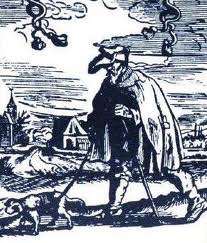
Blind people don’t want to work. All blind people must know each other. What wonderful medieval ideas, I thought. I pictured the blind, all of them, living under a bridge in Paris, all clutching battered fiddles, one or two of them with an untrained skinny dog on a string.


The Art of Getting Disabled and a Short Rant

We talk about the art of getting naked or of flower arranging, but we never speak of the art of becoming disabled. In America disability is discussed simply as rehabilitation, as if living is no more complicated than lighting a stove.

The art of getting disabled is a necessary subject. When we look to history we find examples of this art everywhere. Disabled makers stand against loss. They make something of difference. When traveling in France Thomas Jefferson broke his wrist. A surgeon set the break badly. A major facet of his life was changed forever. He was forced to put aside his treasured violin. In turn he took up long, slow, leisurely horseback rides as a meditative practice.

Blind people don’t necessarily need dogs. White cane travel is a very fine way to get around. But I say guide dog travel is an art. It’s a means toward living much as Jefferson learned to live. Moving in consort with an excellent animal is one way to make a life. Art is mysterious. Some find a path to a certain form. Some find an unlike form.

Oh I know Jefferson sang to his horses. He was very fond of singing. Moving in consort requires it I think.

It’s hard to imagine singing to a white cane.
Do you need to sing to live well? No. I’ve a great good friend who is nonspeaking. But in turn his whole body is music.
My deaf friends sing.
“You got to keep something moving all the time,” said Huddle Ledbetter, otherwise known as “Leadbelly” when asked how he played the 12 string guitar.

Many of my wheelchair pals are dancers.
Several of my disabled friends are comedians.
We crackle, zip, exhale, inhale, sport with our fingers, flap, jump, pop wheelies, and jingle with harnesses.

Resourceful life is practiced. Sometimes it is silly. Art can and often should be frivolous. With permission from curators at the Museum of Modern Art I was once allowed to spin Marcel DuChamp’s famous wheel, a bicycle fork with front wheel mounted upside-down on a wooden stool. DuChamp was a DaDaist. He made art by placing things side by side that did not formally belong together. A MOMA staff member handed me a pair of latex gloves and I pulled them on and with Corky watching beside me, I reached out and gave DuChamp’s aluminum wheel a spin. “This is the steering wheel of my life,” I thought. Eccentric motion. A dog walking life not always understood by others, but simple and smoothly elegant.

No you don’t need a dog, or any other animal if you have a disability. Solo life contains its own joys.

I certainly know some blind folks who would say I’m over the top talking about art in the context of service dog life. I know people who say a guide dog is just a mobility aid. I’m fine with that. As long as they’re kind to their dog machines I’ve nothing to say about this view. To each his own. I have friends who don’t like poetry. I don’t think their worlds are harmed by their disinterest. All I know for sure is what a guide dog can do. Though the stationary wheel of your life seemed forever stopped, she says give it a turn. You’ll be surprised where the imagination can take you.

**

Nowadays one thing the blind have to contend with is service dog proliferation. There are many kinds of professionally trained dogs performing dozens of assistive tasks for disabled people. This is a very good thing in my view, as dogs and humans working together can change the world or at least the playing field. Service dogs are, in the strictest sense, dogs trained specifically to help the disabled manage one or more life functions that otherwise would be impossible.

In fact that’s what disability is — a function disjunction. The ADA makes it clear:
The term ‘disability’ means, with respect to an individual (A) a physical or mental impairment that substantially limits one or more major life activities of such individual, (B) a record of such an impairment or (C) being regarded as having such an impairment. Major life activities
include: but are not limited to, caring for oneself, performing manual tasks, seeing, hearing, eating, sleeping, walking, standing, lifting, bending, speaking, breathing, learning, reading, concentrating, thinking, communicating, and working.

Major bodily functions means: “functions of the immune system, normal cell growth, digestive, bowel, bladder, neurological, brain, respiratory, circulatory, endocrine, and reproductive functions.”

The range of disability is broad not because bureaucrats have big imaginations but because substantial limitations are wide spread in a complex society. In turn, when thinking of service dogs, I’m reminded of the digital slogan: “there’s an app for that.” Nowadays there’s a dog for almost any disability as canines assist wheelchair users retrieve objects, open cupboards, hand money to cashiers or help with balance, just to name a few of their skills. Dogs are trained to detect the onset of seizures or help hearing impaired people detect audible signals. Some dogs assist diabetics by sensing changes in blood sugar. There are dogs to help children with autism and dogs who accompany people with Post Traumatic Stress Disorder. All these skills reflect the amazing talents of dogs and the pioneering vision of the guide dog movement which started the service dog industry by pairing trained dogs with blind veterans.

Despite the acceptance and advantages of working dogs many who use them are experiencing increasing obstacles in public. One reason is dogs are often trained to help people with invisible disabilities. Many wounded warriors are being helped by extraordinary dogs trained to help with anxiety. Post Traumatic Stress Disorder is crippling but it can’t always be seen. Ironically, when a trained dog helps its owner stay focused and calm, his or her disability won’t be at all apparent. Legitimate service dog users are routinely denied entrance to public venues and are often humiliated. Lately the stories have been piling up on my desk — a service man and his superbly trained dog were recently booted out of a fast food restaurant; another veteran not long ago was denied access on a public bus. A legally blind woman, whose blindness allows her what’s called “residual vision” was recently hassled in a movie theater by another customer who argued loudly that she and her dog were fakes. As I say, the stories are legion. Not long ago I was prevented from entering a restaurant near Central Park by an overly officious doorman. He didn’t question my disability — he questioned whether my dog was legit.
Some argue these problems could be prevented by requiring service dog users to carry identification cards. But there’s a good reason we’re not compelled to do this — my disability is my business and not yours. Why should I have to disclose that I have a psychiatric condition or a neurological disease? Moreover the ADA defines a service animal as any guide dog, signal dog or other animal individually trained to assist an individual with a disability. If they meet this definition, animals are considered service animals under the ADA regardless of whether they have been licensed or certified by a state or local government.
The simplest way to tell if an a dog is a working animal is by its professionalism. If you’re a business owner the law does not force you to endure a misbehaving animal. In fact it’s the performance of a service dog that really matters — not just in traffic or in crowds, but everywhere. Public life is the goal for the disabled but I fear the village square is narrowing and has grown more covetous over the past decade. Not long ago a reporter for a major New York tabloid took her own badly behaved dog into a famous restaurant, telling the manager she had a disability, knowing full well she didn’t need to produce any proof. Then she ostentatiously encouraged her dog to eat off plates on tables. Her point? Anyone can bring his or her dog anywhere because of the specious ADA. Lost on on this writer is the hoary fact that people can imitate anything in America. If you wish, you can pretend to be a Rockefeller or dress as a priest. We’ve always been a nation of con men and the able bodied have always pretended to be disabled, imagining advantages like better parking or early boarding on airplanes. But here’s what I suggest: Look for the professionalism of the disabled and their companion animals and try to remember the village is open space, and we’re here: women, men and our dogs.


A Dog Named Harmony

I got the call this afternoon from Lisa at Guiding Eyes for the Blind that starting next Monday (August 10) I’ll be united with my fourth guide dog, a yellow Labrador female named “Harmony”.

Timing is everything whether you’re talking of comedy or the calendar. I’ll have ten days to work with Miss Harmony before the start of a new semester at Syracuse University where I both teach and direct the Honors Program for outstanding undergraduates. Ten days are before me when I must study hard to understand the ways of my new canine companion. We say all the time that everyone is different. This is true of guide dogs. Each has his or her unique personality and though they come already trained, it’s the job of a blind handler to relearn dog handling techniques (for some things inevitably change in the land of dog training) and to learn what the new dog knows and expects. The training is a team activity. In my case, though I’m a veteran dog handler, I have lots of new things to learn. “Be curious every day,” I tell my students. “Be open,” I tell them. Well now it’s my turn. With Harmony and trainer Lisa I’ll be practicing what I preach.

My friends and colleagues will see me walking with Harmony and Lisa on the campus at SU. On day one, which will likely be next Tuesday, anyone chancing to see us will see me with a dog in harness and a young woman walking behind. I will be relearning how to be a good dog handler. Harmony’s life and my own will depend on this.

Timing is everything. I’ve just completed a new book (a memoir) recounting what it was like to discover freedom with a guide dog for the first time. In the next few weeks I will be revising the book for the last time before it goes into production at Simon & Schuster. As I’m preparing to revise the manuscript I’ll be walking richly in the open, with more than a little vulnerability, and with lots of trust.

Miss Harmony is coming. My current guide “Nira” will retire as our beloved house pet. Nira is sneaking up on 10. She’s more than a little tired. She loves me deeply as I love her. Now we will have to separate as hourly companions. I know this will be a bit hard for her, and it won’t be that easy for me.

Harmony will have her different ways. A different gait. She will be faster than Nira who has inevitably slowed. I expect Harmony and I will soon be moving fast.

And so for the sake of Nira and Harmony I’ll endeavor to be the best student I can be.

In the new memoir I describe meeting my first guide dog Corky for the first time:

She was brilliant and silly. I couldn’t believe my fortune. Back in our room Corky licked my eyes. She wanted me to invite her on the bed. I told her to remember the rules. Dogs on the floor, people on the beds. The trainers had been clear about guide dog etiquette and I was going to follow the regimen. Guide dogs aren’t encouraged to climb on the furniture. “You stay on the floor,” I said, and she nibbled my nose again as if to say, “I’ll wear you down brother.” I saw in our first moments we were having the manifold dance of relationship—we were joyous and communicating. I talked in a running wave. She bounced, literally bounced, cocked her head, backed up, ran in circles, and came back. All the while I kept talking. “Oh let’s go any place we choose,” I said, feeling I was on the verge of tears. 

Our first hours unfolded. We began the lifelong art of learning to read each other.  

Oh let’s go any place we choose, Harmony. I’m ready.


Disability and Eye Rolling in the Great Big Academy

Its a truism perhaps but having a disability possesses significance because of its permanence. Your blindness or paralysis or autism isn’t going away anytime soon and though it might someday (especially if you believe marketing from the cure industry) holding your breath is both risible and injurious. Keep breathing. You’ll feel better. If you keep breathing you’re at least guaranteed to feel something.

I work at a big university where I’m a senior faculty member and an administrator. Students and staff who experience disability problems often seek me out because they’re having trouble with transportation, parking, information technology, bathroom access, you name it. One side effect of being a disability advocate is that you often earn unjustified eye rolling from non-disabled colleagues. “Here comes Kuusisto again, saying we’re not up to snuff with accommodations.” I know this is true, though of course I don’t know precisely what’s being said about me. “Here he comes again!”

Non-disabled people don’t really understand that disability means permanence. Its not like a week on crutches or pregnancy. Crutches and pregnancy are situational and while they’re entirely inconvenient, they’ll go away. The permanence of disability means, among other things, that barriers to access are a daily feature of life and the eye rolling and obstructive bureaucracy is routine. When you throw away your crutches your difficulties with architecture and bathroom stalls come to an end. When you’re blind with a guide dog and the restroom doesn’t have accessible facilities the impactful disregard for human variability never comes to an end. For wheel chair users the malfunctioning automatic doors and badly constructed ramps (or the absence of ramps) never comes to an end. For deaf people the absence of sign language interpreters or CART never comes to an end. Around it goes.

The eye rolling would be easier for me if I had a misanthropic streak. But the truth is, I like people. I like them quite a lot. I went into teaching because I enjoy young people and admire my elders—or many of them. (If you teach in higher ed long enough you’re likely to meet Professor Polonius or Dr. Fraud, and you slowly learn not to share your cucumber sandwiches with them.) Still, sharing books and probative ideas is a critical aspect of what I do for a living and its made easier because I like human kind.

Historically, people with disabilities in the United States entered public schools on the coat tails of the landmark Supreme Court decision Brown vs. Board of Education. By desegregating schools the Court opened the doors of public education for the blind, the deaf, and people with learning disabilities. I am a first generation “mainstreamed” disabled citizen whose education was made possible by that momentous civil rights victory.  As a result the schoolroom has been the life-long instrument of my citizenship.

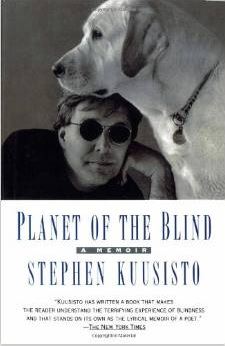
In my memoir Planet of the Blind I describe learning to read with the help of an African-American teacher who put in the extra time to make certain I achieved literacy. She pushed me into writing. Therefore in my own teaching I challenge my students to write with firm control of content and form. In a paper assignment I may ask students to explore the formal elements in Auden’s elegy to Yeats because the exercise will help them see how the lyric component of the poem is central to its political and psychological contents.

Creative writers and theorists who have concerned themselves with the experiences of historically marginalized people influence my teaching. I aim to show students how inherited figurative language may itself become an obstacle for the writer or at least for his or her imagined characters. Raymond Carver’s story “Cathedral” comes to mind as a teaching tool. In Carver’s story the miserable working-class “sighted” narrator guides a blind man’s hand across an oversized sheet of paper in a sympathetic effort to show the sightless man what a cathedral looks like.

I am engaged by what the critic Lennard Davis has called “the construction of normalcy” in the area of Disability Studies. “Normalcy” can be understood as an economic construct of 19th century industrialization. In this kind of analysis no one is normal enough for the factory and no citizen is taught the language of self-identity. In a course on the contemporary memoir I demonstrate for students how Nancy Mairs (who has multiple sclerosis) argues with our culture’s assumptions about the role of women and the value of the disabled. Additionally I strive to show students how a memoirist’s concerns are informed by Feminist Theory, Queer Theory, and African-American Theory and Literature. The memoir is a synthesis of statements about identity whether the writer is Dorothy Allison, John Hockenberry, Paul Monette, James Baldwin, or William Styron—all are engaged in the progressive art of expanding the social parameters of belonging in America, even as they must address the ironic difficulty of that very enterprise.

As a poet and writer of creative nonfiction I hope to demonstrate how imaginative writing transforms the received and static forms of personal language and plot. In turn I aim to show students how to find new and releasing autobiographical material. The art of memoir resides in talking back, but hopefully the memoir or poem or personal essay will become an alchemical romance both for the reader and the writer. I find that I spend a great deal of time “listening” to students both in the classroom and in conferences. Of course in a very literal sense I sometimes need students to read aloud for me a revision of a text. “That’s odd,” I’ll say, “can you hear how you’re saying that?” Ironically blindness often allows me to focus a student’s attention on the emerging or instinctual subject of a poem or essay. At such moments my hearing conceives just beyond a student’s rising music the possibilities for a better line, or a newer theme that still remains to be explored. I try to show my students that where imaginative language is concerned one must cultivate a passionate curiosity about the word—a curiosity that only further writing and “revisioning” will satisfy. I hope I can help them hear their better voices.

The problem for those of us with disabilities is that the permanence of physical or neurological difference is unbridgeable and the built environments that occlude or obstruct our progress are still omnipresent. The Americans with Disabilities Act told us boldly to come into the village square or the agora. We’re here. We like our colleagues. We want them to like us. We feel sad about the eye rolling. The good news? Eye rolling can be a temporary condition.

To Have Done with the Massacre of the Body: A Disability Perspective on Rachel Dolezal

I have been trying to think magnanimously about Rachel Dolezal’s self declared blackness, a venture that many who write critically about embodiment and society ought to attempt, if for no other reason than to interpret the difference between an emotional reaction to a cultural circumstance and a nuanced reading of the current moment. I can’t help but recall Jacques Lacan’s observation that to live in a body is to experience fragmentation, moreover, according to the principle of corps morcele, every man and woman lives out his or her imaginary anatomy. The self-consciousness of embodiment is one form of hysteria and it’s fair to say that in a culture where eating disorders, gender dysphoria, and the abjections that accompany physical flaws are legion, Rachel Dolezal’s story isn’t unique. The 24-7 news cycle insists we think so, demanding indignation because her black identification is merely a ruse. This is fair enough. It’s also fair to argue, as many have, that her “act” was possible only by virtue of white privilege. Others say that by pretending to be a woman of color she stole public positions that ought, rightfully, to have gone to an authentic black person. Yes, the story is a mess. Add the long history of miscegenation and “one drop” jurisprudence and Dolezal’s act appears cynical and perhaps even cruel.

I’m a blind person. For many years I tried to prove I could see because my parents said appearing sighed was crucial for me. My story isn’t unique. Many people with disabilities struggle to accept their bodies. Beyond acceptance one learns about the body politic—the values assigned to bodies are often the products of sinister histories. But I digress. I know a little something about pretending to be someone else, and I know a good deal about not liking the corps morcele. Did I do damage to people back in the days when I pretended I could see? I think so. I made other people hostages to my circumstance—I needed people to accompany me even as I feigned capacities of self-determination I didn’t possess. Deceit isn’t good for the deceiver and it pollutes his surroundings.

And so, back to my earlier point—Lacan’s really—that all of us live in our imaginary anatomies. These visions can be strictly compensatory, like thinking you’re athletic when you’re not. Or telling yourself you can see when in fact you can’t. Or they can be artfully constructed and exceed simple escapist desires. Who would not say Ru Paul isn’t authentically alive and dazzling?

Let us all play act at being one another. There is more health in constructive imaginations of embodiment than there is in culturally enforced denial. We need new public narratives for Lacan’s fragmented anatomies.

What if we applauded people for telling us how they really feel on the inside?

In his famous essay “To Have Done with the Massacre of the Body” the French philosopher Felix Guattari wrote:

No matter how much it proclaims its pseudo-tolerance, the capitalist system in all its forms (family, school, factories, army, codes, discourse…) continues to subjugate all desires, sexuality, and affects to the dictatorship of its totalitarian organization, founded on exploitation, property, male power, profit, productivity…Tirelessly it continues its dirty work of castrating, suppressing, torturing, and dividing up our bodies in order to inscribe its laws on our flesh, in order to rivet to our subconscious its mechanisms for reproducing this system of enslavement.

With its throttling, its stasis, its lesions, its neuroses, the capitalist state imposes its norms, establishes its models, imprints its features, assigns its roles, propagates its program… Using every available access route into our organisms, it insinuates into the depths of our insides its roots of death. It usurps our organs, disrupts our vital functions, mutilates our pleasure, subjugates all lived experience to the control of its condemning judgments. It makes of each individual a cripple, cut off from his or her body, a stranger to his or her own desires.

What I saw this week in moist and spasmodic reaction to the Dolezal affair was affirming of Guattari—which is to say, the outrage may have a great deal to do with repression, the condemning judgments may be designedly disruptive, assuring we will not talk about the provisional anatomies we’re forced to live under the flag of “norms”.


Disability by Any Other Name

Each day clouds arrive in the public square. No one can ignore them.

Men and women at the water cooler, who talk of football matches, they’re going to the clouds. I wish I could help them.

One may become cloudy at any moment.

I think its necessary to have cloud parking.

The UN Charter on the Rights of People with Clouds is important.

I wonder if its OK for cloudy couples to have sex?

People don’t really take the proper time to buy cloud insurance. Only a few think of it.

Once you’re clouded it’s best for everyone if you just stay home.

The University has a special office for its cloud students.

Age related clouds…

Birth clouds…

Veterans who come home with clouds…

“How can I study from below, that which is above?” (Aristophanes)


You have to take a course or two in Cloud Studies.