Mr. Lincoln, I’m Sad This Morning

Disability can be found everywhere in history once you learn to look for it. President Lincoln’s depression lead him to abandon the White House for several days. When he returned he unveiled the Emancipation Proclamation to his startled cabinet.

Lincoln’s moodiness allowed him to reflect on the value of life and on what was right. That’s Lincoln’s story. Not all who are bi-polar have the moral qualities of Lincoln. And not all depressed people ask themselves what the nature of suffering can teach them. Yet after a certain age one finds this caste of mind is important. What does it mean to feel my heart is ripped out and is now under my shoe? The proper tears, those mixed with luck, tell us to walk for a time because weeping can be a map. Maps, all maps, are born of agonies. One sees disability wisdoms are not often or probable in textbooks. Look for the stains at the paper’s edges.

As a poet I like the margins.

There are so many minutes for which no proper names exist. Deep in the night I carved my name on a seed. Now I’ve awakened outside the broken temple.

Mr. Lincoln I am sad this morning.

I’m thinking of these lines by Cesar Vallejo, the great Peruvian poet:

“There are blows in life so violent—I can’t answer!

Blows as if from the hatred of God; as if before them,

the deep waters of everything lived through

were backed up in the soul … I can’t answer!”

(translated by Robert Bly)

Oh I can’t answer but I’m searching the corrugated quick of the page.

Mr. Lincoln…


What a Dog Can Do

So I’m writing a book about my decade spent with “Corky” my first guide dog. When you live with a dog every day and travel everywhere with her you ask yourself questions.

I thought she was heroic. She thought I was hopeless. Question one: “what was Corky really thinking while guiding me?”

I could only surmise what was in her head. This would become a habit.

I imagined the exercise of man-to-canine dialogue was good for the mind. If you play the game properly it means you’re tough minded. For instance, a man thinks his dog is always looking out for him—she’s valiant, non-distractible. This isn’t entirely correct but he chooses to believe it. He needs to think it. After all he has his insecurities.

But he also knew his dog was a dog.

And so, walking in strange cities I thought about my investment in ideas about Corky versus Corky’s likely thoughts.

She watched cars. We were in Wichita, Kansas. I said “forward” and she didn’t budge.

A bus roared past and then a truck.

How had I not heard them?

She’d done her job—had stopped at a curb and had scanned all movement.

I was thinking about all the summers that might remain. How long might I live? What oceans had I yet to swim in?

Oh heroic dog! Who’d saved me! She was “Lassie” and “Rin Tin Tin” rolled into one.

We walked a few blocks and entered Wichita’s Botanical Garden and I asked Corky directly if she felt like Rin Tin Lassie. She wasn’t paying attention to me.

“She’s watching butterflies,” said a woman. “You’re talking to her, and she’s got butterflies on the brain!”

She had a smoker’s laugh, big and phlegmy.

“We have a lot of butterflies here,” she said. “This is the “Butterfly Garden”.”

“Ah,” I said. Smoker woman went away.

“Butterflies and trucks,” I thought, “are equally compelling in a dog’s eyes.”

A bright flash of color. Each appears at the margins of vision. Both warrant full attention. They create amplitude—both ends of the motion spectrum are the same.

“Dogs aren’t heroic,” I thought. “but they are alert, quick, and certain.”

Dogs say: “That’s motion and it’s mine.”

Sitting there amid the Wichita butterflies I saw that it takes some bravery to understand your dog’s view of things.

Once you understand this there’s a purity to it.

A dog sees all the dizzying, big eyed sparks of dailiness.

And doesn’t worry about it.


Starbucks and the “Racing Together” Dilemma

When Trayvon Martin was murdered (and I’ve no compunction saying so) I published a blog post saying race and disability are linked by stigmatizing architectures. I wrote from an outlier’s position as I’m a blind man whose presence in public is nearly always conditional. One thing my friends of color and my pals with disabilities (and yes, sometimes they’re the same) know is that nowadays there are more gated spaces in the US than ever. Some places have patrolled fences while others offer no signs of implicit exception. All outliers understand that when you transgress—when you expect to enter closed spaces you’ll be sized up. I said:

As a person who travels everywhere accompanied by a guide dog I know something about the architectures and the cultural languages of “the gate” –doormen, security officers, functionaries of all kinds have sized me up in the new “quasi public” spaces that constitute our contemporary town square. I too have been observed, followed, pointed at, and ultimately told I don’t belong by people who are ill informed and marginally empowered. Like Trayvon I am seldom in the right place. Where precisely would that place be? Would it be back in the institution for the blind, circa 1900? Would it be staying at home always?

Tippy-toe-racist-ableist-architecture isn’t new. Slavery was always architecture. And the “ugly laws” kept cripples off the streets of America for a century. Yes, we’re living in a time of vicious retrenchment. Enter Starbucks.

By now almost everyone knows the CEO of Starbucks, Howard D.Schultz  launched a campaign called “Racing Together”—baristas were instructed to write the phrase on every coffee cup sold. Starbucks’ aim was to start a national conversation about race. I’m saying the motive was good but I’m also scratching my head, for Mr. Schultz must have imagined his franchises are genuine 18th century coffee houses where informed citizens gather regularly to exchange ideas and conduct solemn conversations. I love the notion. I enjoy picturing Samuel Johnson seated across from me, slumped in a leather chair, hoisting his mocha latte, and cheerily dissecting our manners.

I fear Mr. Schultz had a good idea but oddly, inexplicably, misunderstood what the average Starbucks essentially is. Note: I’m not claiming his coffee shops are gated spaces (though some may be) nor am I saying conversations about tricky subjects shouldn’t happen—for I believe our nation is woefully indisposed to the art of engagement. In fact I care so much about conversing I even wrote a book about it called Do Not Interrupt: A Playful Take on the Art of Conversation.

No. I think Mr. Schultz forgot that for over sixty years, Americans have been schooled by Madison Avenue to think they deserve a break today. Although the slogan was originally coined for MacDonalds, it stands for the advertized appeal of every commercial space. The slogan was also accompanied by the claim: “at MacDonalds it’s clean.” The subtexts are variable but one thing’s for sure: you shouldn’t feel guilt when spending money on junk food (you deserve it) and you have every right to expect the place where this food is sold offers “time out” from your daily troubles. All franchise businesses in the United States sell these presumptions.

In fact, so trouble free are these franchises imagined to be, their managers often run afoul of the Americans with Disabilities Act. There are frequent stories about people with service dogs, mothers with crippled children, deaf people trying to sign—all experiencing discrimination in fast food venues.

Some gated communities are entirely created by the advertising industrial complex. (How can the Hamburglar cheer up the tots when there’s a motorized wheelchair user at the next table?)

Where would the right place be for coffee and conversation about outliers when long ago we sold the vision that fast food restaurants are fully sanitized for our protection?


Normal

I’ve been trying unsuccessfully for years to imagine the kind of society that cultural theorist Lennard J. Davis envisions in his book The End of Normal. Briefly: we know race, gender, and disability are social constructions—which means in the widest sense “normality” might be, conceivably, on the ropes. A boxing analogy is appropriate. We’ve been punching Old Normal for a long time. The maddening thing is how “Normal” keeps smiling, taunting us, snarling through his tombstone perfect American teeth. And if you think his teeth are infuriating, well, his odor is worse. He smells like “Brut” and bacon.  


Joking aside, we’re now in an age of post-modern bio-politics. We know “normality” was designed by committee in London early in the reign of Victoria. “Normal” meant “factory ready labor” and everyone else became a commodity (slave labor) or a liability (cripples). I’m simplifying but I get to do this because after all, this is my blog, and to paraphrase Huck Finn, “I don’t take no stock in normal.”     


The Huck Finn joke is pretty good I think, because Normal of course doesn’t take any stock in me. He can’t help it. As a blind person I’m of dubious value to him. (Or to her—there’s feminine normal too.)


Let’s say you were blind in the 17th century. You could get a job currying horses. Or feeding them.

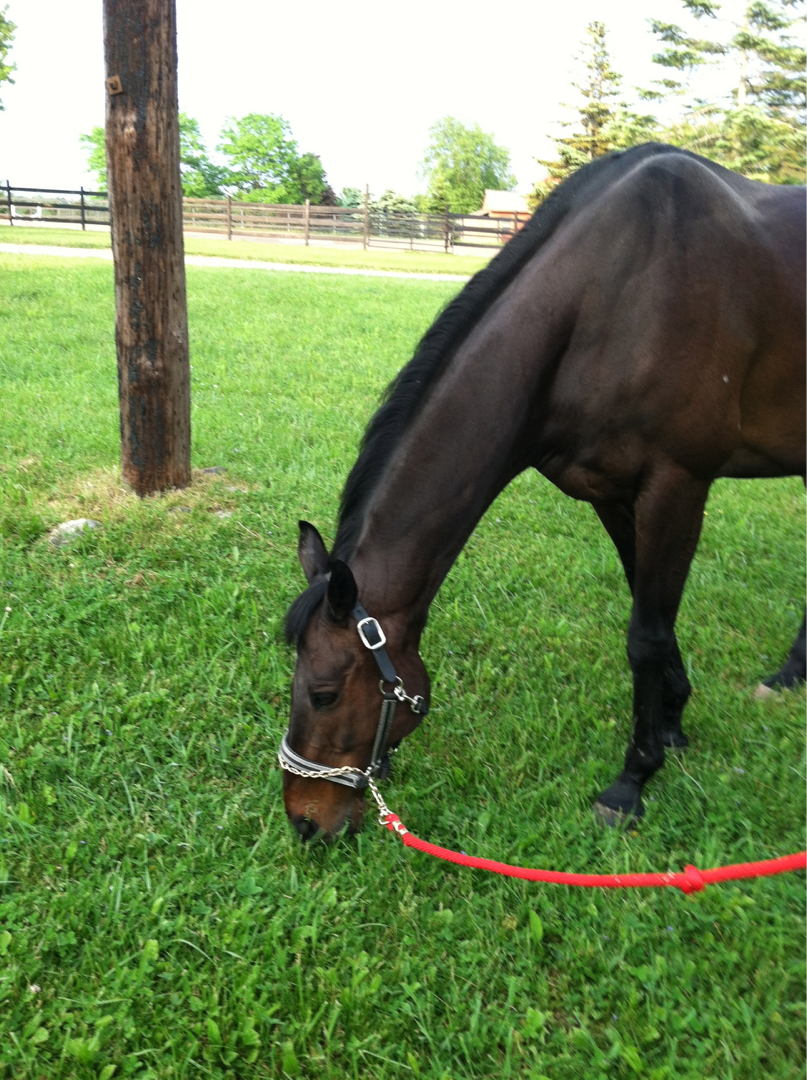
If you were deaf you could work in the blacksmith’s shop. The photo below depicts my wife’s horse “Luigi” who is an ex-racehorse. He’s a dark “bey” chestnut colored thoroughbred who has a very long neck. He’s eating grass on a summer’s day. In the old days, he’d have had a blind friend to braid his mane. He might have had a hunch backed girl to clean his hooves. 


Disability is a modern pejorative construction. We’ve known this for a long time now. I’m not talking about ableism; racism; misogyny, homophobia—these are with us still, and hauntingly so. But Lennard Davis has me thinking about the world we can insist on—one where the tyranny of industrial normal is over. One where everyone gets to curry the horse. 


Currying the horse is a metaphor and I won’t deny it. Proper accommodations change the world. 

As I write, people of color, predominantly young males, are being shot down in American streets. 

“Old Normal” sees them as having no value—just as he sees the disabled or transgendered people as having no value. But everyone can curry the horse. There’s a proper life and job for everyone in a culture that understands what a liability “normal” really is. 


Now I must go and shave. My chin wants to appear normal. He has different views than my upper noggin. But he won’t be getting any Brut. 


Ding Dong! Who's There?

I was at the guide dog school and it was Sunday. I did some unrehearsed and ridiculous dances with my dog. I had a blues harp and I played and lunged around the room and she jumped and wagged. My hair was crazy. I was a Viking beserker, the stranger you don’t invite home to meet your mother. I was cross-eyed and happy and unkempt. I was blind Enkidu. And that’s when a knock came at the door and I opened it and there before me was the Mayor of New York City and his family—his wife and children and a photographer, and the president of the school. “Hi,” said Rudolph Giuliani, “I’m Rudy Giuliani.” It was 1994. Rudy wasn’t yet “America’s Mayor” and he hadn’t yet cashed in all his political and PR capital as “the man who cleaned up New York” but he was working on it. Instead of his daily charcoal Armani suit he was wearing a “Members Only” aqua baseball jacket and blue jeans. He was having a day in the country. Life was “tres sportif” and photogenically arranged, save that now the Mayor was meeting Volroth the Hairy whose forest green cable sweater was covered with dog fur; whose hair was pure electrolysis—his hair almost on fire with weirdness. To better understand this moment, you must know I’m a lifelong Democrat, without reservation and I wasn’t certain I should touch Giuliani, for I am truly a primitive; he might have had cooties; but his kids were there, and my dog Corky was poking her head into the hallway and Giuliani’s little daughter had come forward and was reaching out and so I shook the man’s hand because what else could I do—and I said something about the wonders of the guide dog school and its amazing dogs and staff. And the Mayor smiled. He had one of those glacial smiles. Its chief asset was its largeness. And the entourage moved on.

What all Dogs Know

Steve and Vidal
 

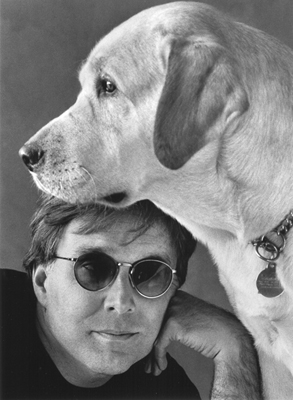
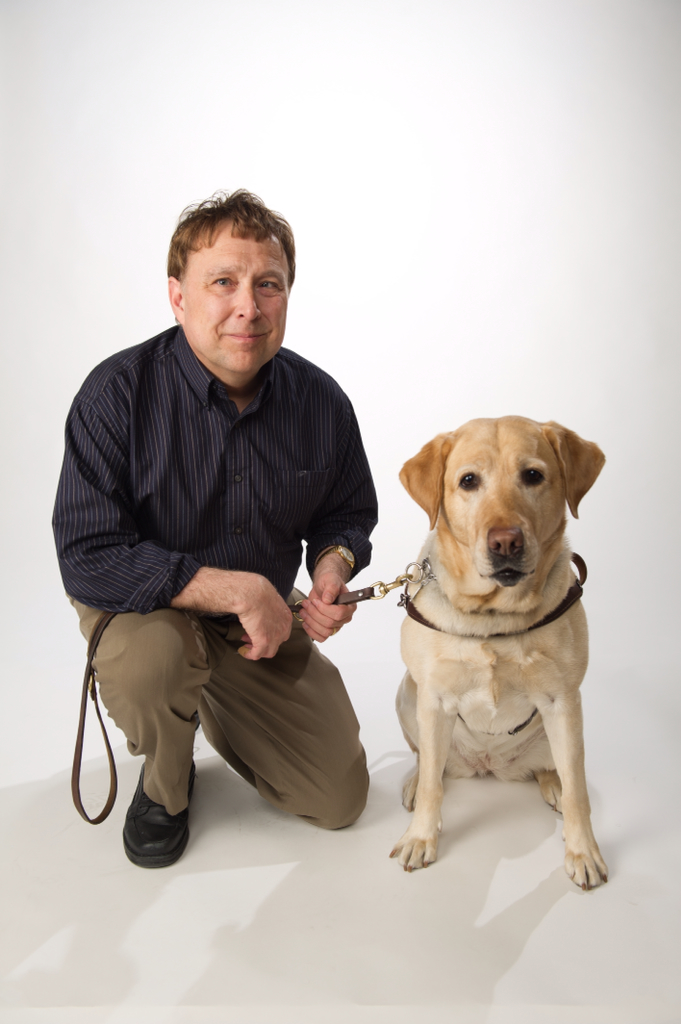
Image: Steve Kuusisto with "Vidal" (a handsome yellow Labrador)–his second dog from Guiding Eyes for the Blind:


I don’t want to be a celebrity. I just want to be my dog. Ipse dixit. 


When we hug dogs and smell their fur we’re fully realized. Then we drift back into reason and dogs see we’ve gone to a far room. Empathy matters then. Dogs know we’ve entered a fearful place in a crystal palace of abstractions. They touch our knees. They live only in amazement.


I don’t know as much about amazement as I should. D.H. Lawrence wrote:


They call all experience of the senses mystic, when the experience

is considered. 

So an apple becomes mystic when I taste in it 

the summer and the snows, the wild welter of earth

and the insistence of the sun. 


I understand a dog’s amazement in our company is indeed mystic but only insofar as we consider it. 


I walked up the pale green avenue—7th avenue in New York—end of day, my great guide dog working to keep us safe, working us toward the postulate of arrival, the grandest of things, a task accomplished, going where we had to go. 


I was grieving for my father who had died only a month before. Grief is impossible to maintain so we engage it in small gasps. I saw my father was on an aerial bridge, high in the fading light, the span without end. My father had nowhere to go. And outside a monolithic computer store I began weeping. And my guide dog stopped, turned, saw me stricken, rose up on her hind legs and gently washed my face. I, who could not reason clearly, was being guided in more than one way. My father’s bridge vanished. I heard his laughter. “Beauty,” says the dog, “is very strong.”


We have to let the dogs in. Consider what they know. 


Why I'm a Crippled Poet

I am a poet who’s blind—I’m also short, dyspeptic, and addicted to savory treats. I feel better for having said so. This is, after all, national poetry month. 


Not long ago I attended a writing conference. A poet who has MS said she didn’t want to be a “wheelchair poet” by which (one presumes) she meant she didn't want her writing to be viewed through the lens of disability. Expanding this, I imagine she wouldn't want to be a black poet, a lesbian poet, or a really tall poet. In her view, poetry should be the product of an ex cathedra pronouncement—with a stroke of the pen we can erase all the nagging identity markers of humanity. 


Its possible to have a disability and live your life pretending you don’t have one. Plenty of people have done so. But getting away with this charade in literary terms means the imagination has been suborned—bribed—you’ve tricked yourself into thinking there’s a pot of gold that will be yours but only if there isn’t a hint of physical difference in your work. To paraphrase Garrison Keillor: “All the poets are strong, good looking, and above average.” 


Forget that our nation’s greatest poet Emily Dickinson had rod-cone dystrophy and couldn’t see in sunlight; forget Walt Whitman’s stroke; ignore bi-polar depression in the case of Theodore Roethke and Robert Lowell;  dismiss Alexander Pope’s spinal disease—I’m sorry this is a long list—Sylvia Plath; Hart Crane; Ann Sexton; Allen Ginsberg; William Carlos Williams; forget them all. Disability doesn’t belong in poetry. God help you if you let it in—the critics will dismiss you from the poetry pantheon IN A FLASH since “great” poetry comes from the grandest of all human resources—the dis-embodied mind. (Picture it as a Star Trek arrangement, a brain in a plexiglass case with wires emanating from it.) 


When I went to college in the 1970’s English majors were introduced to “New Criticism”—and though this approach to literature was already fading by the time I graduated—poetry world still has a “New Criticism Hangover”. New Criticism argued the study of literature required no knowledge about the writer behind the work. The shaping of words, the wit, the poet’s irony, his literary allusions—these were all you had to know to discern meaning—or as I came to call it—the “soft, chewy center” of a poem. 


Back then everyone was still under the sway of T.S. Eliot’s poem “The Wasteland”. We were instructed to read it as a compendium of allusions and to critique it as an allegory of modern exhaustion. No one (and I mean no one) raised his or her hand and said: “Wasn’t Eliot’s wife in a madhouse when he wrote this; and wasn’t he clinically depressed at the time?” We simply talked about the quest for the Holy Grail and the “objective correlative” and, if we were out to impress the prof, we looked up everything in the original Greek.


The New Criticism Hangover stipulates you mustn’t admit your complaining, belching, limping, loudly breathing, dis-articulated, lumbering body into poems. You may only lampoon or parody “other bodies” but this should be reserved for pathos or other symbolic distancing effects. 

Many of America’s leading poets do this—blindness represents profound isolation; deafness is simply a metaphor for lack of knowledge; deformity is nothing more than a Grand Guignol effect. If you write like a poet who has NCH you must never hint you have a body of your own. 


Of course there are messy feminist poets with their leaking womanly poems; and black poets with their jazzy outrages; but the New Critics Hangover School is uncomfortable with all that stuff. 


The “wheelchair poet” remark is part of this heritage—its a highly conscious position—to sequester the outlier body; to keep it in its sarcophagus; to tighten down all the screws. 


Me? I’m a messy “wheelchair poet” in the broadest sense. I’m demanding too. I cause trouble in public spaces. I’ll make you move your stone lions if they block the damned sidewalk. I’ll demand you provide me with a trash can at the Hilton so I can pick up my dog’s shit. If you don’t bring me the can, I’ll leave the shit right here. I’m loud. I’m really loud. I like hip-hop. I like Mahler symphonies and I turn them way up. I’m a poet who not only admits the defective body into literature—I think the imagination is starving for what that damned body knows. I happen to be blind. What do I know? I know things like this: 


“Only Bread, Only Light”


At times the blind see light,

And that moment is the Sistine ceiling,


Grace among buildings—no one asks

For it, no one asks.


After all, this is solitude,

Daylight’s finger,


Blake’s angel

Parting willow leaves.


I should know better.

Get with the business


Of walking the lovely, satisfied,

Indifferent weather —


Bread baking

On Arthur Avenue


This first warm day of June.

I stand on the corner


For priceless seconds.

Now everything to me falls shadow.”


Excerpt From: Stephen Kuusisto. “Only Bread, Only Light.” iBooks. https://itun.es/us/1017I.l             


Did I mention William Blake? He had a disability too. 
 

Disability and the Radial Republic

NewImage

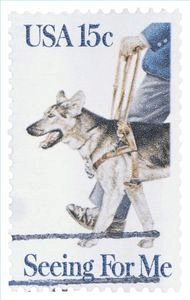
US Postage stamp honoring guide dogs, picturing Morris Frank and his pioneering American guide dog Buddy, a German Shepherd. Beneath them it says: “Seeing For Me”


I haven’t been posting on my blog lately. Sometimes the limbed life of physical difference is overwhelming and one feels a temptation to lie down in the long ditch of sadness. The largest psychiatric hospital in the United States is the Los Angeles County Jail. Veterans with disabilities  since 9/11 face extraordinary obstacles to employment. Rehabilitation services for all persons with disabilities are underfunded. 70% of the disabled remain unemployed in the US. Only one quarter of matriculating college students with disabilities actually graduates. Long standing charities like guide dog schools are experiencing a general decline in philanthropic donations—Baby Boomers and their children aren’t as generous as “The Greatest Generation” it seems. 


Meanwhile the toxic and shrill bloviating of politicians like Paul Ryan (who argue social programs are the root of America’s financial problems) helps to convince Americans that generosity and fairness are nearly unpatriotic—and would this were not so—for giving hard working and ambitious people with disabilities a shot at the American Dream ought to be deeply carved on the entablatures of our public buildings. 


What do I mean by a “radial republic”? Many things of course but principally a renewal of the social contract—our American contract which has grown stronger after every war and which has assured veterans with disabilities will be properly assisted, treated, educated, and welcomed. What do I mean by a radial republic? As we nurture disabled vets we assist all Americans with disabilities. Many people know I’m a guide dog user but I’m willing to bet that most of my readers don’t know that guide dogs (or “Seeing-Eye Dogs” as they’re sometimes called in the US in homage to North America’s first guide dog school which is named “The Seeing-Eye”) are the product of rehabilitation work in Germany at the end of WW I. 


Halfway through the First World War a German physician, Dr. Gerhard Stalling introduced a blind veteran to his pet dog. The two men were in a hospital garden when Stalling was suddenly called away. When he came back the soldier whose name is now lost, was laughing as the dog licked his hands. Stalling saw dogs might be trained to guide the blind. The war had produced an astonishing number of blind veterans. The total number of wounded from the first world war remains unknown but during the four and a half years of the conflict 230 soldiers died every hour. 11% of France’s entire population was killed. The ten month Battle of Verdun in 1916 caused over a million casualties. Chlorine and mustard gas killed nearly 90,000 troops and left one and a quarter million men permanently disabled. Blindness was a common result of gas warfare and one of John Singer Sargent’s most famous paintings (“Gassed” 1919) depicts a ragged line of soldiers, their eyes bandaged, all the men walking in a line, each man’s hand on the shoulder of the man before him—with two sighted men in the lead. The sky is yellow above a field of corpses. 


Trench warfare included working dogs. Germany employed 30,000 dogs in the field and their work was divided according to need. Sentry dogs were used on patrols. They were taught to give warning when a stranger entered a secure area. Scout dogs were also used. Their job was more refined—they accompanied soldiers on reconnaissance and had to keep quiet. They could detect the enemy at a distance of a 1000 yards, “scenting” and pointing. 


Casualty or ‘Mercy’ dogs, also known as ‘Sanitatshunde’ were trained to find wounded or dying soldiers in the heat of battle. They carried medical supplies on their backs. The wounded could use the supplies if they were able, or they could count on the Mercy Dog to wait with them as they died.


Dogs also ran long distances across battle fields carrying messages, often during artillery attacks. The heroism of working dogs was well known on all sides. The Germans employed 30,000 dogs during the war. British and French forces had approximately 20,000 dogs in the field.    


The guide dog was a consequence of war. Because dogs had proved themselves capable of miraculous work under the worst battle conditions ever seen, it was clear to Stalling war dogs could be trained to help the blind navigate post-war streets which were suddenly filled with automobiles. With a small group of military dog handlers Stalling began training dogs for blind soldiers. Old photos show trainers and veterans working with German Shepherds, all the men wearing peaked hats and long wool coats. In addition to harnesses the dogs wore tunics bearing the Red Cross logo—the insignia of the battle field “mercy” dog.   


Stallings idea captivated the public’s imagination. An official guide dog school opened in in Oldenberg in 1916. The sight of veterans and dogs working in traffic was powerful and seemed natural. In popular imagination blind people had always been accompanied by dogs: a first century mural in Roman Herculaneum depicts a blind man with his dog.  A 19th century woodcut from the United States shows a blind man from Boston being lead by a dog and crossing the Commons. Such pairings were likely the products of serendipity—the blind and their dogs forged relationships by necessity. The history of blindness is filled with sorrow. Before reforms like Social Security and organized rehabilitation services were created in the 20th century, the blind often begged for food and shelter—some played musical instruments—many wandered searching for compassion. Dogs helped ease their loneliness and offered untrained navigational assistance.    


Sometimes I like to joke by saying the guide dog is the only good thing every invented by the German Army. This may be true. But what is true is that rehabilitation programs for disabled veterans impact the broader republic. Nowadays when an autist, or a deaf person is accompanied by a trained service dog we can and should give thanks to Dr. Stalling. And in turn we should be seeking with all our Republic’s strength to carry on the difficult work of lifelong optimism that disability rehabilitation and education calls for. 


I’m not fond of the term “wounded warrior” precisely because disability isn’t a wound—it may heal in some dimensions, but in others it will always be present. A commitment to people with disabilities in general and to veterans in particular means understanding the full arc of life. The radial republic means giving people with disabilities and equal shot at education, travel, vacation, family, housing, medicine, you name it. 


Making this happen benefits all.


Thank you to The Huffington Post

I’d like to thank The Huffington Post for allowing me the privilege of being an occasional guest blogger.  I am honored to have this opportunity.

Steve_Corky_GEBIn this post titled Dogs on the Playing Field I discuss the role of professionally trained service dogs serving people with disabilites in the U.S. today and ask (and answer) this question: …even 23 years after the passage of the Americans with Disabilities Act and 70+ years since the introduction of guide dogs in the U.S. life in public isn’t always friendly. Lately it seems more unfriendly than at any time since the late 1930s when the blind had to fight for the right to enter a store or ride a public bus. What’s going on?

I am grateful to The Huffington Post for allowing me the use of their platform to explore this issue.  You would “make my day” by stopping by and sharing THIS POST with your social circles.  Thank you!

Photo: author Steve Kuusisto being guided by yellow Labrador, guide dog “Corky”, circa 1995.

Dog Schmooze

Professor Stephen Kuusisto is the author of Eavesdropping: A Memoir of Blindness and Listening” and the acclaimed memoir Planet of the Blind, a New York Times “Notable Book of the Year”. His second collection of poems from Copper Canyon Press, “Letters to Borges has just been released. Listen to Steve read “Letter to Borges in His Parlor” in this fireside reading via YouTube. He is currently working on a book tentatively titled What a Dog Can Do. Steve speaks widely on diversity, disability, education, and public policy. www.stephenkuusisto.com, www.planet-of-the-blind.com

NPR: Unfit to Write About Disability

There’s a piece by Chana Joffee-Walt on NPR’s website entitled “Unfit for Work: the Startling Rise of Disability in America” which is so ill informed about its subject it reminds me of one of those Ronald Reagan stump speeches. Driven by anecdote rather than cultural analysis, her thesis is simple: the number of unemployed Americans receiving disability benefits has skyrocketed over the past twenty years. She intimates without fully declaring it, that there’s a vast social “scam” taking place–in the absence of good middle class jobs, and following the “end welfare as we know it” enterprise, poor people simply decline into aches and pains, thereby getting themselves declared unfit for work.

Alas, Joffee-Walt hasn’t done her homework, a matter that may be inapparent to many of NPR’s readers, just as Reagan’s audiences were unaware that behind the curtain the Gipper believed “facts were stupid things” and was untroubled by any and all of the misrepresentations of social programs that propelled his candidacy for president. Such arguments depend on pathos rather than facts. Joffee-Walt fails to address the biggest fact in the room, that disability is a social construction even more than a medical category, and in turn the artificial architectural and physical constraints marshaled against people with disabilities are both products of history and the industrial revolution. One wishes she had bothered to read Lennard J. Davis’ essay “Constructing Normalcy: The Bell Curve, the Novel, and the Invention of the Disabled Body in the Nineteenth Century”. Disability is entirely economic and has been so since the move to industrial models of labor. Those who cannot work in the factory were labeled “disabled” and that model of human economic utility largely continues to this day. Reasonable accommodations are the solution for workers whose physical capacities decline but as any seasoned person with a disability who has managed to remain in the workforce knows, obtaining accommodations is often so difficult, so humiliating, so Kafka-esque, most people give up.

70% of the blind remain unemployed in the United States, many of whom might well be able to work with the proper accommodations but employers don’t want to provide accommodations fearing the expense, though in point of fact most workplace accommodations are relatively inexpensive. Think of a laborer, someone who is required to lift boxes. He suffers a ruptured disc. He can’t lift boxes. Perhaps he could be retrained to work with software. Most businesses resist this kind of accommodation, preferring medical and social determinations that are no more sophisticated than those the Victorians had.

Another way to say this is that a nation that believes in work is also a nation that believes in accommodations. Joffee-Waitt misses this dynamic and ongoing dialectic and fails to illuminate the true nature of disability and joblessness. 

~~~~~~~~~~~~~~~~~~~~~~~~~~~

Professor Stephen Kuusisto is the author of Eavesdropping: A Memoir of Blindness and Listening” and the acclaimed memoir Planet of the Blind, a New York Times “Notable Book of the Year”. His second collection of poems from Copper Canyon Press, “Letters to Borges has just been released. He is currently working on a book tentatively titled What a Dog Can Do. Steve speaks widely on diversity, disability, education, and public policy. www.stephenkuusisto.com, www.planet-of-the-blind.com