“Creative Writing and Disability Studies: Liminal Epistemologies”

–“Life is a hospital where every patient is obsessed by the desire of changing beds.”
–Charles Baudelaire, Paris Spleen

1.

What can we learn from poetry about the body and the culture of bodies? Is what we see in a poem merely a figurative illustration of extrinsic historical or political truths or can a poem create a new and unforeseen nexus of identity and consciousness? As scholars concerned with the social construction of disability identity we know instinctively that the answer to the question is determined by our own rhetorical stance toward figuration. A poet is Aristotelian if she’s aiming to look beyond history for the subject of her poem. A poet is essentially Platonic if she is working in the service of verisimilitude. These categories aside we know that Ezra Pound was echoing Aristotle when he said that the poet is “the antennae of the race”. The Aristotelian imagination probes in the unknown space ahead and reports back to the great segmented worm of culture.The poet Richard Wilbur writes: “The mind is like some bat/ Beating about in caverns all alone/ Trying by a kind of senseless wit/ Not to conclude against a wall of stone.” Poetry is instinctive, far-seeing in its peculiar interiority, re-constructing the world that surrounds it. This vision of poetry holds that figurative language is exploratory, (neo)constructionist, progressive, lyrically alive.

2.

Again Baudelaire: “It always seems to me that I should be happy anywhere but where I am, and this question of moving is one that I am eternally discussing with my soul.” One can say that lyric poetry in general is concerned with moving as an operation that defies analysis. The soul is always the totem of irresolvable and competing desires. In poetry the soul is a synonym for the reliquary; it is a place. We position the furniture of our suffering in the soul’s room. But the lyric insists there is life outside the hospital–life beyond the ward. Notice that lyric poetry concerns itself with containment. One can add adjectives that work well with suppression: abject containment, unaware containment, irrational containment—disability studies scholars will recognize this impressionistic terrain as inherently akin to the historic figurative language of disability—the lyric concerns itself with the conditions of individual abjection and is always therefore a fit medium for exploring disability awareness. The modernist Italian poet Salvatore Quasimodo wrote the following lyric in the 1930’s as Italy was descending into Fascism:

And Suddenly It’s Evening

Each of us is alone
At the center of the earth,
Pierced by a ray of sunlight,
And suddenly it’s evening.

I don’t know of any more beautiful cris de couer from the Age of Existentialism. My feeling is that lyric discord, rendered almost always in figurative darkness represents the creation of what the Swiss psychoanalyst Carl Jung referred to as “individuation” a state where the conscious and unconscious modes of thought are brought into harmony. The condition of the mind in such poems is fearful, repressed, circumscribed, and lost. The lyric mindscape is blindness whether the poet behind the poem is literally blind or not. The lyric occasion does not represent blindness. It merely works from the epistemological and psychic locus of blindness. I do not mean figurative blindness but the very real step-by-step navigation of the unknown. The urgencies of perception are necessarily reckoned with care.

3.

Claiming disability (Simi Linton’s term) is to claim the lyric. In turn the lyric is the mode of poetry that best resists the falsifications of narrative imprinting. If people with disabilities have been exiled by history, by the architectures of cities and the policies of the state, then the lyric and ironic form of awareness is central to locating a more vital language. The exile that belongs to oneself,/the interior exile…(Richard Howard) We claim disability by lyric impulse. And by lyric impulse we rearrange the terms of awareness. The lyric mode is concerned with momentum rather than certainty. This is the gnomon of lyric consciousness: darkness can be navigated. The claiming of disability is the successful transition from static language into the language of momentum. But of particular importance in this instance is the brevity of the lyric impulse. The urgency of short forms reflects the self-awareness of blocked paths and closed systems of language. The lyric reinvents the psychic occasion of that human urgency much as a formal design in prosody will force a poet to achieve new effects in verse. Igor Stravinsky put it this way: “The more constraints one imposes, the more one frees one's self. And the arbitrariness of the constraint serves only to obtain precision of execution. We are in a hurry. We must tell the truth about the catastrophe that is human consciousness. And like Emily Dickinson who feared the loss of her eyesight we will tell the truth but “tell it slant”—the lyric writer may not have a sufficiency of time.

4.

Poetry about the body looks beyond the constraints of physicality. The lyric is in this manner a metaphysical pursuit. William Blake’s sick rose is the mandala of consciousness:

O rose, thou art sick!
The invisible worm,
That flies in the night,
In the howling storm,

Has found out thy bed
Of crimson joy,
And his dark secret love
Does thy life destroy.

The body is not our own. In lyric time the body is faced with the urgencies of the Elizabethan memento mori. This self-awareness we describe in terms of the body is equivalent to what disability advocates refer to as the condition of being “temporarily abled” but it’s useful to understand this condition as a crucial circumstance of imaginative and spiritual consciousness.
One thinks of T.S. Eliot’s narrator in “Gerontian”: “I an old man,/A dull head among windy spaces.” How should consciousness proceed in the company of the failing body? This has always been the lyric occasion. In her booklength poem an Atlas of the Difficult World Adrienne Rich writes:

I know you are reading this poem in a waiting-room
of eyes met and unmeeting, of identity with strangers.
I know you are reading this poem by fluorescent light
in the boredom and fatigue of the young who are counted out,
count themselves out, at too early an age. I know
you are reading this poem through your failing sight, the thick
lens enlarging these letters beyond all meaning yet you read on
because even the alphabet is precious.
I know you are reading this poem as you pace beside the stove
warming milk, a crying child on your shoulder, a book in your
hand
because life is short and you too are thirsty.
I know you are reading this poem which is not in your language
guessing at some words while others keep you reading
and I want to know which words they are.
I know you are reading this poem listening for something, torn
between bitterness and hope
turning back once again to the task you cannot refuse.
I know you are reading this poem because there is nothing else
left to read
there where you have landed, stripped as you are.

5.

Lyric consciousness is “stripped” consciousness. The word is menacing because the world is invariably opposed to youth, sexual freedom, multi-racial identities, disabilities, the poor…
In Adrienne Rich’s poem momentum and the deciphering of language are equivalent. The lyric occasion demands a larger future because it is the epistemological equivalent of the alphabet—
a new alphabet, one acquired in transition or in pain. Emily Dickinson thinks of this epistemological circumstance as an equation:

I reason, earth is short,
And angu
ish absolute,
And many
hurt;
But what of that?
I reason, we could die:
The best vitality
Cannot excel decay;
But what of that?
I reason that in heaven
Somehow, it will be even,
Some new equation given;
But what of that?

The lyric intelligence is Emersonian, ”transcendental” and concerned with instinctual knowing. Lyric poetry is not inherently opposed to materialism or the body—but neither is it concerned with the body as the figurative representative of spiritual or divine perfection. The broken body is as good as the one without blemish. But what of that? In this view the body is not a vehicle of transcendence. The lyric is akin to Emerson’s “other half” of man—the mind beyond the body’s confining narrative preoccupations with the establishment of a representational self.

6.

As it became a component of English departments the discipline of creative writing began to be understood as the teaching of craft. But the signature work of contemporary poetry has been concerned with the narrative constraints of identity politics and the languages of social enforcement. Poets as diverse as W.S. Merwin, Gregory Orr, Adrienne Rich, Olga Broumas, Primus St. John, Patricia Goedicke and hundreds of others have turned the lyric impulse toward the (re)visioning of social and intellectual freedom. It seems right that in “claiming disability” the work of poets should occupy more than passing interest to the emerging field of disability studies.
In turn the crucial question is “What can (re)visioning suggest in disability terms?”

7.

Walt Whitman is the progenitor of the “disability memoir.” His discovery of lyric prose, first as a hospice nurse, and then as a man experiencing paralysis represents the creation of a wholly conscious rendering of altered physicality in prose. Whitman begins his reminiscence in a wholly new mode. This is not the metaphorized body of the strapping, ideologically constructed man of robust, democratic labor:

Specimen Days

A HAPPY HOUR'S COMMAND
Down in the Woods, July 2d, 1882. — If I do it at all I must delay no
longer. Incongruous and full of skips and jumps as is that huddle of
diary-jottings, war-memoranda of 1862-'65, Nature-notes of 1877-'81, with
Western and Canadian observations afterwards, all bundled up and tied by a big
string, the resolution and indeed mandate comes to me this day, this hour, —
(and what a day! what an hour just passing! the luxury of riant grass and
blowing breeze, with all the shows of sun and sky and perfect temperature, never
before so filling me body and soul) — to go home, untie the bundle, reel out
diary-scraps and memoranda, just as they are, large or small, one after another,
into print-pages. (Whitman 689)

This is the lyric Whitman, the disabled poet working to shape and re-shape his memories as well as his present circumstances. He does so with fragments, jottings, things untied, things untidy, nature notes, bureaucratic memoranda… He is announcing his intention to create a “lyric collage” –and by announcing that this is for the printed page he is also announcing that this is a work of art, one created out of a new urgency.
Here is Whitman again, writing of his increasing paralysis and its effect on his ways of living:

Quit work at Washington, and moved to Camden, New Jersey — where I have lived since, receiving many buffets and some precious caresses — and now write these lines. Since then, (1874-'91) a long stretch of illness, or half-illness, with occasional lulls. During these latter, have revised and printed over all my books — Bro't out "November Boughs" — and at intervals leisurely and exploringly travel'd to the Prairie States, the Rocky Mountains, Canada, to New York, to my birthplace in Long Island, and to Boston. But physical disability and the war-paralysis above alluded to have settled upon me more and more, the last year or so. Am now (1891) domicil'd, and have been for some years, in this little old cottage and lot in Mickle Street, Camden, with a house-keeper and man nurse. Bodily I am completely disabled, but still write for publication. I keep generally buoyant spirits, write often as there comes any lull in physical sufferings, get in the sun and down to the river whenever I can, retain fair appetite, assimilation and digestion, sensibilities acute as ever, the strength and volition of my right arm good, eyesight dimming, but brain normal, and retain my heart's and soul's unmitigated faith not only in their own original literary plans, but in the essential bulk of American humanity east and west, north and south, city and country, through thick and thin, to the last. Nor must I forget, in conclusion, a special, prayerful, thankful God's blessing to my dear firm friends and personal helpers, men and women, home and foreign, old and young."

In lyric terms this prose is necessary to assure the poet’s survival. Gregory Orr’s useful polarities of lyric incitement come to mind: Whitman is experiencing “extremities of subjectivity” as well as the “outer circumstances [of] poverty, suffering, pain, illness, violence, or loss of a loved one.” As Orr points out: “This survival begins when we "translate" our crisis into language–where we give it symbolic expression as an unfolding drama of self and the forces that assail it” –see Orr's insightful book "Poetry of Survival" the most elegant analysis of crisis recast as fragmentary immanence.

SK

– Posted using BlogPress from my iPad
Drawing, Alone

"The opening of Palestine's National Festival of People with Disabilities featured an exhibition of drawings by Echlas Al-Azzeh, 37, who lives in Aida refugee camp in Bethlehem and has muscular dystrophy.

"I show my feelings through my drawings … I learned to draw when I was always in hospital and it has grown with me," Al-Azzeh told Ma'an."

Full story here: http://www.maannews.net/eng/ViewDetails.aspx?ID=443747 

**


I remember being shunned by other children because of my own disability and how I spent countless hours writing stories and drawing pictures by holding the paper up to my one good eye. My stories were always about magical creatures, animals, who knew there was something wondrous about living.


**

Yesterday I hit the reply button on an email from the Obama campaign telling them that the President can't have my vote, that subborning the civil liberties of Americans was the last straw. 


**

Mayor Bloomburg doesn't like people with disabilities. We've all figured that out. His opposition to accessible taxi cabs for NYC is laughable with his assertion that wheelchair users can't hail cabs anyway. What a stupid, venal, half-man he's proved himself to be. I'd like to challenge him to a game of wheelchair basketball. But of course I don't play wheelchair basketball. 


**

"All over the place, from the popular culture to the propaganda system, there is constant pressure to make people feel that they are helpless, that the only role they can have is to ratify decisions and to consume."


–Noam Chomsky


**

And, of course, thinking of Chomsky and today's headline that Kim Jong-Il has died:

"Any dictator would admire the uniformity and obedience of the U.S. media."


SK

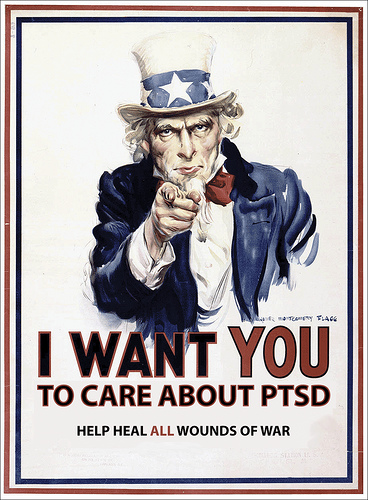
Disabled Veterans, Wounded Warriors, Call Them What You Will, Their Numbers are on the Rise


Uncle Sam PTSD

The wars in Iraq and Afghanistan may be winding down, but the long-term costs of caring for those wounded in battle is on path to rival the costs of the Vietnam War.

While Vietnam extracted a far higher death toll — 58,000 compared with 6,300 so far in the war on terror — the number of documented disabilities from recent veterans is approaching the size of that earlier conflict, according to a McClatchy Newspapers analysis of Department of Veterans Affairs data.


Read more: http://www.fresnobee.com/2011/12/11/2646193/the-cost-of-wars-a-pricey-legacy.html#ixzz1gJoNyIsW


Disability On Theory Road

–after Pentti Saarikoski


In the morning on Theory Road

Ableists and doctrineaire landscapers accosted me

Told me I was sily wanting to go places like everyone else

A little higher up under my apple tree a fawn and her twins nosed fallen fruit

Malice, dressed as a bureaucrat told me to give up

His forehead wavy, eyes quite specific, didn't much like the blind he said

I climbed the steps to the dance floor

Late summer clouds calling me

To dance with them but I lay down on my back

& listened as if my life depended 

The Quandary of Therapy

In the interests of full disclosure I must say that I have had therapy on more than one occasion owing to my lifelong struggles with disability and the attendant circumstantial depression that so often accompanies lives of physical difference. I will also say upfront that I believe in health care for all and that means, in especial, care for those who face mental health issues. Such matters are central to human rights and should be central in a great society. Given that I hold these beliefs it is with more than passing interest to me that Rep. Weiner has declared that he will take a moratorium from the U.S. House of Representatives to get therapy for his sexting addiction. I’m sure you see my quandary: I believe that people with disabilities shouldn’t lose their jobs because of mental illness; believe ardently and unequivocally in disability rights. And here’s Mr. Weiner attempting to hang on in the House by entering a rehabilitation program for sex addicts. I want to hold my nose. I am distressed. If Weiner was an alcoholic I would afford him the benefit of the doubt. Oh yes, my quandary is the liberalist’s quandary par excellence. I must bid Rep. Weiner farewell, ever so briefly, imagining his breakthroughs, and live by the laws of protection that I so fervently believe in. Mustn’t let the latent Calvinist in me take hold and give in to hypocrisy. But I believe that he and David Vitter should resign.
SK

The Thermal Layer

Several years ago I came across a small pamphlet called Rejoicing in Diversity by Alan Weiss. The subtitle of the booklet was: "A Handbook for Managers on How to Accept and Embrace Diversity for Its Intrinsic Contribution to the Workplace"–certainly a mouthful and perhaps not much of an advertisement. But I liked the word "rejoicing" and I also liked "intrinsic" for when you put these words side by side they speak of poetry. (The Chinese have two ideograms that stand together for poetry: a figure for "word" and a figure for "temple"). In any event, diversity in the workplace is seldom framed in ways that suggest spirit. Yet at the core of culture, spirit is all there is. Take away politics, real estate, the fighting over which end of the egg to crack and what you have left is the human wish for meaning. We tend to lose sight of this in Human Resources circles, substituting phrases like: Raising the Bar, Leadership, Assets, and the like. Talking about spirit is embarrassing. Its like talking about the philosophers' stone. Not even medieval historians feel comfortable talking about alchemy. You might look foolish. And we all know that the workplace should not be foolish.

I have advised many organizations on matters of disability and inclusion over the years. These opportunities came about because my first book of nonfiction was a bestseller and because for a time I was a senior administrator at one of the nation's premier guide dog traning schools. I had the opportunity to travel widely. Between 1995 and 2000 I visited 47 of the states in "the lower 48" and spoke at local, state, and federal agencies and public and private colleges. I have advised lots of blue chip organizations including the Museum of Modern Art in New York, the Metropolitan Museum, the Kennedy Center, even resorts and hotels. Inevitably, wherever I have spoken I've heard the rhetoric of middle management: "empowerment"; "equal opporthnity"; "productivity"; "zero tolerance"; "bias"; "sensitivity" and the like.

There is nothing wrong with these terms but to paraphrase Bill Clinton there's nothing right about them either. And this is because the terms have no alchemy in them. They're just nouns. Not all nouns have spirit inside them. The word "battleship" has no spirit but the word "blueberry" does. One of the first things a poet has to learn is that not all nouns are obedient to the soul.

Well meaning organizations (and some that may not be so) rely on the rhetoric of inclusion without imagining the opportunities for soul–and I mean "soul" the way Marvin Gaye would mean it: its what's goin' on. The human soul is present everywhere whether management acknowledges it or not. By way of analogy one can thik of management as playing "battleship" while the soul is picking berries. Human souls are looking for ways to be fed and to be happy; management is often trapped in brittle or arrid pronouncements.

Many organizations talk a good game when it comes to diversity. The top echelon recites the right words. My own employer, the University of Iowa, has lots of websites that propose equal opportunity and where matters of disability are concerned, the university has sites that suggest that accommodations for people with disabilities are easy to obtain. The web sites look great. They have all the right language. The trouble is that the university of Iowa has what Alan Weiss calls "a thermal layer" –the metaphor is atmospheric–one can think of it as an administrative echelon that's capable of distorting communications and directives it receives. Here's what Alan Weiss writes about the subject:

"I have had the rather unique experiences of providing comprehensive reports to top-level executives on the acceptance of diversity in the workplace, only to have them shout, wide-eyed, "That's not my company you're describing!" Yet the feedbhack has been based on extensive focus group and survey work. Who's wrong?

No one is wrong. What's happened is that the respondents have reported what they are actually experiencing, I've conveyed that feedback accurately, and the executives are using their own intent and strategy as their frame of reference. The psychologists would call it cognitive dissonance–fully expecting one set of circumstances, while experiencing quite another.

The phenomenon at work is what I call the "thermal layer," which is a management layer capable of distorting communications and directives it receives, turning them into something quite different. Managers in the thermal layer are the ones who actualy control resources, make daily decisions and deal with the customer. They often have strong vested interests in preserving the status quo…think they have a better way of doing things, don't trust senior management, don't buy-into the strategy or, for whatever reasons, have some agenda of their own. "

Alan Weiss has perfectly described the breakdown that most often creates obstacles to true diversity and inclusion–or to use the language of the soul, communal berry tasting and picking.

For the past three years I've been asking folks at the University of Iowa to take ownership of disability and accessibility issues and have found a deeply invested thermal layer–a phenomenon I like to call the "Iowa Rope-a-Dope" to borrow from Mr. Ali. The Iowa Rope-a-Dope takes advantage of a highly silo-ed administrative hierarchy to in effect pass the buck where disability and accessibilityy are concerned. Let's be clear: no one wants to be identified as being part of the thermal layer just as no faculty member wants to be outed for being "dead wood"–and let's also be clear that the person who persists in calling for blueberries when everyone else wants to talk about battleships will eventually be the victim of considerable distortion.

Alan Weiss again:

"Organizations seldom if ever fail in their intent, executive direction or strategy formulation. They fail in the execution and implementation of their initiatives. Nowhere is that more true than in the accommodation of diversity."

For my own part I have called for the university to provide accessible bathrooms in the student union building and in the Enlgish department–and to date, one floor's restrooms have been modified and I can assure you that this isn't enough. I can also assure you that at the level of departmental administration, no one knows who's in charge of these matters. That's because the thermal layer is in charge. And the T.L. has a hundred silos. It also has committees.

I was put in mind of all this when, this past week, I was upbraided by someone from the human resources department. I've been calling for the installation of assistive technology in the classrooms where I teach for three years. The lack of compliance and communication around this issue has been comical and my method of handling it has been to bring my own talking laptop into each classroom and manfully wire it to the projection system–sometimes this works and sometimes it doesn't. My every teaching experience is therefore a kind of gamble. Have I asked for help? Yes. I've asked the information technology office for help for a full three years. I've discussed this with deans, with department chairs, with the UI's president's office, with HR with the library, and with a stray dog that I met while walking with my guide dog. No one is in charge.

How was I upbraided? I was told that by calling attention to my difficulties with assistive technology compliance that I'd done considerable damage to my reputation with the committee that handles disability issues–the point being that I've apparently not gone through the proper channels in my requests for accommodations. This is how the thermal layer works. The thermal layer likes to deflect by distortion.

Alan Weiss:

"How could anyone oppose an accommodating, equal-opportunity workplace?"

"Well, we know that some people can, sometimes with malicious motives, sometimes with prejudicial judgment, and sometimes because they perceive themselves to be adversely affected by the policies. You must be constantly on the watch for thermal zone reactions and distortions. If there's a policy or value which causes conflict in the workplace, bring it to the surface and discuss openly. If there are misconceptions about policies, resolve them. The failure to do this doesn't make the policies go away, it simply preserves the thermal layer until, like the executives above, the key decision makers get some shocking news. The reaction to that is usually worse than any other alternative, because senior management will try to legislate change rather than help people to embrace it."
This brings us back to blueberries vs. battleships. The spirit of diversity vs. the demeaning of diversity initiatives through the employment of thermal language.

S.K.

Ruprecht the Monkey Boy

Ruprecht the Monkey Boy

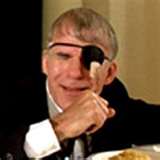
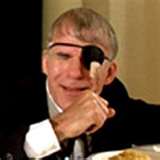
 If you'be ever seen the movie "Dirty Rotten Scoundrels" with Steve Martin and Michael Caine you will doubtless remember Mr. Martin's portrayal of "Ruprecht the Monkey Boy" who, owing to his misfortunes must have a cork on his fork lest he hurt himself at table. Now of course if you're a sensitive person or a righteous one you will be properly apalled by the movie's strategems knowing full well that the world of people with mental disabilities remains a terrible outpost of conditional human rights to say the very least. Then again, within the dynamics of plot, Steve Martin and Michael Caine are scoundrels, and Ruprecht is a posuer, the putative burden that Mr. Caine must carry thorugh life–the unfortunate grown child that he must contain in a quaint dungeon filled with monkey toys–for what else is a good man to do? And Mr. Caine is hunting for a credulous rich woman to marry so he can steal her millions.

Well, thinking of Glenn Beck's march on Washington I was reminded a bit of Ruprecht for Mr. Beck and the Tea Party are the agents of the corporati, who are in turn the rotten scoundrels of our time, who in turn will bilk the old lady out of her last nickel in the name of responsibility–we the upright, we the moral and just shall save the nation by fiscal responsiblity. This of course will mean a return to America of the 1880's–see Ruprecht, be-dungeoned, as all the poor and dazed must be. Make no mistake the Tea Party is as dangerous as can be for its paths to the civic square are as devious as those of Mr. Caine and Mr. Martin in the film aforementioned. The aim of the Tea Party is to steal people's loot while simultaneously appealing to their poorly examined sentiments. If they succeed in developing a real electorate then we will be fighting over who gets to live in the sreet and who gets to live in a state sponsored dungeon.

This is not much of a joke. Still I love the image of Ruprecht above with his cork on a fork. I know what he feels like. I really do.

S.K.  

ADA Restoration Act Clears Hurdles

While you won’t hear much about it from the national press the “ADA Restoration Act of 2007” cleared two House committees yesterday with only one opposing vote. (I’ll have more to say on that in a minute…) 

You can read all about yesterday’s proceedings and learn a good deal about the history  of the “ADARA” at the website of the American Association of People with Disabilities (AAPD):    

It is heartening that in a time of divisive squabbling in Washington the cause of Americans with disabilities has once again “shown the way” for true bi-partisan legislation and negotiation.

Disability is universal—it transcends race, class, gender, point of origin, sexual orientation, social status, age, fortune, and happenstance. Just so: the lives and concerns of people with disabilities are in fact the most logical point of “ethos” for a largely divided country to reassert its American values of fairness and decency.

While you wouldn’t always know it from the strident qualities of my prose I am at heart an optimist about the United States. I have lived to see kids with disabilities get a real chance in public education—when, not so long ago I was one of those “mainstreamed” kids who struggled without civil rights or appropriate educational supports. Yes, we’re a decent nation. We’ve come a long way in many areas. There’s reason for  a positive outlook. And yes, there’s also reason to stay strident. Rights and liberty are inconvenient for the ruling classes and we forget this at our peril.

“Aw, c’mon, Kuusisto, you don’t really think we have a ‘ruling class” in the United States, do you? I mean, don’t you agree that we’re a ‘classless society” etc. etc.?”

Continue reading “ADA Restoration Act Clears Hurdles”

Who are the Political Friends of People with Disabilities?

ADA Restoration Headed to House Markup on Wednesday 
ADA Restoration Moves Forward in the House 
Disability, civil rights and employer groups are working hard to secure support for the negotiated legislated language that has been circulated on JFA and now has the support of more than 50 national and 60 state and local disability groups, the US Chamber of Commerce, the Society for Human Resource Management, the National Association of Manufacturers, the Human Resource Policy Association, and a growing list of companies, including McDonalds, General Motors and Honeywell. Lobbying on the House side for this negotiated deal began in earnest yesterday, focused on the members of the House Education and Labor Committee and the House Judiciary Committee (which also plans to mark up the bill next Wednesday).

To avoid confusion with the bill that was introduced last July, we have begun referring to the negotiated legislation as the ADA Amendments Act. In anticipation of next week’s markup, we are working to counter any efforts in either committee to attach an ADA notification requirement to the bill, a cause that was championed in prior Congresses by Representative Mark Foley of Florida and that is strongly opposed by the disability-civil rights employer coalition working to enact the ADA Amendments Act. We are also working hard to secure White House and Senate Republican support for the negotiated bill.

:::TAKE ACTION:::
At this point, it looks like the bill will receive strong bipartisan support in the committee markups in
the House. We have included a list of the members of the House Education and Labor Committee and the House Judiciary Committee below.
 

·      Contact Members on the House Education & Labor Committee and the House Judiciary Committee between now and Wednesday morning and urge them to support the bipartisan negotiated language that will become the Chairman’s mark in both committees. The names are below.

Locate the Members’ contact information online, or call the Capitol Switchboard at (202) 224-1904 (V) / (202) 224-3091 (TTY) and ask to be connected to their offices by name. 

·      If you haven’t already, consider having your organization "sign on" to the proposed deal language by sending an email to Anne Sommers, JFA Moderator, at aapdanne@earthlink.net. Support of the deal language means you not only approve of its language and terms, but that you also agree to defend it against all attempts by Members of Congress to amend it–unless both sides agree to the amendments.

We will continue to share the list of organizational support with Members of Congress as ADA Restoration moves forward in both the House and Senate in coming weeks. 

·      Attend the markup! The House Education and Labor Markup is scheduled for Wednesday, June 18th, at 10:00 in the Rayburn building, Room 2175. Advocates are encouraged to show their support through numbers. The accessible entrance to the building is the main entrance with the horseshoe drive off South Capitol Street.

Continue reading “Who are the Political Friends of People with Disabilities?”