Thanks for Every Kind Word

Over the past few months I’ve felt gratitude for friends both old and new. Growing up in an alcoholic family and striving with a disability I learned nothing about thankfulness. If I thought about it at all I thought it was indebtedness—surely gratitude was dangerous—a slowing down when speed meant everything. 

I’m thankful to have written a book about a remarkable dog—a harder thing than it sounds because the actual topic of the memoir was gratitude. While working on an early draft I described the project to a friend who said “where’s the drama?” He was right to ask. And I couldn’t answer. Learning to love the world with a dog is not a customary narrative. I was writing about how I changed on the inside and for the better. 

That so many people have written me to say how much Have Dog, Will Travel: A Poet’s Journey has moved them means more to me than I can easily say. Gratitude is acknowledgment, recognition, a mirroring. Properly understood it means we’re together as we express satisfaction. 

In Columbus, Ohio last weekend I had the privilege of speaking on two panels at the Ohioana Book Festival. The first session was about dogs and books—the subject isn’t as simple as you’d think—what do dogs mean to us? I still don’t know the answer. I know I merely know I’m better off for all the dogs in my life and not just my guide dogs. 

The second session was more prosaic. It had to do with how we write. My fellow panelists were more practical than I was. They had useful things to say about researching topics, plotting their stories, joining writing groups, etc. All I could say was: “I get up early. Drink coffee. Throw words like Jackson Pollock throwing paint….and wait to see what happens….” 

I’ve had a hard life. Lord knows my new memoir details some of it. But what a remarkable moment I’m having—and it’s not about me! I set out to write a love poem in prose for my first guide dog Corky. What I managed to do was write about curiosity, joy, and spontaneity, three things dogs know better than we do. 

So here’s to all my friends who’ve written me, tweeted, posted, sent emails, texted—and here’s to the folks I’m getting to know. We’re in this life and affirming why we are respectively, often privately grateful for animal joy and poetry. 
 

Stephen Kuusisto and HarleyABOUT: Stephen Kuusisto is the author of the memoirs Have Dog, Will Travel; Planet of the Blind (a New York Times “Notable Book of the Year”); and Eavesdropping: A Memoir of Blindness and Listening and of the poetry collections Only Bread, Only Light and Letters to Borges. A graduate of the Iowa Writer’s Workshop and a Fulbright Scholar, he has taught at the University of Iowa, Hobart and William Smith Colleges, and Ohio State University. He currently teaches at Syracuse University where he holds a University Professorship in Disability Studies. He is a frequent speaker in the US and abroad. His website is StephenKuusisto.com.

Have Dog, Will Travel: A Poet’s Journey is now available for pre-order:
Amazon
Barnes and Noble
IndieBound.org
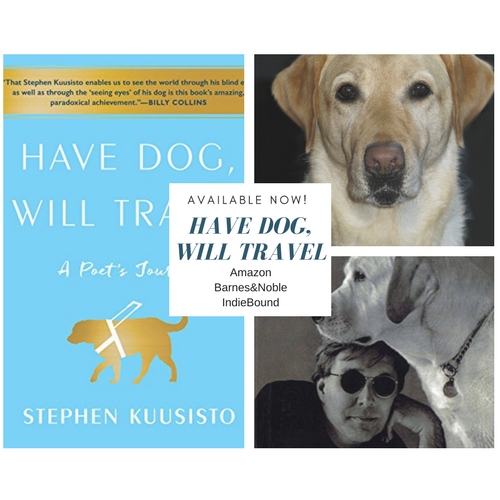
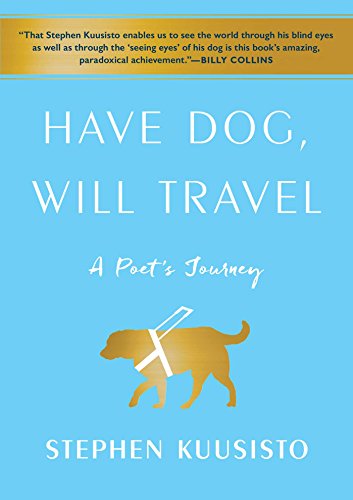
Have Dog, Will Travel by Stephen Kuusisto

(Photo picturing the cover of Stephen Kuusisto’s new memoir “Have Dog, Will Travel” along with his former guide dogs Nira (top) and Corky, bottom.) Bottom photo by Marion Ettlinger 
Soul Clap Its Hands

I have reached the age when I must ask “what kind of old person do I want to be?” One thinks it may be an American question, the pursuit of happiness has no age limit. I don’t mean wealth, or success in common forms. I don’t know how the coming years will unfold. All I know is I want to be flexible, kindly, and retain my curiosity until the end. This isn’t a workday ambition. It’s a matter of soul. Soul clap its hands as William Butler Yeats once said.

Often these days I’m forced to reflect on Marcus Aurelius’ famous maxim: “the soul becomes dyed with the color of its thoughts.” I am 63 and entering the age of disappointments. This means I’ve had my share of luck. I wasn’t a refugee child. As a boy I was treated with penicillin. If my schooling wasn’t superb it was adequate. It is proper to reflect on one’s advantages. If I was a blind child who was bullied—well, I also fell in love with Duke Ellington in solitude and later an excellent professor told me about Ralph Ellison’s “Invisible Man” and so muscular lyricism came my way. I have enough good sense to count these discoveries as good luck.

I remind myself to stay mindful of small fortunes. The color of thought is yet another thing I can’t describe. But reflecting on it has to be good. Before this sounds like a self-help book let me point out human imagination is dark. 9/10 of it is pessimistic. You don’t have to be Buddhist to know it’s difficult to hold a clear thought in mind. The direction of thought influences its coloration. This much I know.

Perhaps I’ll die lonely without money. America is such a place. Maybe I’ll die in good company like Allen Ginsberg. If I pass like my father I’ll fall over while walking my dog. The soul has its own “thing” as they used to say in the sixties. Steeped in its iridescent moon-glow it can be open and unconcerned.

Of disappointments there are many. I know I won’t live to see a golden age of peace and tolerance. I understand it was silly to imagine such things even as late as fifty. Americans are encouraged to be naive. I wept with joy when Barack Obama was elected in 2008. I even allowed myself to believe if only for a minute in the phrase “post-racial America.” Of course remembering optimism is like recalling seasons of love. I see all about me younger people who will not give up on equality and justice. They are still progressively Romantic. Disappointment is nothing compared to future hope. Even in age I can have this. The soul says so.

Maybe I sound like a half baked version of Martin Buber. Or Mary Poppins. I don’t know any more than you what colors the soul prefers. Let’s say it’s a clean window after everything we endured.

Stephen Kuusisto and HarleyABOUT: Stephen Kuusisto is the author of the memoirs Have Dog, Will Travel; Planet of the Blind (a New York Times “Notable Book of the Year”); and Eavesdropping: A Memoir of Blindness and Listening and of the poetry collections Only Bread, Only Light and Letters to Borges. A graduate of the Iowa Writer’s Workshop and a Fulbright Scholar, he has taught at the University of Iowa, Hobart and William Smith Colleges, and Ohio State University. He currently teaches at Syracuse University where he holds a University Professorship in Disability Studies. He is a frequent speaker in the US and abroad. His website is StephenKuusisto.com.

Have Dog, Will Travel: A Poet’s Journey is now available for pre-order:
Amazon
Barnes and Noble
IndieBound.org

Have Dog, Will Travel by Stephen Kuusisto

(Photo picturing the cover of Stephen Kuusisto’s new memoir “Have Dog, Will Travel” along with his former guide dogs Nira (top) and Corky, bottom.) Bottom photo by Marion Ettlinger 

Fear of Falling, Twenty Times Each Day

I walk up and down stairs while I’m awake and as far as I know I don’t do it in my sleep. Stairs are bad enough in my waking life. My blindness means every set of steps will be both challenging and vaguely frightening. Often walking with sighted friends they sail down staircases talking all the while as I nervously feel my way with electrostatic feet. I’ve always loved James Tate’s line: “when riding an escalator I expect something orthopedic to happen.” Me too James. Or worse. I expect to fall face forward into death’s arms.

No matter how proficient you are at traveling blind you’re always aware of the manifold instances when, frankly, you’re risking physical harm. It is not fashionable to say this. What’s fashionable is to assert blindness is a minor inconvenience—with the proper accommodations it is practically nothing.

And then there are stairs, intersections, drunk drivers, distracted bicycle messengers, tiny revolving doors, all the daily invitations to behead myself.

On the surface I appear collected. Underneath, even with a guide dog by my side I feel that old fear of falling, feel it at least twenty times a day.

Connie Kuusisto :
Stephen Kuusisto and HarleyABOUT: Stephen Kuusisto is the author of the memoirs Have Dog, Will Travel; Planet of the Blind (a New York Times “Notable Book of the Year”); and Eavesdropping: A Memoir of Blindness and Listening and of the poetry collections Only Bread, Only Light and Letters to Borges. A graduate of the Iowa Writer’s Workshop and a Fulbright Scholar, he has taught at the University of Iowa, Hobart and William Smith Colleges, and Ohio State University. He currently teaches at Syracuse University where he holds a University Professorship in Disability Studies. He is a frequent speaker in the US and abroad. His website is StephenKuusisto.com.

Have Dog, Will Travel: A Poet’s Journey is now available:
Amazon
Barnes and Noble
IndieBound.org

Have Dog, Will Travel by Stephen Kuusisto

(Photo picturing the cover of Stephen Kuusisto’s new memoir “Have Dog, Will Travel” along with his former guide dogs Nira (top) and Corky, bottom.) Bottom photo by Marion Ettlinger 
Thoughts on the AWP, Christopher Hitchens, and Jefferson’s Idea of Happiness

Last evening I spoke with several scholars who are researching histories of confinement among the disabled. This morning I’m reading about the latest failure of the AWP (The Association of Writers and Writing Programs) which just concluded its annual national conference having once again treated disabled attendees miserably. Confinement means the asylum or special hospital but it is also the product of disdain—find a conference site with insufficient elevators, no shuttle service, make sure no one answers the accessibility helpline, make public your indifference to disability inclusion and you’ve got what the leading consortium of academic creative writing programs thinks is OK where the cripples are concerned. Maybe they’ll go back to the institution—and we don’t mean the Ivory Tower.

**

“Imagine that you can perform a feat of which I am incapable. Imagine, in other words, that you can picture an infinitely benign and all-powerful creator, who conceived of you, then made and shaped you, brought you into the world he had made for you, and now supervises and cares for you even while you sleep. Imagine, further, that if you obey the rules and commandments that he has lovingly prescribed, you will qualify for an eternity of bliss and repose. I do not say that I envy you this belief (because to me it seems like the wish for a horrible form of benevolent and unalterable dictatorship), but I do have a sincere question. Why does such a belief not make its adherents happy? It must seem to them that they have come into possession of a marvelous secret, of the sort that they could cling to in moments of even the most extreme adversity.”

Excerpt From: Christopher Hitchens. “God Is Not Great.” iBooks. https://itunes.apple.com/us/book/god-is-not-great/id357657047?mt=11

I’m a fan of Hitchens’ book “God is Not Great” as it forces me to play with aspirational circuits in the spiritual Neo-cortex. The “SNC” is where creative optimism fires its fastest signals—listen to Beethoven’s sixth symphony for an example of its art—so here, thinking of the above, lets just say that Christopher Hitchens has planted a red herring and I suspect he knew it. In truth all people are sad. It’s possible melancholy plays a role in human evolution for no matter what you may say about it, it’s the precursor for growth. Religious people are human too—their sadness is in no way different from the miseries of atheists. Thank you Mr. Hitchens for reminding me of this. There’s no secret among the sincerely religious—only what I’ll call muscular hope and a willingness to not give up on decency. And you bet there are bad Christians.

**

You see, I’m able to say, though it may be un-American, that I often wake up unhappy. My job as I see it is to work it. I say un-American with irony, as I think Jefferson’s pursuit of happiness long ago morphed into the expectation of happiness. I’m in the Jeffersonian camp. And you bet: I won’t mind the help of others as I lift my portion of weight.


Stephen Kuusisto and HarleyABOUT: Stephen Kuusisto is the author of the memoirs Have Dog, Will Travel; Planet of the Blind (a New York Times “Notable Book of the Year”); and Eavesdropping: A Memoir of Blindness and Listening and of the poetry collections Only Bread, Only Light and Letters to Borges. A graduate of the Iowa Writer’s Workshop and a Fulbright Scholar, he has taught at the University of Iowa, Hobart and William Smith Colleges, and Ohio State University. He currently teaches at Syracuse University where he holds a University Professorship in Disability Studies. He is a frequent speaker in the US and abroad. His website is StephenKuusisto.com.

Have Dog, Will Travel: A Poet’s Journey is now available for pre-order:
Amazon
Barnes and Noble
IndieBound.org

Have Dog, Will Travel by Stephen Kuusisto

(Photo picturing the cover of Stephen Kuusisto’s new memoir “Have Dog, Will Travel” along with his former guide dogs Nira (top) and Corky, bottom.) Bottom photo by Marion Ettlinger 

I Just Lost My Civil Rights Thanks to the GOP

Yesterday, February 15, 2018 the U.S. House of Representatives voted 225-192 to gut the Americans with Disabilities Act.   The bill known as “The ADA Education and Reform Act, or H.R. 620” is designed, so its proponents argue, to prevent frivolous “drive-by lawsuits” brought by lawyers who see inaccessible businesses and want to capitalize on the problem. The bill requires those filing against businesses for violating the ADA to first give business owners 60 days to describe how they’ll fix the problem. Then they have another 120 days to implement the changes. Sounds reasonable right? But the bill is actually designed to make the problem of lawsuits go away and does not put any onus on businesses to actually make changes.

As the Consortium for Citizens with Disabilities correctly notes: “H.R. 620 would create significant obstacles for people with disabilities to enforce their rights under Title III of the Americans with Disabilities Act (ADA) to access public accommodations, and would impede their ability to engage in daily activities and participate in the mainstream of society. Rather, the burden of protecting the right to access a public place is shifted to the person with the disability, who first has to be denied access; then must determine that violations of the law have occurred; then must provide the business with specific notice of which provisions of the law were violated and when; and finally, the aggrieved person with the disability must afford the business a lengthy period to correct the problem.”

The “lengthy period” is a red herring as the bill’s supporters know. Again from the Consortium for Citizens with Disabilities: “We know of no other law that outlaws discrimination but permits entities to discriminate with impunity until victims experience that discrimination and educate the entities perpetrating it about their obligations not to discriminate. Such a regime is absurd, and would make people with disabilities second-class citizens.”

As of this morning my civil rights and the rights of over 50 million Americans are now in jeopardy. Like thousands in the disability community I’ve watched with growing alarm as a well organized largely Republican lead coalition both in state and federal government has moved aggressively to weaken or even eliminate the rights of the disabled. Betsy DeVos has instructed the Department of Education to look the other way when matters of equal access for students with disabilities are on the table. Congress and the Trump administration are cutting Medicate.

These are outrageous developments.

Imagine this scenario if you are not disabled. One day you decide to go to a commonplace establishment. A popular eatery or coffee joint. When you get there the owner says, “Well, I don’t like serving  people with cartoon character tee shirts.” Then he adds: “Mickey Mouse violates my decor. And I don’t have time or resources to change my decor” You’re turned away.

Do you think this analogy is fatuous? I admit it seems ludicrous. But the principle is the same. The shop owner has made a decision, rather consciously, that there’s a type of customer he doesn’t want. Rather than admit his prejudice he complains that resolving the issue will likely cost him plenty. He tells you to go away.

Imagine that you then had to explain through lengthy filings why your rights were violated. Then further imagine that the owner has almost unlimited opportunities to do nothing.

How does that grab you?

Stephen Kuusisto and HarleyABOUT: Stephen Kuusisto is the author of the memoirs Have Dog, Will Travel; Planet of the Blind (a New York Times “Notable Book of the Year”); and Eavesdropping: A Memoir of Blindness and Listening and of the poetry collections Only Bread, Only Light and Letters to Borges. A graduate of the Iowa Writer’s Workshop and a Fulbright Scholar, he has taught at the University of Iowa, Hobart and William Smith Colleges, and Ohio State University. He currently teaches at Syracuse University where he holds a University Professorship in Disability Studies. He is a frequent speaker in the US and abroad. His website is StephenKuusisto.com.

Have Dog, Will Travel: A Poet’s Journey is now available for pre-order:
Amazon
Barnes and Noble
IndieBound.org

Have Dog, Will Travel by Stephen Kuusisto

(Photo picturing the cover of Stephen Kuusisto’s new memoir “Have Dog, Will Travel” along with his former guide dogs Nira (top) and Corky, bottom.) Bottom photo by Marion Ettlinger 
No to H.R. 620, No to the GOP, Defend the Disabled!

Some days are hard to bear—you’re a single mom and rent is due. You don’t know where that money is coming from. Child care is hit or miss. Your children are sick and what meagre health insurance you have is being depleted by politicians who imagine poverty is a moral weakness.

There’s a lot of “moral weakness” going around these days in the United States. If you listen to GOP senators, and house representatives you hear that the lame, the halt, the poorest among us are undeserving of public help. There’s something wrong with them, according to the right wing narrative. They’re lazy. Feckless.

The disabled are part of this objectified collection of wanton souls. We’re costly. What with our needs for ramps and Braille and breathing tubes. What with our claims on health care. It’s hard to escape the lingering horror of Adolf Hitler’s dictum that the disabled are just “useless eaters.” The aggressive, rightward tilt of the GOP leans toward the wholesale elimination of Medicaid and deep cuts in medicare. This isn’t some kine of fiction—fake news—the GOP is working overtime to make sure the elderly, the poor, and the disabled have no supports to help them live. Pro-life party indeed.

Right now the GOP is pushing in the house a bill (H.R. 620) which is the product of long standing and relentless lobbying by organizations like the Better Business Bureau, and which is designed to eliminate the capacity of the disabled and their allies to sue businesses for willfully ignoring the accessibility provisions in the Americans with Disabilities Act. Here are some basic bullet points that have been shared nationally by The Disability Rights Education and Defense Fund.

HR 620 will eliminate the need for businesses to be accessible until a complaint is received; there will be no need to make a business accessible until someone complains; that will mean many groups building new buildings, renovating buildings, opening new businesses will not make their services accessible

HR 620 shifts the burden of accessibility from those who offer services to the person with a disability; no other group needs to prove their right to access to publicly offered services

We should not be gutting the rights of people with disabilities; if there is a problem, we should be limiting the actions of a small number of lawyers who are bad actors

HR 620 will take away the civil rights of people with disabilities; would we ever think about eliminating the rights of any other group of Americans? This is disgraceful.

You can read more about H.R. 620 and the cover language the GOP is using to confuse the public about the bill here:

https://dredf.org/wp-content/uploads/2017/08/myths-and-truths-about-the-ada-education-and-reform-act.pdf

**

What does it mean when a nation decides that the most vulnerable of its citizens should be stripped of their rights to participate in civic society? What’s the deep text underscoring predates of the weak?

The answer lies in right wing melodrama. Like the Third Reich, today’s Republicans have a scarcity narrative which is predicated on the idea that Mom and Pop America won’t get what’s due them if we take care of these obviously non-productive people. That we’ve come down to this just 28 years after the wholly bi-partisan adoption of the ADA is both horrifying and quite telling. Not long ago I was at an event in Washington, DC where former U.S. Senator Bob Dole, a wounded veteran, who championed the ADA said openly, “Today I fear that law could never pass on Capitol Hill.”

Please, if you’re reading this, call your local U.S. Representative and say “No!” to H.R. 620.

Stephen Kuusisto and HarleyABOUT: Stephen Kuusisto is the author of the memoirs Have Dog, Will Travel; Planet of the Blind (a New York Times “Notable Book of the Year”); and Eavesdropping: A Memoir of Blindness and Listening and of the poetry collections Only Bread, Only Light and Letters to Borges. A graduate of the Iowa Writer’s Workshop and a Fulbright Scholar, he has taught at the University of Iowa, Hobart and William Smith Colleges, and Ohio State University. He currently teaches at Syracuse University where he holds a University Professorship in Disability Studies. He is a frequent speaker in the US and abroad. His website is StephenKuusisto.com.

Have Dog, Will Travel: A Poet’s Journey is now available for pre-order:
Amazon
Barnes and Noble
IndieBound.org


The GOP and Medicaid

I have relied on accommodations all my life from kindergarten to the halls of academe. I can count on one hand the times a simple request was treated with courtesy, understanding, and warmth not to mention efficiency. When I write about ableism, whether in the academy or on a common bus, I’m pointing to the fact that hostility to the disabled is rife, both in the United States and abroad. As I grow older—I’ll be 63 in March—I’m seeing how effective neoliberalism has been at creating systemic structures that make it harder for the disabled to live, and yes, this translates intersectionally across historically marginalized differences. This is hardly news to those of us who live in coverts of fragile identity, but one feels the need to keep typing. This morning I’ve awakened to see the GOP is trying to tie Medicaid to new work initiatives—a thing so heinous I can’t find the proper analogy for it—one pictures a plutocrat dangling medicine on a string before an elderly woman with a wheelchair—“C’mon, if you want this, stand up!”

When in the service of cruelty the powerful initiate stumbling blocks for the weakest and count themselves “prudent” and “efficient” one must remember that the role of democratic government is to assure the common good of the people. The only way to rationalize an opposing opinion is to say that many lives don’t matter echoing Hitler’s famous characterization of the disabled as “useless eaters.”

I am angry today. At 63 I’ve come to realize I’ve entered a doubly abject cohort—I’m disabled and old. I’m lucky because I have a job, at least for a little while longer. If all goes well I’ll get to appear useful for a few more years. But when I’m older, blinder, more inform, will I have to leap for a string? Will my job be crawling across the floor for amusement?

This morning it’s starting to look that way.

The Forehead Egg, Biopolitics, Disability

When I was in my early twenties I read a lot of poems by James Tate. If you’re an American who’s interested in poetry and you’re over forty there’s a good chance you’ve visited Tate’s poignant, Da-da universe where dark alleys and cemetery willows remind a man to have a cigarette; where Sam Beckett’s people enter cereal naming contests; where only a dish of blueberries can pull you out of a lingering funk. Somewhere in my reading I saw a line about a man who feels like a fried egg has been glued to his forehead, which is to say, he walked around that way. There I was, blind, in college, cross eyed, the streets before me erasing themselves as I moved, lonesome, stamped by the U.S. Department of Alienation, hyper-aware that a cutting remark would be coming my way any moment. I knew Tate’s fried egg was my third eye, my sunny side up stigma. Disability can feel like that.

When we, the disabled discuss the biopolitics of disability, which is to say, the economic and political performances and entrapments of disablement, it often seems, at least to me, we’re talking about eggs and foreheads as much as anything else. What kind of egg will it be? Will you cook it yourself or will someone do it for you? Just so, will you self-apply your egg or have it done professionally? (I’m not metaphorically describing disability but the stances one must take because of it.) And there’s more: will it be a free range organic egg or from a factory? Perhaps if you’re lucky it will be cooked just right.

The neoliberal egg-on-forehead (hereafter NEOF) is like the cereal naming contest above–you have to pay to win and while you may be named Estragon you’re reliably in the game because it’s now an inclusive economy. In the bad old days you’d have been forced to live in the NEOF asylum but suddenly you have putative value. A productive, non-normative worth has either been declared or assigned. You round up your pals who once lived in the ward with you and together you create a federation. You’re online. Christ, you even blog. You belong to a Single Condition User Group. You’re no longer just a person with egg on the unibrow, you’re informed, itchy, talkative, contrary, ardent if not militant.

In their groundbreaking book The Biopolitics or Disability: Neoliberalism, Ablenationalism, and Peripheral Embodiment, David Mitchell and Sharon Snyder point out that: “as medical citizens within neoliberal biopolitics we are expected to take active control of our health management regimes to a greater extent than in any time in history. This active control taking health represents the double-edged sword of biopolitics and results in the desperate necessity of participating in funding initiatives on behalf of physicians and researchers to provide the missing profit motive for future investigations of potential medical treatments for members of rare condition groups.”

You were in a special hospital not so very long ago but now you’re an anguished expert on forehead eggism because you must be. You must be because either you’ve a job and want to keep it (you’ll need an accommodation—you can’t wear standard issue hats) or you hope to have a job—or jobless, you wish to have community relevance, which means among other things you should have the right script memorized.

I for one commit to memory a lot of self-declarative language. Yesterday I went to the ophthalmologist. I told him all about my eyes. In ophthalmology land I’m a failure. You mustn’t imagine eye doctors view low-to-no vision patients as successful and autonomous citizens. I felt the need to take care of myself and control the medical narrative to the best of my ability. I wasn’t an uninformed blind person. I wasn’t in need of rehab. No. That’s not a laser scar on my left retina, that’s what it looks like. You see, I don’t need to be cured, and even if that’s something in the cards it’s not happening today. I like the eggs. Yeah you can call me Estragon.


Ableism in the Academy, Thoughts on Moliere

Ableism, the experience of it, requires the French adjective écœurante —for disability discrimination is simultaneously heartless and sickening. I recall the professor of English at the University of Iowa who told me my blindness would preclude me from being in his “famous” graduate class on Charles Olson. Another professor snickered when I said I was reading books on tape. When I protested the chairman of the English department said I was a whiner and complainer. I wept alone in the Men’s room. My path forward to a Ph.D. in English at the University of Iowa was stymied. This was a full six years before the ADA was signed into law. Who was I to imagine a place at the agora’s marble stump?

I had an MFA degree from the creative writing program at that same university and I just went ahead and wrote books and sometimes appeared on radio and television and I wrote for big magazines and over time I received tenure at The Ohio State University. Later I went back to teach at Iowa despite my earlier experience and these days I’m at Syracuse. I’m a survivor of sorts. I’m a blind professor. The odds were never in my favor. Somewhere along the way I began thinking of Moliere in my private moments and I laughed because after all, every human occasion is comical and Moliere recognized the comedic types one encounters in closed societies better than anyone before or since.

It doesn’t really matter what institution of higher education you’re at, if you’re disabled you’ll meet the following Moliere-esque figures. The heartless and sickening ye will always have with ye if you trek onto a college campus. You’re more likely to spot them first if you hail from a historically marginalized background however, the ecoeurantists are more prone to blab at you if you’re disabled, especially behind closed doors. Ableists love closed doors. All bigots love closed doors.

The “Tartuffe” is an administrator, usually a dean or provost who will tell you with affected gestures that he, she, they, what have you, cares a great deal about disability and then, despite the fact a disabled person has outlined a genuine problem, never helps out.

The “Harpagon” is also an administrator, but he, she, they, can also be a faculty member. The Harpagon is driven by rhetorics of cheapness. It will cost too much to retrofit this bathroom, classroom, syllabus, website, etc. If the Harpagon is a professor he, she, they, generally drives a nice car.

Statue du Commandeur: a rigid, punctilious, puritanical college president—“this is the way we’ve always done it. If we changed things for you, we’d have to change things for everybody. Yes, it certainly must be hard…” See:

The Geronte: when his son is kidnapped he says: “Que diable allait-il faire dans cette galère?” (What in the deuce did he want to go on that galley for?” In other words, he brought this upon himself. “Really, shouldn’t you try something easier? I could have told you.”

These are the principle types of ableists. I invite you to add your own.

The one thing they have in common besides a privileged and thoroughly unexamined attachment to the idea that education is a race requiring stamina and deprivation, is that they all genuinely believe accommodations are a kind of vanity.


Dogs, Hats, and Faith

As the new year dawns I’m doing my best—that is, I’m drinking coffee. And since I went to bed last night at 9:30 (at the insistence of a small dog who thought it was the right thing when the outside temperature was 5 degrees Fahrenheit) well because of this I’m wide awake sans hangover.

To be fair the dog didn’t make me go to bed. It’s good to distrust people who say dogs make them do anything other than feeding them and taking them outside. I went to bed early because it seemed like a good idea.

I’ve been taking antidepressants for over twenty years. They help me stay “in the game” but they also make me tired at night and that’s just the way it is. By taking Celexa I live on dog time. Early to bed, early to rise. I’m Ben Franklin with pills and dogs.

What are dogs and antidepressants for? I imagine they’re about hope. Even facing the aborning year which cannot be promising, what with the looting of the planet, corporatized warfare, slavish and corrupt politicians of every stripe, human trafficking, the new slavery, which is old slavery tied to offshore banking—I’ll stop in a moment—even with the assault on the poor, the infirm—here I am again tossing my moth eaten chapeau onto a fountain of hope knowing one of my two dogs will retrieve it.

Dogs teach us to put our wet hats on again.

They teach us to avoid rising to the level of our expectations, but fall to the level of our training, as Archilochus would have it and which I’ve always taken to mean “get on with it brother.”

The wet hat has some toothmarks.

Lots of people sneer at hope. It is for one thing akin to faith and nothing gets kicked more often than faith, even the faithful do it.

I agree with Maxine Hong Kingston: “In a time of destruction, create something.”

Dogs say wet hats are better than no hats.

Dogs say you can indeed get there from here.

Dogs say even wearing that hat you’re not as bad as you appear.

Or they say, well, you might be as bad as you appear—so throw your hat again and we’ll bring it back. You can try for a new look.

A hat damp with hope is still a hat.

A damp hat is expectation halved, still wearable.

The hat your dog brings means you have a plan.