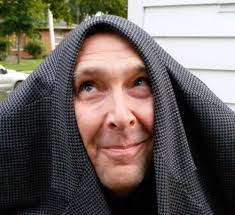
CHRISTMAS 1961: UNCLE CHUCK

By Michael Meteyer

(From a Silly in Progress)

Uncle Chuck smoked five cigars a day, dressed like a tweed wastebasket, and was rumored to do unpalatable things with his hands.

A hug from Uncle Chuck was like a dive into a smoldering garbage bin, and would hang on you for days afterwards, like a miasma from a swamp of dead alligators, frog innards and spoiled wet tobacco and moldy latrines.

Uncle Chuck was a tenor with the voice of an angel. He sang songs from World War l.

His speaking voice was as plummy as a radio announcer from the 1940s. Everything about Uncle Chuck except for his odor was plummy, even his face color, even his body shape, which was round, with a crease in his forehead where you expected a stem to appear, as if he were a tomato.

There were rumors about Uncle Chuck. We were told as children, to never ask about Uncle Chucks history, which only made us more curious.

Was Uncle Chuck a murderer? Did he work for the government? Had he been a florist? Did he come back from the dead?

No matter: at every family gathering Uncle Chuck was central to a ritual that had evolved.

First there was the imbibing and storytelling, our paramount adult activities: and to this day I am so grateful I came from a clan of storytellers who cherished language as much as a Babylonian farmer cherished his hoe.

Then after the initial bonhomie, and then the giddiness, and then wild laughter, and then me and my brother Timmy would get in a fistfight, and the gathering would become sad and wistful… then it was time for Uncle Chuck to sing the mournful song “My Buddy”.

“My Buddy” was a song from the Great War about the death of a friend, which, although I didn’t know it then, was also about the death of youth, and the end of dreams, and the impermanence of… everything, especially precious family instances and crowded Christmas moments.

Uncle Chuck’s angelic voice- the voice of a plummy winged angel- brought tears to everyone’s eyes, even to those of us, adolescents, who had no knowledge yet of the preciousness of common things and tiring rituals.

I remember the thick snow falling outside, slow but insistent, illuminated by the multiple colors of lights on all the houses in the neighborhood. It seemed like each snowflake was a different color, but I realize now this was because of the Christmas lights on the houses behind them. Something like Plato’s Allegory of the Cave.

“Each snowflake”, Aunt Marla once confided to me in slurred tones, “Is not only a piece of time, which melts the moment you think about it; it is the secret kiss of an anonymish, ah, aninnymoosh angel who will protect you. And there are numberless angels… They shee everything you do. Except, we’ll, let’s just say they know when to look away. They know what it means to be alive. Most of them. They aren’t nosy, they just want to protect you. Did I tell you they were numberless? Like snowdrops? Like kisses from your Aunt Marla”?

Then she would giggle, and give me a kiss: wet, like a snowdrop, but much warmer, and then she would look deeply into my eyes, as if seeing all things past and future, but especially the present. And her eyes would fixate that moment into my consciousness like it was riveted by a laser beam.

But then her eyes would quiver and she’d burp or hiccup or something, and it rather changed the moment.

In Babylonian Times there were parties and rituals around the solstice, and lamps and torches set alight in the dark, and the presentation of gifts and the recitation of prayers to urge the Sun, the God that controlled the light, to come back, to return us to light and warmth again.

They acted as if light and warmth and illumination were as fragile and promising as a new born infant, as if everything, even the continuation of life, depended upon its growth and thriving.

Those Babylonians didn’t have snow. Or tinsel. They had their own form of crèches, and talked to the statuettes in them all year, as if they were alive, but that is a different thing, and I don’t want to get into it now.

Those Babylonians, they didn’t have snow, either.

They didn’t have, like I had, Gloria Matthews dressed up as the Virgin Mary in our fifth grade Christmas play.

They didn’t have, as we have, the Christ child.

And then as now, several thousands of years later, the prayers and the lights and the gifts and the love worked. The infant son, as good as God, began its way home us, bringing more light and longer days.

I’m sure the pagan Babylonians had their own version of doleful ballads and plummy Uncle Chucks.

And when Uncle Chuck finished singing, we were all as quiet as the stars in the night sky.

Then the adults would wipe away their tears, and begin to sober up for the journey home.

Michael Meteyer is a longtime friend of the blind, a newly retired orientation and mobility instructor. He studies creative writing at the University of Rochester with the poet Anthony Hecht and spent many afternoons riding horses with Lawrence Ferlinghetti. He lives in San Rafael, California.
The Blind Whale, Part One

I am inside the blind whale. I should say it isn’t Melville’s whale nor is it Jonah’s brute. The blind whale is made of all the dreams of sighted people occurring now and simultaneously. It is easier to say what the blind whale is not: it isn’t a prospect; it’s not a fortune; it’s not a standard nightmare. It isn’t of the left or of the right.

**

Now is the blind whale distinct from blindness itself? Yes. Genuine blindness is just a fish. A small one. A guppy. It swims in shallows. By distinction the blind whale cannot be seen. It’s a visual man’s phantasm. Or woman’s. Women are also screwed up by the blind whale.

**

Of course sighted people are terrified of blindness but this isn’t that. If the damned blind whale has significance beyond furnishing my roof it must be this: it’s composed of the oneiric afterthoughts of all visual humans. I do not mean repressed fears. Forget Freud and Jung. I mean the dropped car keys and lost buttons in dreams.

**

Petty detail is what the blind whale feasts on. The krill swims straight into the maw. What I mean is “sighted petty” —the blind spot in a rearview mirror.

**

I’m inside a non-fictive creature designed haphazardly by the small frights of the sighted. This is a problem.

**

When reading “Moby Dick” I’m always struck by what Melville doesn’t have to say. For instance he needn’t say that the intricate industrial-scientific butchery of a whale carcass is merely bloody psychoanalysis misunderstood. Nor does he have to say, “always remember what’s under the boat.”

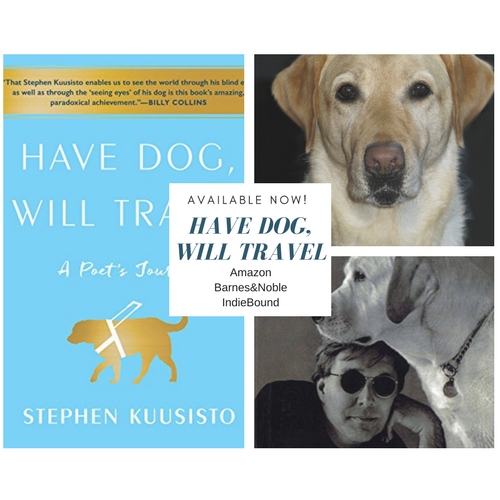
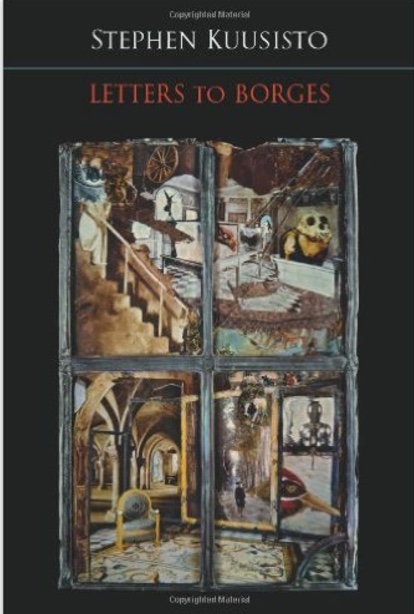
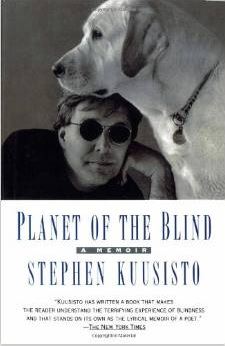
Stephen Kuusisto and HarleyABOUT: Stephen Kuusisto is the author of the memoirs Have Dog, Will Travel; Planet of the Blind (a New York Times “Notable Book of the Year”); and Eavesdropping: A Memoir of Blindness and Listening and of the poetry collections Only Bread, Only Light and Letters to Borges. A graduate of the Iowa Writer’s Workshop and a Fulbright Scholar, he has taught at the University of Iowa, Hobart and William Smith Colleges, and Ohio State University. He currently teaches at Syracuse University where he holds a University Professorship in Disability Studies. He is a frequent speaker in the US and abroad. His website is StephenKuusisto.com.

Have Dog, Will Travel: A Poet’s Journey is now available for pre-order:
Amazon
Barnes and Noble
IndieBound.org

Have Dog, Will Travel by Stephen Kuusisto

(Photo picturing the cover of Stephen Kuusisto’s new memoir “Have Dog, Will Travel” along with his former guide dogs Nira (top) and Corky, bottom.) Bottom photo by Marion Ettlinger 

Diabelli

I’m listening to Beethoven’s Diabelli Variations on a windy November day when the last leaves are falling from the trees.

Did the ghost trains come through already?

All of a sudden he checks himself as if he’d said too much.

I wanted to buy flowers yesterday but didn’t.

When sighted people talk about blind certainty I wonder what they’re talking about.

About my other side, it has a lonesome house.

Everywhere, directions, possibilities, but still rain at the windows.

Where else would I walk?

I don’t like your smile sir.

Up river where they eat song birds.

I’ll lend my heart to you but only to make you hear.

Autumn, more ancient than my recklessness….

I Ran Straight Out of Myself….

I ran straight out of myself. I’m certain that’s what death will be.
I ran straight into myself. Birth. How it was. Once while on acid I saw my birth doctor.
He had eyebrows like antennae.

I ran straight around myself. Like blowing leaves all my selves whirling around the street lamp of my body.

I ran through myself more than once, often jacked up on alcohol and guilt. My clumsy feet broke the delicate toys inside me.

Down the road, down the road, all my friends live down the road.
Ain’t got a letter since I don’t know when.

Older now I run to catch up with myself. Mind goes very fast these days.

In this life inside the falling a long sweet glide.

**

There was a time when every hour was whole.
Part of Beethoven’s wisdom is how he incorporated this knowledge into his late quartets.

For my part I have a childish psyche with a porous understanding of time.

The child inside me is wishful because of a leaking hourglass.

I’ve lived my life for my twin brother who died at birth.

The doctor had terrifying eyebrows.

**

I wasn’t a poet by choice but by the bardo.

I am however a citizen by choice.

Are you disabled? No I’m a citizen.

The smell of smoke from my neighbor’s houses….

The Discords

I could tell you things
But I’m not old enough—
Just walking over a large and shining ice patch

**

Did I eat Prufrock’s peach yesterday?

**

Of the bumblebee Lars Gustafsson writes:

“A flying man who lives far within the wood
Has folded up his wings and sleeps in the rain.”

**

Up river and down
My childhood
But unlike Huck
No Jim, no friends

**

“So that’s what made you a poet!”

**

In the forest there are still signs of the old mill.

**

Terry Eagleton says pessimism is the most difficult moral condition to obtain.
Silly. He never ate frozen strawberries with a 100 year old monk in rural Finland in winter darkness. In general academics need to get out more.

**

If I knew so much parataxis would occupy me
I’d have (instead) invented the shoe horn.

**

Everyone has a debt to death
But on clear mornings you can hear them thar pianos…

I didn’t exactly begin my life. I suppose I was always riding out
From the big bang; show time dust; the carbon democracies.
Vedas say we’ve been here before but I don’t think it.
We were here and then gone and there’s no analogy.
This morning on the first cold day of autumn
I “saw” (the way blind people do….very close….
On hands and knees….)
A tiny wasp emerge unsteadily
From a frost apple—
Though I was only in the grass
Looking for my keys
Sorry for myself.

A Valediction of Fainting

The surgeon plucked at my eye with a forceps. I said I was fainting. Then I fainted.

It was a textbook instance of the “vasovagal reflex”. You can ask the CIA. Touch the lenses of the eyes and you can induce loss of consciousness.

Reader: perhaps you’re a frequent fainter and are familiar with the poetry of the matter. I doff my hat to you.

I woke in a chair. Although I couldn’t see I heard a nurse say: “I can’t hear his pulse.”

The neo-cortex (mine) which thinks fast (yours does too) said inwardly: “Merd! Je suis mort!”

(The neo-cortex it turns out, speaks only French, as it was in fact discovered by Denis Diderot. You don’t have to know French to understand the neo-cortex. The translation process is automatic. It does not matter if you are a Finn or a Croat or Laotian.)

(Theory: the French language was invented by and for dead people.)

(Proof of above: Diderot: “Man will never be free until the last king is strangled with the entrails of the last priest.”)

The nurse said next: “Okay. I can hear his pulse but it is very faint.”

Stephen Kuusisto and HarleyABOUT: Stephen Kuusisto is the author of the memoirs Have Dog, Will Travel; Planet of the Blind (a New York Times “Notable Book of the Year”); and Eavesdropping: A Memoir of Blindness and Listening and of the poetry collections Only Bread, Only Light and Letters to Borges. A graduate of the Iowa Writer’s Workshop and a Fulbright Scholar, he has taught at the University of Iowa, Hobart and William Smith Colleges, and Ohio State University. He currently teaches at Syracuse University where he holds a University Professorship in Disability Studies. He is a frequent speaker in the US and abroad. His website is StephenKuusisto.com.

Have Dog, Will Travel: A Poet’s Journey is now available for pre-order:
Amazon
Barnes and Noble
IndieBound.org

Have Dog, Will Travel by Stephen Kuusisto

(Photo picturing the cover of Stephen Kuusisto’s new memoir “Have Dog, Will Travel” along with his former guide dogs Nira (top) and Corky, bottom.) Bottom photo by Marion Ettlinger 

More About Hating Smokey the Bear

I don’t like Smokey the Bear. I’ve already written about it. He’s a slick defier of logic. Children are powerless to prevent forest fires and telling kids they’ve a singular moral responsibility fo forestall contagion is the kind of cartoon horse shit Americans are forced to grow up with.

Meanwhile the forests are being systematically cut down by Weyerhaeuser and fried by acid rain from “clean coal”—a phrase I’m sure Smokey the Bear would approve.

Now you will say: “But Kuusisto, is it Smokey the Bear you don’t like, or is it the fatuous, bloated, running dogs of the bourgeoisie who created him who you dislike?”

Of course I dislike Madison Avenue. But it’s the cartoon Bear I hate. He’s the kind of anthropomorphic dungaree wearing shovel toting ranger hat wearing dingus who will pick your pockets if you’re not careful. He’s out to mess with your conscience. He wants you to feel responsible when bad things happen in nature.

Only you can prevent hurricanes.

Only you can prevent global warming.

He’s anti-democratic and the purveyor of superstition.

Thomas Jefferson would have despised Smokey the Bear.

Why am I “on” about this?

Because when you make a woman who’s survived sexual abuse stand alone before a room fool of smug, pink, hostile men on Capitol Hill, you’re saying, “only you can prevent sexual assault”—the American social lie…the idea that the culture isn’t responsible, only you, only you.

Stephen Kuusisto and HarleyABOUT: Stephen Kuusisto is the author of the memoirs Have Dog, Will Travel; Planet of the Blind (a New York Times “Notable Book of the Year”); and Eavesdropping: A Memoir of Blindness and Listening and of the poetry collections Only Bread, Only Light and Letters to Borges. A graduate of the Iowa Writer’s Workshop and a Fulbright Scholar, he has taught at the University of Iowa, Hobart and William Smith Colleges, and Ohio State University. He currently teaches at Syracuse University where he holds a University Professorship in Disability Studies. He is a frequent speaker in the US and abroad. His website is StephenKuusisto.com.

Have Dog, Will Travel: A Poet’s Journey is now available for pre-order:
Amazon
Barnes and Noble
IndieBound.org

Have Dog, Will Travel by Stephen Kuusisto

(Photo picturing the cover of Stephen Kuusisto’s new memoir “Have Dog, Will Travel” along with his former guide dogs Nira (top) and Corky, bottom.) Bottom photo by Marion Ettlinger 

This is the Smokey the Bear Social Lie Complex.

The corridors of power depend on this.

Oh, the Poor Sighted People, etc.

I will tell you how to be blind but only when first you tell me how it is to be sighted. You will tell me what you see which has very little to do with the matter. You cannot help yourself. To see, seeing is this sail turning before the wind, this nearly transparent orchid. When your thoughts turn atavistic your vision has much to do with being a prey animal for humans have a great deal in common with horses.

So by turns, given this is what you believe about sight—that it is the sum of its contexts and each “peep” stands for something universal—you must believe the absence of sight is nothing more than a mineral blank.

You think there’s a tribe called “the blind” and we are pulling off a sinister trick by our very attempt to live in the world. You want to ask: “how can you live if you can’t see?” You know you want to ask it. A famous fiction writer once asked me during a job interview: “How can you write so clearly if you can’t see?” Translation: “How exactly are you fooling us? Maybe you can see? In any event you must be dishonest.”

Blindness is dishonesty to many sighted. If I can be called “blind” you can be called “sighted” though I prefer mis-sighted for you. In any event you believe you’re the sum of your sights however poorly apprehended.

Yes, you see as through a glass darkly. Most of you know it and are afraid. “Why if I lost my little peephole it would be like death itself.”

The blind are, to the poorly apprehended, the walking dead.

Yes. The blind are zombies to the P.A. kids.

Yes. The poorly apprehended are just kids.

Children who believe they’re the sum of their toys.

Seeing is toy collection.

Wouldn’t life without toys be impossible?

You’d have to be a zombie.

**

Not long ago while visiting a famous arts colony I heard a notable writer say that henceforth the famous arts colony would no longer be blind and poor when it comes to appreciating outlier forms of art. He said it twice during a formal speech.

And there I was with my guide dog. I’ve spent the last thirty years writing six books which argue that blindness is a rich way of knowing.

I was insulted and remain so. Yet this is business as usual for the poorly apprehended who can’t describe sight but imagine they know it thoroughly and think the blind are among the sighted “on sufferance” and yes, we make the P.A. tribe nervous by our very appearance.

I share with my black and LGBTQIA pals and all my foreign friends a capacity to make the poorly apprehended nervous. All of us are believed to be “here on sufferance” but there’s something especially dishonest about the blind, the lame, the halt.

The dishonest thing is that you, the sighted, unable to tell me what vision means, and only able to describe your toys, you fascinations as it were, the majority of you have no spiritual center. Without this you can’t imagine the glory of life itself. You think sight seeing is the secret to living.

And if you believe this, then you also must believe that language isn’t much of a thing.

My answer to the famous writer who wanted to know how I could write about the world with clarity was simple: all nouns are images. Horse. Battleship. Rose bush.

All I have to do is jot down a noun and voila! I saw what you saw little dude.

Or: of course I didn’t see it. But according to neurological findings, neither did you.

Stephen Kuusisto and HarleyABOUT: Stephen Kuusisto is the author of the memoirs Have Dog, Will Travel; Planet of the Blind (a New York Times “Notable Book of the Year”); and Eavesdropping: A Memoir of Blindness and Listening and of the poetry collections Only Bread, Only Light and Letters to Borges. A graduate of the Iowa Writer’s Workshop and a Fulbright Scholar, he has taught at the University of Iowa, Hobart and William Smith Colleges, and Ohio State University. He currently teaches at Syracuse University where he holds a University Professorship in Disability Studies. He is a frequent speaker in the US and abroad. His website is StephenKuusisto.com.

Have Dog, Will Travel: A Poet’s Journey is now available for pre-order:
Amazon
Barnes and Noble
IndieBound.org

Have Dog, Will Travel by Stephen Kuusisto

(Photo picturing the cover of Stephen Kuusisto’s new memoir “Have Dog, Will Travel” along with his former guide dogs Nira (top) and Corky, bottom.) Bottom photo by Marion Ettlinger 

Cranky

I must admit I’m a cranky man. This means I’m a hurdy gurdy man, a street nuisance. Did you know most curbside organ players were disabled? Many were war veterans. Jobless. They played for your amusement. Several cities in America didn’t like them. “Ugly Laws” were adopted across the nation at the turn of the last century—edicts stipulating bothersome, unsightly people were forbidden to appear in public. This was excellent news for the asylum business. The United States loves to lock people up for any reason at all—you’re black and deaf. Asylum. You’re blind. Asylum. You’re an immigrant in Trump’s America. Instant prison camp. Native American. Home detention. Gay? The Asylum. The Los Angeles County Jail is the largest psychiatric facility in the U.S. Cranky? You bet. I’m so cranky I can’t muster irony.

Disabled I know a good deal about cruel irony—“the act of using somebody’s words against them, usually when something to their great detriment is about to be inflicted upon them.”

I’ll never forget an administrator of a certain college who, once he had me behind a closed door told me I wasn’t a competitive blind person, why he had a roommate at university who was a blind Olympic rower and so forth. He was essentially firing me because I’d asked for a reasonable accommodation.

But you see here’s the trap. I’m cranky if I talk back, assert my dignity and my rights. I am especially cranky at the University where when I ask for basic ADA 101 accommodations, (a sighted graduate assistant to help me in my daily work) accessible texts, descriptions of overhead projections, asking that our websites and teaching software be accessible and so forth) I’m labeled as a real cranky pants. Academic ableism is built on cruel irony. “If you were more like us you wouldn’t have a problem. You don’t like what’s happening to you? You must be the problem. Not us. Not us able bodied birdies….”

I’ve met so many able bodied birdies. They may have different kinds of feathers but their song is always the same.

Ableism, the experience of it, requires the French adjective écœurante —for disability discrimination is simultaneously heartless and sickening. I recall the professor of English at the University of Iowa who told me my blindness would preclude me from being in his “famous” graduate class on Charles Olson. Another professor snickered when I said I was reading books on tape. When I protested the chairman of the English department told said I was a whiner and complainer. I wept alone in the Men’s room. My path forward to a Ph.D. in English at the University of Iowa was stymied. This was a full six years before the ADA was signed into law. Who was I to imagine a place at the agora’s marble stump?

Now I had an MFA degree from the creative writing program at that same university and I just went ahead and wrote books and sometimes appeared on radio and television and I wrote for big magazines and over time I received tenure at The Ohio State University. Later I went back to teach at Iowa despite my earlier experience and these days I’m at Syracuse. I’m a survivor of sorts. I’m a blind professor. The odds were never in my favor. Somewhere along the way I began thinking of Moliere in my private moments and I laughed because after all, every human occasion is comical and Moliere recognized the comedic types one encounters in closed societies better than anyone before or since.

It doesn’t really matter what institution of higher education you’re at, if you’re disabled you’ll meet the following Moliere-esque figures. The heartless and sickening ye will always have with ye if you trek onto a college campus. You’re more likely to spot them first if you hail from a historically marginalized background however, the ecoeurantists are more prone to blab at you if you’re disabled, especially behind closed doors. Ableists love closed doors. All bigots love closed doors.

The “Tartuffe” is an administrator, usually a dean or provost who will tell you with affected gestures that he, she, they, what have you, cares a great deal about disability and then, despite the fact a disabled person has outlined a genuine problem, never helps out.

The “Harpagon” is also an administrator, but he, she, they, can also be a faculty member. The Harpagon is driven by rhetorics of cheapness. It will cost too much to retrofit this bathroom, classroom, syllabus, website, etc. If the Harpagon is a professor he, she, they, generally drives a nice car.

Statue du Commandeur: a rigid, punctilious, puritanical college president—“this is the way we’ve always done it. If we changed things for you, we’d have to change things for everybody. Yes, it certainly must be hard…” See:

The Geronte: when his son is kidnapped he says: “Que diable allait-il faire dans cette galère?” (What in the deuce did he want to go on that galley for?” In other words, he brought this upon himself. “Really, shouldn’t you try something easier? I could have told you.”

These are the principle types of ableists. I invite you to add your own.

The one thing they have in common besides a privileged and thoroughly unexamined attachment to the idea that education is a race requiring stamina and deprivation, is that they all genuinely believe that accommodations are a kind of vanity.

Stephen Kuusisto and HarleyABOUT: Stephen Kuusisto is the author of the memoirs Have Dog, Will Travel; Planet of the Blind (a New York Times “Notable Book of the Year”); and Eavesdropping: A Memoir of Blindness and Listening and of the poetry collections Only Bread, Only Light and Letters to Borges. A graduate of the Iowa Writer’s Workshop and a Fulbright Scholar, he has taught at the University of Iowa, Hobart and William Smith Colleges, and Ohio State University. He currently teaches at Syracuse University where he holds a University Professorship in Disability Studies. He is a frequent speaker in the US and abroad. His website is StephenKuusisto.com.

Have Dog, Will Travel: A Poet’s Journey is now available for pre-order:
Amazon
Barnes and Noble
IndieBound.org

Have Dog, Will Travel by Stephen Kuusisto

(Photo picturing the cover of Stephen Kuusisto’s new memoir “Have Dog, Will Travel” along with his former guide dogs Nira (top) and Corky, bottom.) Bottom photo by Marion Ettlinger