The 2018 Armando Montano Reading at Grinnell College

The 2018 Writers @ Grinnell Armando “Mando” Alters Montaño Memorial Reading

Sometimes one has a bit of unforeseeable luck–as if we’d rubbed the proper coins. Sometimes there’s implicit history to that luck as was the case when I was invited to read poetry and nonfiction at Grinnell College in rural Iowa. The reading series honors Armando Montano, a young writer and journalist and a graduate of Grinnell who died in Mexico City just as he was starting his career. The reading program created in his honor asks writers to speak about human rights, creativity, and perhaps, just perhaps, optimism, for Armando–“Mando” to his friends–is remembered at Grinnell for his enthusiasm for others, his multiple satisfactions as a Mexican-American, half white, gay writer whose every impulse, so far as I know, was generous in the manner of Walt Whitman. Trust me, I spoke with a lot of his friends and former faculty. So I was reading at an event unlike other visiting writer gigs. I wasn’t there to tout myself. I didn’t show up to feed my ego as Robert Bly once put it when describing the deleterious effects of being the parachute poet who drops in and recites.

Mando was the extra man in the crowd, Elijah at the table. And I’m here to tel you I felt his presence and hoped that, in my own way, I could evince some of his hope. In a jaded age when academia or academics who labor in it tend to believe optimism is unfashionable, suspect even, I found the very act of reading in this series absolutely restorative. I do believe in positive change. I also imagine words matter and that anyone can take up the art of poetry with the right encouragement and examples.

At this stage I’ve given a lot of readings in many places. But I’m certain this year’s Mando Lecture was the best public performance this poet has given and I tip my hat to Armando and all the people who’ve seen fit to create a reading program in his honor.

Thank you, Ralph Savarese, for the invitation to participate.

*****************************************************
Stephen Kuusisto and HarleyABOUT: Stephen Kuusisto is the author of the memoirs Have Dog, Will Travel; Planet of the Blind (a New York Times “Notable Book of the Year”); and Eavesdropping: A Memoir of Blindness and Listening and of the poetry collections Only Bread, Only Light and Letters to Borges. A graduate of the Iowa Writer’s Workshop and a Fulbright Scholar, he has taught at the University of Iowa, Hobart and William Smith Colleges, and Ohio State University. He currently teaches at Syracuse University where he holds a University Professorship in Disability Studies. He is a frequent speaker in the US and abroad. His website is StephenKuusisto.com.

Have Dog, Will Travel: A Poet’s Journey is now available:
Amazon
Prairie Lights
Grammercy Books
Barnes and Noble
IndieBound.org
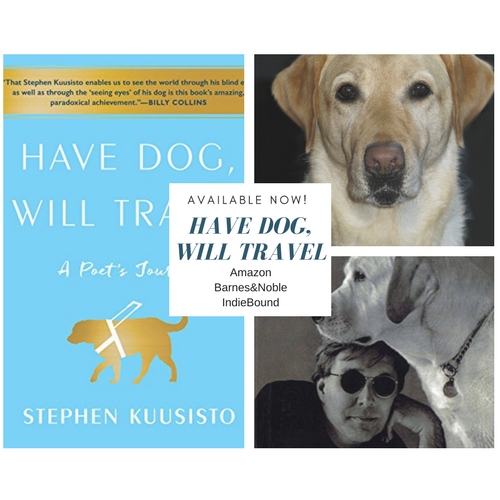
Have Dog, Will Travel by Stephen Kuusisto

(Photo picturing the cover of Stephen Kuusisto’s new memoir “Have Dog, Will Travel” along with his former guide dogs Nira (top) and Corky, bottom.) Bottom photo by Marion Ettlinger 
Wintering

—in memory of Jarkko Laine

Memory loves coffee 

And steam pipes

Banging inside the walls

O what have you.

On Helsinki’s esplanade

We walked 

In matching trench coats—

Two Bogarts with poems

Sticking from our pockets.

Some about sea horses

Some about manners of love

Some about snowstorms burying books.


Stephen Kuusisto and HarleyABOUT: Stephen Kuusisto is the author of the memoirs Have Dog, Will Travel; Planet of the Blind (a New York Times “Notable Book of the Year”); and Eavesdropping: A Memoir of Blindness and Listening and of the poetry collections Only Bread, Only Light and Letters to Borges. A graduate of the Iowa Writer’s Workshop and a Fulbright Scholar, he has taught at the University of Iowa, Hobart and William Smith Colleges, and Ohio State University. He currently teaches at Syracuse University where he holds a University Professorship in Disability Studies. He is a frequent speaker in the US and abroad. His website is StephenKuusisto.com.

Have Dog, Will Travel: A Poet’s Journey is now available:
Amazon
Barnes and Noble
IndieBound.org

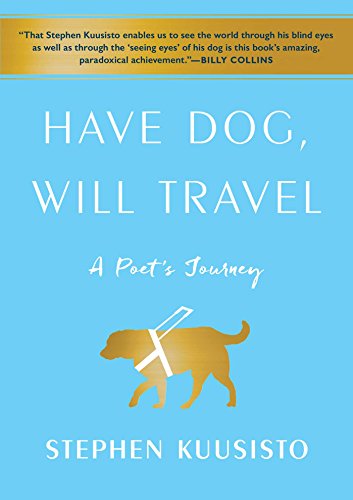
Have Dog, Will Travel by Stephen Kuusisto

(Photo picturing the cover of Stephen Kuusisto’s new memoir “Have Dog, Will Travel” along with his former guide dogs Nira (top) and Corky, bottom.) Bottom photo by Marion Ettlinger 
Disability Today

Like you no doubt I wake and reach for the newspaper. If you’re younger maybe you reach for your Twitter feed but the instinct to see what’s happened overnight beyond the cave is universal. I’m still a newspaper dude though I view them online with screen reading software. Assistive technology keeps me in the game though I don’t really believe in that term since all technology is assistive whether you’ve a disability or not and there shouldn’t be any categorical distinctions.

Reading the news with a computer generated voice is not a good aesthetic experience. Hearing that a woman has just killed her autistic son with a band saw because “she couldn’t take it anymore” is shattering no matter how you encounter the story, but there’s something about the dolorous and impersonal computer that further shivers one–as if my Mac knows something I don’t. As if the Voiceover software invented by Apple to make all their products usable by the blind has been in touch with Hal from 2001 Space Odyssey and together they know disability doom is coming.

Disability doom is a large subject. From pre-natal testing and the abortion of Down syndrome babies to a new militant rightwing hostility to the Americans with Disabilities Act there’s every reason to think there’s a war on the disabled.

As what’s left of Western democratic traditions wilts under corporatized Neo-liberalism and nationalist populism (fascism) the disabled are in the cross hairs. Everyone’s in the crosshairs: high school children, people of color, women, trans and gay people. Fascism, allowed in the mainstream, sees all difference as deviant. Yet there’s something unique about the disabled: they trigger apprehension across all cohorts of diversity. As people literally struggle to survive, it’s easy to imagine the disabled are a burden. They’re a burden at your rally, your business, and yes, on the streets.

Cries come from all directions: we must get the mentally ill back into gated institutions. If we no longer have money to build these facilities we should put them all in prison. Currently the largest mental health faculty in California is the Los Angeles county jail.

Even as I type there’s a concerted movement on Capitol Hill to roll back important parts of the ADA. Even as I type the unemployment rate for the disabled remains at close to 70%. Even as I type veterans with disabilities are being denied services or or made to wait in line for help–a line that grows longer and longer.

As a poet who’s disabled I know a thing or two about irony. When disability is talked about in political circles there’s an assumption that “they” are not “us”–as if disability is something that happens to some other tribe, as if the disabled aren’t your mother, your father, sister, brother, uncles, neighbors, children, children, children. It’s this othering strategy that scares me the most. When the Americans with Disabilities Act was signed into law in 1990 there was a strong bi-partisan sense that the disabled are us. I think there’s an erosion going on. The irony works this way: we celebrate singular disability achievements–Aimee Mullins running on her blades and wearing designer clothing for the cameras; Marlee Matlin’s acting, Stevie Wonder’s music, and yet we think of them as exceptions, even as we imagine they’re representative of a large population. You can’t have it both ways. The disabled are us. Black, white, trans, gay, women, men, oh, wait I’ve already said that.

Right now I’m on a book tour of sorts. When interviewers ask me about my experience growing up pretending I could see more than I really could, asking as though I’m unique in that regard, I say: “this is not an uncommon story” because it’s true, and also to underscore that the singularity of one blind poet shouldn’t be mistaken for an isolating and categorical representation. The disabled I know, both here in the United States and around the world are struggling to stay in the public square.

Stephen Kuusisto and HarleyABOUT: Stephen Kuusisto is the author of the memoirs Have Dog, Will Travel; Planet of the Blind (a New York Times “Notable Book of the Year”); and Eavesdropping: A Memoir of Blindness and Listening and of the poetry collections Only Bread, Only Light and Letters to Borges. A graduate of the Iowa Writer’s Workshop and a Fulbright Scholar, he has taught at the University of Iowa, Hobart and William Smith Colleges, and Ohio State University. He currently teaches at Syracuse University where he holds a University Professorship in Disability Studies. He is a frequent speaker in the US and abroad. His website is StephenKuusisto.com.

Have Dog, Will Travel: A Poet’s Journey is now available for pre-order:
Amazon
Barnes and Noble
IndieBound.org

Have Dog, Will Travel by Stephen Kuusisto

(Photo picturing the cover of Stephen Kuusisto’s new memoir “Have Dog, Will Travel” along with his former guide dogs Nira (top) and Corky, bottom.) Bottom photo by Marion Ettlinger 

The Hive


1.
In the summer of 1965 when I was ten I became enamored of a giant wasp nest. The thing was as large as a basketball, perhaps bigger, and it depended from a birch limb. I was in love with the very fact of the nest and I loved that I couldn’t see it. Blindness meant nothing in the presence of those wasps; I had no hunger to understand them visually. That hive became my Bodhi tree. I was entirely still in its company. If you’re sighted you likely haven’t placed yourself strategically under a wasp hive and held yourself still. Sometimes in a convex schadenfreude mental leap I feel sorry for sighted people. They haven’t heard the zith of fast wasps leaving the house.

I know: wasps have nests, not hives but I knew it was more than a nest. I called it a hive. Adults corrected me when I talked about it. I didn’t care. It was the Taj Mahal. That was my first experience with the art of blind-decision. I’d no use for sighted words. Or if I did, I could pick and choose them. Meanwhile the wasps didn’t care. They were beautiful. They let me sit underneath them. They didn’t sting me.

Yes I see the trouble with this story: unstinging paper wasps and sightlessnesss combine and swap around until they are a mystical alembic. Yes I’m in danger of saying I was a boy-Tiresias, a seer, Orphée des guêpes. But that’s just what I was. I was the maestro of stinging insects. I was stealthy. Mindful. Given to curiosity. Those are facts. At the center of romanticism you’ll find the truth. Crippled romanticism is no different.

2.

The disabled must anticipate objections to their viewpoint in advance. In rhetoric this is called “prolepsis” and its a dynamic of argument. I know you won’t believe me. You shopkeeper I know you don’t want me in your store. You physician, I realize you don’t want cripples I your waiting room. And the Human Resources types—how they can’t stand us with our breathing tubes, crutches, oversized wheelchairs, dogs, assistive technologies, sign language, Braille transcribers—just the sight of us can cause Better Business Bureau types to faint.

Blind I must anticipate expostulations and grievances. One may say that being disabled in a world clinging desperately the fiction of normalcy and good health is much like the act of writing. We must know what contrarian abstract readers will find troubling or inconvenient and find ways to put it over. And one more thing: to get the point across without apology.

3.

Ableism, the experience of it, requires the French adjective écœurante —for disability discrimination is heartless and sickening. I recall the professor of English at the University of Iowa who said blindness would preclude me from being in his “famous” graduate class on Charles Olson. Another prof snickered because I read books on tape. When I protested, the chairman of the English department said I was a whiner. I wept in the Men’s room of the English-Philosophy Building. My path to a Ph.D. in English at the University of Iowa was blocked. This was six years before the ADA was signed into law. Who was I to imagine a place at the table?

If you want to be in the world as a cripple you’ll live in prolepsis, step by step, wheel rotation by rotation, breath by breath.

4.

Sometimes the wasps got drunk on rotten fruit.

Sometimes they carried beetle larvae.

Sometime they sounded like buttons thrown against glass.

Sometimes I fell asleep listening.

Yes, the wasp will build you an inner life.

Yes, they carry yeast back to the spring grapes.

Yes, there’s no wine without them.

Yes, they are wholly misunderstood.

5.

So I must anticipate you, always, whoever you are. “You” a receptor whose thoughts of disability are cinctured with Victorian string.

I see this is imprisonment. I who must think about you thinking about me in the pejorative.

In a meeting at the university where I teach I must raise my hand to say the power point is inaccessible; the texts are inaccessible; the website…

Even as I commence lifting my arm I feel threads of prolepsis growing taut under my skin.

6.

Of course you my reader can’t be the you I anticipate.

Of course the wasps were themselves, aleatoric, driven by winds.

“Label jars, not people,” says the sign on the bulletin board outside my office.

I can’t straighten my citizenship to fit the sidewalk.

I walk in circles and they are altogether warming.

The wasps were to be admired because they did not circle.

7.

Wasps were my very first accommodation.

Stephen Kuusisto and HarleyABOUT: Stephen Kuusisto is the author of the memoirs Have Dog, Will Travel; Planet of the Blind (a New York Times “Notable Book of the Year”); and Eavesdropping: A Memoir of Blindness and Listening and of the poetry collections Only Bread, Only Light and Letters to Borges. A graduate of the Iowa Writer’s Workshop and a Fulbright Scholar, he has taught at the University of Iowa, Hobart and William Smith Colleges, and Ohio State University. He currently teaches at Syracuse University where he holds a University Professorship in Disability Studies. He is a frequent speaker in the US and abroad. His website is StephenKuusisto.com.

Have Dog, Will Travel: A Poet’s Journey is now available for pre-order:
Amazon
Barnes and Noble
IndieBound.org

Have Dog, Will Travel by Stephen Kuusisto

(Photo picturing the cover of Stephen Kuusisto’s new memoir “Have Dog, Will Travel” along with his former guide dogs Nira (top) and Corky, bottom.) Bottom photo by Marion Ettlinger 


Went down to the Piraeus…

Head for the water

If you have questions

Keep the dead in mind

Our railway car

Was filled with babies

Mothers and babies

They all had questions

The conductor—

A Greek version

Of Alfred Hitchcock—

Had questions


When I was a child in Finland

I had an imaginary friend

Who rode beside me

On streetcars

When it was time to get off the train

I’d gently wake him


Even a soul submerged in sleep 

is hard at work and helps 

make something of the world

Donald Trump Dreams of the Titanic….

Seek not the favor of the multitude; it is seldom got by honest and lawful means. But seek the testimony of few; and number not voices, but weigh them.

—Emmanuel Kant

Last night I dreamt I was at the top of a tree. By daylight I can say it was an oak. We embellish the details in dreams. A man dreams he’s a great man because he was on a mountain and like Jesus he spoke to a crowd.

In the morning he forgets the people below him were in Hell and of so course his interpretation loses all value. He walks the world seeking approval from the wrong tribe all the while telling himself he’s favored. The current occupant of the White House is such a man.

Of course I’m presuming Donald Trump has dreams, or at the very least he once had them in childhood. Maybe he has a recurring dream. Perhaps once a week he dreams he’s on the Titanic pushing people out of lifeboats.

Ableism in the Academy, Thoughts on Moliere

Ableism, the experience of it, requires the French adjective écœurante —for disability discrimination is simultaneously heartless and sickening. I recall the professor of English at the University of Iowa who told me my blindness would preclude me from being in his “famous” graduate class on Charles Olson. Another professor snickered when I said I was reading books on tape. When I protested the chairman of the English department said I was a whiner and complainer. I wept alone in the Men’s room. My path forward to a Ph.D. in English at the University of Iowa was stymied. This was a full six years before the ADA was signed into law. Who was I to imagine a place at the agora’s marble stump?

I had an MFA degree from the creative writing program at that same university and I just went ahead and wrote books and sometimes appeared on radio and television and I wrote for big magazines and over time I received tenure at The Ohio State University. Later I went back to teach at Iowa despite my earlier experience and these days I’m at Syracuse. I’m a survivor of sorts. I’m a blind professor. The odds were never in my favor. Somewhere along the way I began thinking of Moliere in my private moments and I laughed because after all, every human occasion is comical and Moliere recognized the comedic types one encounters in closed societies better than anyone before or since.

It doesn’t really matter what institution of higher education you’re at, if you’re disabled you’ll meet the following Moliere-esque figures. The heartless and sickening ye will always have with ye if you trek onto a college campus. You’re more likely to spot them first if you hail from a historically marginalized background however, the ecoeurantists are more prone to blab at you if you’re disabled, especially behind closed doors. Ableists love closed doors. All bigots love closed doors.

The “Tartuffe” is an administrator, usually a dean or provost who will tell you with affected gestures that he, she, they, what have you, cares a great deal about disability and then, despite the fact a disabled person has outlined a genuine problem, never helps out.

The “Harpagon” is also an administrator, but he, she, they, can also be a faculty member. The Harpagon is driven by rhetorics of cheapness. It will cost too much to retrofit this bathroom, classroom, syllabus, website, etc. If the Harpagon is a professor he, she, they, generally drives a nice car.

Statue du Commandeur: a rigid, punctilious, puritanical college president—“this is the way we’ve always done it. If we changed things for you, we’d have to change things for everybody. Yes, it certainly must be hard…” See:

The Geronte: when his son is kidnapped he says: “Que diable allait-il faire dans cette galère?” (What in the deuce did he want to go on that galley for?” In other words, he brought this upon himself. “Really, shouldn’t you try something easier? I could have told you.”

These are the principle types of ableists. I invite you to add your own.

The one thing they have in common besides a privileged and thoroughly unexamined attachment to the idea that education is a race requiring stamina and deprivation, is that they all genuinely believe accommodations are a kind of vanity.


Dogs, Hats, and Faith

As the new year dawns I’m doing my best—that is, I’m drinking coffee. And since I went to bed last night at 9:30 (at the insistence of a small dog who thought it was the right thing when the outside temperature was 5 degrees Fahrenheit) well because of this I’m wide awake sans hangover.

To be fair the dog didn’t make me go to bed. It’s good to distrust people who say dogs make them do anything other than feeding them and taking them outside. I went to bed early because it seemed like a good idea.

I’ve been taking antidepressants for over twenty years. They help me stay “in the game” but they also make me tired at night and that’s just the way it is. By taking Celexa I live on dog time. Early to bed, early to rise. I’m Ben Franklin with pills and dogs.

What are dogs and antidepressants for? I imagine they’re about hope. Even facing the aborning year which cannot be promising, what with the looting of the planet, corporatized warfare, slavish and corrupt politicians of every stripe, human trafficking, the new slavery, which is old slavery tied to offshore banking—I’ll stop in a moment—even with the assault on the poor, the infirm—here I am again tossing my moth eaten chapeau onto a fountain of hope knowing one of my two dogs will retrieve it.

Dogs teach us to put our wet hats on again.

They teach us to avoid rising to the level of our expectations, but fall to the level of our training, as Archilochus would have it and which I’ve always taken to mean “get on with it brother.”

The wet hat has some toothmarks.

Lots of people sneer at hope. It is for one thing akin to faith and nothing gets kicked more often than faith, even the faithful do it.

I agree with Maxine Hong Kingston: “In a time of destruction, create something.”

Dogs say wet hats are better than no hats.

Dogs say you can indeed get there from here.

Dogs say even wearing that hat you’re not as bad as you appear.

Or they say, well, you might be as bad as you appear—so throw your hat again and we’ll bring it back. You can try for a new look.

A hat damp with hope is still a hat.

A damp hat is expectation halved, still wearable.

The hat your dog brings means you have a plan.

A Brief Poem Written at the End of a Bitter Year

What did they think at the edge of the world?

The type of thing written in poems…

One should say, think, where money was useless.

Where the crossbows failed.

The end of another year in a talkative country.

I think of Donald Trump as an “interprandial pooper”—

From Hipponax, one who leaves the table to defecate

So that he may again eat more.

At the edge of the world

Where the poor have only flags of parody….


Thoughts on My Saint’s Day

Life is given humans so we can imagine the eventual posture of our corpses—a paraphrase of Pentti Saarikoski. I’m haunted by my father’s body, its lying face down on the floor of the retirement complex, the face blue from heart failure, hands still clutching the New York Times. The man died with the intent to read. Death was sudden. That is, as they say, about as good as it gets.

Forgive me. My holiday mood is altogether dark, inchoate, tiny fishes of doubt and fear and aversion swim inside me. I don’t seem to be able to help myself. Last night I prayed as I lay down. I asked to be made kinder and stronger. I am aware this isn’t hip.

Strictly speaking I’m not hip. When I was very young I thought the postman was the coolest person alive. Wanting to be like him I walked up and down our rural street ringing doorbells and handing out out old copies of, you guessed it, the New York Times.

I am not sad. The fishes in my bloodstream are too mindful for sadness.

Today is St. Stephen’s Day. The fishes inside him were something.