Notecard: the Best Poetry Reading I’ve Heard in Years….

where-i-come-from

Photo: cover of Jackie Warren-Moore’s collection of poems “Where I Come From”

W. H. Auden famously wrote “poetry makes nothing happen” in his elegy for William Butler Yeats and poets have argued about the assertion ever since. Last night, hearing poet Jackie Warren-Moore read from her new book “Where I Come From” at the Artrage Gallery in Syracuse, New York—the poet reciting to a standing room only crowd of one hundred plus listeners, people who came out on a damp upstate night, who brought entire families, well, I saw how wrong Auden was. Poetry when read aloud by Warren-Moore commands attention, shakes loose the garments of habit, opens the brain, and “lifts” even while her poems are sharp, unsentimental, and hot. I felt lucky to be in that room. Poems were happening. Later I joked to a stranger (for it was that kind of reading—people had bumped along the ceilings of their skulls and then they were bumping into one another, loosened with affections) I joked that Jackie Warren-Moore had given everyone a chiropractic adjustment for the soul.

Jackie Warren-Moore’s reading will be available shortly on the “Talk About Poetry” podcast series which you can visit at iTunes. Or find it at Nine Mile Magazine. You can buy Warren-Moore’s new collection here.

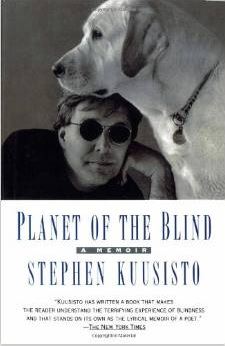
Prologue (from my Forthcoming Memoir “What a Dog Can Do” )

People ask: “what’s it like walking with a dog who’s trained to keep you from harm’s way?” Or they say: “I don’t think I could do that.”

Truthfully it’s like nothing else. There’s no true equivalent for the experience.

My wife is an equestrian. Years ago she was a guide dog trainer. “On a horse,” she says, “you’re hyper vigilant, aiming to avoid accidents by controlling your animal. Sometimes you and your horse will have a meditative rhythm. But you can’t count on horses to look out for you.”

A guide dog is not like a horse. She looks out for you. Always.

I can only offer hints of what a guide dog feels like.

Say you’re in Italy in a swirl of motor bikes.  It’s Milan with thin sidewalks, ugly street crossings and barbaric drivers. Montenapoleone street is crowded with what seems like all the people in the world.

Let’s say you’re walking at night to the Duomo with Guiding Eyes “Corky” #2cc92. Corky does her thing and relishes her job. She pulls and the pull is strong and steady and you feel like you’re floating. Her mind and body transmit through a harness an omni-directional confidence.

Why are you going to the cathedral with a dog? One of your favorite books is Mark Twain’s The Innocents Abroad which contains passages so beautiful you sometimes recite them aloud. Of the Duomo Twain says it has a delusion of frostwork that might vanish with a breath!… The central one of its five great doors is bordered with a bas-relief of birds and fruits and beasts and insects, which have been so ingeniously carved out of the marble that they seem like living creatures– and the figures are so numerous and the design so complex, that one might study it a week without exhausting its interest…

Now it’s just the two of you. You’re determined to touch birds and fruits and beasts and insects carved from marble.

There are skateboarders. Judging by the sound there must be a half dozen of them. Your Labrador eases gracefully to the left.  You hear clattering wheels. You think Milan must be dangerous for skateboarding what with its jagged paving bricks, broken sidewalks, and Vespas like runaway donkeys. Pedestrians surely dance with death every twenty feet. Milan is a fantastic, ghastly place.

In the midst of this your dog is unflappable. Trained to estimate your combined width she looks for advantages in the throng and sometimes she surges because the way is clear or she suddenly slows because an elderly woman has drifted into your path. Occasionally she stops on a dime, refusing to move.

There’s a hole in the pavement. It’s unmarked–there are no pylons or signs. A stranger says it’s remarkable there aren’t a dozen people at the bottom of the thing. Corky has saved you from breaking your neck. She backs away, turns, pushes ahead.

Yes, this is sort of what it’s like but there’s something else too—a deep affection between you, a mutual discernment. Each of you knows you’ve got the other’s back.



In the Raining World

I spoke once to the renowned Finnish poet Pentti Saarikoski by telephone. He was ill, dying in fact and receiving no visitors, but he said: “maybe we will meet one day in this mad world.”

I think of him often. I meet him. Have met him. Yesterday a lonely man, today a teenaged boy walking in rain.

Saarikoski knew his Heraclitus. “Whoever cannot seek the unforeseen sees nothing for the known way is an impasse.”

Rain fate. Let this be our character.

“The most beautiful arrangement is a pile of things poured out at random…”

In this mad world…


The American Smile

The American smile offers a containment: agreeable, ebullient, it imprisons tears; denies they exist.

Years ago, walking in Spain with a friend, who’d grown up under Franco, he said: “there’s nothing to smile about. Laughing from joy is different, it’s experiential. You’ve had a child, you’ve shared a lively song. Smiling is for crooks.”

“In Spain,” he’d said, “we know smiling is just the skeleton peeking through.”

Of course in America smiles are profitable. Very. If this was a defensible essay I’d tell you how much orthodontists make per year.

When my maternal grandmother died I saw my first undertaker’s smile. It was churlish, perfectly smiley–smile-wide, flash of exceptional teeth, then his lips remembered to cover the gravestones, but not before that invidious flex said “you can’t afford the Conquistador, the casket that conquers death.”

Blood Smoke

I am unaccountably sad this morning like a boy who recalls his prior life beside a river but has no words and the memory is without images, it’s nothing more than smoke in his blood.

Sometimes when I stand I feel my dead brother behind my knees. He was my twin.

It’s true: there are mornings when the first word that comes to mind is river.

Sadness is virtue. At least in this life.

Steam rises from coffee.

Water pipes groan Inside the walls of this strange hotel.

Cesar Vallejo, I love you.

Soon I must enter the day, leaving my kindly ghosts here in room 233.

It’s possible to be deeply sad and yet hopeful.

We’ll never know each other. We have no language for blood smoke. None at all.


America

America with your history of eugenics.
With your hostility to the global charter on disability rights.
With your jails, stocked with psychiatric patients—worse than the Soviet Union. We are Gulag Los Angeles; Gulag Rikers Island; Gulag Five Points in Upstate New York.
America with your young Doctor Mengeles.
With your broken VA.
With your war on food stamps and infant nutrition.
With your terror of autism and lack of empathy for those who have it.
Wih your 80% unemployment rate for people with disabilites.
With your pity parties—inspiration porn—Billy was broken until we gave him a puppy.
With your sanctimonious low drivel disguised as empathy.
With your terror of reasonable accommodations.
With your NPR essays about fake disability fraud, which is derision of the poor and elderly.
With your disa-phobia—I wouldn’t want one of them to sit next to me on a bus.
America when will you admit you have a hernia?
When will you admit you’re a lousy driver?
Admit you miss the days of those segregated schools, hospitals, residential facilities—just keep them out of sight.
When will you apologize for your ugly laws?
When will you make Ron Kovic’s book irrelevant?
America, you threatened Allen Ginsberg with lobotomy.
Ameica you medicated a generation of teenagers for bi-polar depression when all they were feeling was old fashioned fear.
When will you protect wheelchairs on airlines?
When will you admit you’re terrified of luck?

–Stephen Kuusisto

The Boy-Man Epidemic

It was simple when I was twenty: appetite wrapped stone, stone was appetite, scissors, you guessed it, appetite. Every man, woman, house plant, thesaurus, phone book—every one of these could be absorbed for the sake of hunger. All boys at 20 are this way. How does one not turn into a predatory creep? The answers are as variable as the social contract, but safe to say one finds a binding, a principle of community, and appetite turns to a deep desire to belong. One can get there through poetry or dance, but also with fair minded business practices, entrepreneurship, any desire to provide services that assist others. Some people refurbish ambulances and sell them at fair prices. Some dedicate themselves to clean water. I do not say only grown men accomplish these things, only that grown men become gracefully “beyond” themselves. I’ve been teaching college courses for over thirty years and I’ve seen “the boys” who won’t make it, who will become embittered when the shine of the fraternity houses fades. And I’ve seen the boys who want to live in the world with something no one can precisely describe but we know it for it’s palpable, and one may call it decency or civics or respect.

This is becoming a sermon. Forgive me. Don’t stop reading. I’ve a quick story to tell. It’s deeply personal. It concerns my family. My maternal grandfather didn’t care if people lived or died. He simply loved machines and explosives. Really, one may think of him as an anarchistic tinkerer who loved dynamite. He bought run down farms all over the state of New Hampshire solely to indulge his dynamite habit as he loved to blow things up. By things I mean telegraph poles, large boulders, houses, fences. He enjoyed TNT the way regular people like to work in their gardens. The man didn’t give a shit about people.

He was an American “type” who really did say to his 11 year old daughter (my mother) “shoot first and ask questions later” when he left her alone on the farm for three days. He was an American “type” who stirred dynamite into the drink of a game warden who chanced to visit. He was the “type” who sat on a flaming sofa with a pitcher of water beside his feet because eventually he’d have to put it out, but he was enjoying his cigar. He had a special kind of “screw you” and he never relinquished it. He was, in short, an American boy for whom personal growth never materialized. Unlike many boy-men he didn’t become a serial divorcer. He stuck with his family and destroyed everyone.

The Jungian psychoanalyst Marie-Louise Von Franz wrote a compelling book about men who have big bodies but remain children. Such men are often the life of the party, charming, at least at first. Then they tire of you (insert “children”; “wives”; “girl friends”;  “friends”) and jump ship (insert “leave home”; “skip town”) and find a new circle to hoodwink. While I know of no studies linking these “flying boys” (Von Franz’s term) with sexual assault, it’s a good bet that groping, rape, violence, and child abuse are all parts of their arsenal.

So I’m in mind of these matters during this election season. In mind of boys who remain boys, embittered, predatory, loud, overtly talkative. In mind of our contemporary fascination with public relations and self-branding, which are deeply tied to the “boy-man complex” (insert Billy Bush). I believe every journalist in America who covers local, state, or national politics or business, or sports, or yes, higher education, will read Von Franz’s book about the devastating consequences of the boy-man epidemic.


Humility, Dogness, and the Horizontal Hula

“What does being a better person actually mean?” I thought.  Did I believe “better” was something spiritual? Probably. After just two weeks training with Corky I was thinking about humility. If you’ve spent much of your life feeling shame you don’t have room for a modest view of your own importance. That would of course be a step up from all encompassing misery. In my case I’d even had some contempt for humility—I’d made fun of St. Augustine when I was forced to read his Confessions in college. Augustine’s humility was out of control. He regretted stealing pears! If that was the gateway to meekness who needed it?

I needed it. Shame had been my ego, a necklace of depressions and self-enforced isolations. The disabled learn to wear this. Or some do. My lot had been whatever wasn’t self aware but angry, wounded; or desperate for acceptance which I started seeing as an extravagance. There’s not an ounce of modesty in anger or embarrassment. They offer a fight or flee world of tears and shouting.

Walking around Guiding Eyes with jangling Corky by my side I wondered if humility might also be nobility; if I might climb above my boyishness, my inheritance of sadnesses, with something like self-effacement and thankfulness. It wasn’t a question of healing myself or of “giving away” my disappointments, but wanting to find ways to think of myself less. This is one of the things a dog can do. I saw it.

That dog lay on her back with all four feet in the air and did a horizontal dance, a kind of hula and I saw it was unwise to be too sure of my own wisdom.

Disability could afford a potent life. One could be graceful. That was something new for me. Something new.


Of Kipling and Superman

When I was approximately 9 years old, though maybe 10, I fell in love with Rudyard Kipling’s “Jungle Book” and couldn’t put it down. That’s a figure of course especially since I “read” Kipling by way of long playing records from the Library for the Blind—big scratchy slow disks that required a bulky oversized government issue record player, but let’s say I couldn’t put the book down.

I loved so many things about the “Jungle Book” I can still call them to mind. Kipling praised curiosity, a thing all children need to hear.

“It is the hardest thing in the world to frighten a mongoose, because he is eaten up from nose to tail with curiosity. The motto of all the mongoose family is “Run and find out,” and Rikki-tikki was a true mongoose.”

And I loved Kipling’s recondite, arcane Victorian prose:

“Now Rann the Kite brings home the night That Mang the Bat sets free— The herds are shut in byre and hut For loosed till dawn are we. This is the hour of pride and power, Talon and tush and claw. Oh, hear the call!—Good hunting all That keep the Jungle Law!”

I marched around reciting those lines in my Superman costume.

Little Superman knew nothing of colonialism. He liked animals, magic, and abstruse lingo. He liked a thick alternate reality to days of being bullied in the schoolyard. Who wouldn’t’ want to live with real wolves like Mowgli?

By the age of 10 I knew I’d never be bored. Books. Fantasies. Living nose to tail with curiosity.

Oh don’t give up on curiosity. Please. I love you, you stranger, don’t let them take this precious gift from you.

Read some Kipling. Kipling:

“No price is too high to pay for the privilege of owning yourself.”