It’s difficult to give thanks in America when we’ve decided bravery is simply a matter of bullying and bigotry. When we’ve forgotten courage was once a defense of the weak and that sustaining human…
Source: On Giving Thanks Just Now
It’s difficult to give thanks in America when we’ve decided bravery is simply a matter of bullying and bigotry. When we’ve forgotten courage was once a defense of the weak and that sustaining human…
Source: On Giving Thanks Just Now
It’s difficult to give thanks in America when we’ve decided bravery is simply a matter of bullying and bigotry. When we’ve forgotten courage was once a defense of the weak and that sustaining humanitarian values was what we imagined we stood for. At least that’s what we said. At least we used to say it. Maybe we only said it between 1932 and 1945. And maybe even then we didn’t mean it. Ask Japanese-Americans. Ask the Jews of Europe. Ask the men who were experimented upon at Tuskegee. Today you might ask the brave men and women fighting the Dakota Standing Rock pipeline. What values does America defend? One is tempted to say, “thanks are so old school.”
I’m giving thanks for our literary culture and it’s unafraid practitioners—those who dare say the Emperor has no clothes, who still believe our souls can clap their hands. From Chris Abani to Carolyn Forche; W.S. Merwin to Ethelbert Miller; Alberto Rios to Sam Hamill—oh it’s a long list…Rita Dove to Dorothy Allison; Marvin Bell to Natalie Diaz; Mark Doty to Gregory Pardlo—the list is vital, enduring, sweet and sour, filled with ichor and iodine, our tough minded American writers who believe still in Walt Whitman, Allen Ginsberg, Gwendolyn Brooks, John Dewey.
I think the coming years will be painful, arduous, and mean spirited. When, last week, Newt Gingrich floated the idea of a new House Un-American Activities Committee, one could only imagine the plan was already “off the work bench” as Newt never has an original idea and “The Donald” hates contrarianism, free speech, the press, academics, and science. I’ve seen several posts on Facebook quoting Bertolt Brecht’s famous lines:
In the dark times
Will there also be singing?
Yes, there will also be singing.
About the dark times.
Against this, or alongside, one may add Churchill’s axiom: “Success is not final, failure is not fatal: it is the courage to continue that counts.”
I’m giving thanks for the continuation, the fights to come, the ardor that is poetry and literature, the rising notes and the silences just before them when we imagine impeccably how the song will go.
When I was very small I didn’t know that I’d meet people who wouldn’t like me until one day, climbing stairs with my father, my hand in his, we met an elderly Swedish woman who lived just below us and who said, “Tsk, Tsk” because I was blind. I was only four and it was winter in Helsinki, Finland. This was a foundational moment for me as such moments are for all sentient beings, its the very second we sense we’re not who we’ve met in the mirror, or having no mirror, we’re not exactly who our parents say we are. Cruelty is one way we arrive. It comes without warning like branches tapping a window. “She’s a fool,” my father said as if that solved the riddle of human embarrassment.
If you teach at the post-secondary level and care about soul (not all teaching concerns itself overtly with soulful things, nor should this be the case per se) you’re likely a stair climbing contrarian, the kind of professor who knows the Swedish dowagers both of history and the ones living next door. Knowing we’re incontestably faced with deviant personalities, people who, according to private or political history, have been rendered un-civic-minded is central to narrative literature and when properly encountered this can strengthen the ironies of compassion. I swear, as a boy I felt sorry for my grey Swedish matron. She’s still (for me) the image of absolute loneliness. The reach of dramatic irony is broad in poetry and fiction and while it’s not my intention to sound new age-y the human soul needs all the nutrients it can get. Who hurt the old Swedish woman who lived downstairs? Was it her White Russian husband who beat her and her children and then died in middle age having drunk away her dowry?
No one should have the power to steal our compassion. Books alone won’t prevent the theft but they’re the perfect anodyne for thin skinned covetousness and envy, the two conditions most prevalent in hyper-consumerist, post-industrial economies. No one’s reading John Bunyan these days but he’s worth quoting: “You have not lived today until you have done something for someone who can never repay you.” Compassion is a muscle. It’s flexible when used. Employing it we enter wider circles.
In the Age of Trump we’ll need help with compassionate climbing. I do not single out students any more than faculty or administrators—all people of conscience are rightly confused by the wide and unrelenting brutishness we’re now seeing.
Love and compassion are necessities, not luxuries, as the Dalai Lama has often said. Our survival both as individuals and communities will now depend on understanding this. Again, echoing the Dalai Lama, compassion is the radicalism of our time. It’s a radicalism that can be practiced daily. It’s also the hardest thing to put into action. “You must not hate those who do wrong or harmful things; but with compassion, you must do what you can to stop them — for they are harming themselves, as well as those who suffer from their actions.” (Dalai Lama)
Over the past few days I’ve been putting together a literary reading list for our present moment. I’ve been culling books that highlight the radicalism of what, for lack of a better term I’m calling compassionate irony. These poets, non-fictionists and fiction writers are assembled here in no discernible order—their work has come to me as I’ve walked in the public square. The public square is a steeper place now. I believe the following books are now necessities:
Viet Thanh Nguyen: The Sympathizer
James Lecesne: Absolute Brightness
Toni Morrison: Sula
Anne Finger: Elegy for a Disease
Gail Godwin: Father Melancholy’s Daughter
Colson Whitehead: The Underground Railroad
Adrienne Rich: An Atlas for the Difficult World
Jacqueline Woodson: Another Brooklyn
Kurt Vonnegut Jr: Slaughterhouse Five or The Children’s Crusade
Kwame Alexander: The Crossover
James Baldwin: Giovanni’s Room
Dorothy Allison: One or Two Things I Know for Sure
Ralph Ellison: Invisible Man
Saul Bellow: The Adventures of Augie March
Azar Nafisi: Reading Lolita in Tehran
Naguib Mahfouz: The Cairo Trilogy
Sam Hamill: Habitations
Walt Whitman: Leaves of Grass
Pema Chodron: The Places That Scare You
Kenneth Rexroth: Collected Poems
Deborah Tall: A Family of Strangers
Kwame Dawes: Duppy Conqueror: New and Selected Poems
Mark Doty: Fire to Fire
Wang Ping: The Last Communist Virgin
Robert Bly: My Sentence Was a Thousand Years of Joy
Pablo Neruda: Selected Poems
Bernard Malamud: The Stories of Bernard Malamud
Anita Desai: Clear Light of Day
John Banville: The Sea
Thomas Hardy: The Mayor of Casterbridge
John Irving: The Cider House Rules
Richard Yates: A Good School
Carl Jung: Memories, Dreams, Reflections
Paule Marshall: The Fisher King
W. H. Auden: Collected Poems
Evelyn Waugh: Brideshead Revisited
Chimamanda Ngozi Adichie: Americanah
Salman Rushdie: Midnight’s Children
Naoki Higashida: The Reason I Jump
W. B. Yeats: Collected Poems
Per Petterson: Out Stealing Horses
Magda Szabo: The Door
Tove Jansson: The Summer Book
Majgull Axelsson: April Witch
Jean-Dominique Bauby: The Diving Bell and the Butterfly
Bruno Schulz: Sanitarium Under the Sign of the Hourglass
Jerzy Ficowski: Waiting for the Dog to Sleep
Gyula Krudy: Sunflower
Chris Abani: The Secret History of Las Vegas
Binyavanga Wainaina: How to Write About Africa
Joan Didion: The Year of Magical Thinking
Carlos Fuentes: The Death of Artemio Cruz
Mo Yan: Life and Death are Wearing Me Out
The list above is my start—a syllabus of the compassionate climb. You’ll notice I’ve left Kafka off but include Bruno Schultz. Left off Camus but included Carl Jung. One prefers the early Rushdie and Thomas Hardy before he elevated his wife to sainthood. Compassion resists Aristotelian templates—it doesn’t like being talked about. Like a milk snake it shines in its own way. Compassion is more than fellow feeling or empathy—it is mercy. All the books listed here are merciful. Please, start your own lists. Share them. The literatures of compassion are necessarily shared in a university without walls.
Baltic sun, early winter, silly pastime, drinking coffee beside a Viking mound, putting thoughts in a notebook, as if my life had salubrious virtues, as if something of “me” might be original, that conceit of the young though I was easily 25 and had read enough to know my vanity—but keep in the present, pouring from a Thermos, bundled against the cold, and a stone moves, granite changes position, just an inch.
I am writing just now from the JetBlue terminal at JFK airport in New York. The woman seated to my right has a big bag of Cheetos which she’s crinkling and this alone would not be entirely disturbing but she also has an evident head cold and she’s snuffling almost in rhythm with her cellophane foraging. This alone would not be entirely disturbing but she also has an odor of cucumber. And she’s chewing. These varieties of experience would, taken together not be entirely disturbing but she’s also talking on her cellphone and hiccuping.
She’s a happy innocent. I herald her. I’m not quite ready to celebrate her “scene” in the manner of Walt Whitman but I’m all for her. She’s just getting on with it.
The two men to my left are very quiet. They’re getting on with it too. When they deign to speak with each other they whisper. They may be philosophers.
They can’t be poets. Poets never whisper.
JetBlue just paged a man named Richard Bigger. They don’t know someone is having them on.
I had a classmate in college whose last name was Dickoff.
Once, on a flight to Reykjavik the cabin attendant called for a Mr. Magnus Krapper to identify himself by pressing the button above his seat.
We’re all just getting on with it.
No one gets a free cookie in the work camp called America. You kids get back to work. Get on your scabby knees and scrub the jetsam.
Last night two cabs in Brooklyn refused to give me a ride. No to the guide dog. No to the man.
The man was told, despite the ardor evident in his heart, and perhaps observable on his smiling face to get back on his scabby knees.
No taxi. No cookie. Same old.
I never get used to it.
This came after a beautiful poetry reading honoring the late poet Deborah Tall at Bookcourt, a lovely indie bookshop. We had a good turnout and wonderful readers and wisdom and lyrical intelligence were all about us. About. We were about together honoring a poet who passed away young and who’s posthumously published final book is now out.
I said to someone, “well they can’t take our souls” in reference to Trump. Later I had to say it about the taxi men. You can’t have my big plush heart you bastards. And I’m terribly sorry no one gave you a free cookie. I haven’t gotten mine either.
Meanwhile I almost got run over yesterday while walking down Sixth Avenue when a bicycle messenger ran a red light and almost struck me, save that my guide dog made a quick maneuver and saved us both.
Meanwhile strangers, pedestrians, witnesses jeered the bicyclist who fell of his damned bike and was scrambling to get to his feet.
Meanwhile I thought he’s just another guy who didn’t get his cookie. I couldn’t be angry. I was alive. He was alive. We went our separate ways.
Meanwhile I like this recipe for the free cookie:
I part Walt Whitman’s breakfast (whatever he was having)
2 parts reexamined opinion (almost anything by Naomi Wolf)
3 generous doses of George Orwell’s “Animal Farm” and—
3 equally generous doses of Susan Sontag
Garnish with Christopher Hitchens “Notes to a Young Contrarian”
You can tinker with this recipe. It will accept many ingredients but the caveat is that the input, the human sine qua non must represent ardor and a history of assisting others. So, for instance, Ayn Rand doesn’t quality. No also to Norman Podhoretz.
You can put in Hilda Doolittle or Roberto Clemente if you like.
And of course we’re talking about spirits, so it’s up to you how you’re going to get this into cookies.
See? I’ve nearly forgotten being almost killed and then denied my rights.
The fence falls down, the boy needs new shoes, an owl has taken up residence in the apple tree and five clouds resembling horses crossed the moon last night—local magic is still safe in our district. I say it under my breath while walking my dog—local magic comes home with me tonight.
Do you remember those tiny mummified insects from Egypt? Beetles wrapped in linen with miniature hand carved sarcophagi? Everything will have its magic honored when they believe in living stars.
I want the newly elected American President to have that “new car smell.” Alas, DJT has this odor of antimacassar and freshly peeled snakeskin. There isn’t enough Vicks “Vapo-rub” to cover it. Even a third rate used car comes standard with a urinal cake Christmas tree ornament hanging from the rearview mirror to hide the stink of teen sex and beer. I think the GOP should give out miniature mega-theric squirting bouquets.
It remains to be fully seen what they’ll be giving out. My sister who’s gay and her partner who’s Jewish fear they’ll have to wear pink stars in Trump’s vast used car lot and their fear is considerable. Everyone knows what hatred permits if they’ve been brutalized consistently throughout life. Some fears are intelligent. Pink stars may not be the order of the day in a Trump administration but upending gay rights—you can smell it. It’s what’s on the wind. Deporting people. Yup. Smells like bully boy testosterone.
The smell I’m mostly picking up is familiar in the midwest—blood and feathers. The whole world can smell it. It used to be a localized stink—Iowa, Ukraine, Guangdong, but now, it’s spindrift over Washington. We’ll need a mini-bouquet for each nostril. And for those who care enough, we’ll need them for our pets.
Meantime I’m still trying to describe the odor of Trump. I think it’s got something of the sweat of Andrew Jackson, who in turn carried in his skin the stink of Rome. It’s the stink of Jackson’s deathbed.
“Despite a legacy consisting of enough violence and death for twenty men, Jackson admitted to having two regrets on his deathbed: “I didn’t shoot Henry Clay and I didn’t murder John C. Calhoun.” In a life rich with murdering people for little-to-no reason, Jackson’s only regret was that he didn’t kill quite enough people. People like Calhoun, who, it should be noted, was Jackson’s vice president. No one is safe from Jackson’s wrath.”
― Daniel O’Brien, How to Fight Presidents: Defending Yourself Against the Badasses Who Ran This Country
The Jungian psychoanalyst Marie-Louise Von Franz wrote a compelling book about men who have big bodies but remain children. Such men are often the life of the party, charming, at least at first. Then they tire of you (insert “children”; “wives”; “girl friends”; “friends”) and jump ship (insert “leave home”; “skip town”) and find a new circle to hoodwink. While I know of no studies linking these “flying boys” (Von Franz’s term) with sexual assault, it’s a good bet that groping, rape, violence, and child abuse are all parts of their embodied politic.
So I’m in mind of these matters post election, 2016. In mind of boys who stay boys, embittered, predatory, loud, bullying. In mind of America’s contemporary addiction to public relations and self-branding, both of which are deeply tied to the “boy-man complex.” Every journalist or public intellectual in America who covers local, state, or national politics, human rights or business, or sports, or yes, higher education, should read Von Franz’s book about the terrifying reality and devastating consequences of the boy-man epidemic.
Anais Niin once said: “I hate men who are afraid of women’s strength.” Without knowing it she was referring to flying boys. At the risk of sounding like Robert Bly, true men are aware of their failings and capable of bravely addressing them. For my money, what little I may have, what’s so disturbing about Trumpism is it’s fealty to collective, loud, masculine weakness. Bigotry and bullying belong to the ten year old boy or the “mean girls” who emulate them.
So what does blogging mean in the age of Trump? Say you’re a human rights activist and modestly recognized public figure, a poet, someone who believes in the American intellectual tradition of John Dewey and Doris Lessing. The morning after Trump’s victory I thought of these lines from Lessing’s Golden Notebook:
“Ideally, what should be said to every child, repeatedly, throughout his or her school life is something like this: ‘You are in the process of being indoctrinated. We have not yet evolved a system of education that is not a system of indoctrination. We are sorry, but it is the best we can do. What you are being taught here is an amalgam of current prejudice and the choices of this particular culture. The slightest look at history will show how impermanent these must be. You are being taught by people who have been able to accommodate themselves to a regime of thought laid down by their predecessors. It is a self-perpetuating system. Those of you who are more robust and individual than others will be encouraged to leave and find ways of educating yourself — educating your own judgements. Those that stay must remember, always, and all the time, that they are being moulded and patterned to fit into the narrow and particular needs of this particular society.”
What does blogging mean now? To stay more robust and individual and when you’re encouraged to leave, do so in the quest of your own best education rather than adhering obediently to the narrow and particular needs of dominant culture. Trumpists believe this is what they’ve done, that they’ve bravely taken on fictional “elites” but they’ve merely leaned into the spit of baby boy adolescence. Spit is the language of resentments and playground canards.
Gloria Steinem (who is not without her flaws as I am not without my own) said: “Any woman who chooses to behave like a full human being should be warned that the armies of the status quo will treat her as something of a dirty joke . . . She will need her sisterhood.”
Sisterhood yes. And grown men. More of Steinem: “Women may be the one group that grows more radical with age.” Is it too much to expect our nation’s boys to grow into individuated free thinking men? No.
I will continue to blog in the service of this very idea.
Who are the great poets of coffee? Everyone knows William Carlos Williams was the poet of plums, Keats the poet of urns. Elizabeth Bishop, fish; Robert Bly had snowy fields; Ginsberg had cocks and balls; Emily Dickinson had the soul.
There’s Ron Padgett’s prose poem “The Morning Coffee” which is pretty good, though it’s not about coffee at all—you’ll have to read it, no spoiler here.
There’s the old nursery rhyme:
Molly, my sister and I fell out,
And what do you think it was all about?
She loved coffee and I loved tea,
And that was the reason we couldn’t agree.
Now there are plenty of poems that feature coffee and we’ll have a look—but there are no poems of coffee, the hot tropic wind of coffee’s phenomenology—in poem after poem, all written by excellent poets, coffee is a minor thing, lacking salience, like pillows on a couch. I do not dislike these poems. I’ll trade coffee for a pillow most of the time. Here are some of my favorite “almost coffee” poems:
“The Fight”
—Russell Edson
A man is fighting with a cup of coffee.
The rules: he must not
break the cup nor spill its coffee; nor must the cup break the
man’s bones or spill his blood.
The man said, oh the hell with it, as he swept the cup to
the floor.
The cup did not break but its coffee poured out
of its open self.
The cup cried, don’t hurt me, please don’t hurt me; I am
without mobility, I have no defense save my utility; use
me to hold your coffee.
**
“Recipe for Happiness Khaborovsk or Anyplace”
—Lawrence Ferlinghetti
One grand boulevard with trees
with one grand cafe in sun
with strong black coffee in very small cups.
One not necessarily very beautiful
man or woman who loves you.
One fine day.
**
“How Did You Meet Your Wife?”
—Richard Jones
Swimming the English Channel,
struggling to make it to Calais,
I swam into Laura halfway across.
My body oiled for warmth,
black rubber cap on my head,
eyes hidden behind goggles,
I was exhausted, ready to drown,
when I saw her coming toward me,
bobbing up and down between waves,
effortlessly doing a breaststroke,
heading for Dover.
Treading water
I asked in French if she spoke English,
and she said, “Yes, I’m an American.”
I said, “Hey, me too,” then asked her out for coffee.
**
Coffee is a stage prop in poetry—Wallace Stevens—“Coffee and oranges in a sunny chair…”
Gary Snyder: “There are those who love to get dirty and fix things./They drink coffee at dawn, beer after work./And those who stay clean, just appreciate things./At breakfast they have milk and juice at night./There are those who do both, they drink tea.”
Some poets get closer to coffee’s fizz in the nervous system. Neruda:
Take it all back. Life is boring, except for flowers, sunshine, your perfect legs. A glass of cold water when you are really thirsty. The way bodies fit together. Fresh and young and sweet. Coffee in the morning. These are just moments. I struggle with the in-betweens. I just want to never stop loving like there is nothing else to do, because what else is there to do?
**
The coffee plays in my coarse hair.
When it gets to my tongue it takes the rust off old family stories.
Regarding the premise of life, coffee entered me.
I breathed its steam; wrote with my finger when it found a window.
Coffee: a stop in midair.
—these are my lines, just off the top of my head, be-coffeed, quick, still trying to reach the world….
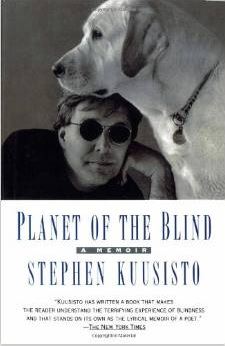


 Planet of the Blind