Hafez Comes to Mind

A tenderness sweeps past, aiming for someone,

By God I feel the air. I open my shirt—

Blind man on University Avenue

Baring his chest—

Hafez comes to mind:

Why not become the one

Who lives with a full moon in each eye

That is always saying,

With that sweet moon 

Language

What every other eye in this world

Is dying to 

Hear?

**

The eyes hear plenty.

But still, you have to close them now and then

And trust the air.

If Blindness is Your Game

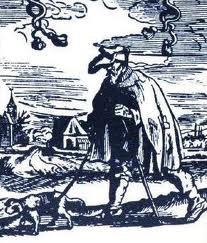
Image: blind man and dog, 17th century woodcut.

No one gets a free pass to success in the Unites States, though we believe everyone is born equal. This is a conundrum for the blind who are unemployed at a rate estimated to be between 60 to 80 per cent.
Equality, if you have a disability, means better social contracts between the governed and the government. Good governance is the key.

Here at Planet of the Blind we (my dog and I) applaud Senator Michael Bennett (D-CO) for co-sponsoring the Transitioning to Integrated and Meaningful Employment (TIME) Act (S. 2001. As the National Federation of the Blind notes on their website:

“The National Federation of the Blind applauds Senator Michael Bennett (D-CO) for cosponsoring the Transitioning to Integrated and Meaningful Employment (TIME) Act (S. 2001). Senator Kelly Ayotte (R-NH) introduced this legislation to repeal Section 14(c) of the Fair Labor Standards Act, in order to incentivize the transitioning of workers with disabilities into integrated, meaningful employment, and to phase out the discriminatory practice of paying workers with disabilities as little as pennies per hour. Senator Bennett is the first cosponsor of Senator Ayotte’s legislation. Companion legislation has also been introduced in the House of Representatives by Representative Gregg Harper (R-MS) as H.R. 188 and has forty-four cosponsors.”

Twenty years ago while I was working for a major guide dog school I visited a “sheltered workshop” for the blind in a major American city.
I was shocked by the tin roof warehouse without windows where blind people hunched over sewing machines stitching flag decals for army uniforms. The working conditions were positively Dickensian. The manager of the operation was pleased as punch. The blind had jobs. The blind were laboring in the dark. The blind were making pennies on the dollar.

I asked Mr. Gradgrind (for so I thought of him) “Where do your workers live?” knowing full well they couldn’t afford apartments on their wages.
“Oh,” he said, “you know, all over.”

Let us hope these conditions are now all over.

In Defense of Good Writing, and Maybe, Just Maybe of Christopher Hitchens

It’s hard to know what’s more objectionable about Richard Seymour’s philippic “Un-Hitched” concerning the late writer Christopher Hitchens, his style or his opinions. The former is employed to disguise  threadbare analysis, the latter are subventions of liberal dogmas. Throw in some Freudian kicks to the ribs and you’ve got the tenor of the book.

Reading Seymour’s torquere prose I was put in mind of Pascal’s observation: “When we come across a natural style, we are surprised and delighted; for we expected an author, and we find a man.” Seymour is surely an author, and like all wrenched stylists, manages to be fatuous where nuance is required, and urgent where irony is called for. (If your subject is Christopher Hitchens and you sally forth without subtlety or wit, you’re cooked.) Consider the following, alas, the opening paragraph of Seymour’s chapter on Hitchens’ Englishness:

“Precisely what it was about Mrs Thatcher’s femininity that attracted Hitchens is not entirely clear from his multiple accounts of the concupiscence. His hyperventilating eulogies to the adamantine leader of British reaction usually took as their point of departure a brief encounter between the pair which resulted in his being lightly spanked with ‘a rolled-up parliamentary order paper’ and adjudged a ‘naughty boy’. He had written of the romantic poet Byron that he was ‘intimately aware of the relationship between sex and cruelty’. It is fair to say that Hitchens was too, as the sadism–masochism couplet frequently made an appearance in his writing. And if he wrote of sado-masochism primarily as a relation between ruler and ruled to be deplored and resisted, it clearly also had its temptations.”

Or consider this, again lines opening a chapter on Hitchens’ atheism:

“There usually comes a time when a child begins to notice the inconsistencies and absurdities in the silly stories that grown-ups tell them in order to get them to behave. Christopher Hitchens was nine – a little late, if I may say so. His teacher one day exclaimed how wonderful it was that God had made the trees and grass green so that they would be pleasant to the eye, and he simply knew that the teacher had it wrong: ‘The eyes were adjusted to nature, and not the other way about.’1 After this he began ‘to notice other oddities’ such as, if Jesus could heal a blind person, why not heal blindness? Why were prayers not answered? Why was sex so toxic a subject?

Such ‘faltering and childish objections’, as Hitchens called them, are not disgraceful in a child.2 Yet what is surprising is how frequently demotic reasoning of this type returns in Hitchens’s writing on religion. It may be objected that this is because, in his words, ‘no religion can meet them with any satisfactory answer.’ But this is far from true, as I will demonstrate. At any rate, it is hardly a good reason to persist with such humdrum observations. Just as curious is the literal-minded John Bullishness with which the author approached his subject and above all his careless errors and ham-fisted generalisations. By Hitchens’s own standards, this combination – obviousness, literalism, and bullshit – constitutes a triple-crown howler. To this extent the author was a poor atheist. He made secularism seem uninteresting and materialism incondite. Worse, at key moments chauvinism, paranoid alarums for civilisational warfare, and downright racism took hold of his onslaught against religion.”


If clean, supported arguments are what you’re after you won’t find them in Seymour’s concatenation of barbarous, ad hominem attacks. That Hitchens strayed from his orthodox schoolboy’s Marxism to embrace what Seymour calls “Jeffersonian Imperialism” following the Al Qaeda attacks against the US on Sept. 11, 2001, calls for analysis, but besotted by a style at once moist and turgid (an accomplishment of a kind) Seymour proves inept, callow, and rabidly phlegmatic. Accordingly one would scarcely know that the struggle of public intellectuals, to the extent they are sincere (and no one can reasonably fault Hitchens’ sincerity) is to locate reasoned liminal spaces outside the reflexive dogmas of ideology. Both the left and right have been adept at consolidating and husbanding rhetorical and critical deconstructions. Neither has managed to build much. Hitchens thought Enlightenment values worth fighting for.

The only thing we know for sure reading Seymour’s “Un-Hitched” is that inflated prose can still sell a book if you have the right friends, a variant perhaps of Gore Vidal’s famous assertion: “politics is knowing who’s paying for your lunch.”


Perhaps They Need to Read More at the New York Times?

There’s a dialogue in the most recent Sunday New York Times Book Review entitled “Whatever Happened to the Novel of Ideas?”  which, by its very title, inveigles readers to believe, even before setting out on the stertorous voyage, that good old smarty pants novels have been abducted, or killed off. The headline reminds me of Life magazine’s famous hatchet job on Jackson Pollock: “Is This the Greatest Living American Painter?”—block letters inviting the credulous to skip incredulity (how can a dripper make art?) and jump straight to offense. “Once there, we’ve got them!”

Per the assignment, writers Pankaj Mishra and Benjamin Moser both explain how the suffocation occurred. Mishra gathers the usual suspects—American prosperity following WW II, the middlebrow culture’s precipitous decline, and a contemporary American penchant for living suspended between fear and reaction, what Daniel Golman might call “neurological hijacking”.

Moser suggests that the genre may not exist at all (elegance while begging the question perhaps) arguing that novels of ideas must be composed from both poetry and philosophy, a demand so entirely impossible one should best give up now. Or to put this another way, real life is implausible and can scarcely be believed when its made to appear real, and worse yet, philosophical ideas expressed by a novel’s characters decline to mere ideological blather.

Missing, of course, is that the novel of ideas still exists and we still read them. Writers write them. Gail Godwin’s work comes to mind. May we mention Martin Amis? How about Ben Okri’s “The Famished Road” or Norman Rush’s “Mating”?  Barbara Kingsolver? Toni Morrison?  Richard Powers? Shirley Hazzard?  William T. Vollman? Chimamanda Ngozi Adichie? Nadine Gordimer?

One can build a long list.

What Mishra and Moser are arguing is hard to reckon. We grant the decline of the novel as a dominant cultural force (a deterioration that properly reflect the novel’s origin as the art form of empire) but I can’t buy their proposition that the “thing” is too difficult to be achieved, or that it’s been killed off by small “w” western prosperity and televised fear. The arguments as they’ve marshaled them are sophomoric and curiously introverted and are not in any sense “reality based” as they say in the vernacular. There are vitalities and ideas aplenty in contemporary fiction.

Pollock was a pretty good painter, too.


Thomas Jefferson and the University of California

In his first inaugural address Thomas Jefferson uttered the most immortal words in American history regarding freedom of expression: “If there be any among us who would wish to dissolve this Union or to change its republican form, let them stand undisturbed as monuments of the safety with which error of opinion may be tolerated, where reason is left free to combat it.”

Error of opinion, unreasoned arguments, all may be safely tolerated in a republic where a prevailing and unshakable faith in freedom may combat it. This was Jefferson’s faith in the common man and one fairly imagines Thomas Paine was our third president’s ghost writer, save that we have Jefferson’s scrip. Tom Paine’s influence is certainly there, and it’s still with us.

“Truth is great” said Jefferson, “and will prevail if left to herself…) (See Bill for Establishing Religious Freedom, Virginia, 1785). Truth, he said, has nothing to fear “from the conflict unless by human interposition disarmed of her natural weapons, free argument and debate, errors ceasing to be dangerous when it is permitted freely to contradict them…”

Recently the State of California proposed the adoption of regulations designed to govern speech on the campuses of its public colleges and universities. Called “principles against intolerance” the measure is being debated this week at a meeting of California’s Board of Regents on the campus of UC Irvine.

According to the LA Times: “The statement would condemn bias, violence and hate speech based on race, ethnicity, religion, citizenship, sex or sexual orientation while also attempting to protect free speech on campuses.”

California’s Regents and academic administrators have clearly lost faith in Jefferson’s faith that free argument and debate will always trump fearful ideas when permitted freely to contradict them.

What’s especially troubling about the LA Times article is the suggestion that student groups are in no small measure leading the fight to silence people they don’t like. Quote:

“Some Jewish groups want UC to formally adopt a U.S. State Department definition of anti-Semitism, which includes the demonization of Israel and denials of that nation’s right to exist.

Those groups say that anti-Israel protests and activism on UC campuses sometimes cross the line into anti-Semitism and create a hostile environment for Jewish students.”

One may fair sympathize with Jewish groups (as I do) but I also support the rights of others to say what they will. “Truth has nothing to fear from conflict, unless by human interposition disarmed of her natural weapons.”

California’s Regents suggest that they will protect free speech on campuses—which is to say, that hateful or unpopular ideas can presumably be the subject of academic inquiry.

In this model, academic inquiry leaves the agora and enters laboratories. (Metaphorically speaking.) Another way to think of this is to imagine that within the sequestered classroom free argument and debate will carry on when it’s been forbidden in the public sphere.

Jefferson understood the public sphere is everywhere. Anything else is essentially a prescription for tyranny.

I have a dog in this hunt. I’m blind, a member as I like to say, of a historically marginalized group.

Throughout my sojourn on this earth I’ve been bullied. In college a rather noxious fellow who lived across the hall from me in our freshman dormitory used to poke me in the chest and call me “blindo”. One day, I went to the local fish market and bought a two foot long dead eel. When my tormentor was taking a shower, I deftly dropped it over the shower curtain. I can still hear his screams. I can still “see” his embarrassment when he bolted naked into the larger room where he was greeted by every student who lived on our floor.

He never called me “blindo” again.

Intolerance is ugly. It’s hurtful. The “N” word and the “R” word; the militant distrust of partisans of every stripe—distrust which becomes malevolent and strident—all of these are to be abjured.

They cannot be abjured by legislation. As Jefferson fully understood.


Of Blindness, Miami University, and its Happy Trolls…

I read this morning about a blind student at Miami University (in Ohio) who has essentially been forced to file a lawsuit against the college for its use of inaccessible course materials. What does it mean if you’re disabled and you’re forced to file a lawsuit? It means the school or business or “entity” has refused to acknowledge it’s in violation of the Americans with Disabilities Act.

Well OK. Any sophomore pre-law student knows this. That administrators at Miami U seem not to understand their obligations is surprising. A cursory online search of the matter should have produced for their middling minions enough information to have assisted them in avoiding bad press and a loser lawsuit.

Two things caught my attention at the bottom of the article. A Miami spokesman is still quoted as saying “we did nothing wrong”—which is rather foolish. Zip it. Zip. Get on with your 21st century obligations, really.

The second thing that grabbed me was a “troll” who wrote: “They have blind colleges, you know.”

I love trolls. Especially ableist ones. “They can go away, you know. They can go back to their asylums, you know. They can return to the attic, you know.” The voice of the ugly laws. “We shouldn’t have to see them, you know.”

The troll in question is perfect. He makes the requisite pro-forma trollish assertion, the necessary one, the one that’s never factual, but which establishes trollish dominance: “There are blind colleges, you know.”

There are no blind colleges.

And the ADA is designed to integrate our public sphere.

Troll drinks milk and iodine and farts a frog.

Troll has never met a blind person.

Troll thinks books and course materials should be reserved for sighted people.

Even Stalin didn’t believe that.

In general, the idea that the blind couldn’t be taught to read went out of fashion in the early 18th century.

Shame on Miami U, not just for a violation of the ADA, but for giving a sub-Cartesian idiot room to clatter around in.


Blind Man’s Staircase, A Lament

Endpoint. Surcease. Equals staircase. Expectation: up or down stairs a goal. Perhaps several. Stairs propose accomplishments. And stairs are blind. Like Tiresias they may know the future.

Unlike him, they’re not talking.

Yesterday I visited the home of people I didn’t know. It was a private affair. A fund raising party for a good cause. The house was modernistic. It had more steps from room to room than any house I’ve ever been in. I said to someone hanging out by the cookies, “this is a blind person’s nightmare…I’ve had dreams like this…where I’m running in a strange house with lots of stairs…and something’s chasing me…”

Stairs are my enemy whether I’m awake or sleeping.

Before I got my first guide dog I fell down a long flight of steeply pitched wooden stairs. I didn’t break anything but for weeks I had a hematoma the size of a basketball on my ass. Couldn’t wear pants. Had to go around in oversized sweats. Limping. Falling down stairs has no merit. Maybe it’s true, stairs propose accomplishments. But they are only a propositional architecture. As a disabled person I have many suspicions about architectures—the untruth of propositions being just one. (There are others—unfairness, cruelty of aesthetics, etc.)

Zen stairs: they are another thing that will never be my friend.

Interview the stairs, they say: “what are we doing coming back here with this pain?”

Climbing the stairs, man and woman, planning to make a child…

Descending stairs, one imperative of art…

The entrenched stairs, where long ago primeval animals stood…

Where suitcases are handed from heart to heart…

Who profits from stairs? Really?


Would You Like Some Enlightenment with Your Coffee, Sir or Madame?

While reading Peter Gay’s Enlightenment, Volume 1 the following passage intrigued me. Gay is referring to his lifelong fascination with Scottish philosopher David Hume, and in turn, the work of Stuart Hampshire:

“I was delighted to read Stuart Hampshire’s brief appraisal of Hume, “Hume’s Place in Philosophy,” in David Hume: A Symposium, 1–10, which accords precisely with my own estimate—an estimate I have arrived at after years of close and affectionate concern with Hume’s work. Hume, writes Hampshire, “defined one consistent, and within its own terms, irrefutable, attitude to politics, to the problems of society, to religion; an attitude which is supremely confident and clear, that of the perfect secular mind, which can accept, and submit itself to, the natural order, the facts of human nature, without anxiety, and therefore without a demand for ultimate solutions, for a guarantee that justice is somehow built into the nature of things. This philosophical attitude, because it is consistent and sincere, has its fitting style: that of irony …” (pp. 9–10). The demands and the possibilities of modern paganism have rarely been stated better than this.”

Excerpt From: Peter Gay. “Enlightenment Volume 1.” iBooks. https://itun.es/us/vuGqN.l

I’m fascinated by this wee passage. Of course the paragraph is a palimpsest, Gay’s admiration for Hume frames everything. If we think in the manner of Linnaeus, Gay is the inciting species. Notice that he’s a delighted scholar! (Are scholars nowadays allowed to express their delight?)

Peter Gay is also an affectionate intellect. Adoration, devotion, and caring are critical to the life of the mind. (Have scholars forgotten this at their peril? One may well think so.)

What does Gay like so much in this passage? He likes an appraisal of Hume. Hume is in the room, but he isn’t speaking. Gay’s delight is doing the talking, and then, voila, he brings forward a paratactic delight—a tandem pleasure, Hampshire’s elegance, which is also in the service of Hume. Hume, who isn’t speaking. Here in a cloister of estimation we see two scholars whose respective lives were devoted to ideas celebrating the nobility of a third. And the third is their father, and ours too.

Notice the use of “attitude”. Talk about nuance! From Latin for “fit” it was originally the proper word for placement, especially of figures in painting. Later it became synonymous with stance. And once it entered the world of ideas it became the template for self-awareness. Attitude is valuable only insofar as it has the manners of irony.

I know of no better description of the contrarian intellectual. No anxiety, just the facts. So let’s say there is no God. Let’s say justice isn’t built into nature. What then? Why we get to build a confident and clear pagan democracy.

The natural order is ours to govern.

We must stand for justice because it is ours to develop and extend.

It is a consistent and sincere style.

David Hume:

“Epicurus’s old questions are still unanswered: Is he (God) willing to prevent evil, but not able? then he is impotent. Is he able, but not willing? then he is malevolent. Is he both able and willing? then whence evil?”

“In our reasonings concerning matter of fact, there are all imaginable degrees of assurance, from the highest certainty to the lowest species of moral evidence. A wise man, therefore, proportions his belief to the evidence.”

**

These thoughts of a morning.

The pleasures of thought, the marvels of freedom.

The Comic Book in Your Eye and Mine, or, Candide? He Dead.

Daily the cartoons. Not Voltaire-ish Candide. Much stupider. (In Voltaire there was something Aristotelian—after all, comedy should hurt, and moreover, you were supposed to know why.)

Now our public square is just one big stoner cartoon fest.

The public square is all boo hoo and snarling.

Candide? He dead.

**

Political cartoons are to democracy what stock is to soup and they’ve always been confrontational. (Comedy is supposed to hurt).

Liberty means never having to say you’re sorry.

People who wish to trade liberty for taste are un-American. Many of these types serve on school boards.

**

Twenty years ago I told a group of students we were now entering the age of holographic cartooning. “Everyone,” I said, “is now a 3D walking representation of something.”

“It works like racism,” I said. “Only now every one is victimized by one gruesome projective cliche after another.”

“What do you mean?” asked a boy-man who always sat in the back of the room.

“Ah,” I said, “You own a deck of serial killer trading cards, am I right?”

(He was surprised I knew.)

He admitted it.

“How did you know?”

“Because your friends talk about you. And this is my point. You are now the serial killer trading card guy. Nowadays everyone becomes a cartoon. End of story.”

“What can be done about it?”

“The only way not to be a cartoon is to ask questions—like—who makes the serial killer cards? Why are they a commodity? What audience are they aimed at? Why would there be an audience for them?”

**

Donald Trump knows that the public likes cartoons, doesn’t care about nuance, asks no questions, and is comfortable living with two dimensional representations of everyone else.

Most politicians have given in to a worldview that’s entirely composed of cartoon pathos.

They portray complex issues as 2D Looneytunes.

Both sides of the aisle do it.

Liberal Dems argue the rich are sucking the brains out of children.

Rightwing Repubs argue that a treaty preventing the Iranians from developing a nuclear weapon is a prologue to almost immediate armageddon.

2D. Looney.

Iran is Wily Coyote. The US is the Road Runner, headed straight for a painted tunnel.

The rich are contemptible because, well, they’re rich.

Meanwhile, the policies that lead to either circumstance are insufficiently examined.

You don’t have to demand much of politicians if you see the world as a shitty cartoon.

You certainly don’t have to demand much of yourself.

**

The serial killer trading card kid flunked the course. He never turned in a paper.

He was having too much fun.


Nixon, Philip K. Dick, Einstein, and the New American Moral Imperative

When I was in college it was sufficient to say you were either against or for the Viet Nam War–you were either a supporter or an opponent of Richard Nixon. Those were simpler times, for even though the Cold War was dangerous, young people in the United States had the luxury to imagine we understood global reality.  It is a good thing we no longer live in that world. I think its good we are confused. Globalization, satellite and digital networks now make it possible to collaborate with people around the world in productive ways. These networks also make it impossible to blink away the effects of imperialism as the war in Syria and the refugee crisis now at hand (and largely of the West’s making) both demonstrate.

But with the disappearance of cultural simplicity comes greater responsibility. Consider this quote from the great sci-fi writer Philip K. Dick:

“Because today we live in a society in which spurious realities are manufactured by the media, by governments, by big corporations, by religious groups, political groups… So I ask, in my writing, What is real? Because unceasingly we are bombarded with pseudo-realities manufactured by very sophisticated people using very sophisticated electronic mechanisms. I do not distrust their motives; I distrust their power. They have a lot of it. And it is an astonishing power: that of creating whole universes, universes of the mind. I ought to know. I do the same thing.”

And here is a quote from Albert Einstein:
“How strange is the lot of us mortals! Each of us is here for a brief sojourn; for what purpose he knows not, though he sometimes thinks he senses it. But without deeper reflection one knows from daily life that one exists for other people — first of all for those upon whose smiles and well-being our own happiness is wholly dependent, and then for the many, unknown to us, to whose destinies we are bound by the ties of sympathy. A hundred times every day I remind myself that my inner and outer life are based on the labors of other men, living and dead, and that I must exert myself in order to give in the same measure as I have received and am still receiving…”

Nixon may or may not have been a good man. We will never know if he’d have been better off with Prozac. We do know he was paranoid and depressed. He derived solace from racism and hyperactive fantasies about the “East coast establishment” who he believed was out to get him. He didn’t think the people of South East Asia were our fully formed brothers and sisters.

What is real? Brothers and sisters. Families. People struggling for dignity and freedom.

They are real.

Donald Trump wants to build a wall between the US and Mexico. Scott Walker wants to build a wall between the US and Canada.

Let’s not see our neighbors. Let’s not visit with them. Let’s not give them humanitarian relief. Let’s not be part of the family of nations. Let’s allow ourselves to be bombarded with pseudo-realities; visions of fear; racialized paranoia.

I believe the United States has a moral imperative to admit refugees and asylum seekers from Afghanistan, Syria, Libya, Tunisia, Darfur, Sudan, Egypt, Iraq, Algeria—please note, I’m just getting started…Mexico, Colombia, Guatemala, Nicaragua…

Einstein again: “A hundred times every day I remind myself that my inner and outer life are based on the labors of other men, living and dead, and that I must exert myself in order to give in the same measure as I have received and am still receiving…”