Prose Poem for Harilyn Rousso

Prose Poem for Harilyn Rousso


When I was a boy there was a small door at the end of our garden. I used to climb it. It didn’t matter I couldn’t see. On warm summer days, possessed of natural intuition, I’d reach the top and swing and World blemishes spun fast. Light was wide and waving my arms, innocent, the road was altogether new. 1959. Sundays. No able bodied children for miles! 

Prose Poem for Bill Peace

Prose Poem for Bill Peace


Most days, as disabled people, we’re screwed…” (author)


Dear Bill—I’m green in my knees, green ribbed. I spent today alone with a dictionary. Sometimes I find words from the age before newsprint. Catabasis, a trip to the underworld…

The Greeks understood: anger increases after death. Odysseus’ mother was the first zombie in literature, hungering for a bowl of blood in the twilight of Hades. I fear the dead are full of sorrows. Meanwhile half the houses hereabouts are crammed with sadness and the strictures of fear. To forgive is not so simple. Dictionary: discourse, utopia, harmonia…Some days words are immanent, warmer than the streets.

What the Dogs Know: A Guide Dog's Primer

Think of a dog’s language. Its ours of course—ball, rope, shoe. But for a dog there’s a proto-sign, a dog sign, rich in smells and motions, and pale colors, quick as the sparrow in grass. I think dogs have words before they meet us. For “grouse” it may be something moist or theatrical for dogs are feeling machines as well as hunters. 


As I bonded with Cork I thought about canine lingo. Boarding her first airplane I wondered what her language was turning out? If dogs have commands they in turn have words, ones we cannot know. Smell would necessarily be a big part of the lexicon. 


US Airways, “Dash 8” aircraft… 


For Corky it carried odors of fish bladders and burnt feathers. The smells of human fear. Every person on that plane was quietly scared. Upright stick figures stared at magazines amid stinks of decaying linen and rotten apples. She lay at my feet and I thought that while dogs don’t have preceptive nouns they have a canine genome—a long, hieratic, true dictionary of olfactory resonance. Their smell language is always truthful.


I would spend the rest of my days thinking about this business of dog truth and visceral language. As we walked together through cities like San Francisco I thought over and over about her stink dictionary and her complicated sidelong vision. I began to understand that when a dog sees something they see it for what it is, not what they believe it is. Smell is their confirmatory and simultaneous truth detector. Human beings merely imagine what they’re seeing, playing facts against a rolodex of memories. Dogs don’t have to do this. Their perceptual and optic language is better than ours. 


You learn this about a dog’s language when a dog regularly saves you. We were in the laboratory of real life. 


In one of his notebooks Leonardo DaVinci wrote: “Man has great power of speech, but the greater part thereof is empty and deceitful. The animals have little, but that little is useful and true; and better is a small and certain thing than a great falsehood.” DaVinci was correct about human speech and deceit, and nearly right about animals having a truer lingo, but as an ophtho-centric Renaissance man he couldn’t have guessed how much language the animals have.  


Confession of a Guide Dog Whisperer

At Guiding Eyes 1996

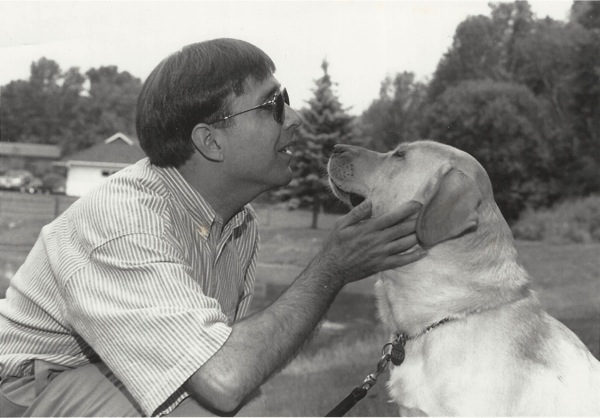
Photo of Stephen Kuusisto with his first guide dog Corky, on the grounds of Guiding Eyes for the Blind, 1995


What else can be said about a dog’s words? They hear them like flights of birds. They hear them as life revealed. A dog doesn’t care about rhetoric. Nor does a dog think of words as habits of affection or disapprobation. For a dog every word is fresh—even those words already contained in their lexicon. When was the last time I thought of a word as new? I had to ask myself. I couldn’t answer. I remembered the poet Ezra Pound saying “poetry is news that stays new”—maybe Ezra was thinking as a dog. The body of a dog corresponds with the sprit of a dog. Words are little trampolines of the emotive. 


Fresh words and fresh remembrances—Corky saw the sea lions and remembered the sincere pleasure of her rabbits. Corky was freed of nostalgia. A dog is her recognition—her reception and her language were a different language than any I might have supposed. My dog was smarter than I had imagined and I had believed she was plenty smart. Her language was always open to the instant. For humans language doesn’t wear well, we are mechanical in our pronouncements. But this is not so for dogs. 


When you bond with a guide dog you begin to understand the vigor of mind meeting the body. Against such amazement people would inevitably ask me all kinds of questions—questions like cold hydropathy—“will your dog protect you if you’re attacked?” or “exactly how many commands does she know?” And I would endeavor to answer with cheer, or at least without a grudge: “She’s not trained to protect me, so go ahead and steal my wallet if you must,” or “I don’t know, she’s secretive about her attainments.” I usually tried to have fun with strangers. Though once I told a man I went blind from masturbation. “How did you go blind?” is my least favorite question. But a freshness, a genuine open-minded innocence that dogs possess is their anodyne to us—to all of us, whether you’re disabled or not, but especially when you’re blind. Corky wagged her tail in the midst of unfamiliar cities. Her courage was her joy. 


This lead me to ask if my own courage was my joy. Courage is a tricky concept, mostly reserved for stories of military heroism of civil rights or the fire department. Courage is also hard for people with disabilities because there’s an overcoming narrative, a kind of Victorian sentimentality about disability. The mainstream culture loves it. “She overcame her disability through the force of will.” “He has Multiple Sclerosis but look at his spirit! He’s so courageous!” You shouldn’t have to be temperamentally or politically courageous to demonstrate your value. No one should. And the courage “thing” is hard to embrace. People would say: “You go places with your dog, alone, wow that’s courageous!” Was it? I didn’t think so. I thought the true answer was more nuanced. I was discovering that a dog’s joy, her sincere pleasure and competence make a man better than he is. At least this man. I was better with Corky. My joy lay in her stamina and loyalty. It struck me that ancient people would understand this better than contemporary Americans for whom the cult of individuality is dominant. I wasn’t a self-made man so much as a stalwart believer in my dog’s stride. 


The Day My Guide Dog Met Ezra Pound

What else can be said about a dog’s words? They hear them like flights of birds. They hear them as life revealed. A dog doesn’t care about rhetoric. Nor does a dog think of words as habits of affection or disapprobation. For a dog every word is fresh—even those words contained in their lexicon. When was the last time I thought of a word as new? I had to ask myself. I couldn’t answer. I remembered the poet Ezra Pound saying “poetry is news that stays new”—maybe Ezra was thinking as a dog. The body of a dog corresponds with the sprit of a dog. Words are little trampolines of the emotive. 


Kairos and Logos


Word and time revolve like money, 

forget the dream of Eden 

or a good, long, unpolitical cry,

word grips a pocket watch, time its knife

and no one gets home so clean 


as when he left—no wonder 

we can’t find luckier selves—

like Auden we should have known

Faery Queens are beyond our means.

Some justly plead with both,


standing at the mantle 

of winter and hearth, low murmur,

let me have another ten or twenty.

Giver of life, translate for me

A spindrift, twilit word of snow 


If nothing more I should know.   


The Guide Dog and the Sea Lions

I sat in the sun on the wharf for a long time. I blinked in the mild, clear weather of San Francisco. I imagined a dog’s words would be far subtler than our own. Corky would talk of companionable whispers. Dogs hear words of friendship without the messy interpolation of human longing. Corky would tell me if she could about the morning her puppy raiser Reba pointed out the rabbits under the yew bushes and said, “Corky, the rabbits!” And her joy was forever affixed to Reba’s joy—words of affirmation and communion. Lingo and joy. For guide dogs they’re together in every syllable like the hydrogen bonds in DNA. “Look, Corky,” I said. “Sea Lions!” 


The Professors: A Poem from Inside the Academy

Imgres 

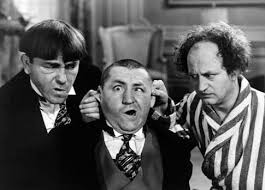
Photo: The Three Stooges—Moe and Larry, pulling Curly’s ears…


Triflers beware! The professors are here:

Punctilious, mindful, on the move,


They’ll flush you out, invest your reveries,

Or close your brown studies. It’s you they’ve watched


Woolgathering, or nonchalant, improvident- tant pis!

Micawbers, slackers, skimmers, here’s your match,


The professors have arrived: the robed Savonarolas!

Leap in the dark, grope or guess, send up a trial balloon,


Rummage, ransack, winnow or appraise–

Inquisitors will grill you: mooncalf, booby, lout, buffoon.


It’s time for gumption, prudence, brains and mother wit:

A bluestocking’s wrangle, a sine qua non;


Alas, poor duffers, bookless, smattering, you invent

A limerick, an Irish muddle, clearly heretic.


O the professors are here: praise Mentor!

They swoop through the long schoolroom,


Vertiginous, oracular, confirmatory, O rodomontade!