Mowing My Brain

The neighbors are afoot with their gasoline driven machines. When I walk with my guide dog at twilight they’re still at it, fouling the air, obscuring the birds, working mindlessly but without the muscle of Buddha.

One guy has a weed whacker which sounds like 42,000 mosquitoes amplified by a 70watt Marshall amplifier. He could play with “The Clash” except of course he has no genuine outrage. He thinks his taxes are too high and that all politicians are liars and that’s enough in the idea department to claim world citizenship.

Asleep I can still hear them. The bastards have entered my dreams. They’re mowing the orgonocity of my nautilus. The dream mowers are rectilinear, dim, unfeeling, plodding, stinking of fuel and hypo-minty deodorant. 

Gadzook! The American lawn! A pastoral jail with commodity fetishized pre-bagged toxins and ride ’em cowboy tractors and little white baseball caps. 

The Environmental Protection Agency estimates that Americans spend 3 billion hours annually mowing their lawns. One thinks inevitably of all the things they might be doing instead but if I tread there I will be susceptible to the charge of intellectual snobbery. Ah but occasionally some “I.S.”   feels good. Although his article isn’t about the depredations of lawn mowers I like Tom Vanderbilt’s essay over at Slate: “Lawn Pox: Children’s Play Equipment and the Decline of the American Yard” Mr. Vanderbilt’s vituperations are about the dread sprawl of overdetermined, plastic play devices that he sees in every suburban and ex-urban yard–all of it in iridescent oranges and reds and collectively modeled on the playlands at McDonalds.

He notes that children don’t actually play on this crap. They’re all in the house playing Nintendo. He wonders if Americans no longer believe in community playgrounds. We know the answer of course. The playground is a dangerous place. Of course this is likely to be true. There aren’t enough stay at home moms and cops on the beat to keep the old time swingsets free of meth addicts.

My point such as it is has to do with the fortress of the home, the manicured lawn its pastoral invitation, the unexamined sentimentalization of the English garden superimposed on American frontier fantasies, each further influenced by the suburban super-ego and the lawn equipment industry. Why not grow wild grasses, pachysandra,lilacs untrimmed, plenty of trees, force some germinal natureback into our lives?

Of course smarter people than I have written about these matters of American pastoral and the cowboy rancher at home next door. Michael Pollen and Debrah Tall   come to mind.

I’ll merely add that when you’re blind and hoping for some walking joy and all the little ball cap wearing Bubbas are erasing the soundscape you feel the stultifying and sleepwalking misery of the business. 


S.K.
Drinks and Bingo

I’ve been reading Paul Theroux’s excellent travel memoir about Britain: “The Kingdom by the Sea” which is a walker’s paradise of emerging images. Tired of London’s ingrown self-satisfactions and smug urbanity the writer takes off with his knapsack for a stroll along England’s coast. The writer is slightly irascible. (A Theroux trademark–ever just enough but not overblown; never cheaply ironic or decadent)and in this way he is akin to Melville’s Ishmael who must get to sea or knock the hats off the heads of strangers.  

There is more of course. Much more. Mr. Theroux rides the rural branch lines of the rail system and provides preter-nostalgic views of provincial culture and its affection for 19th century travel. But despite the endangered charm of local rail lines (where the Brits get to dress up as Victorian porters) the British coast is a late Bictorian hell of cheap amusements, fried foods, bad pubs, dirty hotels, crumbling architectures, toxic landfills, rainy weather, roving skinheads and sad families “on the dole”. 

As a walking writer by necessity I love the slow image. What is that ahead of me? Is that a man or an elephant’s ear? I see only provisionally so I’m trapped in phantasmagoria and that’s the way it will always be until some neurologist figures out how to plug a donated eye into a functioning brain without a manual. I adore the slow image. Mr. Theroux walks us into assemblies of modernist legacies with a rolling gate:

“I was happy, going to places I had never been, that had only been names to me, or descriptions in books that had falsely fixed the place in my imagination. In Rural Rides, William Cobbett had said, “Deal is a most villainous place. It is full of filthy-looking people. Great desolation of abomination has been going on here … Everything seems upon the perish …” And I had assumed it was like that, the judgment was so strongly expressed. But it was a small mild town, without a seawall or much of a beach, and few trees, and open to the breezes from France. It was raggedly respectable. The boats on shore looked practical — slow, clumsy, and made for one purpose; they had numbers but no names; rusty ironwork: fishing boats. Men still went out every day from this old trampled coast and its crowded houses, and they made a living at the hard work of catching fish.”

“They were winching up the fishing boats when I set out from Deal that day in bright sunshine. Winches on shore always meant there was serious fishing being done in a small way; and more than the usual number of public houses also suggested a fishing population; and timbers and rope hanks and a kind of tar-smeared and indestructible litter on the foreshore meant fishermen, too. Another thing about fishermen was that they never looked as though they could swim.”

These images are better than slow: they’re insistent and methodical like the tread of feet, like the sound of a parade to a blind man. The country is everywhere slowly in decline. People ever so slowly are repairing their shoes. Margaret Thatcher is slowly playing at Victorian war in the Falklands. The exhausted locals play at exhausted jingoism. Nothing has any glory”

“I walked a half a mile south and found Walmer altogether different. The newsstands seemed especially gruesome that day, with the headlines gloating over the sinking of the Argentine battleship and all the deaths. I crossed the grassy patch from Deal into Walmer, beside the low shore (“generally believed to have been the first landing place of Julius Caesar in Britain”). Walmer had the smack of a London suburb — flower gardens and elderly shoppers and a whiff of the sickroom and the sight of people dressed a little too warmly. In some coastal places people were living, and in others they were dying. Deal and Walmer, side by side, illustrated each type. There was further proof in Walmer. After a certain age, English people did not buy new shoes, but just went on cleaning and buffing the cracks in their old ones, and making them look decent. They looked at them and thought: These will see me out.”

“The beach here was level, a continuation of the Sandwich Flats, but ahead were the white cliffs of Coney Point and Bockhill Farm, beyond the village of Kingsdown. As I approached the cliffs I saw a sign indicating that a Ministry of Defence Rifle Range lay under the cliff: do not touch anything — it may kill you . Another sign warned walkers to “ascertain high water to prevent being cut off by the tide.” Most beach paths were subjected to tides, so a walker might find himself unable to go forward or back. The term for such a predicament was embayed: to be trapped and immobilized by the rising tide. “Walkers should be careful to consult a tide-table so as to avoid the risk of being embayed.””

We live in the age of fast image. Minimalism. Fragments. Irony cast as literary allusion. Accordingly much of contemporary nonfiction writing is imitatively addicted to the cut and forced speed of televised pictures. A walking writer is however just lost enough and just sufficiently satisfied by the business of discovery that immanence and facts are sweetly equal. I remember once upon a time teaching T.S. Eliot to a group of undergraduates. A boy said: “Eliot likes being exhausted.” “Yes,” I said. “He doesn’t have a choice.” This is the province of the slow image. People making do. Travelers waking up in unfamiliar locales. And for both groups nothing is as it should be. One keeps moving.


S.K.

Compulsory Able-bodiedness

The term is not mine but from the disability studies scholar Robert McGruer who in addition to being a cultural critic of disability is also a writer who pushes the parameters of our discourse on queerness.

McGruer properly asserts that as heterosexuality is the compulsory position of the many it is in its own way the shaper of queerness (which of course becomes reactive, performative,parodic, what have you).

And just so with disability. The able-bodied assumptions of the many are doubled and re-doubled by the placements and displacements of bodies that our disfigured, broken, require accommodations for the senses, or any variety of other taxonomic differences. Do you want  to be a freak? Well, yes. The able-bodied love to play at freakdom if its a matter of style as with Haight-Ashbury in the late 60’s or the followers of Marilyn Manson. Able-bodiedness is after all so static and on some days its boring.

Ah but the parodic is boring. Freaks of yesteryear put on their business suits. Compulsory able-bodiedness is an unremitting social expectation. Its symbolism is unavoidable. President Barack Obama plays basketball with more than passing skill. Jack Kennedy was a sailor. The able-bodiedness must still hold at the tiller when it comes to our ship of state. We may finally have a statue of F.D.R. using his wheelchair but don’t get too giddy. Its just a statue.

I do not believe that people with disabilities should engage in parody of what I’ll call the athlete-worshipping, or half-starved feminine followers of commodified and highly stylized body images. Nor do I think people must be cured to be included at the roundtable of culture.

But the compulsory able-bodiedness continues because Americans aren’t capable of asking questions about their body assumptions. Looking thin and even less than thin is an apriori expectation of the millions though owing to genetic inheritance and factors of poverty millions are either overweight and ashamed or they are shaped like their forbears who were tough country people and who held no resemblance to a Madison Avenue model.

But people are depressed by their bodies in numbers that are not merely indicative of a reasoned hope for simple better health–you know, let’s lose a few pounds and get into summer activities. The depression I refer to is deeper, inspired by the compulsory able-bodiedness  industry which is far more powerfulthan the average persons capacity to ask: “does this image of the body really do me any good or even matter  very much?”

I’m blind and I’m different. I don’t like being different on every occasion for in fact I don’t like the business of being stared at when I walk into a new barbershop.No one likes this. But letting  this go can bedone. You simply tell yourself:”I’m the most interesting thing to happen to these sad barbers at least for today.”


S.K.  

Why Sarah Palin Loves Dead Animals

By now everyone knows that Sarah Palin (who is the putative governor of Alaska and a former Republican Vice Presidential candidate)  likes to be photographed in the company of dead or dying animals.

This is what anthropologists call “a primary need” and what the heck–so what she needs dead critters to feel the sparkle of her inner life?

Liberals and moderates should try to understand this. You see, dead things have a radio-theric quality–that is, they give off minute electrostatic signals that only the most rarefied human beings can receive. These special human beings who I will call “Dead- Flesh Radio Receptive Hominids” are actually healed of illnesses when they are surrounded by defunct animals.

IN ancient times such people were called “stay at home moms” since the men would bring the bounty of the hunt back to the cave and some of the women would leap to their feet (where formerly they had been nearly comatose in the dank and bosky darkness) and they would be restored to giggling animation.

Men can experience the therapy of dead critters as well. Apparently men can also experience the joy of dead fish. Women don’t seem to care for dead fish. Some scientists believe that men are related to dogs but that’s another story.

When Sarah Palin leans back on a dead bear she is being healed. My Finnish grandmother could tell you about the benefits of rubbing yourself with a cat’s skin. Its nothing. Its just like aspirin.

All those blue state people who think Sarah Palin is trying to be Caribou Barbie or a mega-biker-chick are missing the point.

Sarah Palin has gout.


S.K. 

I'm So Beyond Joe Biden


Headlines are everywhere. The airlines are furious with Vice President Biden for his remarks urging people to avoid air travel and crowded spaces. 


Me? I’m so beyond Joe. I think people should avoid the airlines in the United States because they stink.


The seats smell. The air filters are never replaced. They don’t have running water in the restrooms. They don’t clean the shit off the flors between flights. They stink. They stink. They stink and they stink and they stink.

I’d ratehr travel by donkey cart sitting in moldy hay than fly on most of the regional airlines in this country. You think I’m kidding? Don’t kid me. I’ve seen it all. Diapers in the magazine racks; half a sandwich on the floor under my seat. (My dog found it.) Who knows how many snots and boogers there are on the arm rests?


Joe Biden was right. People should avoid flying. If not for the swine flu let’s just say in the service of general health.


I won’t talk about the rudeness of airline employees who routinely treat people with disabilities like simpletons or burdens or worse.


I’ll just stick with the smell.


They stink.


S.K.


They stink.

From Mornings with Borges


Graz, Austria


Tourists are fighting at a near table

In this cafe close by the mountain,

Something about losing the map or the tickets

My French isn’t what it used to be.

Borges I remember your witty comment on the Falklands war,

Britain and Argentina

“two bald men fighting over a comb”.

It was worse than that of course:

Thousands of children dead for an ink stain.

Still I like these mornings out of the library

Taking the lottery of blind streets wherever the numbers fall.

NO one should confuse aestheticism with sightlessness

Or imperial ambitions with the washroom.

I hold close to strange paths in every city.

In general, meeting people there

Is the antidote to showing off one’s clothes.


S.K. 

Thinking of Jeeves and Wooster as Spring Gleams Upon the Sward

Yes, the iris gleams upon the burnished dove as Bertie Wooster would say. T’is the season when a lad wants to dance upon the freshet and lassies long to be saved from trained assassins for verily that’s what spring is for?

From The Inimitable Jeeves:

After breakfast I lit a cigarette and went to the open window to inspect the day. It certainly was one of the best and brightest.

Jeeves,’ I said.

‘Sir?’ said Jeeves. He had been clearing away the breakfast things, but at the sound of the young master’s voice cheesed it courteously.

‘You were absolutely right about the weather. It is a juicy morning.’

‘Decidedly, sir.’ ‘Spring and all that.’ ‘Yes, sir.’

‘In the spring, Jeeves, a livelier iris gleams upon the burnished dove.’

‘So I have been informed, sir.’

‘Right ho! Then bring me my whangee, my yellowest gloves, and the old green Homburg. I’m going into the Park to do pastoral dances.’

I don’t know if you know that sort of feeling you get on these days round about the end of April and the beginning of May, when the sky’s a light blue, with cotton-wool clouds, and there’s a bit of a breeze blowing from the west? Kind of uplifted feeling. Romantic, if you know what I mean. I’m not much of a ladies’ man, but on this particular morning it seemed to me that what I really wanted was some charming girl to buzz up and ask me to save her from assassins or something. So that it was a bit of an anti-climax when I merely ran into young Bingo Little, looking perfectly foul in a crimson satin tie decorated with horseshoes.


S.K.

Remarkable is as remarkable does

Steve and Nira remarkable

Steve won't post this, but I will…
 
~ Connie

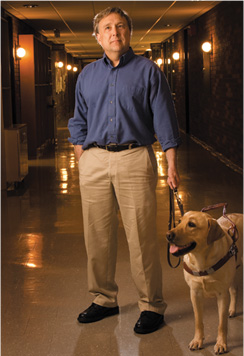
A special thank you to Nicole Riehl for writing and submitting this article and to Tim Schoon, photographer.

Through his teaching, writing, and outreach, a faculty member
strives to create an academic culture that celebrates and explores the
experience of disability
.

P.S. There are plenty of other remarkable people with much to celebrate.  You'll find their stories there too.


Tell Me Again Department


I’m in the mood for a fractured fairy tale.

Tell me again the story of how your business or college can’t modify bathrooms for people with wheelchairs or put assistive devices in the hands of students or staff. Tell me over again how this minor and utterly legistlated matter is just too hard for you, even as you spend money on non-essential things like computerized security cameras or a new fleet of trucks or fancy copiers or expensive coffee or, well you get the drift.

People complain that the ADA is an “unfunded mandate” as though Democracy requires a hand out. But the ADA says that when you’re doing the daily business of your business you will make modifications to help people with disabilities even as you modify the rest of your programs and services. In short, all the ADA requires is good budget planning when management is performing the routine task of doing business.

Someone told me not long ago that the ADA was “a burden” and they explained how replacing a broken elevator in a parking garage was a horrible expense.

I suggested that if you didn’t replace the elevator you might as well tear down the garage since people will stop using it.

Its not always fair to blame the ADA because the real life pressure of doing grown up business is hard.

But people still do it.

Tell me again how you can’t do your jobs and how the people who need elevators or ramps are just killing you.

Its estimated that people with disabilities and their families have half a billion in disposable income here in these United States.

The ADA is just good business. Unless of course you don’t like your job.


S.K.

Same Old, Same Old?


The article below comes to us from The Inclusion Daily Express

Police Arrest Disability Rights Activists At White House Fence
(ABC News)
April 27, 2009
WASHINGTON, DC– [Excerpt] Police have started to arrest some of the disabled protestors picketing outside the White House right now. Almost all of the 400 demonstrators are in wheelchairs.

“Shame on you, Obama is a liar! Shame on you, Obama is a liar!” some are chanting.

They’re here from all over the country — Texas, Montana, New York, Pennsylvania — to protest what they see as President Obama not sufficiently supporting the Community Choice Act, a bill that would amend the Social Security Act to provide those with disabilities and older Americans the ability to use federal funding for community-based attendant services instead of just for nursing homes.

ADAPT wants the Community Choice Act to be included as part of the overall health care reform package. The White House says that President Obama supports CCA, but whether or not it’s part of the overall health reform effort hasn’t been decided.

Entire article:
Police Arresting Angry Members of the Disabled Community Who Are Picketing White House
http://blogs.abcnews.com/politicalpunch/2009/04/police-arrestin.html
Related:President Obama fails to lead on Community Choice Act (ADAPT)

http://www.dimenet.com/hotnews/archive.php?mode=A&id=7106;&sort=D

91 Arrested When ADAPT Told Obama Administration Won’t Support Inclusion of Long Term Services in Health Care Reform (ADAPT)

http://www.dimenet.com/hotnews/archive.php?mode=A&id=7107;&sort=D