Skull Kissing in the Age of Twitter

In The Revenger’s Tragedy by Christopher Middleton, Vindice avenges the murder of Gloriana by the Duke who’s tricked into kissing Gloriana’s skull which has been treated with poison.

Jacobean theatrics offer an excellent example of what’s come to be called “cancel culture” since love, lust, advantage, politics, and poison are in plain view, center stage, and one fairly wonders if social media “posters” recognize tragic irony as it requires knowing everyone sins and understanding what love requires of citizens.

There is no such thing as an unpolitical cry. And we must cry. But to cry for justice requires love not skull kissing. Any Jacobean viewer would get the point. Try explaining this to the trolls for whom single issue politics and resentments are the tinctures de jour.

Anne Sexton wrote: “live or die, but don’t poison everything.” One can only imagine what she’d say about Twitter. I say its often the kissing of skulls.

I know disabled people who believe all non-disabled people are disability bigots or guilty of ableism. Since this cannot be true its just a poisoned prop. All poisoned props are falsehoods but they’re irresistible. Most people would rather believe in toxicity than see beyond it. In identity politics anyone who’s not like you must surely have bad motives.

Watching last night’s democratic debate I saw the variant toxicities on display. There was a lot of skull kissing going on. If you like Mayor Pete you’re a heartless shill for billionaires; if you like Bernie you have to believe that the rich are un-American. Each candidate has his or her variant of this. You can say this is politics as usual and yet the code switching and winks to singular toxicities is everywhere apparent which means the democrats will likely fail to unite. Skull kissing is never the art of winners.
Applications Now Being Accepted for Zoeglossia, the premier Disability Poetry Workshop

We are proud to announce the opening for applications for the next Zoeglossia Retreat!

Teaching Faculty: Allison Hedge Coke Ilya Kaminsky, and Khadijah Queen with manuscript consultations by Ellen McGrath Smith

Keynote Speakers: Stephen Kuusisto and Diane Weiner of the Burton Blatt Institute

We are pleased to announce the launch of Zoeglossia’s call for fellows for 2020. Please see the details and more about Zoeglossia below. People of color and queer and trans folks are highly encouraged to apply.

Zoeglossia is a literary organization that is seeking to pioneer an inclusive space for poets with disabilities. Much like its forbearers Canto Mundo, Kundiman, Cave Canem, Vona, and Lambda Literary, Zoeglossia strives to create an open and supportive community that fosters creativity and provides professional development for poets with disabilities.

During an annual, 4-day retreat, poets from all backgrounds will have the chance to workshop with established writers, and give and attend panel discussions and readings.

In 2020, we will be providing the retreat at Syracuse University in Syracuse, New York,

Any poet who identifies as disabled, ages 21 and over, is eligible to apply. Fellows, once accepted, are invited to attend two additional retreats within a five-year period.

DEADLINE TO APPLY: March 7, 2020 at 11:59 pm EST
APPLICATION FEE: $20

Attendance costs: Each fellow will be responsible for their transportation to and from Syracuse. however, fellows may apply for some travel subsidies if they can demonstrate financial need.

TO APPLY: Please send 8-10 pages of poems and a statement about how disability and poetics to

Calling Carl Jung and My Mother

Some mornings snow comes to the trees like an illness. Or is this my blindness playing tricks? It hardly matters. Look: here comes a white eel across the snow. And childhood dread is in its attached sleigh, tricked out as a wind up monkey with cymbals. He asks himself will the day get better? He wants to call Carl Jung on the phone. And if he could call Jung why not his dead parents? Why not Steven Biko? He’d like to talk to the great, dead human rights activists. Instead he has a toy monkey of the imagination.

Tietääkseni en ollut syntyessäni yksin. (Pentti Saarikoski)

“As far as I know I was not alone when I was born.”

No Pentti, your mother was there. And who knows, a doctor, a midwife?

Occasionally poetic lines sound so good one writes them in fealty to the half mystical and you leave out your mother. Even women writers can do this. The imagination is like one of those old time radio magnets that eliminates plurality.

Of the dark present day I admit my mother. She was a sufferer who had a sense of humor.

Of Spittle and Rainbows

You can’t go home again says the rainbow which is how it breaks your heart. No way back to Alpha Centauri or the mustard blossom planet your spirit sailed from. No way back. And that ratty little clock in the corner sneering all the time. And your damned neighbors laughing drunkenly at their open windows. And the racist sheriff; the dog whistler; the pick-pocket high school principal; the priests with cold semen; the high tech robber who preys on the old; that man who kicks crutches—peel away their bandages and they’re lonely, nauseous, frightened by their own hands. As the bard said: don’t have any kids yourself.

**

It’s a gloomy morning and I don’t want to shave. I made a mistake, woke early, read the news.

**

Once, in China, among eight sighted people, I alone threw the coin that hit the sacred bell. You know, the blind advantage.

**

It’s a gloomy morning. My father once taught me Morse code. Rain at the window just sent a message: “small boats should lie down on the sand.”

**

Have me you winter birds.

**

“One of the best attested miracles in all profane history, is that which Tacitus reports of Vespasian, who cured a blind man in Alexandria, by means of his spittle, and a lame man by the mere touch of his foot; in obedience to a vision of the god Serapis, who had enjoined them to have recourse to the Emperor, for these miraculous cures.”

Excerpt From

An Enquiry Concerning Human Understanding

David Hume

https://books.apple.com/us/book/an-enquiry-concerning-human-understanding/id506317433

**

I love the word spittle. I adore David Hume. Of the god Serapis I know almost nothing. He was eaten by the rainbow.

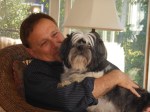
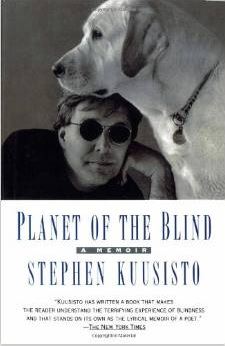
Stephen Kuusisto and HarleyABOUT: Stephen Kuusisto is the author of the memoirs Have Dog, Will Travel; Planet of the Blind (a New York Times “Notable Book of the Year”); and Eavesdropping: A Memoir of Blindness and Listening and of the poetry collections Only Bread, Only Light and Letters to Borges. A graduate of the Iowa Writer’s Workshop and a Fulbright Scholar, he has taught at the University of Iowa, Hobart and William Smith Colleges, and Ohio State University. He currently teaches at Syracuse University where he holds a University Professorship in Disability Studies. He is a frequent speaker in the US and abroad. His website is StephenKuusisto.com.

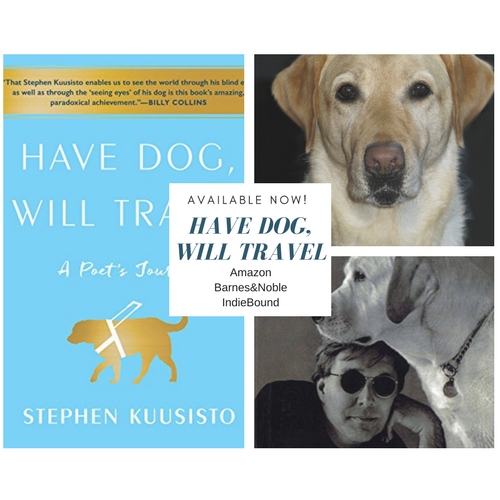
Have Dog, Will Travel: A Poet’s Journey is now available for pre-order:
Amazon
Barnes and Noble
IndieBound.org

Have Dog, Will Travel by Stephen Kuusisto

(Photo picturing the cover of Stephen Kuusisto’s new memoir “Have Dog, Will Travel” along with his former guide dogs Nira (top) and Corky, bottom.) Bottom photo by Marion Ettlinger 

Get Thee to the Laboratory, Cripple….

It’s axiomatic that the disabled are not recognized when people talk of diversity and inclusion even on progressive college campuses. The disabled are just a medical problem. They failed to get cured. This assumes disabling conditions don’t affect every group. Disability is thought of as a medical abstraction and not as a human rights and cultural issue. This extends ableism and promotes injustice.

The materiality of the disabled body is its universality since all bodies are subject to liberal narratives of value or the lack thereof. The connections between animal studies and disability studies highlight the taxonomic reductions of living creatures and the perils they highlight. Do all living creatures matter? Or do only some matter more?

Lennard Davis writes:

“Because disability is tied to this medical paradigm, it is seen as a form of the abnormal, or what I might call the “undiverse.” I say undiverse because diversity implies celebration and choice. To be disabled, you don’t get to choose.15 You have to be diagnosed, and in many cases you will have an ongoing and very defining relationship with the medical profession. In such a context, disability will not be seen as a lifestyle or an identity, but as a fixed category.”

Excerpt From: Lennard Davis. “The End of Normal.” Apple Books. https://books.apple.com/us/book/the-end-of-normal/id1230144861

A fixed category like something out of Linnaeus. A fixed category like a pinned insect.

I can choose to be disabled through acknowledgment or embrace; I can celebrate the shit out of it; but I can’t get others to believe I’m not living in a sub-par category.

In the public square or agora where diversity and inclusion are discussed the abnormal body is still considered something for the laboratory or clinic.

Stepping Out on Nothing

Gore Vidal once remarked that “politics is knowing who’s paying for your lunch” a sentiment I’ve valued for years though I now understand it’s also knowing who picked the lettuce. Nuance is hard to achieve when you’re young. In my late twenties and early thirties I was the exclusive product of academic English Departments which if you don’t know, are still to this day built from Victorian blueprints. Things are right or wrong; black or white; single issue analyses are derigeur even in the age of postmodernism and postcoloniality. Politics is knowing who’s grabbing the check and hating them for it. At thirty I hated everyone who voted for Reagan. I also hated K-Mart. As a blind person I hated most white men who were the deans and professors discriminating against me in graduate school. You must hate the people who oppress you and also resent everyone who looks like them, even the relatively innocent man or woman paying for your caesar salad.

“Never forget that justice is what love looks like in public.” (Cornel West)

There’s seldom love in the political. Try to find “love studies” in the English Departments. Like it or not we live in the era of oppression studies which has some merit but not enough to achieve West’s kind of justice which is a celebratory coalition. It is hard to celebrate if you’re enraged all the time. And it’s impossible if you’re convinced by single issue politics. Cornel West:

“The country is in deep trouble. We’ve forgotten that a rich life consists fundamentally of serving others, trying to leave the world a little better than you found it. We need the courage to question the powers that be, the courage to be impatient with evil and patient with people, the courage to fight for social justice. In many instances we will be stepping out on nothing, and just hoping to land on something. But that’s the struggle. To live is to wrestle with despair, yet never allow despair to have the last word.”

I find the phrase “stepping out on nothing” to be particularly meaningful because as a blind person I cross streets with a guide dog and take a leap of faith dozens of times a day. My sighted companions talk at street corners about bowling and I’m concentrating on the life or death situation before me.

The English Department won’t teach you about serving others. I learned something about how to do it by leaving the academy for five years and working at one of the nation’s premier guide dog schools. Each month blind folks come to the school from around the nation to train with a guide dog. The students are straight out of the pages of “Leaves of Grass” for they’re trans-gendered and black, old and Asian, young and Latino, white and largely poor though not exclusively so, and being among hundreds of blind people I learned that no one experiences disability in the same way, that no one is a symbol, no one is without the need for understanding and friendship, that everyone is hoping to land on something. I learned you have to be impatient with evil and patient with people.

American universities scarcely know how to teach such a thing. In fact, at least in the humanities, students are taught to be impatient with evil but also to categorize people as representationally evil without nuance and reflection. The country is in deep trouble in no small measure because the expansive and spiritual practice of voluntary selflessness are out of fashion when all we’re doing is thinking like Gore Vidal. BTW Vidal ended up a bitter man.

Turi, Turi, Turi

Turi, Turi, Turi

Caruso, the boy, eats a blood orange sorbet outside the café Risorgimento. They call this dessert the “frozen sunset” –a dish of scarlet juice and ice, misted with lemon. All morning he’s been singing love songs to the fiancée of a very rotund man from Caserta. “Only a boy can carry my heart,” says the fat man to his beloved. “Boys are still sweet as the baby Jesus!” Then he clapped his hands the way impresarios do: a fleshy sound of exaggeration. 

The girl seemed embarrassed. This was a street urchin, a boy in a dirty shirt. A child hired to sing love songs! This thing is a joke! But there on the via Carraciola in the din of carts and boats and street hustlers the boy sang Bellini’s Ma rendi pur contento his black eyes shining with joy and concentration so that passersby stood still. Two men, twin brothers from Rome stopped eating their sugared almonds. There in the heat of the day in that unforeseen place was a prodigy. What could surpass the unassuming purity of such a child’s voice?

The boy sings as if the edge of his heart is catching flame. 

The fat man from Caserta is delighted and bobs his head like a pheasant, struts, ruffles his feathers. His fiancée,

Elena  Bianchini-Cappelli tips her head in wonder, her features softening, a portrait reversing to a sketch. Her enormous hat with its absurd ribbons cannot hide the smile. 

Now the boy sings Bella Nice, che d’amore, his hands stretched out, palms up, without irony. Could anything be this sweet again? Vin santo and peaches? Cloves in the boiled sugar?

The boy and the hot Neapolitan day are working together, visioning ice, ice on the fat lip of a hungry lover. There are these oddities to Naples, street boys and libidinous passions and simple coins.  

Eye Rolling and Disability, a Brief Explanation

Do the blind have occult powers? I’m not sure generalizations about any group are worthwhile but as a blind man I can hear sighted people roll their eyes at me.

I hear this at least twenty times a day and sometimes the incidents number higher.

When sighted people roll their eyes it makes a sound like the world’s smallest theremin. It’s a squeaky Hollywood monster movie effect almost below the level of human hearing.

In a meeting with colleagues I say: “I need an accessible version of this handout,” and I hear a dozen teensy monster movies around the table. “The Thing” has risen in all those unseeable heads. The blind guy needs access. We don’t feel comfortable. Oooooweeeeeeeoooooo!

In monster movies it’s not the monster himself (herself) who starts the theremin music. It’s the scientist behind the creature.

I like to think of normatively constructed civic life, which is narrow and grudging about disability in public as the scientist behind the creature.

We can call the scientist the social construction of normalcy as we tend to do in the field of Disability Studies. But the invisible hand of normalcy is perverse, phobic, gloating, superior before its private mirror. The cliche we use most often when thinking of social normalcy is “thinking outside the box” and I’m here to tell you that the disabled are always outside the box. This is where all our thinking and working occurs.

The compulsive normals in their invisible lab coats don’t like inconvenience which means anything or anyone that alters their routines. Need a Braille menu? Theremin. Need an accessible website or application? Theremin. Need a functioning wheelchair lift into a university lecture hall. Theremin. Want audio description of a film being shown on your campus. Theremin. Ooooooweeeeeooooo! If you ask for these things you’re the monster. And worse, you’ve gotten loose. Quick! Hide the children!

There’s theremin music in the supermarket. The little child sees the blind person with a cane or dog and says: “Mommy, what’s that?” And mommy replies: “Shhhh! Don’t look!” Cue the scary music.

Meantime I hear the eye rolling everyday. Catch a cab? Squeeee… Boarding an airplane….
Entering the restaurant. Just walking on the ordinary street.

Checking into a hotel.
Attending a sporting event.
Once, when I was entering a major league baseball stadium with my guide dog, a rather drunken woman said loudly to her man, “why would a blind man go to a baseball game?”
Oooooooweeeee….

The disabled ruin the neat social order.

I almost never have a day without the music.

Stephen Kuusisto and HarleyABOUT: Stephen Kuusisto is the author of the memoirs Have Dog, Will Travel; Planet of the Blind (a New York Times “Notable Book of the Year”); and Eavesdropping: A Memoir of Blindness and Listening and of the poetry collections Only Bread, Only Light and Letters to Borges. A graduate of the Iowa Writer’s Workshop and a Fulbright Scholar, he has taught at the University of Iowa, Hobart and William Smith Colleges, and Ohio State University. He currently teaches at Syracuse University where he holds a University Professorship in Disability Studies. He is a frequent speaker in the US and abroad. His website is StephenKuusisto.com.

Have Dog, Will Travel: A Poet’s Journey is now available for pre-order:
Amazon
Barnes and Noble
IndieBound.org

Have Dog, Will Travel by Stephen Kuusisto

(Photo picturing the cover of Stephen Kuusisto’s new memoir “Have Dog, Will Travel” along with his former guide dogs Nira (top) and Corky, bottom.) Bottom photo by Marion Ettlinger 

Don’t be Rich in the Darkling Cosmos, A New Year’s Resolution

One of the Roman poet Martial’s verses goes this way (as translated by Garry Wills):

“This darkling world he claims, with rue,
Has run itself into a ditch.
And he can prove his thesis true:
In such a cosmos—he is rich.”

As 2019 concludes this surely is a darkling world. Certainly the thesis true is pessimistic. One’s reminded how cheap the pessimism is.

I’m reminded of Chesterton who pointed out that fallacies do not cease to be fallacies because they become fashions.

Fashionable pessimism is all the rage.

This is an old story.

Chesterton again: “the reformer is always right about what’s wrong. He is generally wrong about what is right…”

Reformers are better than pessimists because they believe in actions. But as Chesterton rightly points out, reformers can miss what’s good.

Harkening back to Martial I have the following New Year’s resolution: I will not be rich in the darkling cosmos of my own making.

Stephen Kuusisto and HarleyABOUT: Stephen Kuusisto is the author of the memoirs Have Dog, Will Travel; Planet of the Blind (a New York Times “Notable Book of the Year”); and Eavesdropping: A Memoir of Blindness and Listening and of the poetry collections Only Bread, Only Light and Letters to Borges. A graduate of the Iowa Writer’s Workshop and a Fulbright Scholar, he has taught at the University of Iowa, Hobart and William Smith Colleges, and Ohio State University. He currently teaches at Syracuse University where he holds a University Professorship in Disability Studies. He is a frequent speaker in the US and abroad. His website is StephenKuusisto.com.

Have Dog, Will Travel: A Poet’s Journey is now available for pre-order:
Amazon
Barnes and Noble
IndieBound.org

Have Dog, Will Travel by Stephen Kuusisto

(Photo picturing the cover of Stephen Kuusisto’s new memoir “Have Dog, Will Travel” along with his former guide dogs Nira (top) and Corky, bottom.) Bottom photo by Marion Ettlinger