Farewell MLB

My friend Gary Whittington has a devastating take on the state of Major League Baseball over at Medium which is worth reading whether you care about sports or not. In a sense what he’s written is an indictment of neoliberals in sports management whose dreams of ever greater profits gave us steroids and disrepute in the 1990’s and who now are cheating the fans with electronic cheating.

Gary calls MLB’s cheating a form of depravity and it surely is. At issue is the recent discovery and disclosure that the Houston Astros rigged the game by stealing signs from their opponents catchers and signaling to their own hitters what pitch would be coming next. If you wanna say “well hasn’t this always been the case” go ahead but the answer is no. Electronic pitch tipping is a real time action and far more advanced than old fashioned hand signals from base coaches.

Gary writes:

“The careful planning of this form of cheating makes its depravity complete. Pitchers on other teams lost money in free agency because their performance suffered. The effects of a few timely hits rippled through the destinies of the other 29 teams, and the possible outcomes of untainted seasons entered the cloud of unknowing. This is stealing.”

Indeed. MLB should be concerned about the possibility that tens of thousands of fans like Gary are about to walk away. This is not simple rule breaking. By destroying the honest competition between hitters and pitchers (arguably the best thing about the game) MLB has effectively signaled that the foundation of baseball doesn’t matter.

Gary, a lifetime fan of the Astros, has thrown away his souvenirs and the Astros jacket I bought him for his birthday 12 years ago.He writes:

“Of course, this is not the first time that people driven by ego and greed have gone astray. I suppose that if Pope John Paul II can forgive the man who shot him nearly to death and left him drained of all but a few pints of his lifeblood, I can get around to forgiving the players who cheated. If Altuve was involved, who could stay mad at him? But I plan to spend my time doing other things, and my travel dollars on destinations other than baseball stadiums.”

Albert Einstein once said “logic will get you from A to B. Imagination will take you everywhere.” For me what MLB is proving is that the sport’s biggest power brokers have no imagination left. Money ball is now corruption ball and as the baseball Czars seek to destroy minor league ball and cover up their misdeeds all at the same time they appear not to care who knows it.
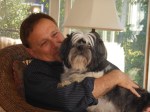
Stephen Kuusisto and HarleyABOUT: Stephen Kuusisto is the author of the memoirs Have Dog, Will Travel; Planet of the Blind (a New York Times “Notable Book of the Year”); and Eavesdropping: A Memoir of Blindness and Listening and of the poetry collections Only Bread, Only Light and Letters to Borges. A graduate of the Iowa Writer’s Workshop and a Fulbright Scholar, he has taught at the University of Iowa, Hobart and William Smith Colleges, and Ohio State University. He currently teaches at Syracuse University where he holds a University Professorship in Disability Studies. He is a frequent speaker in the US and abroad. His website is StephenKuusisto.com.

Have Dog, Will Travel: A Poet’s Journey is now available for pre-order:
Amazon
Barnes and Noble
IndieBound.org
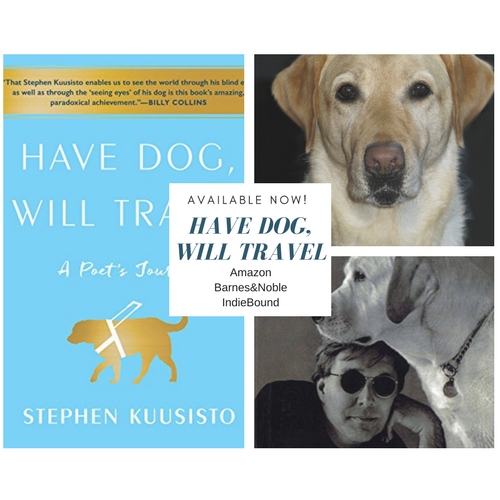
Have Dog, Will Travel by Stephen Kuusisto

(Photo picturing the cover of Stephen Kuusisto’s new memoir “Have Dog, Will Travel” along with his former guide dogs Nira (top) and Corky, bottom.) Bottom photo by Marion Ettlinger 
Disability Day Every Day

Today is the international day of people with disabilities. It’s one of those symbolic days that often don’t translate into the other 364 days of the year. The principle reasons for this are fairly simple: democracies view disability as belonging to the social contract but it’s also an inconvenience. Totalitarian states see it as a sign of cultural weakness: the disabled are defective. I’m using a sharp paring knife. Certainly no one who’s disabled would dispute these assertions. 

Now having a “day” is really rather fascinating when you get down to it. One imagines it’s a bit like Andy Warhol’s declaration that in the future everyone will get fifteen minutes of fame. Today is your day so don’t waste it. 

Alright. As we’re fighting for a livable future and the salvation of our planet I offer the following thoughts with sufficient hope for sharing. As Barbara Kingsolver writes in her remarkable novel Animal Dreams: “The very least you can do in your life is figure out what you hope for. And the most you can do is live inside that hope. Not admire it from a distance but live right in it, under its roof.” 

Livable cities are inclusive cities. Accessible was good, but livable is better. Livable is beyond compliance: it means scalable, breathable, recyclable, open, clean of design, all of which mean human usefulness and dignity can be affirmed for all. I chose the word “usefulness” for a reason: when I enter a library and there’s no system for me to get accessible books and materials then the system is saying I lack usefulness. This tacit design flaw with its associated ableism is akin to the idea that taking care of the environment is simply inconvenient. There’s no difference. 

We disable the environment and we disable people. Advanced design and sustainability can change this. Moreover we must stop disabling people as a principle of war and colonialism. We must see disablement as central to human rights and the attainment of peace. 

And on this day let’s remember that even a Nordic country like Iceland is eliminating children with Down syndrome. Let’s remember that the advanced countries embrace of euthanasia has a eugenics twist. Let’s remember that disability rights are human rights. One should say this is simple but look what happens when the disabled have a “day.” Fifteen minutes isn’t enough.

Human Rights Watch puts it this way: “Worldwide one billion individuals have a disability. Many people with disabilities live in conflict settings or in developing countries, where they experience a range of barriers to education, health care and other basic services. In many countries, they are subjected to violence and discrimination. People with disabilities are also often deprived of their right to live independently, as many are locked up in institutions, shackled, or cycled through the criminal justice system. Many of these human rights abuses are a result of entrenched stigma and a lack of community-based services essential to ensuring their rights, including under the UN Convention of the Rights of Persons with Disabilities.” 

I’ll add to Kingsolver’s idea of hope: we have to live inside it but carry it into the light of day.

Stephen Kuusisto and HarleyABOUT: Stephen Kuusisto is the author of the memoirs Have Dog, Will Travel; Planet of the Blind (a New York Times “Notable Book of the Year”); and Eavesdropping: A Memoir of Blindness and Listening and of the poetry collections Only Bread, Only Light and Letters to Borges. A graduate of the Iowa Writer’s Workshop and a Fulbright Scholar, he has taught at the University of Iowa, Hobart and William Smith Colleges, and Ohio State University. He currently teaches at Syracuse University where he holds a University Professorship in Disability Studies. He is a frequent speaker in the US and abroad. His website is StephenKuusisto.com.

Have Dog, Will Travel: A Poet’s Journey is now available for pre-order:
Amazon
Barnes and Noble
IndieBound.org

Have Dog, Will Travel by Stephen Kuusisto

(Photo picturing the cover of Stephen Kuusisto’s new memoir “Have Dog, Will Travel” along with his former guide dogs Nira (top) and Corky, bottom.) Bottom photo by Marion Ettlinger 
Kropotkin, Ableism, and University Life

No one who teaches disability studies who isn’t disabled—who doesn’t need accommodations in the workplace can understand the operational cruelty of administrative systems that function according to routinized appropriations of normality. No white faculty member can understand the daily emotional drain of being black in the faculty ranks. Hetero-normatives can’t grasp what queer faculty go through. And the reason this is so has little to do with nascent bigotry but rather a failure of the university to create meaningful pedagogical and social dialogue systems for people who teach. The first university to do this will be a national and even international leader.

One of the first books I truly fell in love with, outside of novels and poetry was Mutual Aid by Kropotkin. I still consider it highly. He opens the book this way:

“Struggle for existence.—Mutual Aid—a law of Nature and chief factor of progressive evolution.—Invertebrates.—Ants and Bees.—Birds: hunting and fishing associations.—Sociability.—Mutual protection among small birds.—Cranes; parrots.”

As opposed to the emergent social Darwinists, Piotr Kropotkin saw that cooperation rather than vanquishment was the key to successful evolution and the establishment of a just social order.

Not so much in the faculty ranks. The reason is simple: the attainment of education must be a race, largely individualistic, sanctioned by the strictures of a conservative past (the trivium) and maintained by a fierce but often unstated ideological belief in narrow normative learning styles.

Academic ableism is, if not the foundation of the other isms, its social Darwinist flag.

Kropotkin again:

“The absorption of all social functions by the State necessarily favoured the development of an unbridled, narrow-minded individualism.”

Stephen Kuusisto and HarleyABOUT: Stephen Kuusisto is the author of the memoirs Have Dog, Will Travel; Planet of the Blind (a New York Times “Notable Book of the Year”); and Eavesdropping: A Memoir of Blindness and Listening and of the poetry collections Only Bread, Only Light and Letters to Borges. A graduate of the Iowa Writer’s Workshop and a Fulbright Scholar, he has taught at the University of Iowa, Hobart and William Smith Colleges, and Ohio State University. He currently teaches at Syracuse University where he holds a University Professorship in Disability Studies. He is a frequent speaker in the US and abroad. His website is StephenKuusisto.com.

Have Dog, Will Travel: A Poet’s Journey is now available for pre-order:
Amazon
Barnes and Noble
IndieBound.org

Have Dog, Will Travel by Stephen Kuusisto

(Photo picturing the cover of Stephen Kuusisto’s new memoir “Have Dog, Will Travel” along with his former guide dogs Nira (top) and Corky, bottom.) Bottom photo by Marion Ettlinger 
On the Scholar Whose Name I Can’t Remember

I read an opinion piece recently by a scholar whose name I’ve already forgotten. He teaches at one of those underfunded public universities where with just teensy weensy public attention he can become a star. He’s staked his ten minutes of fame on the premise that area studies (African-American Studies, Women’s and Gender Studies; LGBTQ Studies, Disability Studies and the like) are simply “grievance studies” designed to falsify the truth in the service of teaching students unscientific and hence faulty logic. This is the same guy who a couple of years co-wrote a series of ersatz academic articles laden with specialized jargon as a publicity stunt. 

Yes, I’ve already forgotten his name. 

A lack of curiosity and empathy with the histories and struggles of historically marginalized peoples doesn’t make you a great philosopher. It only means you’ve decided who’s paying for your lunch.

I could look up his name but I don’t want to.

HIs lunch? Courtesy of conservative blogs and news outlets. 

**

Did anyone ever tell you you didn’t belong in the room?

It’s happened to me over and over because of my disability.

It’s happened at the university where I currently teach.

Do I have a grievance? 

Nope.

I’ve moral outrage and a commitment to understanding how prejudice works, how its transmitted from generation to generation, and how bigotry can be so easily acculturated as to be considered nearly compulsory. 

That makes me American.

**

BTW the scholar mentioned above is an ardent follower of Richard Dawkins who, in his perfervid desire to put Charles Darwin on everyone’s wall, has done more for social Darwinism with its disdain for the disabled than almost anyone, save Peter Singer.

**

If you don’t like hearing the problems of your neighbors who are you?

Stephen Kuusisto and HarleyABOUT: Stephen Kuusisto is the author of the memoirs Have Dog, Will Travel; Planet of the Blind (a New York Times “Notable Book of the Year”); and Eavesdropping: A Memoir of Blindness and Listening and of the poetry collections Only Bread, Only Light and Letters to Borges. A graduate of the Iowa Writer’s Workshop and a Fulbright Scholar, he has taught at the University of Iowa, Hobart and William Smith Colleges, and Ohio State University. He currently teaches at Syracuse University where he holds a University Professorship in Disability Studies. He is a frequent speaker in the US and abroad. His website is StephenKuusisto.com.

Have Dog, Will Travel: A Poet’s Journey is now available for pre-order:
Amazon
Barnes and Noble
IndieBound.org

Have Dog, Will Travel by Stephen Kuusisto

(Photo picturing the cover of Stephen Kuusisto’s new memoir “Have Dog, Will Travel” along with his former guide dogs Nira (top) and Corky, bottom.) Bottom photo by Marion Ettlinger 
Old City, New….

I do generally dislike it when someone says “there are only two kinds of people” unless the subject is trivial—“those who like mustard as opposed to mayonnaise” or “dog vs. cat types” or something along these lines. Those who hail from historically marginalized positions know all about the Victorian “either/or” taxonomic system—women are whores or angels; people of color are savages or properly obedient; the disabled are evil or holy—everyone do your own list. One does one’s best to resist bifurcation and entrapment.

But there I was, walking Helsinki’s historic esplanade this morning and realizing just how many old restaurants and shops that I’ve known throughout my life are now gone, replaced by newer places. And I thought, “well there are two kinds of people, those who have nostalgia and don’t like the new, and those who are open to change.” I knew I was of the latter. So what the old Havis Amanda seafood restaurant is no more? There’s a score of fabulous places nearby and they are truly amazing. I felt some happiness then. I like change. I like it that new people are doing new cooking, opening new shops.

I didn’t like discovering there’s a Starbucks in Helsinki’s most famous bookstore. Ugh.

Well, that’s the way the cookie crumbles.

At least some things remain the same. Kappeli, the beautiful 19th century glass cafe still stands next to the harbor.

Ain’t no Starbucks in the harbor by God!

:

Stephen Kuusisto and HarleyABOUT: Stephen Kuusisto is the author of the memoirs Have Dog, Will Travel; Planet of the Blind (a New York Times “Notable Book of the Year”); and Eavesdropping: A Memoir of Blindness and Listening and of the poetry collections Only Bread, Only Light and Letters to Borges. A graduate of the Iowa Writer’s Workshop and a Fulbright Scholar, he has taught at the University of Iowa, Hobart and William Smith Colleges, and Ohio State University. He currently teaches at Syracuse University where he holds a University Professorship in Disability Studies. He is a frequent speaker in the US and abroad. His website is StephenKuusisto.com.

Have Dog, Will Travel: A Poet’s Journey is now available for pre-order:
Amazon
Barnes and Noble
IndieBound.org

Have Dog, Will Travel by Stephen Kuusisto

(Photo picturing the cover of Stephen Kuusisto’s new memoir “Have Dog, Will Travel” along with his former guide dogs Nira (top) and Corky, bottom.) Bottom photo by Marion Ettlinger 

And So Much Longing There Is….

I’m in Helsinki, a city where ever since childhood I’ve come and gone over the years. It’s dark and rainy. I knew it would be. I love it. And yes, there’s Sibelius playing in my head without an iPod, the stark and magnificent opening of “Finlandia” and I’m bundled in my black overcoat walking beside the sea. I love hearing strangers talk and laugh in steep weather.

**

It’s important to know what you love especially the small things. I love the morning song from Peer Gynt, hot soup in winter, the sound of distant dogs barking at night, jazz piano any time.

Of course I love people, my wife, stepchildren, family, old friends, two horses in particular. But I talk about them all the time. I seldom say “I love that barn mouse.”

**

T’was in Helsinki some thirty years ago I discovered the work of Bo Carpelan. He wrote lyric keyholes: Join dreams together/to a single reality/a longing

And so much longing there is. So much of it is outside the body and mind. It’s in Lucretius’ atoms. You smell it in the old book shops.

Stephen Kuusisto and HarleyABOUT: Stephen Kuusisto is the author of the memoirs Have Dog, Will Travel; Planet of the Blind (a New York Times “Notable Book of the Year”); and Eavesdropping: A Memoir of Blindness and Listening and of the poetry collections Only Bread, Only Light and Letters to Borges. A graduate of the Iowa Writer’s Workshop and a Fulbright Scholar, he has taught at the University of Iowa, Hobart and William Smith Colleges, and Ohio State University. He currently teaches at Syracuse University where he holds a University Professorship in Disability Studies. He is a frequent speaker in the US and abroad. His website is StephenKuusisto.com.

Have Dog, Will Travel: A Poet’s Journey is now available for pre-order:
Amazon
Barnes and Noble
IndieBound.org

Have Dog, Will Travel by Stephen Kuusisto

(Photo picturing the cover of Stephen Kuusisto’s new memoir “Have Dog, Will Travel” along with his former guide dogs Nira (top) and Corky, bottom.) Bottom photo by Marion Ettlinger 

Walking in the November Helsinki Rain

It wasn’t easy being a worm so I became a cat.

Catness wasn’t easy so I became a dog.

Bad choice, the dog, so I was a horse.

Finally decided to be human. It was worse yet.

And the Buddha, paring his nails,

Says only mankind attains nirvana.

I think old Buddha was a putz

But he wore his privilege well.

Stephen Kuusisto and HarleyABOUT: Stephen Kuusisto is the author of the memoirs Have Dog, Will Travel; Planet of the Blind (a New York Times “Notable Book of the Year”); and Eavesdropping: A Memoir of Blindness and Listening and of the poetry collections Only Bread, Only Light and Letters to Borges. A graduate of the Iowa Writer’s Workshop and a Fulbright Scholar, he has taught at the University of Iowa, Hobart and William Smith Colleges, and Ohio State University. He currently teaches at Syracuse University where he holds a University Professorship in Disability Studies. He is a frequent speaker in the US and abroad. His website is StephenKuusisto.com.

Have Dog, Will Travel: A Poet’s Journey is now available for pre-order:
Amazon
Barnes and Noble
IndieBound.org

Have Dog, Will Travel by Stephen Kuusisto

(Photo picturing the cover of Stephen Kuusisto’s new memoir “Have Dog, Will Travel” along with his former guide dogs Nira (top) and Corky, bottom.) Bottom photo by Marion Ettlinger 

On Refusing the Sadness Industry

I will not be sad today, even though a faculty member recently treated me to unspeakable ableism. He can’t touch me. There are invisible rubies inside my shoulders. I will not be sad though I won’t live to see disability inclusion—full inclusion—in higher education. The road is too long, the grievous effects of false assumptions about the disabled student and scholar will take another generation to eliminate. I know this now. I imagined something different and better when the ADA was signed. I will not be sad. 

I was treated horrifically on two Delta airlines flights recently. I won’t be sad. Sadness is a manufactured thing—aimed at everyone who hails from a historically marginalized community or heritage. They want you to be sad. Sad will make you doubt your worth or send you back to bed in a fever of depression. Sadness-infliction is an industry. I will not be sad today. 

Now sad is an interesting word. It comes from Old English sæd “sated, full, having had one’s fill (of food, drink, fighting, etc.), weary of,” and its interesting that it didn’t assume its current meaning—inferior, pathetic—until the 1890’s. I’ll venture this: sadness is inflicted and designed to keep immigrants, women, the disabled, people of color, LGBTQ folks fully incapacitated. 

This isn’t news. Of course. But I won’t be sad today. Won’t be addicted to personal misfortune. That’s what they want. 

Stephen Kuusisto and HarleyABOUT: Stephen Kuusisto is the author of the memoirs Have Dog, Will Travel; Planet of the Blind (a New York Times “Notable Book of the Year”); and Eavesdropping: A Memoir of Blindness and Listening and of the poetry collections Only Bread, Only Light and Letters to Borges. A graduate of the Iowa Writer’s Workshop and a Fulbright Scholar, he has taught at the University of Iowa, Hobart and William Smith Colleges, and Ohio State University. He currently teaches at Syracuse University where he holds a University Professorship in Disability Studies. He is a frequent speaker in the US and abroad. His website is StephenKuusisto.com.

Have Dog, Will Travel: A Poet’s Journey is now available for pre-order:
Amazon
Barnes and Noble
IndieBound.org

Have Dog, Will Travel by Stephen Kuusisto

(Photo picturing the cover of Stephen Kuusisto’s new memoir “Have Dog, Will Travel” along with his former guide dogs Nira (top) and Corky, bottom.) Bottom photo by Marion Ettlinger 

Home

Writing with two dogs at my feet.

As far as they’re concerned

I could be doing anything—

Middle distance staring

Thinking where’s my father

All these years—

But I’m working

On poetry of agreement:

The morning is cloudy,

Dogs sleep.

Shifting to the past tense:

It was the best of times.

Stephen Kuusisto and HarleyABOUT: Stephen Kuusisto is the author of the memoirs Have Dog, Will Travel; Planet of the Blind (a New York Times “Notable Book of the Year”); and Eavesdropping: A Memoir of Blindness and Listening and of the poetry collections Only Bread, Only Light and Letters to Borges. A graduate of the Iowa Writer’s Workshop and a Fulbright Scholar, he has taught at the University of Iowa, Hobart and William Smith Colleges, and Ohio State University. He currently teaches at Syracuse University where he holds a University Professorship in Disability Studies. He is a frequent speaker in the US and abroad. His website is StephenKuusisto.com.

Have Dog, Will Travel: A Poet’s Journey is now available for pre-order:
Amazon
Barnes and Noble
IndieBound.org

Have Dog, Will Travel by Stephen Kuusisto

(Photo picturing the cover of Stephen Kuusisto’s new memoir “Have Dog, Will Travel” along with his former guide dogs Nira (top) and Corky, bottom.) Bottom photo by Marion Ettlinger 

Gestural Violence, Philosophy and the Academy

I started reading “the Philosophers” when I was around ten. In a sense there was nothing else to do. Yes I read other things. Poetry, novels, Ian Fleming, instructional manuals. But I had the half-starved mind’s musical anger to know why the body; why the damned consciousness though I didn’t call it that and you shouldn’t either.

Back then I read with a gramophone. Big boxes of recorded books would arrive on my doorstep from the Library of Congress. Those were the days when the classics were available for the blind and I remember reading the following:

“Anybody can become angry – that is easy, but to be angry with the right person and to the right degree and at the right time and for the right purpose, and in the right way – that is not within everybody’s power and is not easy.”

I didn’t know the term “gestural violence” yet but I was bullied at school and daily.

Gestural violence is a means of bullying. Today I’m a university professor and I see how It occurs in the academy because the agora is patrolled space.

Bullying is epigenetic and happens across the globe. It’s not merely a human trait. Chimpanzees have been known to murder their own. The desire to punish even minor differences crosses borders and species. But human bullying, owns what I will call, for lack of a better term, an architectonic structure, which is entirely political. In his altogether relevant book from the early 1960’s Stigma: Notes on the Management of Spoiled Identity Erving Goffman wrote:

“The Greeks, who were apparently strong on visual aids, originated the term stigma to refer to bodily signs designed to expose something unusual and bad about the moral status of the signifier. The signs were cut or burnt into the body and advertised that the bearer was a slave, a criminal, or a traitor—a blemished person, ritually polluted, to be avoided, especially in public places. Later, in Christian times, two layers of metaphor were added to the term: the first referred to bodily signs of holy grace that took the form of eruptive blossoms on the skin; the second, a medical allusion to this religious allusion, referred to bodily signs of physical disorder. Today the term is widely used in something like the original literal sense, but is applied more to the disgrace itself than to the bodily evidence of it.”

Architectonic stigma/bullying comes from constructed and layered significations. The social construction of stigmatized bullying is therefore more sinister than primate bullying. Strictly speaking all of Michel Foucault’s work is concerned with the political enforcement of normality and its accompanying structures of correction. Paris is a good laboratory as it’s still even in its post-modern assembly a late medieval city. Like Kafka’s Prague, Paris is built from disciplinary power, its architectures crafted by coercive persuasion and milieu control. Stigma/bullying where disability is concerned became in Paris a matter of cleaning the streets. In other words we may usefully understand the modern city as a machine of categorization. As Goffman puts it:

“Society establishes the means of categorizing persons and the complement of attributes felt to be ordinary and natural for members of each of these categories. Social settings establish the categories of persons likely to be encountered there. The routines of social intercourse in established settings allow us to deal with anticipated others without special attention or thought. When a stranger comes into our presence, then, first appearances are likely to enable us to anticipate his category and attributes, his “social identity”—to use a term that is better than “social status” because personal attributes such as “honesty” are involved, as well as structural ones, like “occupation.”

We lean on these anticipations that we have, transforming them into normative expectations, into righteously presented demands.”

The ableist believes he or she has the right to her normative expectations; moreover, has the right to be joined only by men or women, boys or girls who sustain those expectations. In sum, all ableism is bullying, relies on stigma and involves what Nietzsche called “will to power”—“My idea is that every specific body strives to become master over all space and to extend its force (–its will to power:) and to thrust back all that resists its extension. But it continually encounters similar efforts on the part of other bodies and ends by coming to an arrangement (“union”) with those of them that are sufficiently related to it: thus they then conspire together for power. And the process goes on…” (from The Will to Power, s636, Walter Kaufmann, trans.)

I like to think of gestural violence as the will to ableism.

Just two days I ago I found myself riding in an elevator with a professor who has (as he believes) “secretly” labeled my presence problematic at the university. Because we were side by side in a tight space he tried joking with me, peformatively, jocular, and every syllable was just more violence.

Again I thought of Aristotle: “Good habits formed at youth make all the difference.”

I said nothing. See the first quote above.

Stephen Kuusisto and HarleyABOUT: Stephen Kuusisto is the author of the memoirs Have Dog, Will Travel; Planet of the Blind (a New York Times “Notable Book of the Year”); and Eavesdropping: A Memoir of Blindness and Listening and of the poetry collections Only Bread, Only Light and Letters to Borges. A graduate of the Iowa Writer’s Workshop and a Fulbright Scholar, he has taught at the University of Iowa, Hobart and William Smith Colleges, and Ohio State University. He currently teaches at Syracuse University where he holds a University Professorship in Disability Studies. He is a frequent speaker in the US and abroad. His website is StephenKuusisto.com.

Have Dog, Will Travel: A Poet’s Journey is now available for pre-order:
Amazon
Barnes and Noble
IndieBound.org

Have Dog, Will Travel by Stephen Kuusisto

(Photo picturing the cover of Stephen Kuusisto’s new memoir “Have Dog, Will Travel” along with his former guide dogs Nira (top) and Corky, bottom.) Bottom photo by Marion Ettlinger