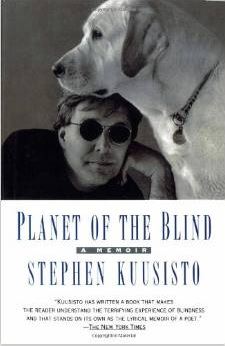
I Was Almost

All day the sounds of wings. I must have been half mad. I could hear the vestigial wings of crickets and wings that mourn their beauty and wings so small they’d been forgotten by God.

I could not tell the cashier about this while cashing my check; couldn’t say a word about my loving private sphere. Outside I gently touched a leaning bicycle. Like I was the Pope or something; I gave a stranger’s bicycle a blessing. I heard wings and wings and moved inside my clothes almost like a musician. Walked all the way up a hill just to feel grass against my legs.

Called forward by a finch whose eyes were stars. I had some folding money in my pocket. Everything that is most beautiful drifted through me. I enforced my skin to admit of fast moving clouds. I was almost…

Disability and Proleptic Imagination


1.

Proleptic. In rhetoric “the anticipation of possible objections in order to answer them in advance.”

Example:

The Swedish poet Kristina Lugn writes about the static nature of normalcy with a nod to a subject’s complicity, an irony known to all the disabled I’ve ever known. I’ve always admired these lines:

There are lots of women my age

who’ve even less reason to like themselves

but force others to do it anyway 

even though they’re neither beautiful 

nor in any way productive. 

Gallop Gallop. 

Perhaps its not that ridiculous after all 

to use vegetable dyes. 

Exercise is also good, especially for the brain. 

And to express your feelings in ceramics. 

Because then you get at the same time a bunch of stuff

that gives the home character.

Something to be proud of.

Gallop Gallop.


Prolepsis is a finely countenanced, socially agreeable internalized mode of oppression. All advertising depends on it and most selling in small “c” capitalism is driven by the subject’s anticipation of possible objections to her features. In disability studies we describe our liberation from this neoliberal garden as “crip ecology” recognizing the biopolitics of commodified abjection and acknowledging the role of theory as the means to freedom.

Proleptic. Definition Two. “The use of a descriptive word in anticipation of its becoming applicable.”

Example:

Something to be proud of.

Gallop Gallop. 

2.

Traveling blind is a performance both within normative subventions of assistance and outside cultural denotations of helplessness. All blind travel, taken as showing, is proleptic, both anticipating and answering implicit objections to the concept of blind independence in the very process of navigation. Accordingly the polysemous tropes of blind travel always pertain to the incitement and enactment of art while walking.

Gallop. Gallop

I believe one may say this for all disability movement—wheel chair dancing, simply using a wheel chair. Entering public with a motorized scooter. Signing with others at a corner table in Starbucks.

“I do not need your help,” cries the blind man.

“I do not need to be rescued,” cries the wheel chair user who has dropped his briefcase.

One half of the proleptic performance is anticipation. Planning what you will say. Gallop Gallop.

The other 50% is movement itself.

Let’s be clear, movement starts inside of me and you. All the way down inside.

Proleptic. The use of a descriptive movement in advance of its becoming.

All disability motion, every single one, becomes, every day, a new word.

Disability motion is a form of revery. Radical prolepsis. At least half the time.

Shortly after I got my first guide dog, a yellow labrador named Corky, I took a long walk alone with her in New York City.

Before Corky came to me I didn’t have words for revery, moments when softness of thought and wish are everlasting. She pushed her face into mine and “abiding” came to mind. These moments would never stop being. I could always have them.

I do not think Corky healed me. I do believe we became each other. This is the truth behind  service dogs.

Life with a guide offers men and women spiritual sobriety; you’re invited to know yourself better to become someone you’d like; in no small measure because your dog has decided to live with you, work with you, trust you, and be vital with you.

We became more than our respective bodies. I say that’s not healing. Not precisely. Revery was the proper word. We became dreamy together. I dreamt of satisfactions and though I didn’t know her dreams I knew she was pleased with me, and happy to be along for the journey.

She didn’t think she was fixing me. She was a confident dog. She enjoyed her confident man.

Reveries are the product of emotional confidence. In middle French “rever” meant to speak wildly. So there it was. Corky made me a better dreamer, a wild thing to say.

What does this mean a better dreamer? After Corky died I thought hard about it. If revery is a waking dream—a softened reality—then this was the first thing she brought me. She brought it the same way she brought me my shoes each morning. Shoes first, then the glorious day, always half in dog rhythm.

Brian Hare, a canine researcher at Duke University says dogs hijacked the human bonding system. In effect dogs understand us, empathize with us, intuitively read our intentions, and are the closest animals to us in emotional terms. From this comes what I call dog rhythm, a shared revery, a mutual hormonal effect. When living by dog rhythm time is invariably faster or slower than customary human minutes.

It must have been only a month after Corky and I were paired. I was talking to myself rather often “post-dog”—which I imagined meant that happiness was having its way with me.

“Maybe I’m developing a talent for contentment,” I thought. “How often do we have the chance to admit this in our lives?” I thought.

“As often as you like,” I said.

“Be joyful as often as possible,” I said.

Corky and I rode the subway to Coney Island.  It was April and off season, but the famed Boardwalk was a grand place for a brisk walk. It was a blustery weekday in early spring and there were very few people about. We pounded down the wood planks fronting the ocean and I said things about well being softly, the way self-talkers tend to do. Corky had her head up, very high, to scent the Atlantic, and it was safe to imagine she was also thinking about delight.

Aristotle described happiness as “human flourishing” which he said involved activity and exhibiting virtue, and both should be in accord with reason. “Corky,” I said, remembering a day from childhood, “no one can be happy while walking the railing of a bridge…” “There was no reason in my youth,” I said. “And now you’re here and you are my virtue,” I said. I wasn’t sure what this meant. “A dog can’t be my full virtue,” I said. “She can only be the agent of my honor,” I said. “But it’s lovely, Corky, to be walking the boardwalk with you and the ghost of Aristotle,” I said.

A policeman approached and said, “Are you OK?” “He’s seen my lips moving,” I thought. “He probably thinks I’m lost,” I thought.

Could I tell him that happiness was having it’s way with me? Tell him about Aristotle’s sense of “Eudaimonia”—good spirit; a burgeoning; a man and his dog growing wings? Could I say that after years I was seeing my life and the surroundings in which I found myself, finally, as objectively desirable? Would anyone on the street, much less a cop, know what I was feeling? I tried to imagine “joy-with-strangers-day” in New York. Something like the Reggae “Sun Splash” in Jamaica.

“I’m just happy,” I said to the policeman who was taken aback. “That’s a first for me,” he said. “I mean, no one ever says that, even at Coney Island!”

Had I been a self-talker throughout my life? I didn’t think so. In childhood development it’s called “private speech”—kids repeat the words they’re hearing, perhaps as a way to absorb them. “Maybe,” I thought, “I’m having the childhood I should have had.”

Prolepsis.


Disability in Higher Ed, Still a Long Dusty Trail

From Scott Lissner, ADA Coordinator at The Ohio State University:


* Princeton University’s disability services director allegedly told doctoral student Rachel Barr that disabilities like her dyslexia and ADHD are “not part of the zeitgeist at Princeton,” and now Barr is asking Princeton to respond to her accusations of disability discrimination, which she blames for the termination of her student status in 2014: http://yaledailynews.com/blog/2016/03/28/yale-alum-alleges-disability-discrimination-at-princeton/


* Inclusive higher education initiatives for students with intellectual disabilities continue to grow, with  new programs at Minnesota state colleges and universities (http://www.mndaily.com/news/metro-state/2016/03/31/proposed-bill-would-create-mnscu-pilot-program-disabled-students) and the University of Central Florida (http://www.centralfloridafuture.com/story/news/2016/03/31/ucf-welcomes-students-intellectual-disabilities/82421126/)


* Following a string of complaints about San Diego County campuses and their sexual harassment proceedings, now another complaint is coming from Cal State San Marcos student Jason Lo, who says a suspension and sexual harassment proceedings for his “leering and staring” are not taking his autism and Tourette’s syndrome into account: http://www.sandiegoreader.com/news/2016/mar/29/ticker-disabled-mans-leering-leads-suspension/#


* Acceptance letters are going out, and once again this year students with intellectual disabilities are being filmed getting their letters – here’s one featuring Rachel Grace getting her letter from East Stroudsburg University (no captions or audio descriptions): https://www.facebook.com/FoxNews/videos/10154193875296336/


* The University of New South Wales in Australia is offering new free Massive Open Online Courses (MOOCs) on disability from a disability studies perspective, designed for people in the community working with those who have disabilities: http://www.australianageingagenda.com.au/2016/03/31/new-moocs-on-disability-launched/


* The Harvard Business Review has published research showing that working women and minorities can be punished for promoting diversity in their organizations: https://hbr.org/2016/03/women-and-minorities-are-penalized-for-promoting-diversity


* Poverty and disability are still linked and adults with disabilities are twice as likely to live in poverty as those without a disability: http://www.huffingtonpost.com/michael-morris/poverty-and-disability-in_b_9557142.html


* University HR offices and managers can get a little help from “TalentWorks” at the U.S. Department of Labor – it offers tip sheets with recommendations for accessible recruiting and hiring systems: http://www.dol.gov/newsroom/releases/odep/odep20160323#main-content

Sleeping Through a Book About Christ

I fell asleep last night listening to a book about Jesus. Fell so deeply asleep I woke to find I’d reached the end. During my REM state Christ stopped the wind at Galilee and as my waking commenced he vanished. I slept through all the footnotes like any church going Episcopalian. When I woke I was outside the church rubbing my eyes.

Reading blind involves assistive technologies. I use Voice Over on the iPad. All night a machine read to me about the King of Kings who rode into Jerusalem on a donkey. I remember thinking “I’d like a donkey,” as I drifted off to sleep.

In the time of Christ the donkey was the poor man’s horse. When I was a freshman in college lots of students drove the Ford “Pinto”—which became notorious because it had a problem with  exploding gas tanks. I told a Pinto driving friend that his car was the donkey of Detroit. “Jesus,” I said, “would drive a Pinto.”

Why did I go to bed reading a book about Jesus? As a teenager I fell quite ill. Back in the early 1970’s hardly anyone understood that boys could become anorexic. I stopped eating and ground my way down to 98 pounds. My mother was a violent drunk. My father was deeply out of touch with all things “family” and so things were quite awful at home. By day I’d go to high school where I was roundly bullied for being disabled.

When I hit 98 pounds my parents, on the advice of our family doctor (who was concerned but helpless) sent me to a psychiatric facility in the upstate New York City of Rochester where again, no one could unravel my problem. I remember a psychiatrist who actually had a little grey beard asking me if the rawhide lanyard I was wearing around my neck was a fetish. I decided he was in idiot. It was how I wore my house key—a matter any child of alcoholics would understand. My week in the institute did nothing for me save that it showed me how badly we can treat people who are in advanced states of suffering. My room mate was an old Ukrainian man who was covered head to toe with scars. He wept openly in bed. Occasionally he would ask me to look at him. I would shuffle over and he’d raise his hospital gown and point to his map of scars—most, if not all of them self-inflicted. He spoke no English. He would point and weep.

On my side of the room things were more scientific. A tall medical student put a piece of meat on a string down my throat. They were testing my digestive enzymes. Was I mad or was I a gastro-intestinal freak? As with most emotional dilemmas the good doctors could never find an answer.

Home again and shivering all the time, sleeping with the electric blanket on its highest setting, I decided one Sunday morning to go to church.

No one in our family went to church.

I got up early and walked approximately three hundred yards to the small Episcopal chapel at the tiny liberal arts college where my father worked.

I went in. I’d never been there before.

There were perhaps twenty professors sitting in the pews. I knew them vaguely from faculty events at our home. They were twisted adults, weird as Rococo picture frames, slightly troubling, since they knew who I was. By appearing alone in the chapel would I be remarked upon?

I sat. I closed my eyes. I was dizzy. Hunger does that of course, but being in public, in a church, sitting in a sunbeam, that will also make you spin. I was killing myself. I knew it, somehow, in that clotted way teenagers know things from the inner life. I both did and did not want to live.

My blindness was a problem wherever I went. School, home, public events, the sidewalk, you name it. Problem. Problem. I was the problem.

I knew I was the reason my mother drank and took pills. Surely my ruined eyes were the source of her despair. Surely if I was a better child, less defective, or more successful at covering up my deficiencies, why then all would be better.

Think about my frail shoulders carrying all that weight. I looked like a skeleton. My hips stuck out along with all my ribs.

I was sleep walking through the pain and suffering of others and simultaneously depriving myself of nutrition—both physical and spiritual. I was 17 years old and already an old man.

I don’t remember much about the service except that an Episcopal bishop from Rochester spoke. He was kindly and seemed to have the same warmth as the sunlight I’d found in my seat and which my troubled body was absorbing rather desperately.

What came next was a bell. We’d entered the celebration known as the eucharist about which I knew nothing. Picture me shivering in a church pew. Understand that I was close to internal organ failure. Kurt Vonnegut Jr. once said he was committing suicide by cigarette. I was doing it by pure denial. You must imagine not eating for months. Imagine the strictness of the enterprise. The countless glasses of water. The refusals in every setting.

The short version is this: I went up to the altar rail, got down on my knees, reached up and took the bread. “Take and eat, for this is my body.” It was the sacrament of Christ’s body and blood. My very fingers were anemic as I took the bread, and my hands shook. “Come, risen Lord and deign to be our guest…” “My God, thy table now is spread…” “I am the bread of life…”

Do this in remembrance of me…How can I explain…hope and memory fill the whole man, the entire woman. Bread and wine, surely they are metaphorical, certainly, until you are a starving blind adolescent, chilled in April light, one inner foot from death; who’d been living in frozen time; who felt a heat inside, who felt his own blood and flesh kissed from somewhere deep down and still. Do this in remembrance of me. Eat, consecrate your mortal flesh.

Far down this moment lies still. From that day forward.

Which is how I came to fall asleep to a book about the taking, blessing, breaking, sharing.

For this I have no dismissal.

To understand your weakness is no easy matter. Take. My body.


My Heart is Moved by All I Cannot Save

stevekuusisto's avatarPlanet of the Blind

Some days the best thing you can do is make a virtue of your isolation–whether it comes from work, your neighborhood, or most glaring of all, the politics of your time. 

I’ve seen so much human perfidy and outright cruelty and so have you. So have you. There’s a good chance you’ve seen worse than I have–a good chance you fought in Viet Nam or you’ve lived in refugee camps. When I write this blog I remember its read around the world. I have readers in Rwanda, readers who’ve witnessed or outlasted events far worse than the incidents contained in my own biography. And still I know that wherever you live you may need to be singular, to let yourself withdraw, even if its only into the privacy of your thoughts. My wish for you, whoever you are, is that when you enter the realm of your wishes and reflections…

View original post 335 more words

A Few Thoughts on Human Voltage

I have tried to be a good man, though I fail, much as anyone must. The clouds come close, deer nest under the apple trees. I walk in the spring light fancying vengeance as the world is evil and banal and I want so much to consign all the meretricious bureaucrats to Hell. I ask Jesus to forgive me my lambent distress. I want to be good. I wish the love my animals show toward me shall be merited. I want to be the kind of poet who builds houses for people.

I agree with Jurgen Habermas: “each murder is one too many.” I wander around grieving. There is so much death and its industries are fed by good and bad citizens alike. This is why terrorists hate the nation states. Try and locate the moral centers of the United States or France. Refugees stream across uncivil borders desperate for food and medicine and they’re met with realpolitik. Neither Vladimir Putin or Barack Obama wants to save the children of this thirty years war. As I write, the half starved winter’s deer are nosing among the daffodils in my yard. I see them as children.

How to be good? “Hell isn’t other people. Hell is yourself” (Ludwig Wittgenstein) I think, “even Jesus went to Hell, and he came back, stronger.” We’re here to be good and to endeavor for strength. Such proud words. I fail, much as anyone must. Old Ludwig Wittgenstein, who often sounded like my Finnish grandmother: “we’re not put here to have a good time.”

I’m the electrolysis of good—how I’m wired. God grant me more volts.

Mystic

Mystic


They call it mystic when the body retires, clambers in air

With twisted spine or cataracts, as if God was nothing

But a lazy finger reading Braille without discernment.


On clear days condensation at the window

Is the best place to write, one thinks of childhood

With its hundredth of a second, posed and waiting


When there was no promise at all—not of the body

You’d become, nor of butterflies or angels,

Just the delicacy, writing across a living sunbeam.


The Associated Writing Programs and Diversity

So you dream of a day when disabled writers, artists, mechanics, parents, neighbors, young and old are customary at any event, in any space. You dream of this because it’s not only the proper dream for your temperament, or because of Jeffersonian values, or because you were once a girl scout, but because frankly, it’s a human vision, the most inclusive ever imagined, for disability intersects race, gender, ethnicity, sexual orientation, and all the manifold future shocks of epi-genetics. You dream of this because you went to college in the late sixties and early seventies when there was a burgeoning awareness of institutional complicity framing and supporting injustice. You read Herbert Marcuse and underlined: “The truth of art lies in its power to break the monopoly of established reality to define what is real.”

The national conference of the Associated Writing Programs or AWP in the year 2016 failed to include any disability literature among its hundreds of literary panels and presentations. Imagine had they failed to include any gay, lesbian, bi-sexual, trans-sexual, queer, gender fluid presentations, or a single panel devoted to writing by people of color or women? The outcry would be considerable, but not so with disability—a matter I consider shocking, not because able bodied people can’t conceive of disablement as a profound and universal element of human life, but because, (and here I shall echo Marcuse) there is no truth in art that does not break the monopoly of established reality). Gay reality is crippled reality; black reality is crippled reality; feminist reality—you get the picture.

So why does the national conference of the creative writing programs in higher education “not” get disability as an artistic seed bed, and perhaps the most inclusive of all marginalized categories, insofar as nearly everyone will have a disability at some point in this life? Why indeed. The answer lies in a paternalistic view of physical difference, a 1970’s model of the disabled as outliers who probably cost lots of money to include at the university; who must have a “special” office to handle their requests for whatever moist and inconvenient things they need. The rest of us able bodied professors fairly shiver at the prospects. These people have breathing tubes, motorized scooters, talk funny, or don’t talk at all. They have colostomy bags and crutches and sometimes they have wigs. They bring “down” the youthful, peppy, yoga-centric, aerobically charged, glossy entitlement of diversity filtered through the optics of good looks and vitality. Why a couple of years ago at their conference in Seattle, they hosted a poet with a disability who said publicly she’s not interested in that identity—would prefer to be understood as a real poet.

You see how it works? Real literature is GQ and Vanity Fair; it’s happy; and we all know those disabled writers can’t be happy—why in fact, disability is so hard, most of us university sponsored, middle class creative writer types imagine if we’re ever going to be disabled, well, by God! we shall commit physician assisted suicide! Do I gild the lily? Am I stuffing the owl? Perhaps. But leaving disability out of the conference, and then, pretending to afford something like awareness by hastily creating a “disability caucus” where the disenfranchised crippled writers can meet, and maybe even express their concerns, well, this is a kind of Uncle Tom business. When I hear separatism I know it for what it is.

Now having said these things, and having said them previously, and in turn, having vowed on my own part to never attend the AWP again so long as it’s both clumsy with its provision of accommodations for those who need them, and dismissive of disability as a literary culture, one every bit as good as the cultures of other alterities, I must also say that I’ve taken some hits. One disabled writer accused me of privilege, as in “having it” because I have a university teaching job and I’ve published a few books, some having received minor acclaim. My disapprobation with the AWP and its cynical “caucus” (insert here, “after the horse has left the barn we will give you a stall…” has cost me a good deal. Yes I have a job, and some books to my credit. But does anyone imagine that boycotting a conference that celebrates American writing is good for my spirit, my friendships, my own “networking” (whatever that may mean)?

Of course it’s not good for me. And it’s not good to be seen as a crank. (That hoary able bodied trope for the cripples, after all.) And it’s not good that my friends who aren’t disabled and who are right now scarfing down canapés and drinking merlot in Los Angeles aren’t talking about this scandalous culturally exclusive matter. That they don’t talk about it has everything to do with the Club Med dynamics of inclusion and sale-able diversity.

Lately poet Jillian Weise has been making some hilarious videos about the AWP and disability. Sporting a hideous blonde wig, and cradling a lap dog, Jillian offers us a persona, one “Tipsy Tullivan” a peachy, lubricious  narrator who talks to the able bodied writing cabal with insouciance and back handed truth. I’m gladdened by Tipsy who I suspect has a tattered copy of Marcuse’s “One Dimensional Man” hidden behind her gladiolas.

Here is one of her righteous “vids”.


Ashley X is Still a Human Experiment

Now that the NY Times has offered a rather narrow “overview” of growth attenuation I’m reposting my first blog post on the subject. I’ve not changed my view on this matter.

Growth Attenuation: Say It Ain’t So

I am always the last person to hear about major stories.  For instance I just found out last week that “Shoeless Joe” of the Chicago White Sox may have thrown the World Series back in 1919.  “Say it ain’t so, Joe!”


When my wife Connie read me the article in today’s Columbus Dispatch about a disabled girl who is putatively named Ashley and who has been rendered permanently child like through a surgical procedure that is designed to keep her small as a kind of accommodation for her care giving parents I was not only shocked but I wondered how I had missed the story.  There are already a number of significant posts on disability related blogs having to do with this story and I want to suggest that readers of this site explore what many disability bloggers are saying about this matter.  Alas, a Blog is a good place to start.  And Blue, of The Gimp Parade had this to say in her post Frozen Girl.  I’m under the impression she’ll write more when she’s feeling better. Feel better Blue.  (Here is another post, ‘here” being the blog of Wheelchair Dancer.  She also had this to say.  And this.)

I am not a medical ethicist nor am I the care giver of a profoundly disabled person who is largely immobile and who is additionally a mentally disabled person.  Nevertheless after hearing this story this morning I found myself shuddering and I said to Connie: “That’s just plain wrong.”

Ashley’s parents argue on their blog that a medical procedure they call the “Ashley Treatment” that they requested and which was in turn performed and that was designed to keep their “pillow angel” forever small was a necessary and entirely utilitarian operation.  The girl’s uterus was removed.  Her breast buds were removed.  She received major doses of hormones, all to assure that she will not grow into adulthood.  The utilitarian aspect of her parents’ argument is that if Ashley were to grow into an adult she would be difficult to transport.  She would be heavier in her bed.  She might have worsening bed sores.  If she became a grown woman her parents wouldn’t be able to carry her from place to place.

As you read the associated blogs and news stories you will see that several medical ethicists have weighed in to say that the entire procedure is troubling.

I teach disability studies and I’m certain that we will be talking about this case in class next week.

I wish only to say the following as a measure of my personal alarm about this story:

My sister who is a physician took the Hippocratic Oath.  I was there when she took it.  A primary principle of medical ethics calls upon physicians to do no harm.

I will leave aside the utilitarian dimension of Ashley’s parents’ argument that by keeping her small they can better care for her.  That position is uncontestable and consequently in rhetorical terms it’s made of what the Greeks called “logos” which is to say that it sounds true.  But this assertion is also tinged with what the Greeks called “pathos” which means that the argument is driven by an emotional component.  Her parents call her their “pillow angel” because she’s good and quiet when she’s lying in her bed.  The figuration in this appellation is obviously sentimental and infantilizing and the Greeks would be hip to this as a tricky emotive plea within the tenor of an argument.  Pathos is always to be distrusted as Aristotle well knew.

I simply want to add that when we do potential harm to another being we are straying from the accepted and ethical criteria of medicine.  To pretend that by keeping Ashley small her parents are doing her a service is to confuse their own desire for an accommodation with the real story of Ashley’s life.  That’s my view and I’m sticking to it.

I am blind.  My wife has fabulous eyesight.  Perhaps it would be more convenient for me if Connie was blinded by a medical procedure so she could know the daily frustrations I experience around our house.  Perhaps if she had to walk in the rain to get the public bus that always seems to come late, well that would be good for our relationship.  And Connie would then likely have a guide dog as I do, and we’d go everywhere together.

When we imagine that by means of surgery and drugs that we’re doing a good thing by making another person’s body and life fit our own convenience we are essentially confusing utility with ethics.  Ashley, who cannot speak for herself has been rendered an object in this process.  Those in the medical ethics and disability communities who see a connection between this procedure and eugenics are in my view not wrong.  I’m very troubled by this story and I sense that my gut reaction is truly the ethical position.

S.K.

Tragic update as of today, October 10, 2007: Doctor at center of stunting debate kills himself

Read also: TV LandDown and DirtyThe Ashley Treatment: Is It Just Me?Anne McDonald. Don’t Call Her a Pillow Angel

Here is a link at NPR: Parents’ Plan to Stunt Girl’s Growth Sparks Debate

Ja

Eastering

My father died on Easter Sunday sixteen years ago. On that day I was busy, flying home to New York from Columbus, Ohio where my wife and I had just bought a house. We boarded a jet, discovered ourselves to be the only people on the plane other than the folk singer Judy Collins.

I fell asleep and somewhere over Buffalo I woke with a start, hearing a voice in my head, not precisely my father’s voice, but something patriarchal for sure, and the words were dreadful: “It’s Easter Sunday, 2000 and your father has just died.” I thought I was tired—knew it. “You’re just tired,” I said half aloud so that my wife looked at me and said, “what did you say?” I said “nothing” as in, “oh, nothing” because how do you say you’ve heard Jehovah explaining the death of your father?

When we got home there was a message on our answering machine from my sister. And so of course the premonitory “thing” was true and while I’ve since studied the history of hearing voices, “paracusia” as it’s known in Greek, I’ve never been able to fully explain or shake off that moment on a commuter jet. Was it Jesus I’d heard? Was it one of the apostles? I’d been close to my father in a complex way, perhaps as all sons must be with their dads, for he was by turns loving and aloof in sequences that always seemed to run against whatever it was I needed. But I was close to him and something vatic and unexplainable had testified to that love. That’s how I came to understand the voice, the unsought quickened narration of his passing—and I remember that I felt him, my father, flying over our airplane on his way.

In his book “Telling the Truth: The Gospel as Tragedy, Comedy, and Fairy Tale” Frederick Buechner writes: “There is a fragrance in the air, a certain passage of a song, an old photograph falling out from the pages of a book, the sound of somebody’s voice in the hall that makes your heart leap and fills your eyes with tears. Who can say when or how it will be that something easters up out of the dimness to remind us of a time before we were born and after we will die?”

I’m hearing my father’s voice today. It is all voices. It’s an eastering voice. And because it feels right to say so, I think his voice is right above.

That was his gift to me on Easter sixteen years ago. There are things we can know, and which, in turn, we do not have to explain.