

Omega and Daniel Craig Team Up to Support Eye Care Mission


craig_omega_orbis


See full press release at link below.

OMEGA and Daniel Craig team up to support eye care mission

Actor News – 29-01-11
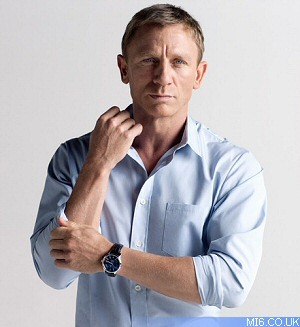
Omega has announced that it will work in cooperation with actor and brand ambassador Daniel Craig to support ORBIS International and its Flying Eye Hospital in the fight against preventable blindness. A special watch – the Hour Vision Blue – has been created to celebrate the partnership, and OMEGA has guaranteed that at least one million U.S. dollars from its sale will be donated to ORBIS, an organization which delivers eye care to some of the world’s most remote and developing regions.


**


Preventable blindness is a funny term. It’s almost metaphysical. But helping people at risk of losing their sight retain their vision is an incredibly laudable enteprise and that Omega  and James Bond are supporting ORBIS International is unambiguously good news.


S.K.


The Blind Beggar

The Blind Beggar


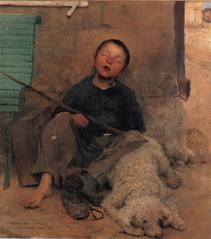
The painting is well known. Jules Bastien-Lepage painted this study of a blind boy, ill clothed, sleeping in an alley sometime around 1868. The boy is pictured holding a crude cane and he’s accompanied by a sheep dog who is also asleep. The dog is not a guide dog but you can bet that if someone tried to steal the boy’s meager earnings he would bark. Night is still with the boy and he’s hard asleep. Only the painter knows that morning has come. In this way the painting is voyeuristic. The boy’s mouth is half open as he sleeps.


Soon the sun will emerge from behind the houses. And soon the boy will wake up and resume his repetitive cries. Meanwhile Bastien-Lepage means for us to stare.

But I am interested in the boy’s dreams.

In sleep he is fetching water. There is a blue light radiating from the village well. He knows the word for blue and in sleep he understands what it is. Blue is the precursor to seeing.

In his dream he feels he is very much alive. The leaves whisper from their dark places in the medieval city.


S.K.


What Health Really Is


Reading Passion in Romania


In 2003 the World Health Organization (WHO) announced its “international classification of functioning, disability and health” and to mark the occasion they invited photographers from around the world to enter a contest called “images of health and disability”. As WHO put it:

“The aim was to raise questions about what health really is, and awareness of how everybody in the course of their life experiences some kind and degree of health decrement or disability.”

The photo above by Janiel Aneculaesel was one of the winners under the category of aging.

As WHO explained the ICFDH the classification was intended to contextualize and organize physical life and its gradients into a forum for understanding human rights:

“The ICF puts the notions of ‘health’ and ‘disability’ in a new light. It acknowledges that every human being can experience a decrement in health and thereby experience some degree of disability. Disability is not something that only happens to a minority of humanity. The ICF thus ‘mainstreams’ the experience of disability and recognises it as a universal human experience. By shifting the focus from cause to impact it places all health conditions on an equal footing allowing them to be compared using a common metric – the ruler of health and disability. Furthermore ICF takes into account the social aspects of disability and does not see disability only as a ‘medical’ or ‘biological’ dysfunction. By including Contextual Factors, in which environmental factors are listed ICF allows to records the impact of the environment on the person’s functioning.”

The “ruler of health and disability” is further described as a “classification intended for a wide range of uses in different sectors. It is a classification of health and health-related domains — domains that help us to describe changes in body function and structure, what a person with a health condition can do in a standard environment (their level of capacity), as well as what they actually do in their usual environment (their level of performance). These domains are classified from body, individual and societal perspectives by means of two lists: a list of body functions and structure, and a list of domains of activity and participation. In ICF, the term functioning refers to all body functions, activities and participation, while disability is similarly an umbrella term for impairments, activity limitations and participation restrictions. ICF also lists environmental factors that interact with all these components.”

One is of course reminded of Arthur Okun’s “misery index” for the pairing of health factors with environmental conditions has a kind of indexed elegance. Okun of course calculated how much inflation the body politic would tolerate against rates of unemployment. He found that the body politic will tolerate modest rates of inflation if jobs follow.

Changes in body function and structure vs. standard environment includes something more complex than Okun’s economic calculation for the ghost in the machine is the social construction of normalcy or what the disability studies scholar Robert McRuer calls “compulsory able-bodiedness”. Able-bodiedness is an agent of industrialized societies and it remains central to the lived experiences of people with disabilities because the value of a healthy body is socially indexed in all societies.

I like the term “compulso-misery” when thinking of the hegemonic shaping of embodied value. If you’ve spent as much time as I have visiting agencies that purport to provide benefits or services to people with disabilities you’ll sense that compulso-misery is certainly not histrionic. Indeed, how much misery you can be induced to endure is a matter of culture, social influence or embodied value, financial conditions, the structural hierarchies of medicine, the military, corporate values, international relations, and narratives of heroism. These dynamics fall under “environmental factors” under the ruler of health and disability but they cannot be confronted without the kind of cultural analyses available in disability studies. In order to understand ageism as a co-efficient of disability we need to understand the cultural shift from the valuation of the old to their extreme devaluation. This symbolic and reductive transformation was not (is not) inevitable in human societies but the ways and means of compulsory able-bodiedness are inherently driven by the signatures of representational physical decline. “This could happen to you!” “Don’t let it happen, study hard!”

In America if you are over 65 and you lose your eyesight there are no programs available to assist you in purchasing assistive technology. You might do well to have a talking computer or a closed circuit TV magnifier but under the system of compulso-misery you are no longer of working age and therefore government programs that help younger people to become “rehabilitated” do not apply to you. Age has limited value. Age and disability have even less value. As I mentioned above these are not inevitable ideas. They are driven by economic and actuarial indexes and are linked to an industrial model of activity and physical value. Robert McRuer argues cogently that neo-liberalism is in this way no better than neo-conservatism and you will get no disagreement from me.

The assignation of value is the critical question for understanding disability. Pejorative value is destructive and unethical. Nazi medicine comes easily to mind. But even the conditions of nursing homes or the current rush to eliminate pensions are a part of the story. How a society envisions bodily value can only be understood by means of understanding human rights as they are relative to national practices that promote well being. Understood from within the world of medicine we could say that the cure vs. no cure debate surrounding individual disability identity can be better appreciated when physicians and health practitioners imagine “the whole patient” –which is to say that no one needs to be cured in order to have his or her full human value. This is perhaps a simple statement, but go looking for examples of this in many medical schools or hospitals and you will come up largely empty. (Largely empty is almost redundant but it’s the right figure.)

At the University of Iowa’s Institute for Vision Research where I hold a dual faculty appointment studying issues of disability, culture, and medicine, we like to think of people with vision loss as being entirely free of cultural devaluation—this is according to the best practices in patient care and to the related understanding that people who are blind or who have low vision are not second rate citizens no matter what society might tell them. Even so we must contend with issues of ageism in the larger social matrix; with disability as a de-legitimized symbolic “sign” vs. compulsory able-bodiedness. When you tell an older person that they can no longer drive they are instantly reduced and devalued in a culture that regards driving as a
matter both of freedom and o
f daily necessity. In the United States the automobile is more important than a passport as a marker of citizenship. That the elderly are terrified, that they weep in the face of losing their driving privileges is as much a social issue as it is a medical one. A society with good public transportation reduces the devaluation of bodily change. Compulso-misery, indeed.

Issues of value and embodiment are central to where we must work and live.


S.K.


What Does It Mean, Mr. Hoover Institute?

Someone today sent me an article from an online source, an OpEd piece by a guy from the Hoover Institute. I read it quickly and deleted it. You know the kind of thing: “America is worn out by labor unions, academia, pension plans, medical benefits, etc. (And for further rhetorical flourish this is presented as an important generational shift—e.g., young people don’t understand why any of these things might matter, doncha know?)

The more I think about this gaseous bromide I see that it contains the real, longstanding GOP agenda which has always been to return America to 1880. No unions, no expectation of college, no pension, no benefits of any kind. By George those were good days! You could really make money back then! Why I’ll just bet today’s young people are bananas with the prospect of living without college education or social programs. I’ll bet they’re just dropping to the ground and rolling wildly in giggling fits. What a great time we’re living in, Mr. Hoover Institute! By jinkies!

Meanwhile, Uncle Sam, wrapped in a cloak of world history keeps laughing at the wrong places in the joke. He puts out his skinny yellow wrists and says, “What about the three million living veterans with disabilities? What about our infant mortality rate? Who has a happy flag for that?”

The plan, ever since Reagan has been to eliminate the government’s role in sustaining the middle class. Wahoo, Mr. H.I.! Ain’t starvation a kind of fanfare!?


S.K.

Lyric Life

Caruso 180px-Enrico_Caruso_As_Canio wild flowers acorns


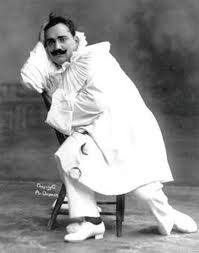
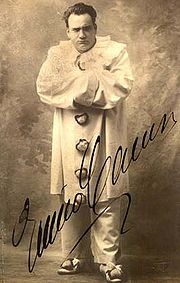
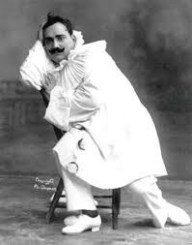
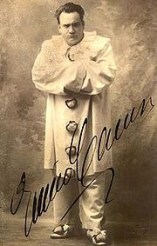
There’s an early 20th century picture of Caruso as the murderous clown Canio and though it was taken in an era of studiously posed images it conveys an inspired, stagey madness. You can see a mercurial glow in the man’s eyes. He wears the famous Pagliacci costume and oddly enough he appears for all the world like a doctor who has become insane as opposed to a clown.

The photo is the real Caruso.

We know this in much the way we understand truth or deceit while playing cards in a neighborhood cafe. We are people of moods, conceits, tempers, and out-and-out lunacies. Most of us accept our roles devotedly. As Jimi Hendrix said: “You have to go on and be crazy. Craziness is like heaven.”

Of course I don’t mean to romanticize (or downplay) mental illness: far too much literary and academic damage has been done in that arena. And no, this is not a post of overcoming depression, nor is it a history of artistic or psychiatric alchemy rehashing again the triumphs of Antonin Artaud or John Clare. It’s possible for men and women with true mental illnesses to find their generous souls in art and just now, in our time we’re learning a great deal about neurodiversity and the magnificence of intellectual disabilities like autism. But this is not a book made of the attenuated histories of illness or the compensations of same.

This post is more in the spirit of the rapper Eminem when he says: “The truth is you don’t know what is going to happen tomorrow. Life is a crazy ride, and nothing is guaranteed.”

Or, if you prefer, here’s the famous fast ball pitcher Nolan Ryan: “It helps if the hitter thinks you’re a little crazy.”

I remember my first inkling that an assumed and barmy spirit was a vehicle—really a “getaway car” like something the Chicago mob would have had.

I was on a playground in Durham, New Hampshire. The year was 1960 and I was five years old. I had thick glasses and I was smaller than my classmates. A big kid who I’ll call Rollie came up to me with a handful of dirt which he clearly meant for me to eat.

“You will eat this,” he said.

“It looks good,” I said. “Hey Rollie, have you ever eaten an acorn?”

Rollie held his dirt before him like a little pillow.

“An acorn?” he said.

“Yeah, they’re just like peanuts, really good, that’s why squirrels like them. You want one?”

“Sure,” he said. He held out his other hand and I dropped a neatly shelled acorn into his palm.

“Go on Rollie, its yummy!”

Rollie ate it. Then he turned red, and I mean red, not beet red or fire engine red—he was red as an unkind boy with his mouth swollen shut. Acorns are among the bitterest things on earth. And of course I only knew this because I’d tried one. I was a solitary kid. Spent a lot of time in the woods. Those were the days when a boy could still go to the woods.

Rollie was incapacitated. I don’t think he ever bothered me after that.

I still recall the thrill of my discovery. That a feeling, a simple reaction, a swing tricked out with language could render a nemesis harmless was rousing.

I didn’t do a little dance. Didn’t brag about the matter. But I was on the way.

A lyric life, I will imagine, is one wherein you can access feelings and then, by turn do something productive with them.

The simplest definition of a lyric poem is a poem that expresses the writer’s feelings.

Freud said: “Life as we find it is too hard for us; it entails too much pain, too many disappointments, impossible tasks. We cannot do without palliative remedies.”

One of those palliative remedies is lyric itself. One may think of this as causative intuition, a feeling that trips a switch and makes you sing when you should properly be weeping or running for your life. Again Freud: “Man should not strive to eliminate his complexes, but to get in accord with them; they are legitimately what directs his contact in the world.”

We are getting in accord. We are beside a country road picking edible flowers in the cool of the day. We do not pick edible flowers beside highways because there are pesticides in trafficked areas.

We remove the pistils and stamens before eating.

“Hey Rollie, wherever you are, have you ever eaten Milkweed?”

“Rollie, you can trust me this time. It tastes like green beans.”

This is a post about unforeseen but productive feelings. A little book of kells…


S.K.
Still Sexy after All These Fears…

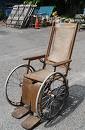
antique wheelchair

Readers’ note: we like this piece from the Huffington Post by neurologist Richard C. Senelick. This excerpt comes to us via Inclusion Daily.

Sex And Disability: How Would It Change Your Life?
(Huffington Post)
January 26, 2011
NEW YORK, NEW YORK– [Excerpt] Sex is something we’ve only felt comfortable talking about in public for the last 30 years. The sex lives of the disabled and elderly are still a hushed topic that causes feelings of discomfort amongst the public and unfortunately many healthcare professionals.

Sex and sexuality are not synonymous and you can easily have one without the other — a key concept when we start to talk about the sexual issues of people with disabilities.

We, as a society, including the medical profession, tend to view both the disabled and the elderly as "asexual," placing little emphasis on the quality of the life of the sexually disabled person. We view both the disabled and the elderly as being different from the rest of us, not sharing the same feelings and desires. But, the concerns of persons who are disabled do not differ significantly from other individuals. They are first women and men, then disabled.

As in most disability issues, we tend to focus more on what we can see with our eyes.

Entire article:
Sex and Disability: How Would It Change Your Life?

http://www.InclusionDaily.com/news/2011/red/0126g.htm

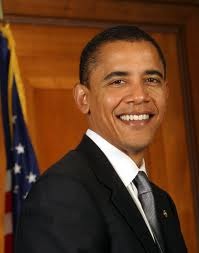
President Obama’s Speech: A Disability Perspective

Obama 6a00d83451be5969e2010536a7b4ae970c[1] FDR and Fala

At times Tuesday night, Mr. Obama was genuinely inspiring with a vision for the country to move forward with confidence and sense of responsibility. Americans need to hear a lot more like that from him. NYTimes.

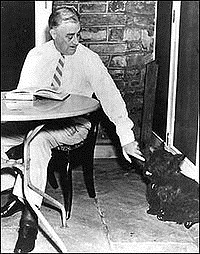
I tuned in to President Obama’s speech last night with my guide dog Nira by my side. (In the photo above you can see Nira posing with a stuffed replica of F.D.R.’s dog Fala.) As I listened to the President argue both for leaner government and intelligent domestic spending I felt like calling him up. In fact I wanted the STOTU to be a live “call in” show. This is because I feel that my own story—my personal journey—reflects the stories of tens of thousands of Americans who have disabilities. Let’s call it a singular story: we got on our feet and became employed (read “became tax payers”) because government sponsored programs helped us get the tools and know how to become fully engaged citizens. I feel as though I should repeat that but I won’t. Not now. Here is what I would have said to the President—and because the format would be like one of those electronic town hall meetings everyone would have been able to hear it:


“Mr. President, as you discuss our nation’s future I would like to point out that people with disabilities are properly part of that future. I say this because in the coming months there will be tremendous pressure to cancel or reduce programs that help people with disabilities in these United States. We have already seen many such efforts from coast to coast.”


“I am the product of services for people with disabilities. I use the Talking Books program of the Library of Congress. I have received training and support in the use of technology from the New York State Commission for the Blind. I have been unemployed and have lived in Section 8 housing and have received food stamps and social security disability payments. Today I am a full professor at The University of Iowa. I dare say that even cursory scrutiny of my financial history will show that I’ve paid back to the government more than I’ve received.”


“Now is not the time to pull back from programs that educate and rehabilitate our people. Now is not the time to take books away from the blind as Governor Christie of New Jersey has tried to do. Now is not the time to eliminate support for in-home care and personal attendants. I could of course go on and on. Mr. President our nation must look after its own people.”


“Mr. President, the Swedish poet Tomas Transtromer once wrote:


“Jesus held up a coin

with Tiberius in profile

a profile without love

power in circulation.”


“Mr. President, what will power become in our country? I will argue that this is the central question of our moment.”


S.K.


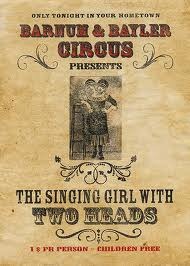
The Singing Girl with Two Heads


The Singing Girl with Two Heads Millie Christine


“Most people go through life dreading they’ll have a traumatic experience. Freaks were born with their trauma. They’ve already passed their test in life. They’re aristocrats.”


–Diane Arbus


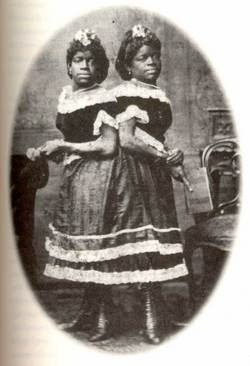
There is no loneliness like theirs. They were born into slavery in North Carolina and subsequently sold to a showman. They were “Millie-Christine”—two girls with a fused spine, two heads, and four legs and arms. They were two entirely singular human beings. I like to think of them as aristocrats.


By advertising them as a girl with two heads the circus transformed their altogether separate and complex identities into a singularity—a reified monstrosity, a symbolic reduction that erased one girl for the sake of the other which is, after all, the oldest trick in showbiz. (Just ask Rock Hudson?)     


A fuller article on Millie-Christine “The Two Headed Nightingale” can be found at the website of J. Tithonus Pednaud at: http://thehumanmarvels.com/?p=140


S.K.

Case Of Young Man Tied To Wall sparks National Debate In Netherlands

The following story comes to us via Inclusion Daily Express:

(CNN)
January 24, 2011
ERMELO, NETHERLANDS– [Excerpt] A Dutch documentary about a mentally ill and potentially dangerous 18-year-old has prompted lawmakers in the Netherlands — amid national outrage — to re-examine the treatment of those in psychiatric care.

The documentary, which was produced by the Lutheran-run Evangelical Broadcasting Company and aired on public television Tuesday, followed Brandon van Ingen, a patient at a mental hospital in Ermelo. Since 2007, van Ingen has spent part of his days tethered to a wall due to the danger he poses to others, according to State Secretary for Public Health Marlies Veldhuijzen van Zanten-Hyllner.

"Brandon’s issue is so serious that he must be restricted in his freedom for the sake of his own safety and that of others," van Zanten-Hyllner wrote in a letter to parliament. "Because of this, Brandon consistently makes use of a band that he fastens himself when he is in the presence of his attendants and other visitors. Whenever there is no one present and at night, the band is loosened."

In response to the documentary, the country’s political parties held emergency meetings Wednesday to discuss care for the mentally ill

The program "Outspoken" learned about Van Ingen’s story from one of his caretakers at the hospital.

Entire article:
Case of young man tied to wall sparks national debate in Netherlands

http://www.InclusionDaily.com/news/2011/red/0124b.htm
Related:
Footage of psychiatric patient, 18, tied up in care sparks bitter debate over treatment for the mentally ill in Netherlands (Daily Mail)

http://www.InclusionDaily.com/news/2011/red/0124c.htm
Patients are restrained all over the world (Radio Netherlands Worldwide)
http://www.InclusionDaily.com/news/2011/red/0124d.htm

Postcard from the Dwarf Garden

Ringling Dwarf Garden


“Everything is arranged so that it be this way, this is what is called culture.”


–Jacques Derrida


The “Dwarf Garden” at the John and Mable Ringling Museum begs no question. It is not an alternative semiotics of our domesticity. It isn’t a metaphor for government. It is, of course, culture itself—an arrangement, a contraindicated tableau of our mortality.


Since I’ve been here I walk among the stone dwarves and think of the tears we shed because, as William Butler Yeats said, we are attached to a dying animal. What can culture do to pay homage to the soul? The soul, that terrible thing, so bitter and slick—yes, if the soul had a flavor it would be a very dark gum, a thing like alum and gutta percha.   


The stone dwarves are Italian imports and hearken to the days of the commedia del arte. One thinks of Pulcinella, the stock figure of Italian comedy, hump backed, lascivious, lively and naughty. You can walk among the little rogues on the grounds of the Ringling Museum. As a disability studies scholar I invariably think of Derrida. These stone figures are arranged so as to suggest a concatenation of deities—they are the temple of the Id. The serpentine path says they are among us but they are not us. They are like the animals, they are well dressed creatures of primitive caste. But look how artfully they are arranged!


In this way they are the tutelary gods of the circus itself.


The real history of little people is a complex affair. The controlled, augmented serpentine walk can only hint at the shivers.


S.K.