Why Some Special Ed Profs are Afraid of Autists: Hint, They Don’t Know Very Much

“It is difficult for nonspeaking people to define their feelings in language which is chiefly made by talkers to express theirs.”

—my paraphrase, Thomas Hardy

Hi. My name is Steve. If this was a twelve step program instead of an essay you’d say “Hello Steve!” (presumably with warmth) and I’d announce: “I’m blind and though I’m a reasonably well known writer (which means I’ve found many nuanced methods to swindle readers) I must make a confession.” Yes. Here it comes. When I type I don’t look at the keys. That’s right: I just peck from inside a cloud of unknowing which some might call memory and others may call serendipity—and soon I’ll explain the difference but not yet—not yet because if you’re a neurotypical sighted person I think you look at your keyboard when you type. You do this not only for help (your knowledge of the keys is incomplete; you really don’t know where the “t” and the “o” are) but also as a means of confirmation. I know you don’t think of your eyes as accommodating agents. I understand you think sight is an autonomic extension of your inmost thoughts. You must believe this for to acknowledge vision’s documented primacy in all your achievements would be too humbling. Yes. Your eyes correct your typing which means you’re not a typist at all. That’s right. And worse for you, your memory is substandard. You couldn’t name where all the letters are on a qwerty keyboard or what’s right now on your bookshelf—not  without your peepers.

I know my keyboard from memory, not by luck or deceit. I’m literate (though the blind have only been viewed as being so since the late 18th century) and what’s more I’ll kick your ass at Scrabble. The difference between mnemonic prowess and serendipity is the difference between lightning and the lightning bug, to borrow an analogy from Mark Twain who used it with more panache though you shouldn’t repeat what he said in mixed company.

I’m a blind high speed typer who knows where everything is on his bookshelf and can find a book in the dark.

I have a dozen autistic friends who type to communicate. They’re frequently attacked by a school of special education professors who believe non speaking people can’t possibly do this. The professors’ thinking goes like this: “If an autistic goes into a forest with Hansel and Gretle and he points at a tree and Gretle supports his elbow so he can touch it, has he really communicated anything? Maybe the hapless autist didn’t want to touch that tree at all. What if Hansel and Gretel forced him to touch that Fagus sylvatica—for Gretle especially loves the beech trees of the Black Forest? (Much worse of course is that Gretle doesn’t even know she has a beech tree bias.) Now in turn, if the autist wanted to point at the beech tree and Hansel took his elbow, well Hansel might conceivably force him to touch a Scotch Pine since Hansel is a variant of “Hans” and Hans means “one who repeatedly rubs pine trees” and yes, Hansel is more than half dishonest, and in any case the poor autist doesn’t know the difference between a beech and a Christmas tree you see.

**

Divagation #1: wandering off the path, especially in forests…

There are no autists or people with autism. There are no blind people, no deaf people. The terms are meaningless as no two disabled citizens who are categorically believed to have the same disablement will experience it in the same way.

Divagation #2:  Charles Darwin put his finger on it…

Referring to Darwin’s trans-speciesism where use of language is concerned, Elizabeth Grosz writes in her book “Becoming Undone: Darwinian Refections on Life, Politics, and Art”:

“The human represents one branch of an anthropoid line of language, birds an altogether different line, and bees and other insects another line again. Each develops languages, communication systems, forms of articulated becoming, sign-systems, according to its own morphological capacities, its own sexual interests, and its own species-specific affects. Each “speaks” as it can, elaborating a line of movement that brings sound, movement, resonance into being, that composes songs, sound-lines, statements, expressions as complex and rich as each species can bear.”

Clearly autists are human and not cockatoos or bees, but articulated becoming, sign-systems, and individuated morphological capacities are essential to any understanding of what language is.

Sound, movement, resonance, articulated becoming, complexity are all components of languages and work across what we call species but which we might as well call life itself.

Divagation @3: the boy next door has made a whistle from a blade of grass; I’m playing a trumpet…briefly, we make the same note on October 2nd 2002, in Columbus, Ohio…

**

The professors I allude to in the field of Special Education are proponents of “exceptionality” and believe that a cohort of disabled students can only be taught if identifiable patterns of strengths and needs common to all students can be understood. In parts of Canada and in various places in the US a disabled student can only access special education services if he or she has an exceptionality—that is, they must prove they’re better than the rest of those dumb kids. In these days when neuroscience and assistive technology are changing our understanding of individual needs and competencies the hoary idea that autistic people must fit a neo-Victorian template, a spectrum if you will, with high functioning and low functioning labels trotted out like specimens in 19th century science is still prevalent. Forget that these professors have a stake in waving the flag of science as a red herring—that the majority of special education faculty are ill equipped to engage with contemporary neurological research into the nature of autism—let us just pretend that autists are mannequins, and voila! You’ve got the professors’ favorite “ableist” conspiracy theory. You see: there are no talented, imaginative non-speaking people. The term “facilitated communication” is their rhetorical weapon of choice—an outdated term and one that has zero relevance these days, but it is so easy to paint with an old, stiff, unwashed brush. It’s important to the proponents of exceptionality that the public continue to think nonspeaking people have no thoughts of their own. Moreover the general public should also believe that all inclusive communication techniques are dishonest because, after all, you must always remember Hansel and Gretle and the woods.
 

Of Phony Service Dogs and True Ones

“I am his highness’s dog at Kew; / Pray tell me, sir, whose dog are you?”

—Alexander Pope

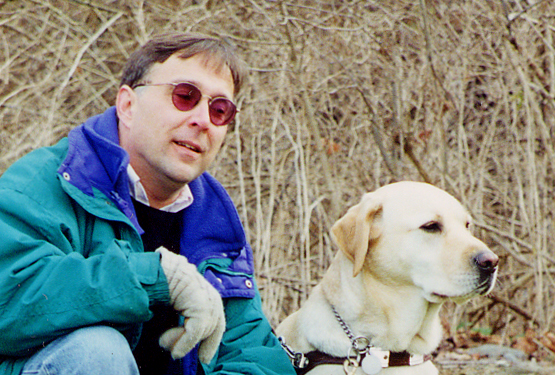
If you’re like me and travel with a trained guide dog you’ve likely heard about the steady and alarming appearance of false service dogs in public. You don’t have to be blind or deaf or experience PTSD or diabetes or balance issues and navigate with the  assistance of a professional canine to have seen this story. Incidents of faux service dogs are everywhere in the news.

My guide dogs have been expertly trained to work in midtown Manhattan traffic, locate the edges of railway platforms and stop, disobey unwise commands, watch out for low hanging branches or storefront awnings, avoid holes in sidewalks, find ways around construction obstacles, locate stairs and elevators, and yes, be good citizens in shops, restaurants, movie theaters, ball parks, or when riding public transportation.

One of the finest compliments a guide dog user can receive is when departing a restaurant someone says: “Oh, I’d no idea a dog was under that table!” The surprise of others reflects the serious training our dogs have received and our commitment as dog handlers to keep that training sharp. The latter is as important as the former.

Yes. Real service dog users have skill. Not only that, we’ve studied it. In my memoir Have Dog, Will Travel: A Poet’s Journey (due out from Simon & Schuster in March, 2018) I describe what it was like to learn how little I knew about myself and about dogs when I trained with my first guide, “Corky” a yellow Labrador. Here, a trainer I’ve called “Linda” addresses a dozen blind people and their new dogs:

“Our new dogs require praise—lots of praise,” said Linda. “It’s all in the voice. Nowadays a guide dog loves it when you say, ‘Good dog’ with a tone of true joy. Try it!” And we all said, “Good dog” just as Linda had shown us. 

Corky raised her face to look at me, her big yellow snout pointing straight up. And every dog in the room did the same. Something palpable went around our circle—the star of praise that only dogs can see was re- leased by our voices. “Good dog!” We said it again and again. Our overdramatized tones were like stylized laughter in an opera. All tails were wagging. 

“We say, ‘Good dog’ because Guiding Eyes dogs really want to work,” said Linda. “They have been through many months of training. These dogs enjoy their jobs. But just like you, they require praise. From this moment on you will be saying ‘Good dog’ as much as a hundred times a day.” 

Who affirms good things even a dozen times a day? Who makes “talking goodness” a habit of her or his minutes? I sat with my Corky’s head on my shoe and thought about the “talking blues”—as a literary guy I’d studied vocal sorrow—but never had I considered a running, day long practice of spoken good. “Good dog” would become my hourly practice and over time (though I didn’t yet know it), dog-praise would change many of my habits of thought.

One of the surest giveaways you’re not seeing a real service dog is its owner’s obvious lack of control and his or her concomitant lack of praise. Not long ago on an airline flight from Dallas to New York I heard a woman loudly berating her dog because it was barking and it obviously had the jitters. It was obvious the dog wasn’t professionally trained to do anything other than follow its owner everywhere.

My own dog was curled up under my feet and entirely quiet.

I felt terrible for that dog much in the way I often feel sorry for children being scolded in supermarkets by unfit parents.

The fake service dog people are ungenerous both to dogs and to disabled folks. It takes profound commitment to train with a guide dog or a PTSD canine—or any other genuine service dog. The disabled who train with professional dogs know more about dogs than almost anyone. Moreover they know a great deal about themselves and their hopes and aspirations.

The shouting woman on that plane insisted that she had a disability and her dog was a service dog. “Look!” She said, “It has a vest!”

That dog barked and scrabbled all through the flight.

The Americans with Disabilities Act asserts that as far as service dogs are concerned authorities cannot ask the disabled for papers, a safeguard is designed to protect a person’s privacy. It’s nobody’s business if you have an invisible disability, or so the thinking goes. I agree with this position. Invisible conditions should in general be your own business. Why must someone with a traumatic brain injury have to disclose their disability to the general public?

Predictably enough unscrupulous vendors have been taking full advantage of the ADA’s guarantees of privacy. A considerable online industry caters to able bodied people who want to take their pets everywhere. All you have to do is get a doctor’s note saying you need of a service dog, send it in, and voila, you receive a vest that says “Service Dog” and no one can ask you a thing about it. You can take your untrained “Barky Boy” anywhere you like.

Dishonest? You bet. But for my money the worst thing about it is the insult to my dog’s ardor, faithfulness, and intelligence. And yes, the further insult to guide dog trainers and puppy raisers who devote a whole year of their lives to raising future guide dogs. And yes, the insult to the work that true service dog users must undertake to become successful.

Another way to say this is, there’s no love in it. Fake service dog people don’t love their dogs or anyone else.


Personal Essay

As I was walking under apple trees.

As my dog was with me.


Yes my father had died not long before.

Yes Fall had come without him.


I said, “insufficiencies of the living.”

I said, “living…”


What cheer to be alive in an orchard.

That was what I thought.


The apples, golden,

Were suspended


Like nothing I’d known

When my old man was alive….

Notes of a Blind Medusa

“When the Dead Man splays his arms and legs, he is a kind of Medusa”

—Marvin Bell

1.

It’s axiomatic: the blind are fruitless dead people. I know about this as I was born blind and I had a twin brother born dead. His name was Bill. In Western religions it is assumed Bill can now see because Heaven offers sight without glasses. (The blind who are left behind offer living proof that something’s genuinely wrong with them—many things actually—blindness is imagined by the sighted as standing for dishonesty, unbridled temper, malfeasance, and various monstrosities.)

In other words, the blind get to be “popularly dead” and the dead get to throw away their glasses when they pass through the pearly gates.

2.

I’ve worked among sighted people all my life. How else should it be? The sighted run planet Earth. As a blind employee I have been verbally disparaged, denied full access to events and to reasonable accommodations and have been humiliated for sticking up for myself and others. These experiences have been consistent no matter where I’ve been employed.

3.

Because I regard myself as an imaginative being I invent scenarios wherein the events mentioned above turn out differently. For instance, the college president who, behind closed doors, told me he had a roommate as an undergrad who was a blind Olympic rower and that I wasn’t competitive enough—really this happened—I like to think of him taking a sudden warm interest in my life. After all, once upon a time the man must have taken a warm interest in “something” unfamiliar to him, his future wife perhaps, or a runny foreign cheese, Lord knows, so this exercise isn’t entirely impossible.

Instead of hitting me with his Olympic rower “inspiration porn” what if the prez had said: “I understand blindness isn’t an obstacle and that no two people experience it in the same way. What’s it like for you?”

4.

One would think it’s simple, taking an interest in a blind man or woman or child but you see, they’re already dead. With luck they’ll be on life support, work in a sheltered workshop or in a place of sufferance where their difference won’t complicate a thing—they’ll answer the phone or sell you a magazine. In highly structured sighted people environments the blind are faulty, stiff, wholly problematic, like weird totem poles, which of course gets us back to deadness. What else is lack of sight but a figure for pre-death? “Those blind people sure do make me uncomfortable Larry!” “Yeah,” says Larry, an IT professional at Wiz University, “And they keep messing up our perfectly lovely websites by demanding access and shit.” And the first guy, “Norm” says, “You’d think there’s be a special college for them, you know like that school for the deaf in DC.”

5.

Of course the Deaf, big D, little D, variegated “d” are not thought of as being dead. Let’s be clear: discrimination against the Deaf is relentless. Period. But discrimination against the blind is relentless because they’re already dead.

6.

“How dead are you?”

“I’m so dead woodpeckers ignore me…”

7.

Blindness is the number one metaphor for death. Number two is still blindness.

8.

In Helsinki, Finland, during my childhood I first understood people can be ill tempered. I was a small boy and climbing stairs in the old apartment building near the harbor–holding my dad’s hand, climbing, the steps curved like inside a lighthouse, my blindness talking to my feet. You understand–this is an early memory, 1958 most likely. An old woman approached us coming down from above and seeing me said in blue blood Swedish (for she was a member of Finland’s small Swedish speaking minority): “Tsk, Tsk, barna blind…” Tsk, tisk needs no translation, even to a boy. I was a blind child, and there, on that stairwell, in the curving darkness, I received my brand–was branded. My father ignored her by shrugging and we kept climbing.

9.

“Even a minor event in the life of a child is an event of that child’s world and thus a world event.” The words are Gaston Bachelard’s and I’ve puzzled over them for years. My minor event, the naming of my blindness took place in the Scandinavian winter on a dark stairwell and I absorbed some very unrefined ideas about physical difference and human worth–knew them instantly–but how could this ever be a world event? As I see it after all these years there are two ways Bachelard can be right. The first is that the old woman’s contempt becomes a cathected and insupportable incitement, the seed of what Carl Jung would call a “complex” thereby draining my life of self-esteem, maybe even stealing my curiosity. The second is this small, nearly infinitesimal occasion turns me to making things. In both scenarios Bachelard is correct. In both cases a child’s world grows upward and outward and influences many people over a lifetime.

10.

How else to be, but a Blind Medusa? If I’m so dead, I’ll freeze you too.

Or I can loan you some snakes for your own unconscious.

And I’m taking a warm interest in you sighted people.

What’s your dream life like, what’s it really like for you?

If you tell me a story I’ll have to tell you one in return…

Talking to myself in a library

Upriver in a town largely unvisited

Ain’t got a letter in I don’t know when

Lonely the name of this book

“Big deal…Always

Been this way…”


Laughing under the skin

Appearing to strangers

Like a mad man

Whispering

Over Selma Lagerlof’s pages….

What Was the Gunman’s Motive?

After gun massacres happen in the US there’s a predictable media response, always the same, with headlines like: “What was the gunman’s motive?” 

Americans like the idea that the violence their society spawns by means of unrestricted gun sales, poor schools, and mediocre social services can be explained away by occultism—“what was the secret in the mind of Joe Blow who transformed from a quiet guy next door to a mass murderer? Surely he must have been mentally ill (unlikely); or he collected Nazi paraphernalia (horrid to be sure but not generally a direct cause of actual brutality); he must have had a barbaric ideology (almost never the case)…oh, what was in Blow’s mind?”

Truth is, people will murder people when the ways and means are easy. And truth is, they needn’t have a motive at all. It’s the banality of utility—easy peasy to pull the trigger; simple to express pent up rage in a berserk fit, a fit without ideology, minus clear provocation, a story that’s unremarkable in its sinister ordinariness. Don’t get me wrong: Dylan Roof was a junior Nazi—the little boy next door can indeed be radicalized by hate groups. But as is so often the case, America’s mass killers are people who can’t imagine living anymore and want to use their guns on their way out. What was the gunman’s motive? Most of them can’t figure out how to live. America is increasingly a soulless place. We don’t have enough social workers and psychiatric outreach centers to meet the needs of a vast population of stricken humans. But we have guns.

Motive: “I am too tired to live. You shouldn’t be able to live either.”

The sooner Americans understand this, the quicker we can find a resolution. People experiencing despair are not necessarily mentally ill. But when their only vocabulary is a stream of bullets, we’re not engaging with the problem as it currently stands.


Freedom’s Safest Place?

The children are delicate and must be kept away from sunlight. Visit any playground and you’ll find the fields empty. It’s not daylight that’s dangerous, it’s the prospects it might bring. All the adults have guns. The adults are a bad group. I’m certain the National Rifle Association has a plan to fix this—baseball gloves with six shooters built in; double barreled hockey sticks. How hard could it be to turn a basketball into a Gatling gun? Hooray for the NRA! Hooray for militarized innocence!

Meanwhile the grownups in America—which means anyone over eleven—go about their business slaughtering each other. And the police go about their business, slaughtering the slaughterers even though some aren’t really all that dangerous, you know, like Tamir Rice for or Philando Castillo but heck they got what they deserved, they made the mistake of going outdoors. What’s that? People can get killed sitting in their houses? Well they ought to live in gated communities. As the faux president of the United States likes to say, “they expect everything to be done for them.”

Here’s the good thing: if your child is killed by gunfire and you can’t afford to bury her most cities still have pauper’s graves. Cheaper than health care. Burying grownups costs extra but mostly it’s still cheaper than health insurance.

The NRA’s website has the slogan: “freedom’s safest place”—better than any playground or happy musical event, really….